August 11, 2026
When Geology Defies Conventional Scale Thinking
Sediment-hosted copper systems have a habit of surprising the market. History repeatedly shows that what begins as a single intercept in a promising geological setting can evolve, drill hole by drill hole, into something far larger than initial estimates suggested. The question investors face at each stage is deceptively simple: is the current footprint the full story, or merely the first chapter?
That tension sits at the heart of the Marimaca Pampa Medina copper system. Located in Chile's Antofagasta Region within the low coastal range, Pampa Medina has delivered a growing body of drill evidence across multiple host units simultaneously. Yet the drilled area represents only a fraction of the geophysically prospective ground. Understanding what the results actually prove, versus what they suggest but have not yet confirmed, is the critical distinction for any investor evaluating this asset.
Furthermore, keeping current copper market trends in mind adds important context, given rising global demand and constrained supply pipelines that make large-scale discoveries increasingly significant.
When big ASX news breaks, our subscribers know first
Understanding the Manto-Style Architecture at Pampa Medina
What Makes Manto Copper Systems Different From Porphyry Deposits?
Manto-style copper mineralisation is fundamentally different in geometry and grade distribution from the porphyry copper systems that dominate most investor conversations about Chile. Rather than forming a broad, low-grade disseminated orebody around a central igneous intrusion, manto systems develop as stratiform layers hosted within sedimentary or volcanic sequences. Copper precipitates along permeable horizons, often producing flat-lying or gently dipping sheets of higher-grade material.
This architectural difference has direct implications for mining economics. Manto systems can deliver narrower but exceptionally high-grade intercepts in specific zones, and their stratigraphy can repeat vertically through stacked horizons. Where a porphyry deposit requires enormous tonnage to justify processing low grades, a well-defined manto system can yield attractive economics from comparatively compact but richly mineralised packages.
At Pampa Medina, the mineral suite transitions with depth. Near-surface zones carry oxide copper minerals including atacamite, chrysocolla, and secondary chalcocite, while primary sulphide mineralisation at depth features bornite, chalcopyrite, covellite, and primary chalcocite. Elevated silver accompanies copper through both zones, adding a meaningful byproduct credit that strengthens the economic case for any future development scenario.
The Sierra de Medina Land Package and 2024 Consolidation
The Sierra de Medina block became strategically significant when Marimaca Copper (TSX: MARI | ASX: MC2) consolidated the entire package under single-operator control in 2024. Before this, fragmented tenure across the district had prevented any systematic, basin-scale exploration programme. The consolidation gave the company the ability to reinterpret accumulated legacy geological datasets and construct a coherent exploration model, which now guides active drilling. The project sits approximately 25 kilometres from the processing infrastructure planned for the Marimaca Oxide Deposit, a meaningful logistical advantage if Pampa Medina evolves toward a feed-source role.
Three Host Units, One Vertically Stacked System
Oxide Grades in the Andesitic Volcanics
The uppermost host unit at Pampa Medina comprises andesitic volcanics, where drilling has intersected near-surface oxide mineralisation. One representative intercept returned 10 metres at 0.31% copper and 2.8 g/t silver from 180 metres depth. While this is not the headline interval, it matters for a different reason: it confirms that the copper system begins at shallow depths accessible to conventional open-pit or low-strip mining methods, expanding the range of potential extraction approaches.
The Rencoret Sedimentary Unit: High-Grade Sulphide Core
The most economically significant mineralisation identified to date sits within the Rencoret sedimentary sequence, a unit comprising sandstones, conglomerates, tuffs, and black shales. The key intercept data illustrates why management has focused its delineation effort here. When interpreting drill results of this nature, understanding the distinction between true widths vs apparent widths is essential for accurately assessing the economic significance of reported intervals.
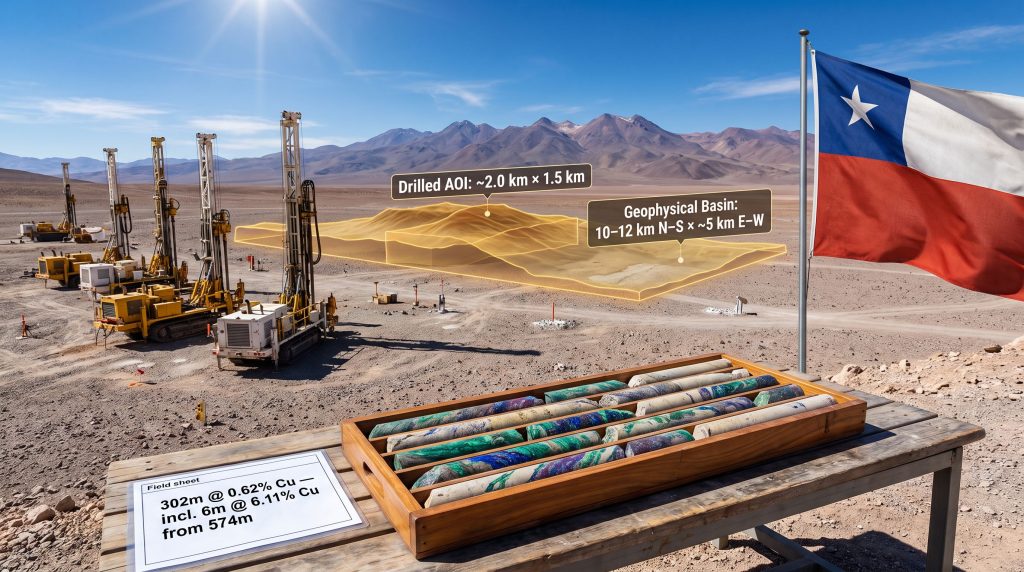
Within the Rencoret sediments, drilling returned a 302-metre interval at 0.62% copper and 2.7 g/t silver from 558 metres depth, hosting a 20-metre zone at 2.65% copper and 13.9 g/t silver, within which a 6-metre core ran 6.11% copper and 24.0 g/t silver from 574 metres depth. A second stacked manto beneath this returned 104 metres at 1.01% copper and 4.7 g/t silver from 664 metres depth, including 40 metres at 2.04% copper and 11.1 g/t silver.
Reported widths are downhole lengths, with true widths estimated at approximately 80% of these figures. The presence of two distinct high-grade manto horizons stacked vertically within a single host unit is the feature management characterises as potentially establishing economic viability for underground sediment-hosted extraction.
First Basement Intercepts: What Does Drilling Below 800 Metres Reveal?
The July 2026 assay release marked a geological inflection point: mineralisation penetrated the basement metasediments beneath the Rencoret unit for the first time. Key results included:
- 66 metres at 0.70% copper from 802 metres depth, with silver assays pending at the time of release
- 6 metres at 1.40% copper from 862 metres depth within the same interval
- Step-out holes 300 metres to the south intersected basement at 6 metres at 0.77% copper and 2.0 g/t silver from 940 metres depth
- The same step-out direction returned 6 metres at 1.05% copper and 8.3 g/t silver from 1,006 metres depth
These basement intercepts add a third host unit to the system, raising the question of how far downward the mineralising event extended and whether the basement could contribute meaningfully to a future resource estimate.
The Scale Gap: Drilled Area vs. Geophysically Defined Basin
One of the most important analytical frames for understanding Pampa Medina is the proportional relationship between confirmed drilling and total prospective ground.
| Parameter | Drilled Area of Interest | Geophysically Prospective Basin |
|---|---|---|
| North-South Extent | ~1.5 km | 10-12 km |
| East-West Extent | ~2.0 km | ~5 km |
| Drill-Confirmed Mineralisation | Yes | No, untested |
| Scout Drilling Status | Underway | Ongoing |
The active drilling area of approximately 2.0 km by 1.5 km represents the drilled corner of a basin that geophysical surveying defines as 10 to 12 kilometres north to south and roughly 5 kilometres east to west. Marimaca's chief executive officer, Hayden Locke, has described the proportions plainly, noting that Pampa Medina is positioned in a small section of a substantially larger prospective structure, with the potential to extend the system significantly in both directions.
The critical qualification is that geophysically defined prospectivity is not drill-confirmed mineralisation. The basin's outer reaches remain untested, and the jump from geophysics to resource remains the central risk in the district-scale thesis.
Analytical note: Gravel cover across the broader basin has historically prevented systematic drill-testing of lookalike targets identified by geophysics. The scout drilling programme currently underway is specifically designed to penetrate this cover and reach bedrock targets across the wider package.
Post-Mineral Dykes: The Structural Complication Investors Must Understand
Not all results from depth drilling have been straightforward. Barren post-mineral dykes trending west-northwest have locally truncated deeper mineralisation at Pampa Medina, creating structural discontinuities that introduce genuine uncertainty into the resource geometry.
This is an important issue for investors to understand clearly. Post-mineral dykes are intrusive features that cut through and displace previously formed mineralisation. Where they are abundant or thick, they can divide a continuous mineralised body into separate blocks, complicating both resource modelling and mine planning. Infill drilling across the affected zones is required before the deeper extensions, particularly within the basement metasediments, can be meaningfully incorporated into any formal resource estimate.
How Pampa Medina Compares to World-Class Sediment-Hosted Copper Benchmarks
The Kakula Selective Mining Zone as a Scale Reference
Management has drawn a direct comparison between Pampa Medina's stacked thickness profile and the Kakula selective mining zone, the high-grade core of the Kamoa-Kakula complex in the Democratic Republic of the Congo. The published parameters of the Kakula zone provide useful context:
| Metric | Kakula Selective Mining Zone (Kamoa-Kakula) | Pampa Medina (Current Drilling) |
|---|---|---|
| Approximate Footprint | ~6 km x 1.5 km | ~2.0 km x 1.5 km (AOI only) |
| Ore Tonnes (Published) | ~400 Mt at ~3% Cu | Maiden resource pending early 2027 |
| Average True Thickness | ~12 metres | Multiple stacked horizons, some exceeding 10x Kakula's average |
| Byproducts | None significant | Silver present in oxides and sulphides |
| Water Challenges | Large overlying aquifer | Dry, no overlying aquifer units |
| Logistics | Landlocked (DRC) | ~50 km from coast (Chile) |
The argument management advances is that Pampa Medina's stacked vertical thickness, in some cases more than ten times Kakula's average true width, means equivalent tonnage does not require the same horizontal footprint. Two additional physical distinctions reinforce the comparison favourably: Pampa Medina is dry with no overlying aquifer units, while Kakula contends with significant water inflows, and Chile's coastal proximity contrasts sharply with the DRC's landlocked logistics.
This comparison is management's framing of third-party published figures and is explicitly conditional on infill drilling confirming continuity. It does not constitute an established resource equivalence.
The Cachorro Stratigraphic Analogue
A regional comparison closer to home provides additional geological context. Pampa Medina's mineralisation occupies the base of the Rencoret sedimentary sequence and extends into the underlying metamorphic basement, which is the same structural position as the Cachorro discovery by Antofagasta Minerals. Cachorro hosts a published resource of 300 million tonnes at 1.0% copper, representing a genuine precedent for significant tonnage in the same stratigraphic setting within the broader Chilean copper belt. In addition, Pampa Medina's positioning as a potential major copper system of note draws further comparisons to other large-scale sediment-hosted discoveries emerging across South America.
The next major ASX story will hit our subscribers first
Copper Fertility Beyond the Active Drilling Area
The Pia Deposit and Basin-Wide Evidence
Beyond the central area of interest, the Sierra de Medina block contains additional evidence of copper fertility. The Pia deposit, located more than 15 kilometres to the north, displays Pampa Medina-style sediment-hosted copper mineralisation. Multiple shallow oxide discoveries across the basin were made historically but never followed up systematically, partly because fragmented land tenure prevented any single operator from prosecuting a coherent basin-wide programme.
Hayden Locke has described the broader basin as a small subset of a system with the potential to be extensive in terms of sediment-hosted copper, while being careful to frame this as a thesis under test rather than a confirmed fact.
Important distinction: Copper occurrences across the Sierra de Medina block, including at Pia, are geological fertility indicators rather than defined mineral resources. They sit well outside the active area of interest and have not been incorporated into any resource estimate.
Key Milestones and Catalysts Investors Should Track
As of August 2026, six rigs were operating on site across the 30,000-metre extensional and delineation programme. The pace of activity reflects both the scale of the target and the time pressure associated with a maiden resource estimate targeted for early 2027.
| Catalyst | Status as of August 2026 |
|---|---|
| Step-out drilling, southern bornite zone extension | Completed; assays released July 2026 |
| First basement metasediment intercepts | Completed; silver assays pending |
| Scout drilling through gravel cover | Underway; no stated completion timing |
| Infill drilling, central AOI definition | Ongoing; 6 rigs on site |
| Maiden mineral resource estimate (oxides and sulphides) | Targeted early 2027 |
The pending silver assays for the 66-metre basement intercept at 802 metres depth represent one of the nearer-term data points. Silver grades in the sulphide zones have consistently added meaningful byproduct value to the copper grades, and the basement intersection's silver content will influence how management weighs the depth extension in economic terms.
How Pampa Medina Fits Into Marimaca's Hub-and-Spoke Strategy
The Marimaca Oxide Deposit as the Production Anchor
The Marimaca Oxide Deposit has a completed definitive feasibility study targeting 50,000 tonnes per year of copper cathode production. The DFS carries a reserve life of 13 years, but management has indicated that ongoing resource extension work at Pampa Medina has already expanded the oxide component in a way that could push mine life beyond that figure. Under the hub-and-spoke model, satellite oxide discoveries across the Sierra de Medina basin would feed into the MOD processing infrastructure, creating optionality that a standalone development assessment would not capture.
Pampa Medina's evolution matters for this strategy in two distinct ways: the shallow oxide zones could contribute feed material relatively quickly, while the sulphide system represents a longer-dated but potentially transformative growth asset if the tonnage thesis holds together through drilling.
Principal Risks That Define the Investment Thesis
Investors considering this thesis need to weigh several distinct risk categories:
-
Structural discontinuity risk – post-mineral dykes have already demonstrated the capacity to truncate mineralisation at depth; their distribution across the system is not fully characterised
-
Scout hole failure risk – the basin-scale thesis rests on geophysics until a distant hole delivers; if scout holes consistently miss at distance, the system may be more limited in lateral extent than the geophysical footprint implies
-
Depth and mining method risk – sulphide mineralisation below 500 metres requires underground extraction, carrying capital and operating cost profiles that differ materially from the shallow oxide heap-leach economics in the DFS
-
Resource estimate uncertainty – the maiden resource due in early 2027 is the first formal quantification; until that number is published, the tonnage argument remains conceptual
Frequently Asked Questions: Marimaca Pampa Medina Copper System
What Type of Copper Mineralisation Is Found at Pampa Medina?
Pampa Medina hosts a manto-style, sediment-hosted copper-silver system. Near-surface zones contain oxide copper minerals, while depth drilling encounters primary sulphide mineralisation including bornite, chalcopyrite, covellite, and chalcocite. Silver is present as a byproduct across both mineral zones.
How Large Is the Pampa Medina Area of Interest Compared to the Broader Sierra de Medina Basin?
The active drilling area measures approximately 2.0 kilometres east-west by 1.5 kilometres north-south. The geophysically defined prospective basin extends 10 to 12 kilometres north to south and roughly 5 kilometres east to west, most of which remains untested by drilling.
What Is the Significance of the First Basement Intercepts at Pampa Medina?
The July 2026 basement intercepts established a third host unit beneath the previously defined volcanic and sedimentary zones, extending the system to depths exceeding 1,000 metres and opening a new potential resource horizon. Their economic significance depends on silver assay completion and infill drilling to resolve dyke-related discontinuities.
When Will Marimaca Publish a Maiden Mineral Resource Estimate for Pampa Medina?
The company is targeting a maiden mineral resource estimate combining both oxide and sulphide mineralisation for publication in early 2027.
How Does Pampa Medina Relate to the Marimaca Oxide Deposit and the Company's Production Plans?
Under Marimaca's hub-and-spoke development strategy, Pampa Medina serves a dual role: contributing near-term oxide feed to the MOD processing plant and potentially evolving into a core underground sulphide growth asset over a longer horizon.
What Is a Manto-Style Copper System and Why Does It Matter for Grade and Thickness?
Manto systems form as stratiform copper layers within sedimentary or volcanic host rocks rather than around igneous intrusions. They commonly produce higher grades within discrete horizons and can repeat vertically through stacked layers, meaning economic mineralisation can accumulate substantial true thickness even within a compact surface footprint. For investors new to this type of deposit, interpreting drill results from manto-style systems requires a slightly different analytical lens compared to more familiar porphyry intercepts.
Key Takeaways: What the Evidence Supports and What Remains Under Test
-
Mineralisation is confirmed across three host units, establishing a vertically stacked architecture rather than a single flat horizon
-
The drilled area of approximately 2.0 km by 1.5 km occupies a small fraction of a geophysically defined basin measuring 10 to 12 km north to south and approximately 5 km east to west
-
Stacked sulphide horizons in the Rencoret unit include intervals exceeding 300 metres downhole, with grades management considers economic for underground sediment-hosted mining
-
The Cachorro stratigraphic analogue at 300 Mt at 1.0% Cu and the Pia deposit more than 15 km to the north are geological context indicators, not resource equivalences
-
A maiden mineral resource estimate combining oxides and sulphides is the first formal test of the tonnage thesis, targeted for early 2027
-
The scout drilling programme designed to penetrate gravel cover and test basin-scale lookalike targets is the pivotal catalyst that will either confirm or challenge the district-scale interpretation
Consequently, how this project ultimately ranks among the largest copper mines in the world will depend entirely on whether infill and scout drilling can validate the basin-scale thesis over the coming years.
Readers seeking additional context on sediment-hosted manto copper systems in Chile's Antofagasta Region and Marimaca Copper's broader project portfolio may find related coverage at the Junior Mining Network's Pampa Medina drilling report, which publishes ongoing analysis of the Pampa Medina drilling programme, and at the Global Mining Review, which provides additional geological context on the manto copper system definition.
Want to Spot the Next Major Copper Discovery Before the Market Does?
Discovery Alert's proprietary Discovery IQ model delivers real-time alerts on significant ASX mineral discoveries — including sediment-hosted copper systems with the scale potential of Pampa Medina — instantly translating complex geological data into actionable investment insights. Explore historic examples of major mineral discoveries and their extraordinary returns, then begin your 14-day free trial to position yourself ahead of the broader market.