
August 10, 2026
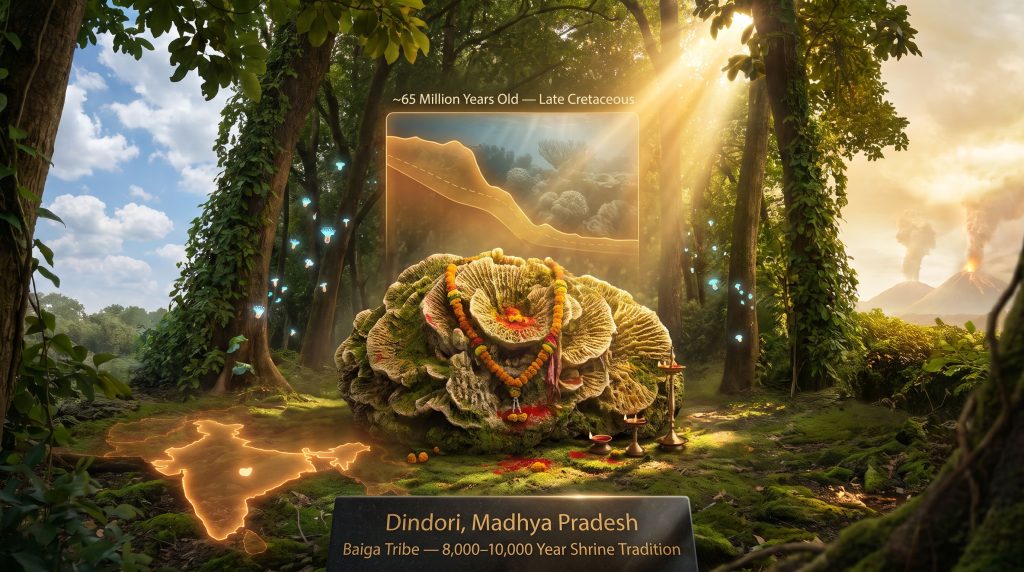
The Silent Guardians: How an Indigenous Shrine Protected a 65-Million-Year-Old Secret
Long before modern science developed the tools to classify geological formations, human communities across the world were doing something remarkable — they were protecting them. Across forests, mountains, and river valleys, sacred traditions built around unusual natural features inadvertently created some of the most effective preservation mechanisms ever known. The Dindori coral fossil shrine in Madhya Pradesh is one of the most striking examples of this phenomenon, representing a convergence of deep time geology and living cultural memory that challenges how we think about both scientific discovery and indigenous heritage.
When big ASX news breaks, our subscribers know first
What Exactly Is the Dindori Coral Fossil Shrine?
Deep within the forested interior of Dindori district, Madhya Pradesh, a stone formation that generations of Baiga tribal communities had worshipped as a sacred shrine has been formally identified by the Madhya Pradesh Directorate of Archaeology, Archives and Museums as a rare coral fossil estimated to be approximately 65 million years old. This places the specimen at one of the most dramatic geological boundaries in Earth's entire history — the transition between the Late Cretaceous and the Paleogene periods.
The discovery emerged not through a conventional excavation but through the work of a geological survey team documenting Dindori's largely unexplored fossil wealth. Researchers came across photographic records of the formation and noted its distinctly layered, structured appearance. That visual profile triggered a field investigation, followed by specimen testing and formal classification.
| Feature | Detail |
|---|---|
| Estimated Age of Fossil | ~65 million years |
| Geological Period | Late Cretaceous / Cretaceous-Paleogene Boundary |
| Location | Dindori district, Madhya Pradesh, India |
| Fossil Type | Rare coral fossil |
| Identifying Authority | MP Directorate of Archaeology, Archives and Museums |
| Indigenous Community | Baiga tribe |
| Estimated Age of Shrine Tradition | 8,000–10,000 years |
| Nearest Major Fossil Site | Ghughwa National Fossil Park, Dindori district |
What makes this find genuinely extraordinary is not just the specimen itself, but the story wrapped around it. The Baiga people, one of central India's oldest indigenous communities, had maintained a living shrine tradition around this object for potentially 8,000 to 10,000 years, according to assessments by ASI archaeologist Dr. Manoj Kumar Kurmi. His view, as reported through the Times of India, is that the earliest human communities in this region had no architectural temples. Instead, they directed reverence toward naturally occurring forms — particular rocks, towering trees, unusual geological features — that carried what felt like an inherent spiritual presence.
Over thousands of years, this informal veneration became formalised. The object became a shrine. The shrine became a protected site within a living tradition. And through that protection, a scientifically irreplaceable specimen survived intact.
Why Coral Fossils From This Era Are Exceptionally Rare
To fully appreciate what was found in Dindori, it helps to understand what coral fossils are and why specimens from this particular geological window are so uncommon.
Coral organisms build calcium carbonate skeletons over their lifetimes. When they die, these skeletal structures can be buried by sediment and, under the right conditions, undergo a slow chemical replacement process called permineralisation — where organic material is gradually substituted by minerals from surrounding groundwater. Furthermore, the result, over millions of years, is a fossil that retains the original organism's physical structure in extraordinary detail. Understanding the mineralogy of ores and mineral preservation helps contextualise just how rare such specimens truly are.
The challenge with Late Cretaceous coral fossils specifically is that the mass extinction event approximately 65 million years ago devastated marine ecosystems globally. The asteroid impact significance of the Chicxulub event — an object estimated at roughly 10 kilometres in diameter striking the Yucatan Peninsula in present-day Mexico — triggered catastrophic environmental collapse. However, combined with the prolonged volcanic activity of India's Deccan Traps, the resulting atmospheric darkening, global temperature disruption, and ecosystem failure eliminated an estimated 75% of all species on Earth, including a significant proportion of reef-building coral lineages. The broader asteroid impact significance for geological and biological history cannot be overstated.
Coral fossils from the Late Cretaceous are therefore rare not only because fossilisation itself is an unlikely process, but because the biological communities that produced them were largely obliterated. Finding a well-preserved specimen in central India's terrestrial landscape suggests an unusual set of geological conditions during its original formation and subsequent burial.
The fact that this fossil exists at all is a product of extraordinary geological fortune. That it survived in recognisable form for 65 million years, and then was unknowingly protected within a sacred tradition for another 8,000 to 10,000, is genuinely without parallel.
The World This Fossil Came From: Earth at the Edge of Catastrophe
Understanding the Dindori coral fossil shrine requires stepping back into a world almost unrecognisable from the present. Sixty-five million years ago, the Indian subcontinent was not where it sits today. It was a large landmass drifting northward following the breakup of the ancient supercontinent Gondwana, and parts of what is now central India were periodically submerged beneath shallow marine environments — precisely the conditions in which coral communities thrive. Indeed, supercontinent cycles played a fundamental role in shaping the geological conditions that made such fossil preservation possible.
| Geological Feature | 65 Million Years Ago | Present Day |
|---|---|---|
| Indian Subcontinent Position | Drifting northward (Gondwana breakup) | Fused with Eurasian plate |
| Deccan Traps Activity | Intense volcanic eruptions | Dormant basalt plateau |
| Sea Coverage | Parts of central India submerged | Fully terrestrial |
| Dominant Fauna | Dinosaurs, marine reptiles, early corals | Modern mammals, birds |
| Atmospheric Conditions | Post-impact deterioration | Stable modern climate |
The Deccan Traps, a vast volcanic system centred on what is now the Deccan Plateau, were erupting with enormous intensity during this period. Some researchers argue that Deccan volcanism was already contributing to environmental stress in the biosphere before the Chicxulub asteroid impact occurred, making the eventual extinction event a compound catastrophe rather than a single cause. This is an area of ongoing scientific debate, but the weight of evidence suggests both events played meaningful roles.
India's own prehistoric megafauna were present in this landscape. Rajasaurus narmadensis, a large carnivorous dinosaur whose fossil remains have been recovered from Gujarat's Narmada Valley, would have been a contemporary of the coral organisms that eventually became the Dindori specimen. The same volcanic and tectonic forces that shaped this dinosaur's habitat also shaped the sedimentary environment that preserved the coral. In addition, metamorphism and mineral formation processes operating across millions of years would have further influenced the fossil's remarkable state of preservation.
How the Identification Process Unfolded
The formal classification of the Dindori coral fossil shrine followed a methodical sequence rather than a sudden revelation. The process illustrates how modern palaeontological discovery increasingly draws on documentary evidence and cross-disciplinary collaboration.
-
Photographic Discovery — Survey teams cataloguing Dindori's geological features encountered images of the unusual formation during documentation work in the region.
-
Preliminary Visual Analysis — The specimen's layered, structured morphology raised immediate questions about whether the formation was purely geological or had an organic origin.
-
Field Expedition — Researchers conducted an on-site visit to assess the formation within its physical and environmental context.
-
Laboratory Testing — Specimens underwent compositional analysis to confirm fossil material and estimate geological age through established stratigraphic and comparative methods.
-
Formal Classification — The MP Directorate of Archaeology, Archives and Museums issued a formal identification of the object as a coral fossil of Late Cretaceous age.
-
Cross-Reference Review — Findings were assessed against existing records of Late Cretaceous coral fossil occurrences across the Indian subcontinent to contextualise the discovery's historical impact, much like a discovery's historical impact can reshape entire fields of understanding.
What makes this identification methodologically notable is that the specimen was not extracted or disturbed during the process. It remains within the shrine context, which raises its own set of complex questions about how the site should be managed going forward.
Dindori's Place in India's Prehistoric Landscape
The Dindori coral fossil shrine does not exist in isolation. The district already houses the Ghughwa National Fossil Park, one of India's most significant prehistoric sites, preserving plant fossils and ancient flora dating back up to 65 million years. The addition of a formally identified coral fossil shrine within the same district significantly deepens Dindori's standing as a region of extraordinary palaeontological density.
| Site | Location | Key Fossils | Estimated Age |
|---|---|---|---|
| Ghughwa National Fossil Park | Dindori, Madhya Pradesh | Plant fossils, prehistoric flora | 40–65 million years |
| Dindori Coral Fossil Shrine | Dindori, Madhya Pradesh | Rare coral fossil | ~65 million years |
| Dinosaur Fossil Park | Balasinor, Gujarat | Rajasaurus eggs and bones | ~65–70 million years |
| Narmada Valley Sites | Madhya Pradesh / Gujarat | Hominid fossils, megafauna | 0.3–0.5 million years |
| Tethys Himalaya Formations | Himachal Pradesh / Ladakh | Marine invertebrate fossils | 200–500 million years |
The concentration of fossil wealth in Dindori is not coincidental. The region sits within geological strata laid down during a period of intense environmental transition, preserving a snapshot of life immediately before and during one of the most catastrophic events in Earth's history. Researchers believe there is substantial additional fossil material in the district that remains formally undocumented.
The next major ASX story will hit our subscribers first
The Deeper Question: Undiscovered Fossil Shrines Across India
Perhaps the most thought-provoking dimension of the Dindori coral fossil shrine discovery is what it implies about comparable sites elsewhere. India's tribal interior is home to hundreds of communities with deep traditions of nature worship centred on unusual geological features. If one coral fossil survived intact for 65 million years partly because an indigenous community built a sacred tradition around it, how many other scientifically significant formations might be preserved within similar living traditions across Madhya Pradesh, Chhattisgarh, Jharkhand, and Odisha?
The Dindori discovery raises a broader methodological challenge for Indian palaeontology: conventional survey approaches focused on geologically mapped strata may be systematically missing sites that indigenous communities have been protecting for millennia.
This suggests a compelling case for community-led documentation frameworks, where researchers work alongside tribal knowledge holders to catalogue sites of cultural significance that may also carry geological importance. The Baiga community's stewardship of the Dindori coral fossil shrine was not scientifically motivated, but its outcome was scientifically invaluable.
Preservation, Policy, and the Tension Between Two Frameworks
The identification of the Dindori coral fossil shrine as a scientifically significant specimen creates an immediate and unresolved tension. India's legal frameworks for archaeological protection, tribal land rights, and palaeontological heritage were not designed to operate in integrated alignment. When a specimen of this geological rarity is embedded within an actively maintained sacred site belonging to an indigenous community, the question of which framework takes precedence has no clean answer under current policy.
There are reports that the fossil may eventually be displayed at the State Museum in Bhopal, which would make it accessible to researchers and the general public. However, any decision to relocate the specimen would require careful engagement with the Baiga community whose ancestral tradition preserved it. Removing the fossil from its shrine context without community consent would not only be ethically problematic, but would sever the very cultural thread that kept it intact.
The more nuanced policy outcome might involve designating the shrine site itself as a protected heritage location, preserving both the fossil and the living tradition surrounding it. This dual-framework approach would be without strong precedent in Indian heritage law, but the Dindori coral fossil shrine may be exactly the kind of discovery that compels new thinking.
Frequently Asked Questions: Dindori Coral Fossil Shrine
What is the Dindori coral fossil shrine?
It is a natural stone formation in Dindori district, Madhya Pradesh, worshipped for thousands of years by the Baiga indigenous community, and recently formally identified as a rare coral fossil approximately 65 million years old.
How old is the coral fossil found in Dindori?
The fossil is estimated to be approximately 65 million years old, placing it at the boundary between the Late Cretaceous and the Paleogene periods.
Who identified the Dindori fossil as a coral?
The formal identification was made by the Madhya Pradesh Directorate of Archaeology, Archives and Museums following field investigation and specimen testing.
What tribe worshipped the Dindori coral fossil shrine?
The Baiga tribe, one of central India's oldest indigenous communities, maintained the shrine tradition around the fossil for an estimated 8,000 to 10,000 years.
Is the Dindori coral fossil related to the Ghughwa National Fossil Park?
Both sites are located within Dindori district and share a broadly similar geological age range. They are separate sites, but their proximity reinforces Dindori's status as a region of exceptional prehistoric significance.
Will the Dindori coral fossil be moved to a museum?
There are reports suggesting the specimen may be considered for display at the State Museum in Bhopal, though no confirmed decision has been publicly announced. Any relocation would carry significant implications for both the Baiga community and the site's integrity.
Why are coral fossils from this period considered rare?
The mass extinction event approximately 65 million years ago eliminated an estimated 75% of all life on Earth, including large numbers of reef-building coral species. Consequently, preserved specimens from immediately before or at this boundary are uncommon in the global fossil record.
Key Takeaways
-
A coral fossil approximately 65 million years old, formed during the final phase of the dinosaur era, was preserved within a forest shrine in Dindori, Madhya Pradesh
-
The Baiga indigenous community unknowingly protected a scientifically irreplaceable specimen for potentially 8,000 to 10,000 years through sacred tradition
-
The formal identification was made by the MP Directorate of Archaeology, Archives and Museums following field visits and laboratory analysis
-
The fossil's age places it at the precise geological boundary defined by the Chicxulub asteroid impact and Deccan Traps volcanism, two of the most catastrophic events in planetary history
-
Dindori district, already home to the Ghughwa National Fossil Park, is now further established as one of India's most palaeontologically significant regions
-
The discovery raises important and unresolved questions about undiscovered fossil sites protected within tribal sacred traditions across India's forested interior
-
Current Indian legal frameworks for archaeological protection and tribal rights do not operate in full alignment, creating a genuine policy challenge for sites of this dual scientific and cultural significance
Disclaimer: This article presents geological age estimates and historical interpretations based on currently available scientific consensus and published reports. Palaeontological dating methods carry inherent margins of uncertainty, and ongoing research may refine existing estimates. Policy implications discussed reflect current frameworks and do not constitute legal advice.
Want to Understand How Ancient Earth Shaped Today's Mineral Discoveries?
The same geological forces that preserved the Dindori coral fossil — volcanic activity, tectonic movement, and mass extinction events — also created the mineral-rich formations driving modern ASX exploration. Discovery Alert's proprietary Discovery IQ model scans ASX announcements in real time, transforming complex geological data across 30+ commodities into clear, actionable insights, with historic discoveries such as those by De Grey Mining and WA1 Resources illustrating the scale of opportunity that emerges when significant finds are identified early — explore those returns on Discovery Alert's discoveries page and begin your 14-day free trial to position yourself ahead of the broader market.