August 9, 2026
The Ground Support Problem Underground Mining Can No Longer Ignore
The deeper underground mines reach, the more hostile and unpredictable the geotechnical environment becomes. This is not a new observation within the industry, but it has taken on renewed urgency as metalliferous mining operations globally push into rock masses characterised by higher stress regimes, greater seismic activity, and far more variable lithology than surface or near-surface workings. The consequence is a ground support challenge that single-principle anchorage systems were never designed to solve.
For decades, underground operations have relied on a relatively narrow toolkit of reinforcement technologies, each engineered around a single anchorage philosophy. Mechanical expansion bolts deliver rapid installation and immediate load capacity. Resin-bonded bolts offer permanence and corrosion resistance but require cure time before the heading can safely advance. Friction-based systems provide flexibility in fractured ground but lack the long-term structural performance of bonded alternatives. Each has its domain of competence, and each has well-documented limitations when conditions deviate from the design scenario.
The operational consequence of this fragmentation is significant. Underground development teams routinely carry multiple bolt types across active headings, shifting between primary and secondary support systems as ground conditions change. This introduces inventory complexity, increases logistics overhead, and, critically, creates windows of vulnerability during the transition between support phases when personnel are present in partially reinforced excavations.
Key Insight: Every moment a development heading relies solely on primary mechanical support while awaiting secondary bonded reinforcement represents a measurable period of elevated geotechnical risk, particularly in variable or seismically active ground.
It is within this context that the Normet HX-Bolt hybrid anchorage system has entered the market, and why its technical architecture deserves careful examination beyond the product launch narrative.
When big ASX news breaks, our subscribers know first
How the Normet HX-Bolt Hybrid Anchorage System Works
The Three-Mechanism Architecture
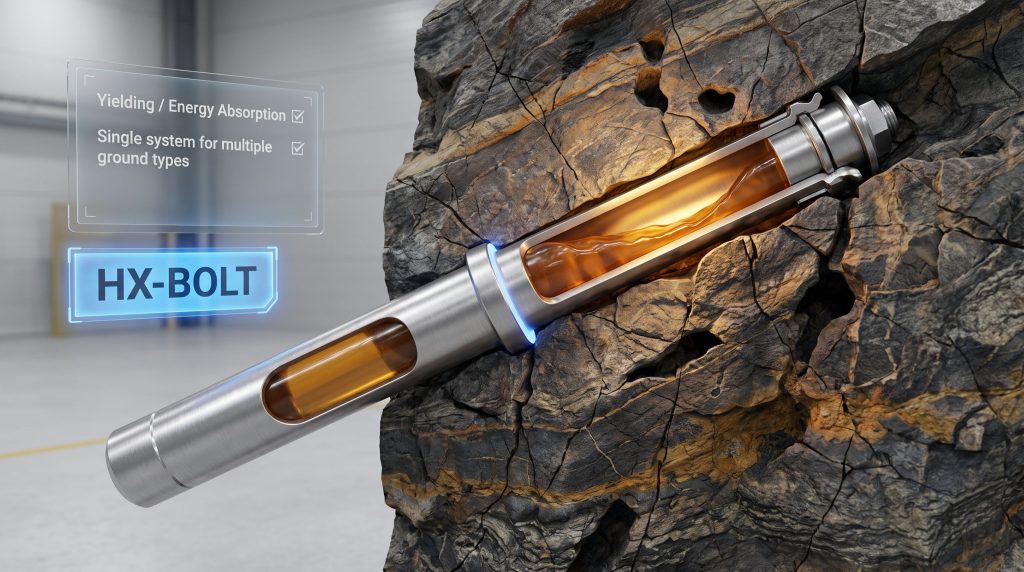
What distinguishes the Normet HX-Bolt hybrid anchorage system from conventional bolting solutions is not any single component in isolation, but rather the simultaneous integration of three distinct reinforcement principles within one unit. Understanding how each mechanism functions, and when it activates, is essential to grasping why this matters operationally.
| Anchorage Mechanism | Primary Function | Activation Timing |
|---|---|---|
| Mechanical End-Anchorage | Provides immediate load-bearing capacity at the bolt toe | Instantly upon installation |
| Frictional Confinement | Stabilises the borehole annulus and contains injection materials | During and immediately after installation |
| Bonded Encapsulation | Delivers long-term corrosion resistance and enhanced block ejection resistance | Upon optional resin or grout injection |
The sequencing here is important. Unlike traditional hybrid bolt concepts that require encapsulation to achieve working capacity, the HX-Bolt reaches full dynamic support performance the moment mechanical installation is complete. This means development cycles are not hostage to resin cure schedules or grout set times.
The Yielding Hollow Bar: Where Engineering Meets Geology
The central structural element that makes this three-mechanism approach viable is the yielding hollow bar. This design choice solves two problems simultaneously, which is what makes it technically interesting.
First, the hollow geometry creates a conduit through which resin or grout can be injected post-installation, transforming a mechanically anchored bolt into a fully encapsulated reinforcement element without removing or replacing any hardware. Second, the yielding characteristic of the bar means the bolt does not resist rock displacement rigidly, as a solid bar would. Instead, it accommodates deformation while maintaining load transfer, which is a critical distinction in squeezing or seismically active ground.
In practical geotechnical terms, a bolt that fails to yield under rock displacement either fractures at the plate or pulls out of the borehole entirely. Either outcome removes reinforcement from the system at precisely the moment it is most needed. The HX-Bolt's yielding bar is designed to avoid this failure mode, maintaining integrity through displacement events that would compromise conventional alternatives.
Single-Pass Installation and Operational Flexibility
From a site operations perspective, the single-pass installation capability represents a meaningful productivity lever. The system is compatible with standard underground bolters and drill rigs, which removes the barrier of dedicated equipment procurement or crew retraining. Immediate dynamic capacity is achieved at installation, allowing the heading to advance without delay. Where ground assessment subsequently identifies a need for long-term reinforcement or corrosion protection, encapsulation is performed through the same bolt using the same hollow bar conduit.
This creates a genuinely flexible support decision framework:
- Install HX-Bolt using existing bolting equipment.
- Achieve immediate full dynamic support capacity.
- Advance the development heading.
- Assess ground conditions at the face.
- Inject resin or grout through the hollow bar where additional reinforcement or corrosion protection is required.
- No re-drilling, no additional bolt installation, no secondary equipment mobilisation.
How HX-Bolt Compares to Conventional Underground Rock Bolt Systems
To appreciate the engineering significance of the Normet HX-Bolt hybrid anchorage system, it is useful to position it directly against the bolt types it is designed to complement or, in some operational scenarios, displace.
| Feature | Resin Bolt | Mechanical Bolt | Self-Drilling Anchor | HX-Bolt |
|---|---|---|---|---|
| Immediate dynamic support | No (cure time required) | Yes | Yes | Yes |
| Long-term bonded reinforcement | Yes | No | Yes | Yes |
| Corrosion protection via encapsulation | Yes | No | Partial | Yes |
| Yielding and energy absorption | No | No | No | Yes |
| Suitable for seismic environments | Limited | Limited | Limited | Yes |
| Single system across multiple ground types | No | No | No | Yes |
| Injection material containment mechanism | No | No | No | Yes (friction anchor) |
The comparison reveals a capability gap that no single existing bolt type fills. Mechanical bolts offer speed but no permanence. Resin bolts offer permanence but no immediate dynamic capacity. Self-drilling anchors address weak or collapsing ground but do not deliver the yielding energy absorption required in seismically active environments. The HX-Bolt occupies the intersection of all these requirements within a single deployable unit.
Furthermore, those new to evaluating these systems may find it helpful to consult a mining fundamentals guide before comparing technical bolt specifications in detail.
Comparison Insight: The most operationally significant differentiator is the elimination of the historical binary choice between installation speed and reinforcement permanence. The HX-Bolt is the first system designed to deliver both within the same unit and the same installation cycle.
Ground Condition Applicability Across Underground Geology
Where the Multi-Mechanism Design Earns Its Value
The practical case for the Normet HX-Bolt hybrid anchorage system strengthens considerably when examined across the full spectrum of underground ground conditions that modern mines encounter. The system's multi-mechanism design is not optimised for a single geological scenario; it is architected to remain relevant as geology transitions within the same mine or even the same development horizon.
- Competent rock: Mechanical anchorage alone may deliver sufficient ground control. Encapsulation can be omitted, reducing consumable expenditure per bolt without compromising performance in the ground type encountered.
- Highly fractured ground: Frictional confinement stabilises loose material around the borehole immediately after installation. Subsequent encapsulation consolidates fractured zones by filling voids and fractures with bonding material, rebuilding structural continuity in the rock mass around the excavation boundary.
- Squeezing conditions: Progressive convergence in swelling or plastically deforming ground imposes sustained displacement on installed reinforcement. The yielding bar absorbs this displacement progressively rather than resisting it to the point of failure, preserving reinforcement function over the life of the excavation.
- Seismically active environments: Blast-induced or tectonic seismic events generate dynamic energy that conventional rigid bolts cannot absorb without fracturing or ejecting from their boreholes. The yielding mechanism dissipates this energy through controlled deformation, maintaining bolt integrity through seismic loading cycles.
- Variable or mixed ground: Perhaps the most practically valuable application, the HX-Bolt allows a single bolt type to be deployed across headings with differing geotechnical character. Operators make encapsulation decisions based on actual face conditions rather than pre-committing to different bolt inventories for different anticipated zones.
This last point carries significant implications for mine planning and ground support scheduling. The ability to run a single bolt type across a development programme, adjusting the support intensity through encapsulation decisions rather than bolt type substitution, simplifies both procurement and ground support design verification.
The Friction Anchor's Role in Reducing Injection Material Waste
A Containment Mechanism With Direct Cost Implications
One of the technically interesting, and commercially underappreciated, aspects of the HX-Bolt design is the secondary function performed by the friction anchor during the encapsulation phase. In fractured or void-rich ground, this feature has direct implications for the cost-per-bolt calculation.
In conventional encapsulated bolt systems, resin or grout injected into a borehole in fractured rock does not remain confined to the annular reinforcement zone. It migrates along fractures and into voids, increasing material consumption substantially beyond what the annular geometry would theoretically require. In severe cases, it is possible to inject large volumes of encapsulation material without achieving effective bonding because the material has dispersed away from the zone of intended reinforcement.
The HX-Bolt's friction anchor addresses this directly. Positioned within the borehole, the friction anchor forms a physical barrier that limits the migration of injected resin or grout beyond the intended encapsulation zone. The result is twofold:
- Reduced injection material consumption per bolt in fractured ground, with material concentrated where it performs reinforcement work.
- Improved encapsulation effectiveness, because the material remains within the annular zone rather than dispersing into the surrounding rock mass.
Operational Efficiency Note: In high-fracture mining environments where grout loss is a persistent and measurable cost driver, the containment function of the friction anchor translates directly into lower consumable expenditure per development metre. At scale across a mine's annual bolt installation programme, this can represent a material reduction in ground support consumable costs.
Primary and Secondary Support Integration: The Development Cycle Productivity Case
Comparing Traditional Multi-System Approaches With the HX-Bolt Method
Underground development efficiency is measured in metres advanced per shift, and every additional task required before a heading can advance imposes a time cost that compounds across the development programme. The traditional two-stage support approach, which involves installing primary mechanical support followed by return visits for secondary bonded reinforcement, introduces multiple inefficiencies that the HX-Bolt architecture is specifically designed to eliminate.
Traditional Multi-System Development Support Sequence:
- Install primary mechanical bolt immediately following excavation to secure the opening.
- Allow the heading to advance while secondary support is planned.
- Return to the heading to install secondary bonded reinforcement, typically resin or cable bolts.
- Manage separate bolt inventories, installation equipment setups, and quality assurance processes for each system.
- Coordinate multiple trades and equipment movements in the same development corridor.
HX-Bolt Integrated Support Sequence:
- Install HX-Bolt using standard bolting equipment already on site.
- Achieve immediate full dynamic support capacity. The heading can advance.
- Assess ground conditions during normal face cycle activities.
- Inject resin or grout through the hollow bar in zones where long-term reinforcement or corrosion protection is required.
- No additional bolt installation, no re-drilling, no separate inventory or equipment management.
The elimination of the return visit for secondary support installation is not merely a scheduling convenience. It also reduces the number of personnel exposure events in the development heading during the support installation phase, which has direct safety implications beyond the productivity benefits.
The next major ASX story will hit our subscribers first
Where HX-Bolt Fits Within Normet's Broader Rock Reinforcement Portfolio
Complementing Rather Than Replacing Existing Solutions
Normet's rock bolting system encompasses dynamic bolts, cable bolts, self-drilling anchors, and conventional resin and mechanical solutions. The HX-Bolt is positioned as an addition to this ecosystem rather than a replacement for existing technologies, targeting a specific performance domain that no prior product in the range fully addressed.
Understanding how the HX-Bolt relates to adjacent products clarifies its intended application space:
- Dynamic bolts are engineered primarily for high-energy absorption in seismically active environments. HX-Bolt extends this capability by adding the option of permanent bonded reinforcement, making it applicable where both dynamic and long-term performance are simultaneously required.
- Cable bolts are suited to high-load, long-tenure applications in stope walls and backs where sustained high-capacity reinforcement over extended excavation lifetimes is critical. HX-Bolt addresses shorter-length development heading applications rather than competing in this domain.
- Self-drilling anchors excel in weak or collapsing ground where drilling and installation must occur simultaneously because the borehole cannot be maintained open. HX-Bolt targets a broader range of ground conditions but is not optimised for the specific collapsing-ground scenario that self-drilling anchors address.
- Conventional resin and mechanical bolts retain their place in stable, well-characterised ground where the multi-mechanism flexibility of HX-Bolt is not required and cost optimisation favours simpler solutions.
The net effect of adding HX-Bolt to this portfolio is that underground operators now have a single system capable of bridging the gap between immediate development support and permanent excavation reinforcement, narrowing the number of distinct bolt types required across a mine's support schedule without eliminating the specialist solutions that serve specific niche applications.
Underground Safety, Regulatory Context, and the Case for Performance Consistency
Why Adaptable Ground Support Has Become a Compliance Consideration
Ground failure remains among the highest-consequence hazard categories in underground metalliferous mining. Industry fatality and serious injury data consistently place ground-related incidents alongside mobile equipment interactions as the leading causes of harm in underground operations globally. This reality shapes how regulatory frameworks in major mining jurisdictions approach ground support design and verification.
Increasingly, regulators require mines to document ground support designs against defined performance criteria and to verify that installed support meets those criteria across the range of ground conditions actually encountered, not merely the conditions anticipated during design. This shift toward performance-based rather than prescriptive-based regulation creates a compliance challenge for operations running multiple bolt types across variable ground, because each bolt type requires its own performance characterisation and verification protocol.
A system like the Normet HX-Bolt hybrid anchorage system, which delivers predictable high-capacity performance across competent, fractured, squeezing, and seismically active ground within a single unit, simplifies this compliance burden. A single performance characterisation covers the full range of ground conditions where the bolt is deployed, reducing the documentation and verification overhead that multiple bolt type programmes impose.
Beyond compliance, the safety case for reducing the number of distinct support installation tasks in an active development heading is straightforward. Fewer installation visits mean fewer personnel exposure events in partially supported ground. The HX-Bolt's ability to deliver complete primary and secondary support functions within a single installation cycle, with optional encapsulation performed without personnel re-entry for additional bolt installation, directly reduces this exposure.
Frequently Asked Questions: Normet HX-Bolt Hybrid Anchorage System
Does HX-Bolt require resin or grout to achieve initial support capacity?
No. The HX-Bolt delivers full dynamic support capacity immediately upon mechanical installation. The mechanical end-anchorage and frictional confinement mechanisms together provide working load capacity without any encapsulation material. Resin or grout injection is an optional secondary step applied where long-term bonded reinforcement or corrosion protection is operationally required.
Can HX-Bolt be installed using existing underground bolting equipment?
Yes. The system is designed for compatibility with standard underground bolters and drill rigs. No specialised or dedicated installation equipment is required, which removes a significant adoption barrier for operations evaluating the system. In addition, those assessing ground support effectiveness may find that check sampling methods provide useful context for verifying reinforcement performance data.
What makes the HX-Bolt suitable for seismically active environments?
The yielding hollow bar component is engineered to absorb dynamic energy generated by seismic or blast loading events. Rather than failing under the sudden displacement imposed by a seismic event, the bar deforms in a controlled manner while maintaining load-bearing capacity. This energy absorption capability is absent from conventional solid-bar bolt systems.
How does the friction anchor improve encapsulation efficiency in fractured ground?
The friction anchor functions as a physical containment barrier within the borehole during resin or grout injection. By limiting the migration of injection material into surrounding fractures and voids, it ensures that encapsulation material remains concentrated within the annular reinforcement zone, improving bond effectiveness while reducing material consumption per bolt.
Is HX-Bolt intended to replace cable bolts or self-drilling anchors?
No. HX-Bolt fills a specific performance gap, addressing variable ground conditions where both immediate dynamic support and optional long-term reinforcement are simultaneously required. Cable bolts and self-drilling anchors serve distinct application domains and remain relevant within a comprehensive ground support programme.
Key Technical Specifications at a Glance
| Attribute | Detail |
|---|---|
| System Classification | Hybrid anchorage: mechanical, frictional, and bonded |
| Immediate Support Capacity | Achieved at mechanical installation, no encapsulation required |
| Encapsulation Method | Resin or grout injected through hollow bar conduit |
| Yielding Capability | Yes: hollow bar absorbs rock displacement and dynamic energy |
| Compatible Installation Equipment | Standard underground bolters and drill rigs |
| Ground Condition Range | Competent, highly fractured, squeezing, seismically active |
| Corrosion Protection | Available through full encapsulation |
| Primary and Secondary Support Integration | Yes: single system replaces two-stage installation process |
| Injection Material Containment | Friction anchor limits resin and grout migration into fractures |
The Strategic Outlook for Hybrid Anchorage in Underground Mining
Why Integration of Immediate and Permanent Support Reflects a Structural Industry Shift
The ground support challenge confronting underground mining is not static. Global mining depth trends, increasing orebody complexity, and the expansion of operations into higher seismic risk zones are all progressing in the same direction, toward conditions that demand more from reinforcement systems than any single-anchorage principle can reliably deliver.
The Normet HX-Bolt hybrid anchorage system addresses a long-standing structural constraint in how underground mines manage the transition from primary to secondary support. By consolidating mechanical, frictional, and bonded anchorage into a single yielding hollow bar, it enables operations to standardise bolt inventories while retaining the flexibility to calibrate support intensity to actual ground conditions, rather than anticipated conditions.
The productivity and safety implications of this integration are directly relevant to development cost management and workforce risk exposure. Fewer installation phases, a single bolt type across a broader range of geological scenarios, and reduced injection material consumption in fractured environments together represent a measurable operational efficiency gain at the development heading level. For broader project planning context, understanding how these systems feed into a definitive feasibility study can further demonstrate the financial value of consolidated ground support approaches.
Strategic Outlook: As underground mines trend toward greater depth, higher seismic exposure, and more geologically variable ore horizons, hybrid anchorage systems that integrate dynamic energy absorption with optional bonded permanence are likely to transition from specialist solutions to standard components of modern ground control programmes. The Normet HX-Bolt hybrid anchorage system represents a technically coherent response to this trajectory.
This article is intended for informational and educational purposes only. It does not constitute engineering advice, safety guidance, or a recommendation to adopt any specific ground support system. Underground ground support design should always be conducted by qualified geotechnical engineers with site-specific knowledge of the geological and operational conditions involved.
Want to Know Which ASX Mining Companies Are Pushing Into High-Risk, High-Reward Deep Ground?
Discovery Alert's proprietary Discovery IQ model scans ASX announcements in real time, instantly identifying significant mineral discoveries across underground and surface operations before the broader market reacts — explore historic discoveries and their returns to understand the scale of opportunity, then begin your 14-day free trial at Discovery Alert to position yourself ahead of the market.