June 25, 2026
The Hidden Value Problem in South African PGM Processing
Across the mineral processing industry, the most persistent source of value destruction rarely occurs at the mine face. It happens further downstream, in the moments when heavy minerals pass through concentration circuits unrecovered and report silently to tailings storage. In platinum group metal operations across South Africa's Bushveld Complex, chromite has long occupied this ambiguous space between valuable co-product and processing nuisance. The engineering challenge of capturing it efficiently, particularly at ultrafine particle sizes, has shaped the development of an entire category of spiral concentrator technology.
Understanding how Multotec spiral solutions for chromite and PGM projects are engineered, deployed, and optimised requires engaging with the mineralogy, fluid dynamics, and circuit architecture that define this processing environment. The decisions made at the equipment selection stage carry multi-decade economic consequences for any operation processing UG2 reef material.
When big ASX news breaks, our subscribers know first
Why Chromite Recovery in PGM Circuits Is an Engineering Priority, Not an Afterthought
The Mineralogical Case for Gravity Separation in UG2 Reef Processing
South Africa's UG2 chromitite layer, which sits within the Bushveld Complex and stretches across Limpopo, North West, and Mpumalanga provinces, is among the most mineralogically complex ore bodies mined for PGMs globally. The reef contains chromite (FeCr₂O₄) at concentrations that can exceed 20% by mass in some horizons, alongside the platinum group minerals that represent the primary economic target.
This co-occurrence creates a dual processing imperative. Chromite is chemically stable, physically dense (specific gravity of approximately 4.5 g/cm³, compared to silicate gangue at roughly 2.65 g/cm³), and liberated at relatively coarse sizes. These properties make it an ideal candidate for gravity-based concentration, where density differential is the primary separation driver. Furthermore, understanding mineralogy and ore economics is essential when evaluating the commercial case for any gravity circuit investment.
The density contrast between chromite and the silicate gangue minerals that accompany it in UG2 reef is substantial enough that well-designed spiral concentrators can achieve meaningful separation without the reagent costs or energy intensity associated with flotation circuits.
The Commercial Logic Behind Chromite as a Co-Product
Metallurgical-grade chromite concentrate commands market pricing tied to ferrochrome production demand, which is itself linked to stainless steel manufacturing cycles. South Africa currently accounts for roughly 44% of global chromite ore output, making it the world's dominant supplier. Within that context, the chromite extracted as a by-product from PGM processing plants represents a genuine revenue stream, not a marginal consideration.
The financial case strengthens further when viewed through the lens of circuit efficiency. Chromite particles that pass through concentration circuits without recovery accumulate in tailings storage facilities, increasing volumetric load, raising long-term environmental liability, and representing permanently stranded capital. Spiral-based recovery upstream of tailings disposal converts this liability into an asset.
How Spiral Concentrators Work: Mechanics, Parameters, and Limitations
Helical Gravity Separation From First Principles
A spiral concentrator operates by feeding a water-mineral slurry onto a helical channel that descends around a central column. As the slurry flows downward, three forces interact continuously: gravitational force acting along the channel slope, centrifugal force generated by the helical path, and fluid drag from the water medium. These forces stratify particles laterally across the trough according to their specific gravity and size.
Dense minerals migrate toward the inner trough, where slower-moving fluid accumulates them for extraction. Lighter gangue minerals migrate outward toward the outer edge of the spiral and discharge as tailings. Splitter blades positioned at extraction ports allow operators to define concentrate, middlings, and tailings fractions.
Key Operating Parameters That Define Spiral Performance
The practical performance of any spiral concentrator is governed by a set of interacting variables:
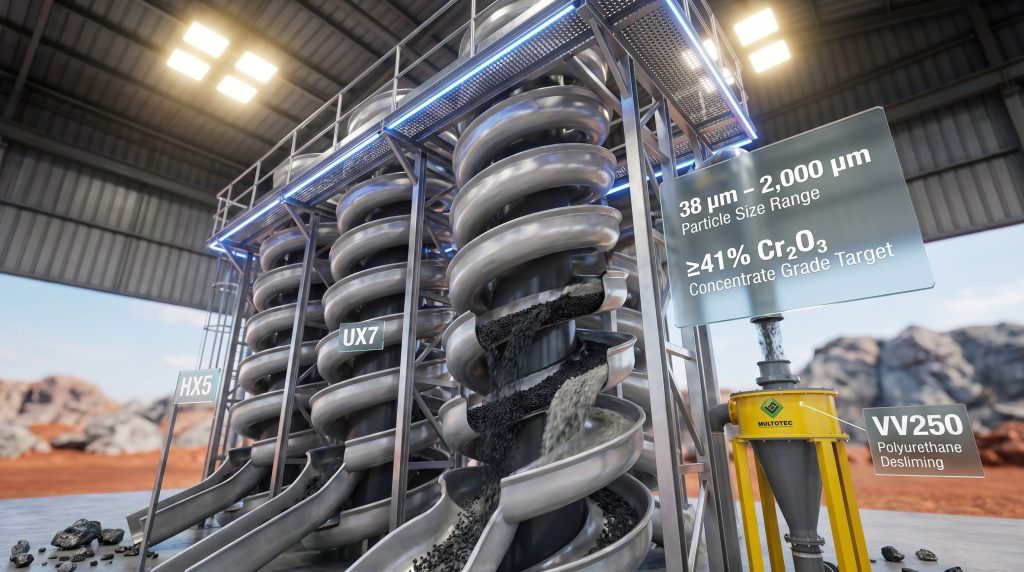
- Feed particle size range: Most conventional spirals operate effectively between 38 µm and 2,000 µm. Below 38 µm, ultrafine particles behave hydrodynamically rather than gravitationally and do not stratify reliably.
- Feed slurry density: Optimal slurry concentration typically falls between 25% and 45% solids by weight for standard applications, though ultrafine-specific designs operate at elevated concentrations of 50–60% w/w.
- Pitch angle: Steeper pitch angles increase flow velocity and throughput but reduce residence time and separation selectivity. Flatter pitch angles improve separation fidelity at the cost of throughput.
- Number of starts: Single-start spirals provide the highest separation precision. Triple-start configurations multiply throughput capacity and are common in high-volume rougher stages.
Why Ultrafine Chromite Presents a Structural Recovery Challenge
Particles below 100 µm, and particularly those below 45 µm, create significant problems for conventional spiral geometry. At these sizes, the ratio of surface drag to gravitational force shifts fundamentally. Fine chromite particles that should theoretically report to the concentrate based on density instead become entrained in the water film flowing toward the outer trough.
This entrainment effect is worsened by slurry viscosity. As ultrafine gangue minerals accumulate in the slurry medium, apparent viscosity increases, dampening the density-driven stratification layer. The result is that a measurable fraction of fine chromite, carrying genuine economic value, bypasses the inner trough and reports to tailings. Across a large-scale operation processing millions of tonnes annually, these losses compound into significant revenue attrition. For a broader perspective on how spirals in mineral processing have evolved to address these challenges, Multotec's technical resources provide useful reference material.
Multotec's Spiral Model Range: Engineering Responses to Specific Processing Challenges
Matching Spiral Geometry to Circuit Position
Multotec's approach to chromite and PGM spiral concentration is premised on the recognition that no single spiral geometry is optimal across all circuit positions and feed characteristics. The company's model range addresses distinct processing stages with purpose-designed equipment.
| Spiral Model | Primary Application | Pitch Configuration | Throughput Capacity | Target Performance |
|---|---|---|---|---|
| UX7 | Ultrafine chromite recovery (<100 µm) | Very flat pitch | 50–60% w/w slurry concentration | Recovery of particles <45 µm |
| HX5 | Rougher and scavenger stages | 19° pitch angle | 4–7 t/h per start; up to 15 t/h triple start | Optimal recovery from UG2 tailings |
| SC21 | Cleaning and upgrade stages | 21° pitch angle | 1.0–2.3 t/h per start | ≥41% Cr₂O₃ concentrate grade |
| 117HM | Low-grade, high-volume recovery | High-rejection configuration | Variable | >90% heavy mineral recovery; 90% waste rejection |
The UX7: Engineering Designed Around the Ultrafine Recovery Gap
The UX7 spiral addresses the most technically demanding segment of chromite recovery: particles below 45 µm that conventional spirals consistently fail to capture. Its defining characteristic is a very flat pitch geometry, which reduces the velocity of the flowing film and extends the residence time of particles on the trough surface.
This extended contact time allows the density differential between fine chromite and silicate gangue to exert influence despite the reduced gravitational leverage available at small particle sizes. Coupling this with elevated feed slurry concentrations of 50–60% solids by weight thickens the flowing film, which paradoxically improves stratification at ultrafine sizes by creating a more viscous medium that slows particle migration and reduces turbulent entrainment.
The economic significance of the UX7 is proportional to the chromite content of the sub-45 µm fraction in any given circuit, which in UG2 processing environments can be substantial given the grinding requirements of PGM liberation.
HX5 and SC21: The Rougher-Cleaner Architecture for UG2 Tailings Recovery
The HX5 operates as a high-throughput workhorse in rougher and scavenger positions. Its 19° pitch angle balances recovery and throughput, making it appropriate for processing the full volumetric output of MF1 or MF2 tailings streams. Triple-start configurations allow a single unit to process up to 15 t/h, reducing the footprint requirements for large-scale rougher installations.
The SC21 operates downstream of the HX5, taking the rougher concentrate and upgrading it to a saleable product. Its slightly steeper 21° pitch angle increases selectivity at the expense of throughput, targeting chromite concentrate grades of ≥41% Cr₂O₃. This grade threshold is significant because it represents the minimum specification commonly accepted by ferrochrome smelters for metallurgical-grade feed material.
Achieving ≥41% Cr₂O₃ through a sequential HX5-SC21 circuit transforms what would otherwise be a low-value rougher concentrate into a specification-grade product ready for direct smelter delivery, fundamentally changing the economics of the recovery operation.
The 117HM: Managing High-Volume, Low-Grade Feed Streams
The 117HM spiral is configured for maximum mass rejection rather than concentrate grade. In processing scenarios where feed streams are characterised by low heavy mineral content and high gangue volumes, the priority shifts from concentrate upgrading to efficient waste rejection. The 117HM achieves greater than 90% heavy mineral recovery while simultaneously rejecting more than 90% of waste material, making it effective as a primary separation stage ahead of cleaning circuits.
The Critical Role of Desliming in Protecting Spiral Separation Efficiency
Why the Sub-38 Micron Fraction Must Be Removed Before Spiral Feed
The particle size floor of effective spiral concentration sits at approximately 38 µm. Below this threshold, particles do not stratify predictably under gravity and centrifugal forces. If these colloidal and ultrafine fractions are allowed to enter the spiral feed, they increase slurry viscosity, disrupt the stratification layer, and cause misreporting of both fine chromite (to tailings) and fine gangue (to concentrate).
Desliming prior to spiral feed is therefore not an optional pre-treatment step. It is a structural requirement for maintaining separation fidelity in circuits processing UG2-derived material with significant ultrafine content.
Polyurethane Cyclone Technology: The VV250 Application
Multotec's VV250 polyurethane cyclones serve the desliming function in this circuit architecture. Polyurethane construction provides wear resistance appropriate for the abrasive chromite-bearing slurries encountered in UG2 processing. The cyclones create a hydraulic classification cut that separates the sub-38 µm fraction as overflow, diverting it away from the spiral feed stream.
The downstream effects of effective desliming extend beyond protecting spiral performance. Removing the ultrafine gangue fraction also reduces the volumetric load on spiral circuits, improves apparent slurry rheology, and allows spiral operating parameters to be optimised for the coarser, gravity-amenable fraction that remains in the underflow feed.
Circuit Architecture: How Spirals Integrate Into MF1 and MF2 Processing Stages
Understanding the MF1 and MF2 Circuit Framework
South African PGM concentrators typically process UG2 reef through a sequential milling and flotation circuit architecture. The MF1 (mill-float one) stage conducts primary grinding followed by first-pass flotation to recover coarse PGM-bearing sulphides. Material that does not float in MF1 passes to a secondary regrind and flotation stage, designated MF2.
The chromite present in UG2 feed is largely non-floatable, meaning it progresses through both flotation stages without reporting to PGM concentrate. By the time MF2 tailings are generated, the chromite fraction is concentrated, fine, and heading for disposal unless a recovery circuit intervenes.
Interstage Chromite Extraction: Strategic Placement Between MF1 and MF2
One of the more technically sophisticated deployment strategies involves positioning UX7 spirals on MF1 tailings before that material enters the MF2 regrind circuit. This interstage placement delivers a dual benefit that is frequently underappreciated:
- Revenue generation: Chromite recovered at this stage is available as a saleable co-product without having passed through the energy-intensive MF2 regrind, which would have reduced particle size and complicated downstream recovery.
- Circuit load reduction: By extracting the dense chromite fraction before MF2 milling, the volumetric and mass load entering the MF2 circuit decreases. This reduces energy consumption per tonne of PGM concentrate produced and can extend the operational life of MF2 grinding media and mill linings.
MF2 Tailings Recovery: Capturing the Final Chromite Fraction
For operations without interstage extraction, or as a complementary final stage, HX5 rougher spirals followed by SC21 cleaning spirals on MF2 tailings provide a last opportunity for chromite capture before tailings storage. This sequential rougher-cleaner configuration processes the highest-volume, lowest-grade chromite stream in the circuit, requiring equipment configured for mass throughput at the rougher stage and precision upgrading at the cleaner stage.
The economic case for retrofitting this circuit into existing concentrators is strengthened by the modular nature of spiral plants. Spiral systems can be installed in relatively compact footprints and connected to existing tailings launders without major infrastructure modifications.
The next major ASX story will hit our subscribers first
The Thaba JV Project: Site-Specific Engineering in Limpopo Province
Why Custom Equipment Selection Matters in Co-Processing Operations
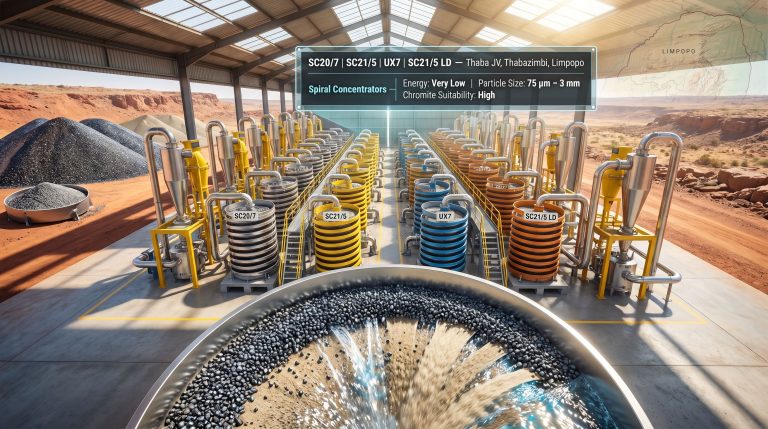
The chromite-PGM joint venture in South Africa's Limpopo Province, known as the Thaba JV project, illustrates the practical consequences of matching spiral equipment to site-specific ore characteristics rather than defaulting to generic gravity separation configurations. The operation selected a tailored Multotec spiral solutions for chromite and PGM project package aimed at boosting both productivity and product quality.
The mineralogy encountered at Thaba, including the specific particle size distribution of chromite across the feed streams, the UG2 chromite content, and the circuit architecture already in place, determined which spiral models were selected for each processing stage. This is a fundamentally different approach from equipment procurement processes that prioritise lowest unit cost over metallurgical fit. For further detail on the Thaba JV chromite and PGM project, the project deployment report provides additional engineering context.
What Custom Circuit Design Delivers in Practice
A site-specific spiral circuit design addresses several variables that generic configurations cannot:
- Feed grade variability: UG2 chromite content varies spatially across mining blocks. Equipment selection must account for both average and peak chromite grades to avoid bottlenecking.
- Particle size distribution: Liberation characteristics at Thaba determine the proportion of chromite reporting to the sub-100 µm fraction, which governs the relative weighting of UX7 versus HX5 capacity in the circuit.
- Product specification targets: The ferrochrome market demands minimum 41% Cr₂O₃ for metallurgical-grade material. Circuit design must ensure the SC21 cleaning stage is appropriately sized to achieve consistent grade under variable feed conditions.
Operations that invest in pre-engineering test work and pilot-scale spiral trials before committing capital consistently report better alignment between projected and actual metallurgical performance than those that skip this validation step.
Economic and ESG Dimensions of Spiral-Based Chromite Recovery
Quantifying the Co-Product Revenue Opportunity
The financial case for spiral installation in PGM circuits is built on the interaction between chromite recovery rate, feed tonnes processed, chromite concentrate grade achieved, and prevailing chromite prices. Given South Africa's position as the world's largest chromite producer, operators processing UG2 material without a chromite recovery circuit are effectively leaving a marketable commodity in their tailings dams.
| Benefit Category | Mechanism | Operational Impact |
|---|---|---|
| Co-product revenue | Chromite extraction from PGM tailings | Additional income stream per tonne processed |
| Circuit load reduction | Pre-extraction before MF2 | Lower energy draw and reduced reagent use |
| Tailings diversion | Recovery before disposal | Reduced environmental liability and storage costs |
| Retrofit compatibility | Modular spiral plant design | Low capital barrier for brownfield integration |
In addition, cut-off grade economics become directly relevant when evaluating whether chromite recovery at a given grade threshold justifies the capital outlay for spiral circuit installation.
ESG Implications: Tailings Volume Reduction and Resource Stewardship
The regulatory and reputational environment surrounding tailings storage facilities has intensified significantly following high-profile dam failures in Brazil and the subsequent revision of the Global Industry Standard on Tailings Management. South African mining operations face increasing scrutiny over tailings accumulation rates, dam stability, and long-term closure liabilities.
Spiral-based chromite recovery directly reduces the mass and volume of material reporting to tailings storage. Each tonne of chromite concentrate extracted from a PGM circuit is a tonne diverted from a tailings facility, contributing to reduced dam raise rates, lower long-term rehabilitation costs, and demonstrable resource efficiency gains. Consequently, these outcomes carry ESG reporting value that aligns with the broader mining sustainability transformation agenda now central to investor and regulatory expectations.
Energy Efficiency: Gravity Separation Against Competing Technologies
Spiral concentrators are passive gravity devices. They require no reagent inputs, consume no electrical energy during separation (feed pump energy excepted), and generate no chemical effluents. Compared to magnetic separation, which requires sustained electromagnet power, and flotation, which demands compressed air, reagent dosing, and intensive agitation, the operating cost profile of spiral gravity separation is among the lowest available to the PGM processing engineer.
This energy efficiency advantage compounds across the life of an operation and is particularly relevant as South African mining faces ongoing electricity supply constraints and carbon reporting obligations.
Broader Industry Trends Shaping Demand for Advanced Spiral Technology
The Bushveld Complex as the Global Epicentre of Chromite-PGM Co-Processing
The Bushveld Igneous Complex represents the world's largest known repository of both PGMs and chromite. Its layered structure, which includes the Merensky Reef, UG2 layer, and Platreef, contains chromite layers that are mined as a co-product from PGM operations and as a primary target in dedicated chromite mines. The concentration of processing infrastructure in this geological province makes South Africa the natural testing ground for advanced chromite gravity separation technology. Furthermore, the presence of volcanogenic massive sulfide deposits in other global jurisdictions provides useful comparative context for understanding how co-product recovery strategies vary across different geological settings.
The Strategic Elevation of Chromite in Critical Minerals Discourse
Chromite's strategic profile has shifted considerably in recent years. Chrome is an essential input for stainless steel production, ferrochrome alloys, and specialist refractory applications. The global stainless steel market, which consumes approximately 90% of ferrochrome production, has driven sustained demand for metallurgical-grade chromite. Growing interest in chrome's role in energy storage and defence applications adds a further dimension to its demand profile.
For PGM operators, this elevated strategic context means that chromite recovery decisions made at the circuit design stage carry longer-term market implications than they might have a decade ago.
Finer Ore Liberation and the Ongoing Challenge of Ultrafine Recovery
As high-grade UG2 ore blocks are progressively mined out, operators are increasingly processing lower-grade material that requires finer grinding to achieve adequate PGM liberation. This trend toward finer grinding increases the proportion of chromite reporting to the sub-100 µm and sub-45 µm fractions, precisely the range where conventional spirals underperform.
The development of ultrafine spiral technology, including the UX7 design, is therefore not merely a current solution but an anticipatory response to a processing trajectory that will only intensify as ore quality grades down over time.
Frequently Asked Questions: Multotec Spiral Solutions for Chromite and PGM Processing
What particle size range can spiral concentrators effectively process?
Standard spiral concentrators operate across a particle size range of 38 µm to 2,000 µm. Below 38 µm, particles behave hydrodynamically and require alternative processing approaches, including desliming prior to gravity circuit feed.
How does the UX7 spiral recover chromite finer than 45 microns?
The UX7 uses a flat pitch geometry to reduce flow velocity and extend particle residence time on the trough. Combined with elevated slurry densities of 50–60% solids by weight, this allows density-driven stratification to occur at particle sizes where conventional spirals fail, enabling recovery of chromite fractions below 45 µm.
What chromite concentrate grade can be achieved using SC21 cleaning spirals?
SC21 cleaning spirals are designed to achieve chromite concentrate grades of ≥41% Cr₂O₃, which meets the minimum specification required for metallurgical-grade chromite concentrate accepted by ferrochrome smelters.
Can spiral concentrators be retrofitted into existing PGM concentrator plants?
Yes. The modular nature of spiral plant designs makes brownfield integration feasible with relatively modest capital expenditure. Spiral launders can typically connect to existing tailings infrastructure, and the compact footprint of multi-start spiral assemblies reduces civil construction requirements.
What is the difference between rougher spirals and cleaner spirals in chromite circuits?
Rougher spirals, such as the HX5, are configured for high throughput and maximum recovery, accepting that concentrate grade will be lower. Cleaner spirals, such as the SC21, process the rougher concentrate at lower throughput and higher selectivity to upgrade the product to a marketable specification grade.
How does interstage chromite removal improve overall PGM circuit efficiency?
Extracting chromite from MF1 tailings before MF2 regrinding removes a dense, non-floatable mineral from the downstream circuit. This reduces the mass load and energy demand on MF2 grinding and flotation stages while simultaneously generating a saleable chromite co-product from material that would otherwise be discarded.
Key Technical Takeaways for Processing Engineers and Project Evaluators
Decisions made during spiral circuit design for chromite-PGM operations have implications that extend well beyond initial capital cost. The following principles capture the essential technical and commercial framework:
- Spiral concentrators processing a 38–2,000 µm particle size range remain the most cost-effective gravity separation technology available for chromite recovery in PGM tailings streams, with negligible reagent costs and low energy consumption relative to flotation alternatives.
- The UX7 ultrafine spiral closes a historically significant recovery gap for particles below 45 µm, a fraction that grows as ore grades decline and grinding requirements intensify across South Africa's UG2 operations.
- Sequential HX5 rougher to SC21 cleaner circuit configurations provide a proven pathway to achieving ≥41% Cr₂O₃ concentrate grades from UG2 tailings, meeting the metallurgical threshold for direct smelter delivery.
- Interstage chromite extraction on MF1 tailings using UX7 spirals generates co-product revenue while simultaneously reducing energy consumption and grinding media wear in the downstream MF2 circuit.
- Effective desliming using polyurethane cyclones to remove sub-38 µm fractions before spiral feed is a non-negotiable pre-processing requirement in ultrafine-rich UG2 feed environments.
- Modular spiral plant architectures enable brownfield retrofits at capital costs that can be justified against the revenue recovery potential and tailings liability reduction achievable in most active UG2 processing operations.
In addition, check sampling reliability remains a critical consideration during commissioning and ongoing optimisation of spiral circuits, ensuring that reported recovery and grade figures accurately reflect true metallurgical performance.
Readers seeking additional technical context on spiral concentrator applications and mineral processing developments across global mining operations may find value in exploring industry resources published by Mining Magazine at miningmagazine.com.
Disclaimer: This article contains forward-looking statements, performance projections, and technical assessments based on publicly available information and industry data. Actual metallurgical outcomes, concentrate grades, recovery rates, and economic returns will vary depending on site-specific ore characteristics, circuit configuration, operating conditions, and market pricing. This content should not be construed as investment advice or a recommendation to invest in any company or commodity.
Want to Know Which ASX Miners Are Making Significant New Discoveries in the Commodities Sector?
Discovery Alert's proprietary Discovery IQ model scans ASX announcements in real time, instantly identifying high-potential mineral discoveries across more than 30 commodities — turning complex geological data into clear, actionable investment insights for both short-term traders and long-term investors. Explore historic discoveries and their market-moving returns, then start your 14-day free trial at Discovery Alert to position yourself ahead of the broader market.