June 25, 2026
The Geological Case That Makes Alum Shale One of Europe's Most Watched Sedimentary Formations
Sedimentary basins across the Nordic region have quietly held some of the world's most complex multi-metal mineralisation for hundreds of millions of years. Among these, the Alum Shale formation of central Sweden stands apart. Deposited during the Cambrian period, this organic-rich black shale sequence is geochemically unusual in its capacity to concentrate uranium, vanadium, nickel, molybdenum, and potash within the same stratigraphic package. That geological characteristic, once considered an academic curiosity, has taken on urgent commercial significance as European nations scramble to reduce dependence on non-allied sources for critical and nuclear fuel cycle materials.
What makes Alum Shale particularly compelling from an exploration standpoint is that its mineralisation model differs fundamentally from conventional hard-rock uranium or base metal systems. Rather than forming through hydrothermal fluid pathways or magmatic processes, Alum Shale accumulates metals through a combination of syngenetic enrichment during deposition and early diagenetic concentration. This means mineralisation can be laterally extensive across very large areas, and thickness can be relatively predictable once stratigraphy is understood.
For exploration companies, that geological consistency reduces subsurface uncertainty compared with structurally controlled ore bodies. Furthermore, sedimentary deposit insights from other formations globally reinforce why this type of predictability is so commercially attractive to junior explorers.
Against this backdrop, District Metals diamond drilling at Österkälen in Sweden marks a significant moment. The company has moved from target generation to active first-pass drill testing of one of the largest untested geophysical anomalies currently identified within the Swedish Alum Shale belt.
When big ASX news breaks, our subscribers know first
Understanding the Viken Benchmark and Why It Defines the Exploration Template
Any serious assessment of District Metals' Österkälen programme must begin with the Viken deposit, the company's flagship asset and the lens through which its entire Alum Shale exploration strategy is interpreted. Viken is described by the company as the world's largest undeveloped uranium mineral resource estimate. That scale distinction matters enormously in exploration terms, because it establishes what a fully developed Alum Shale mineralised system can look like in this part of Sweden.
The Viken-style mineralisation template that guides the Österkälen programme is not an arbitrary framework. It reflects specific geochemical signatures, stratigraphic thicknesses, and mineralogical characteristics that have been extensively documented at Viken through historical and modern drill campaigns. When exploration geologists refer to testing whether a new target shares the hallmarks of a Viken-style system, they are asking whether the same organic-rich black shale intervals, the same elevated uranium concentrations, and the same critical metal co-enrichment patterns are present at depth.
The significance here extends beyond a single project. If Österkälen confirms comparable mineralisation styles to Viken within the same geological corridor, it would suggest that the Swedish Alum Shale belt hosts multiple district-scale systems rather than a single anomalous deposit. That scenario would represent a material re-rating of the prospectivity of the entire region.
How the Österkälen Target Was Built From the Ground Up
The geological case for drilling at Österkälen was not constructed from a single dataset. Instead, it emerged from the integration of multiple independent lines of evidence, each of which individually might justify further investigation but together create a compelling convergent argument for first-pass drilling.
The foundational dataset is a MobileMT geophysical survey flown across the licence area in 2025. MobileMT is an airborne natural-source electromagnetic method that measures variations in Earth's natural electromagnetic field to map subsurface conductivity contrasts. In practical terms, it is particularly well-suited to identifying conductive geological units such as graphitic or metalliferous shales that sit beneath glacial cover or shallow sedimentary sequences. Alum Shale produces a recognisable conductivity signature precisely because of its elevated organic carbon content and the presence of electrically conductive metallic minerals disseminated through the rock fabric.
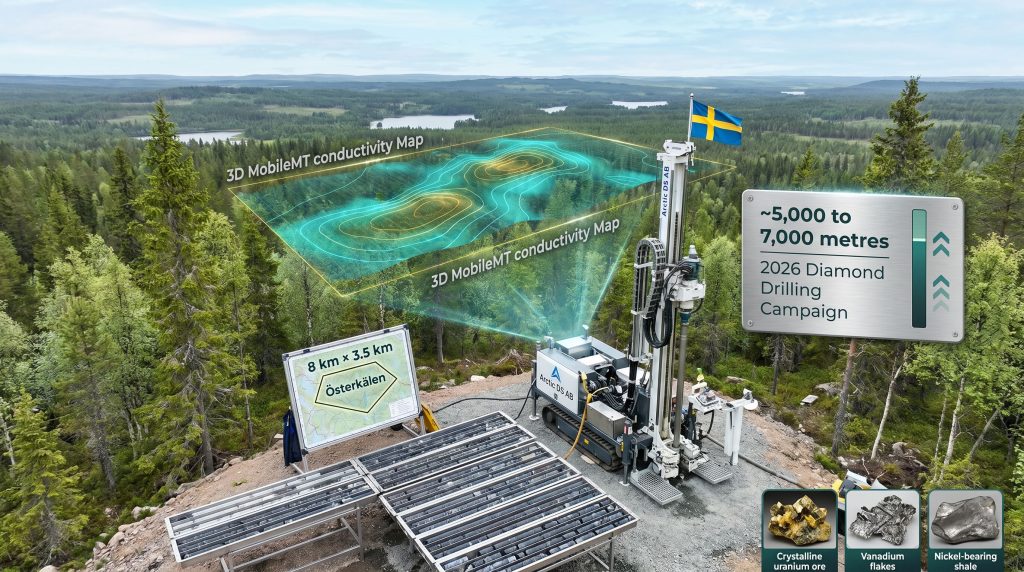
The 2025 MobileMT survey over Österkälen identified a conductive anomaly measuring approximately 8 km in length and up to 3.5 km in width. At those dimensions, the anomaly is consistent with what exploration professionals classify as a district-scale target. Critically, geochemical soil sampling conducted across the same area confirmed that surface geochemical anomalies spatially overlap with the geophysical feature, providing independent verification that the subsurface signal likely reflects genuine mineralised stratigraphy rather than a structural or lithological artefact.
The step-by-step progression from anomaly identification to drill commencement followed a rigorous sequence:
- MobileMT survey completed across the Österkälen licence in 2025, identifying a large conductive anomaly.
- Geochemical soil sampling conducted over the anomaly footprint to assess surface metal dispersal patterns.
- Dataset integration confirmed spatial overlap between geophysical conductivity and geochemical soil anomalies.
- Geological interpretation concluded that the anomaly is most consistent with favourable Alum Shale stratigraphy.
- Work plan and drill permit received on 17 June 2026, completing the regulatory pathway to drilling.
- Diamond drilling commenced with Arctic DS AB, the Swedish subsidiary of Arctic Drilling AS, mobilised to site.
What makes this sequence notable is that no prior drilling has ever been completed at Österkälen. The target is entirely undrilled, meaning the 2026 programme represents a genuine first-pass opportunity at a district-scale anomaly with no historical subsurface data to either anchor or constrain expectations.
The Critical Metals Portfolio Locked Inside Alum Shale Stratigraphy
While uranium anchors the investment thesis, one of the less widely understood characteristics of Swedish Alum Shale exploration is the multi-commodity optionality it carries. The same geochemical processes that concentrate uranium within these sequences also enrich several other metals that have become strategically important in the context of the global energy transition. Indeed, critical minerals demand continues to intensify across Europe, making multi-metal targets like Österkälen increasingly relevant to policymakers and investors alike.
| Metal | Why It Occurs in Alum Shale | Current Strategic Demand Context |
|---|---|---|
| Uranium | Primary target; syngenetic and diagenetic enrichment in organic-rich horizons | Nuclear energy capacity expansions globally; European energy security focus |
| Vanadium | Co-enriched alongside organic matter in reducing depositional environments | Grid-scale vanadium redox flow battery technology scaling rapidly |
| Nickel | Elevated in metalliferous shale intervals through marine chemical precipitation | Central to EV battery cathode chemistry; supply chain concentration risk |
| Potash | Documented in Swedish Cambrian Alum Shale sequences | Global agricultural demand; fertilizer supply chain vulnerabilities exposed post-2022 |
| Molybdenum | Trace to economic concentrations in organic-rich black shales | Steel alloy demand; energy transition infrastructure requirements |
This multi-metal profile means that even a drill programme primarily designed to test uranium potential can return meaningful geochemical data across several commodities simultaneously. From an investor perspective, that optionality can become significant depending on which commodity cycle is dominant at the time results are published. Furthermore, concerns around uranium supply security have sharpened focus on European domestic sources as a credible strategic alternative.
Drilling Methodology: Why the Adaptive Approach Is Scientifically Sound
One of the more technically interesting aspects of District Metals diamond drilling at Österkälen in Sweden is the decision to use an adaptive drilling methodology rather than a pre-determined fixed-hole programme. This approach is worth examining in detail because it reflects sophisticated geological thinking rather than operational uncertainty.
Diamond core drilling was selected as the primary technique because it recovers intact cylindrical rock samples from depth, enabling detailed geological logging, geochemical sampling, and petrographic analysis. Careful attention to geological logging codes is essential at this stage, as standardised logging practices ensure that core data can be reliably interpreted and compared across the programme. In Alum Shale exploration specifically, core recovery quality is critical because the formation can be mechanically weak and may fracture during drilling, potentially compromising sample integrity if less precise methods are used.
The adaptive element of the programme centres on the use of real-time uraniferous radiometric measurements collected downhole during drilling. Scintillometer or downhole gamma logging tools can detect uranium concentrations in situ as the drill string advances, providing immediate feedback on whether the hole is intersecting mineralised intervals before laboratory assay results are available. That real-time signal allows the geological team to make informed decisions about whether to complete a hole to its planned depth, extend it further into mineralised stratigraphy, or redirect capital toward a new hole location that targets a different part of the anomaly.
This is a markedly more capital-efficient approach than committing to a rigid programme of a predetermined number of holes. In greenfield exploration where subsurface geology is genuinely unknown, adaptive methodology allows the drill budget to be concentrated where geological evidence is strongest rather than distributed evenly across a predefined grid.
The combined 2026 drilling budget across the Viken property and Alum Shale Properties including Österkälen is approximately 5,000 to 7,000 metres, a programme scale that is meaningful for a junior exploration company and reflects genuine commitment to advancing these targets within a single field season.
Sweden as a Jurisdiction for Critical Minerals Exploration
The choice to pursue Alum Shale exploration in Sweden rather than in jurisdictions with less developed regulatory infrastructure is not incidental. Sweden possesses a mature mining regulatory framework built on centuries of metal extraction history, a sophisticated geological survey database maintained by the Geological Survey of Sweden (SGU), and a stable political environment within the European Union.
For exploration companies operating at the junior end of the market, jurisdictional risk is often the most underappreciated factor in project valuation. The ability to obtain work plans and drill permits within predictable timeframes, as demonstrated by the approval received on 17 June 2026 at Österkälen, significantly de-risks the operational execution component of an exploration programme.
Sweden also sits within the European Union's regulatory and policy framework, which has increasingly elevated the strategic importance of domestic critical minerals production. The EU Critical Raw Materials Act has classified uranium, vanadium, and nickel among materials requiring strategic supply chain attention, creating a broader policy environment that is broadly supportive of responsible exploration activity in compliant EU member states. However, it is important to note that this represents a general policy tailwind for the sector rather than any project-specific designation or support for District Metals' licences.
The next major ASX story will hit our subscribers first
What Exploration Success at Österkälen Would Mean in Practice
It is worth being precise about what different outcomes from the 2026 drilling programme could mean for the broader Österkälen story. Exploration is inherently uncertain, and no amount of geophysical or geochemical preparation eliminates the fundamental risk that a drill hole may not intersect the mineralisation predicted by surface datasets. Consequently, interpreting drill results with appropriate context will be essential for investors following this programme as data becomes available.
Scenario A: Alum Shale confirmed at depth with elevated uranium and critical metal grades. This outcome would validate the MobileMT interpretation, confirm the multi-dataset anomaly model, and provide the foundation for a resource definition programme across the 8 km by 3.5 km anomaly footprint. It would represent a potentially district-scale discovery adjacent to a deposit already classified as the world's largest undeveloped uranium resource estimate.
Scenario B: Alum Shale confirmed at depth but with sub-economic or variable mineralisation. This outcome would still advance geological understanding of the licence area and could redirect the programme toward higher-grade sub-zones within the anomaly. It would refine rather than close down the exploration hypothesis.
Scenario C: Conductive anomaly explained by alternative lithology rather than Alum Shale. This is the exploration risk scenario that cannot be excluded until drill results are in hand. Even in this case, the multi-dataset integration methodology would be critically evaluated to refine future target selection across the broader Alum Shale Properties portfolio.
For investors, understanding this scenario distribution is essential. First-pass drilling into a genuinely undrilled district-scale anomaly carries binary result risk by definition. The key mitigating factor is that the anomaly's scale, the convergence of multiple independent datasets, and its location within a proven Alum Shale geological corridor all position Österkälen as a high-quality greenfield target by any objective measure.
Key Programme Parameters at a Glance
| Parameter | Detail |
|---|---|
| Licence | Österkälen Mineral Licence, central Sweden |
| Ownership | 100% District Metals (part of Alum Shale Properties) |
| Anomaly Dimensions | ~8 km length x up to 3.5 km width |
| Prior Drill Testing | None, genuine first-pass programme |
| Primary Geophysical Method | MobileMT airborne electromagnetic survey (2025) |
| Supporting Dataset | Geochemical soil anomalies overlapping MobileMT feature |
| Drilling Contractor | Arctic DS AB (Swedish subsidiary of Arctic Drilling AS) |
| Permit Received | 17 June 2026 |
| Drilling Methodology | Adaptive, guided by real-time radiometric measurements |
| 2026 Combined Budget | ~5,000 to 7,000 metres across Viken + Alum Shale Properties |
| Primary Target Metals | Uranium, vanadium, nickel, potash |
Takeaways for Following the Österkälen Programme
Several dimensions of this exploration campaign are worth tracking as results emerge through 2026:
- Whether diamond core drilling confirms Alum Shale stratigraphy at the depths predicted by MobileMT modelling, which would validate the survey technique's application in this geological setting.
- The uranium and critical metal grades returned from initial intercepts relative to the concentrations documented at the Viken deposit, providing the first direct comparison between the two targets.
- How the adaptive methodology influences total metres drilled and hole count, as a higher-than-budgeted programme would signal strong geological encouragement from initial intercepts.
- Whether the geochemical soil anomaly pattern corresponds predictably with downhole assay results, a finding that would refine the exploration model for the remaining untested portions of the Alum Shale Properties.
This article is intended for informational purposes only and does not constitute financial advice. Mineral exploration involves significant risk, and past geological results are not necessarily indicative of future discoveries. Readers should conduct their own due diligence before making investment decisions related to any exploration company or project discussed herein.
Want to Be First When the Next Major Mineral Discovery Hits the ASX?
Discovery Alert's proprietary Discovery IQ model delivers real-time alerts the moment significant ASX mineral discoveries are announced, turning complex geological data into actionable investment insights for both new and experienced investors — explore historic discovery returns on Discovery Alert's dedicated discoveries page to understand what's at stake, then begin your 14-day free trial at Discovery Alert to position yourself ahead of the broader market.