
June 25, 2026
Gravity Separation at Scale: The Engineering Foundations of Chromite and PGM Processing
Across the mineral processing industry, few geological environments test beneficiation technology as rigorously as the layered intrusions of South Africa's Bushveld Igneous Complex. The simultaneous presence of chromite and platinum group metals within the same ore horizons creates a processing challenge that is structurally unlike anything encountered in single-commodity operations. Successfully extracting both commodities from a shared feed stream demands not just capable equipment, but a systems-level understanding of how particle physics, hydrodynamics, and circuit architecture interact under variable ore conditions. It is within this demanding context that the Multotec spirals Thaba JV project deployment offers a compelling case study in applied separation engineering.
When big ASX news breaks, our subscribers know first
What Makes Spiral Concentrators the Preferred Technology for Bushveld Complex Chromite Recovery?
Gravity-based separation has remained the foundational methodology for fine chromite recovery for decades, and the reason is largely physical. Chromite carries a specific gravity of approximately 4.5 g/cm³, compared to the silicate gangue minerals that typically accompany it at around 2.6 to 2.8 g/cm³. This density differential of roughly 1.7 to 1.9 g/cm³ is wide enough that spiral concentrators in mineral processing, which separate particles through centrifugal force, differential settling velocity, and interstitial trickling within a flowing film of water, can achieve high separation efficiency without any chemical reagents.
This reagent-free characteristic is more than an environmental convenience. In the context of integrated chromite and PGM processing, it means the gravity circuit does not introduce chemical contamination that could interfere with downstream flotation circuits used for PGM concentration. The two processes can therefore operate in sequence without chemical conflict, which is a key structural advantage of gravity-first circuit design.
The processing complexity increases substantially when the feed source is not a single, well-characterised ore stream. At the Thaba JV, the plant must treat both freshly mined run-of-mine ore from the opencast Limberg chrome mine and approximately 2 million tonnes of current and historic chrome tailings. These two feed types differ significantly in particle size distribution, liberation characteristics, and mineralogy. Fresh RoM ore typically contains a broader size range with coarser, less degraded particles, while historic tailings are dominated by finer fractions that have already undergone mechanical breakdown during original processing cycles.
Why Particle Size Complexity Demands a Multi-Model Spiral Approach
No single spiral design can handle the full particle size spectrum generated by this dual-source feed system efficiently. Conventional spiral geometries are optimised for specific particle size windows, and performance degrades at the extremes of their operating range. The engineering response is to deploy multiple spiral variants within a staged circuit, each targeted at a defined particle fraction.
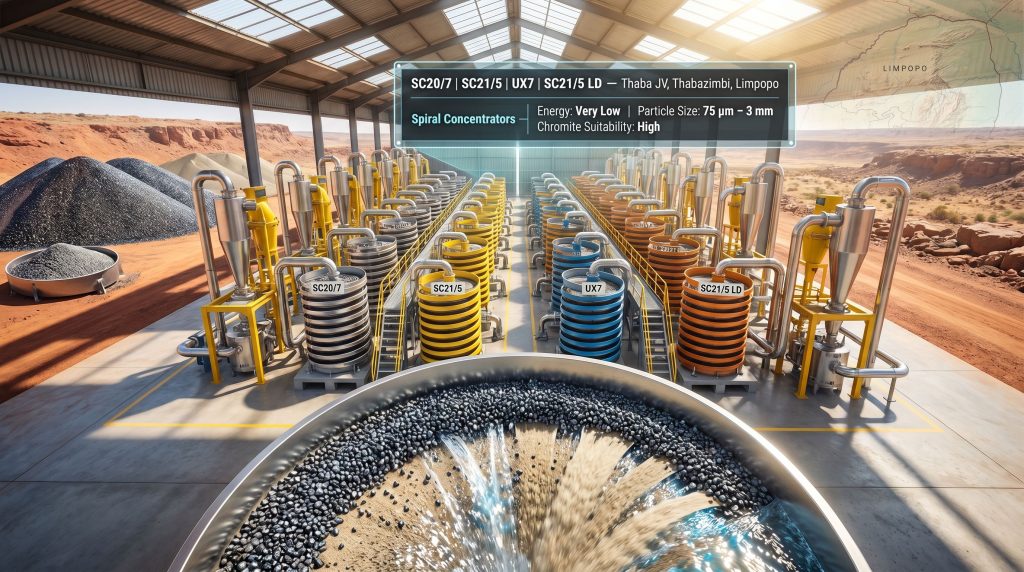
The four spiral models selected for the Thaba JV reflect this logic directly:
| Spiral Model | Classification | Primary Application | Key Performance Characteristic |
|---|---|---|---|
| SC20/7 | Established design | General chromite separation | Robust recovery across standard size fractions |
| SC21/5 | Established design | Intermediate particle recovery | High throughput with consistent grade control |
| UX7 | Next-generation | Ultrafine particle recovery | Engineered for sub-150 micron fractions |
| SC21/5 LD | Next-generation | Cleaning circuit applications | High-capacity design optimised for product upgrading |
The SC20/7 and SC21/5 represent proven workhorses of the chromite processing industry, with established performance records across a wide range of Southern African operations. Their inclusion provides circuit reliability and predictable separation behaviour across the mid-range particle fractions that make up the bulk of RoM feed.
The UX7 and SC21/5 LD, furthermore, address the fractions that older designs handle least effectively. The SC21/5 LD's high-capacity cleaning function is designed to upgrade intermediate-grade material into a saleable concentrate, while the UX7 targets the ultrafine fraction that represents both the greatest recovery challenge and, in tailings-focused operations, the greatest latent value.
The UX7 Spiral and the Ultrafine Recovery Problem
Within the Bushveld Complex chrome processing sector, ultrafine chromite recovery has historically been one of the most persistent sources of value loss. Particles below 150 microns behave differently from coarser fractions in a flowing film: they are more susceptible to entrainment in the water film, less responsive to centrifugal acceleration, and more likely to report to the tailings stream rather than the concentrate.
Technical Note: Historic chrome tailings across the Bushveld Complex frequently contain elevated proportions of ultrafine chromite because mechanical breakage during original processing cycles preferentially fragments chromite grains into fine particles. This material has often been deposited in tailings dams for decades, representing a recoverable resource that was previously uneconomical or technically impractical to treat.
The UX7 addresses this through modifications to the fundamental spiral geometry. Reduced trough pitch lowers the transport velocity of the slurry film, giving fine particles more time to settle and migrate toward the inner concentrate band. Modified trough cross-sectional geometry reshapes the velocity profile within the film, reducing the turbulent outer zone that tends to sweep fine particles into the tailings fraction. Controlled wash water dynamics allow operators to fine-tune the position of the separation boundary without destabilising the flowing film.
These design changes are subtle but consequential. In operations where ultrafine chromite constitutes 10 to 20 percent of the total feed mass, improving recovery in this fraction by even a modest margin translates directly into meaningful increases in concentrate yield and revenue per tonne processed.
Understanding the Thaba JV: Structure, Location, and Processing Architecture
The Thaba JV is structured as a 50:50 partnership between Sylvania Metals, a wholly owned South African subsidiary of Sylvania Platinum, and Limberg Mining Company, a subsidiary of ChromTech Mining. The project is located near Thabazimbi in Limpopo Province, within the northern portion of the Western Limb of the Bushveld Igneous Complex.
This joint venture structure is worth examining from an operational economics perspective. By combining the assets and expertise of a platinum-focused producer with those of an established chrome mining company, the partnership creates an integrated revenue model that neither partner could replicate independently. Sylvania brings PGM processing knowledge and established concentrate sales channels, while ChromTech brings access to the Limberg chrome mine's ore and the commercial relationships needed to market chromite concentrate into ferrochrome and export markets.
The processing plant is designed to produce both chromite concentrate and PGM concentrate from the same ore feed simultaneously. This dual-commodity output architecture improves the economics of the operation significantly. Chromite concentrate provides a relatively stable, volume-driven revenue base, while PGM concentrate adds higher-margin value that is sensitive to price movements across the platinum and palladium markets. The combination reduces commodity-specific revenue risk in a way that single-product operations cannot achieve.
How the Integrated Circuit Produces Two Concentrates from One Feed
The processing sequence begins with gravity separation using the spiral circuit, which targets chromite recovery based on density differential. The chromite-rich heavy fraction reports to the chromite concentrate stream, while the lighter fraction containing silicate minerals and PGM-bearing sulphide particles moves forward to downstream processing.
PGMs in Bushveld Complex ores are typically associated with sulphide minerals including pentlandite, chalcopyrite, and pyrrhotite, which have specific gravities higher than silicates but considerably lower than chromite. This means gravity separation is not an effective primary recovery method for PGMs, but it serves a valuable pre-concentration function by reducing the mass and chromite content of the material that enters flotation circuits, thereby improving flotation efficiency and concentrate quality.
From Equipment Supply to Application Engineering: What Full-Service Spiral Deployment Involves
One of the less visible but critically important aspects of the Multotec spirals Thaba JV project engagement is the distinction between equipment supply and application engineering. Supplying spiral hardware is straightforward. Correctly sizing that hardware, configuring the circuit layout, and calibrating operating parameters to the specific feed characteristics of a given plant is considerably more complex.
Feed characterisation data drives every significant circuit design decision. Considerations such as cut-off grade economics also inform how the circuit is structured to maximise value from variable ore streams. Key parameters include:
- Particle size distribution determines which spiral models are assigned to each circuit stage
- Density and mineralogy data inform separation efficiency predictions and concentrate grade targets
- Volumetric flow rate governs the number of spiral starts required and the piping and launder configuration
- Feed variability between RoM and tailings ore streams sets the operational flexibility requirements for splitter positions and wash water settings
Beyond the initial circuit design, the commissioning phase introduces a further layer of complexity. Feed rate stabilisation, wash water optimisation, splitter position calibration, and product grade verification must all be managed in sequence as the plant transitions from cold commissioning to first ore to steady-state operation.
The Role of Cyclones and Samplers in Supporting Spiral Circuit Performance
Spiral circuits in complex ore environments do not operate in isolation. Upstream desliming and classification are necessary to protect separation efficiency by controlling the particle size distribution entering each spiral stage. Cyclones perform this function by separating slurry into distinct size fractions, ensuring that each spiral operates within its designed size window rather than being exposed to the full, unclassified feed spectrum.
Automated sampling systems provide the real-time process data required to monitor circuit performance continuously. In addition, reliable check sampling methods ensure operators can distinguish between a feed composition change and a circuit performance deviation, making corrective action both faster and more targeted. The interdependency between classification, separation, and sampling means these three technology categories function as a unified system, not as independent pieces of equipment that can be optimised separately.
Why Post-Commissioning Optimisation Is Not Optional in Spiral Circuit Management
A widely underappreciated aspect of spiral circuit operation is that commissioning performance rarely reflects the circuit's true potential. The theoretical recovery capability of a spiral design is established through controlled testwork under stable feed conditions. Actual plant feed is rarely stable, and the transition from testwork conditions to live production introduces variability that requires iterative field adjustment to resolve.
Key Insight: The gap between commissioning performance and optimised steady-state performance in a multi-spiral circuit treating variable feed can represent a significant difference in monthly chromite concentrate output. Operations that invest in structured post-commissioning optimisation programs typically reach stable performance faster and at higher recovery levels than those that treat commissioning as the end of the technology provider's involvement.
The optimisation process for a circuit of this complexity typically involves several iterative phases:
- Baseline performance audit after initial feed introduction to identify circuit sections with recovery deficits
- Splitter repositioning across spiral stages to adjust the mass split between concentrate, middlings, and tailings
- Feed management interventions to stabilise volumetric flow rates and solid concentrations entering each spiral stage
- Wash water adjustment to control the position of the separation boundary in ultrafine and cleaning circuit spirals
- Product grade verification against ferrochrome and export market Cr₂O₃ specifications to confirm commercial acceptability
Chromite concentrate destined for ferrochrome production typically requires Cr₂O₃ content of 42 to 46 percent or higher depending on the smelter's specifications, while export-grade lumpy and fine chrome ore targets vary by destination market. Achieving and maintaining these grades while maximising recovery requires continuous process monitoring and a willingness to adjust circuit parameters as feed conditions change.
The next major ASX story will hit our subscribers first
Gravity Separation vs. Alternative Beneficiation Technologies: A Comparative Perspective
Understanding why spiral concentrators dominate fine chromite processing in Southern Africa requires examining how they compare to the alternatives on the dimensions that matter most in this operating environment.
| Technology | Energy Consumption | Applicable Particle Size | Capital Cost | Chromite Suitability |
|---|---|---|---|---|
| Spiral Concentrators | Very Low | 75 µm to 3 mm | Low to Medium | High |
| Dense Medium Separation | Medium | 0.5 mm to 50 mm | High | High (coarse only) |
| Flotation | High | Below 150 µm | High | Low to Medium |
| Magnetic Separation | Medium | Wide range | Medium | Moderate |
| Shaking Tables | Low | 50 µm to 2 mm | Low | High (fine) |
Dense medium separation is effective for coarse chromite fractions but becomes impractical and uneconomical at fine particle sizes, which are precisely the fractions that dominate tailings feed streams. Flotation is chemically intensive, reagent-dependent, and generates process water streams that require careful management. Shaking tables offer comparable fine-particle performance to spirals but with significantly lower throughput per unit of floor space, making them unsuitable as primary recovery devices at commercial scale.
Spiral concentrators consequently occupy the intersection of the most favourable characteristics: low energy consumption, no chemical reagent requirement, high throughput scalability, and reliable performance across the 75 micron to 3 millimetre size range that covers the majority of chromite processing applications in the Bushveld Complex.
The Broader Strategic Significance of Tailings Retreatment in South Africa's Chrome Sector
The Thaba JV's inclusion of approximately 2 million tonnes of historic chrome tailings in its processing scope reflects a broader trend reshaping the economics of Southern African chrome mining. Decades of conventional chromite processing across the Bushveld Complex have generated substantial tailings deposits that contain recoverable chromite at grades that were previously uneconomical to treat with available technology.
Advances in ultrafine spiral design, combined with improved classification technology, have shifted the economic threshold for tailings retreatment downward. Projects that were marginal under older processing technology assumptions are increasingly viable when assessed against the recovery performance of next-generation spiral designs like the UX7. A thorough definitive feasibility study is therefore essential in confirming whether historic tailings resources meet the revised economic thresholds enabled by these technological improvements.
From a capital efficiency standpoint, tailings retreatment projects also offer advantages over greenfield development. The ore body is already surfaced and accessible, eliminating mining cost and reducing infrastructure requirements substantially. This makes tailings-focused operations attractive in environments where new greenfield capital is constrained or where the environmental permitting burden of fresh mine development is significant. For further context, precious metals market analysis underscores how commodity price dynamics continue to support investment in projects that offer diversified, lower-cost production profiles.
Investors and industry observers should note that projections regarding chromite recovery rates, concentrate grades, and project economics are subject to variation based on actual feed characteristics, market conditions, and operational factors. The figures referenced in this article represent industry benchmarks and technical specifications rather than confirmed operational outcomes for any specific project.
Frequently Asked Questions: Multotec Spirals and the Thaba JV Project
What is the Thaba JV and who are the partners involved?
The Thaba JV is a 50:50 joint venture between Sylvania Metals, a wholly owned South African subsidiary of Sylvania Platinum, and Limberg Mining Company, a subsidiary of ChromTech Mining. The project is located near Thabazimbi in Limpopo Province within the Western Limb of the Bushveld Igneous Complex, and is designed to produce both chromite and PGM concentrates from an integrated processing plant.
What spiral models were supplied to the Thaba JV processing plant?
Multotec supplied four spiral variants to the project: the SC20/7 and SC21/5 as established designs for standard and intermediate particle recovery, the UX7 as a next-generation ultrafine recovery spiral, and the SC21/5 LD as a high-capacity cleaning spiral. Each model serves a specific function within the staged separation circuit.
Why are spiral concentrators preferred for chromite recovery from tailings?
The density differential between chromite (approximately 4.5 g/cm³) and silicate gangue minerals (approximately 2.6 to 2.8 g/cm³) makes gravity-based spiral separation highly effective. Spirals require no chemical reagents, consume minimal energy, and are well-suited to the fine particle sizes that dominate historic tailings deposits.
What is the difference between the UX7 spiral and conventional spiral designs?
The UX7 features reduced trough pitch, modified cross-sectional geometry, and controlled wash water dynamics that together improve separation performance for particles below 150 microns. Standard spiral designs are not optimised for this size fraction and typically produce lower recovery rates when treating ultrafine chromite-bearing feed.
How does the Thaba JV process both chromite and PGMs from the same ore feed?
The plant uses spiral-based gravity separation as the primary chromite recovery stage. The chromite-dense fraction is directed to the chromite concentrate stream, while the lighter fraction containing PGM-bearing sulphide minerals proceeds to downstream concentration processes. This sequential arrangement allows both commodities to be recovered from a single integrated feed without chemical interference between the two separation stages.
What ongoing support does a spiral circuit require after commissioning?
Post-commissioning optimisation involves splitter calibration, feed rate stabilisation, wash water adjustment, and iterative process auditing. On-site application engineering support is required to identify performance deviations and implement corrective adjustments as the Multotec spirals Thaba JV project transitions from initial commissioning to stable, long-term operation.
Want to Stay Ahead of the Next Major ASX Mineral Discovery?
Discovery Alert's proprietary Discovery IQ model delivers real-time alerts on significant ASX mineral discoveries — turning complex mineral data into actionable insights for both short-term traders and long-term investors. Explore how historic discoveries have generated substantial returns on Discovery Alert's dedicated discoveries page, and begin your 14-day free trial today to position yourself ahead of the broader market.