June 23, 2026
The Hidden Cost of Averaged Assumptions in Mining
Every year, mining projects around the world enter production carrying a silent liability: the assumption that ore behaves predictably. Processing plants are designed around composite metallurgical samples, mine plans are built on averaged recovery estimates, and capital is committed based on models that smooth over geological complexity rather than interrogate it. When reality diverges from those averages, the financial consequences compound quickly, through throughput shortfalls, recovery gaps, reagent overconsumption, and costly mid-stream process redesigns.
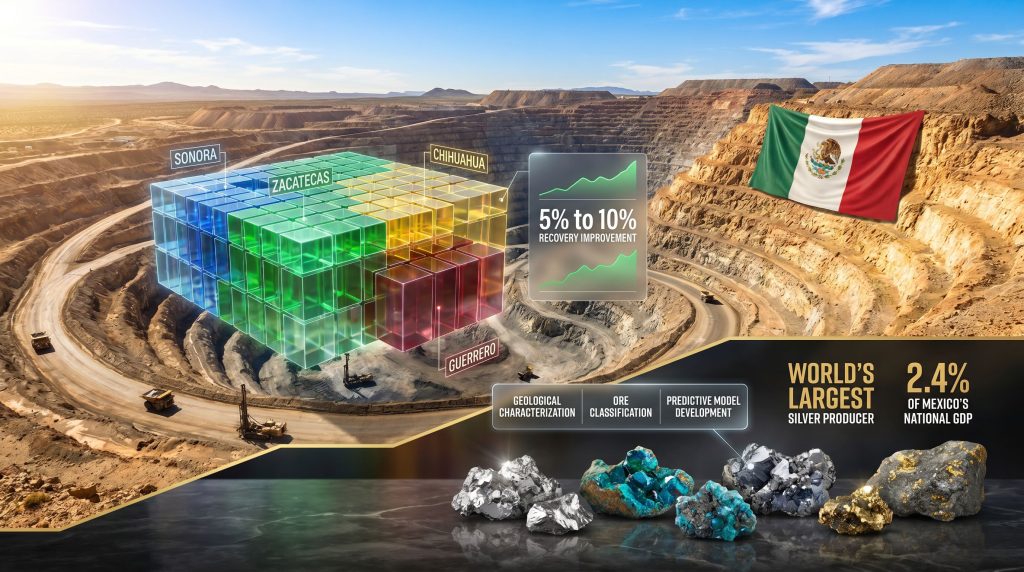
Nowhere is this challenge more acute than in Mexico. The country holds top-tier global positions across 17 distinct mineral commodities, produces more silver than any other nation on earth, ranks second globally in fluorite output, and sits among the leading producers of copper, gold, zinc, and molybdenum. The mining-metallurgical sector contributes approximately 2.4% of Mexico's national GDP, meaning operational inefficiencies at scale carry meaningful macroeconomic weight. Yet the geological character of Mexico's most productive mining belts, polymetallic, structurally complex, and mineralogically heterogeneous, makes averaged ore assumptions particularly dangerous.
This is why geometallurgy in Mexico is rapidly evolving from a specialist technical tool into a sector-wide strategic imperative.
When big ASX news breaks, our subscribers know first
Why Mexico's Orebodies Resist Conventional Characterization
The major producing states of Sonora, Chihuahua, San Luis Potosí, and Zacatecas host deposits that exhibit significant variability in mineralogy, texture, and processing response across relatively short spatial distances. A flotation circuit calibrated to one ore domain may perform poorly when mining advances into an adjacent sulfide assemblage. A comminution circuit sized for moderate hardness ore may bottleneck when it encounters harder lithological units that were underrepresented in composite testwork.
The gap between projected and actual recoveries represents one of the most persistent and underreported sources of capital destruction in Mexican mining. Unlike a geological risk that surfaces during exploration, a metallurgical shortfall typically reveals itself only after capital has been deployed, infrastructure has been built, and the operation is already committed to a process design. At that point, remediation is expensive, and the reputational damage to project credibility with investors can be lasting.
Furthermore, grade versus permitting considerations often distract project teams from the deeper challenge of understanding how ore will actually behave once it enters the processing circuit.
The central challenge in Mexican mining is not resource scarcity. It is the failure to translate geological complexity into actionable operational intelligence before and during production.
What Geometallurgy Actually Does: A Technical Framework
Geometallurgy is an interdisciplinary methodology that systematically links geological characterisation, mineralogical analysis, and metallurgical performance prediction into a unified ore body model. The critical distinction from conventional metallurgical testwork is spatial resolution. Where conventional approaches treat ore as a broadly homogeneous input described by a handful of composite samples, geometallurgy maps ore variability at the block level, in some applications resolving individual ore units as small as 2 cubic metres.
The discipline operates at the intersection of three technical domains:
- Geoscience: Structural geology, lithological mapping, alteration characterisation, and hydrothermal zonation
- Mineralogy: Mineral identification, grain size distribution, liberation analysis, sulfide speciation, and gangue characterisation
- Process Engineering: Comminution behaviour, flotation kinetics, leach response modelling, and reagent consumption prediction
The integration of these three domains is what separates geometallurgy from its component parts. A mineralogical study alone identifies what minerals are present. A metallurgical test alone measures how ore performs. Geometallurgy connects the spatial distribution of mineralogical characteristics to quantitative predictions of processing performance, block by block, across the entire ore body.
The Five-Stage Geometallurgical Workflow
| Stage | Core Activity | Key Deliverable |
|---|---|---|
| 1. Geological Characterisation | Sulfide mapping, host rock classification | Lithological and alteration domain model |
| 2. Ore Type Classification | Texture and mineralogy-based domain definition | Ore type catalogue with processing implications |
| 3. Testwork by Ore Type | Comminution, flotation, and leach testwork | Processing response curves per ore domain |
| 4. Predictive Model Development | Regression analysis, principal component analysis | Recovery and throughput prediction models |
| 5. Geometallurgical Domaining | Spatial ore type mapping onto block model | Optimised mine scheduling and blending strategies |
This workflow contrasts sharply with conventional feasibility study approaches, where a small number of composite samples feed static metallurgical parameters into a single process design. The geometallurgical approach produces a dynamic, variability-aware process design that anticipates how plant performance will evolve as mining progresses through different ore domains. Consequently, teams that invest in interpreting drill results at the earliest possible stage are far better positioned to build accurate geometallurgical domain models.
The Guerrero State Case: From Ore Variability to Operational Recovery
When new ownership assumed control of a polymetallic operation in Guerrero State, the technical team deployed a geometallurgical investigation as its primary diagnostic tool rather than relying on inherited averaged assumptions about ore behaviour.
The study delivered a detailed block-by-block ore characterisation model. That foundational data layer then drove four simultaneous operational interventions:
- Mine plan revision to sequence ore types compatible with the existing plant circuit design
- Comminution circuit blending optimisation to stabilise throughput and reduce specific energy consumption
- Flotation circuit control improvements aligned to the mineralogical variability documented across ore domains
- Reagent dosing recalibration based on anticipated feed mineralogy rather than reactive adjustments to plant measurements
The outcomes were material across multiple metal product streams: recoveries improved by 5% to 10%, and the increased operational confidence supported additional financial commitment from ownership to the project. The resulting geometallurgical block model is now serving as the planning foundation for both plant upgrade programs and sustaining capital allocation decisions.
This case illustrates a frequently overlooked dimension of geometallurgical value. The primary benefit is not simply the recovery improvement itself. It is the restructuring of financial confidence around a project, creating the evidential foundation that enables capital deployment decisions that would otherwise carry unacceptable uncertainty for investors and lenders.
Capital Staging and the Deferral Advantage
One of the less-discussed applications of geometallurgical data in Mexico involves its use as a capital sequencing tool rather than purely a recovery optimisation tool. By identifying which ore domains can be processed through existing infrastructure and which require additional circuit investment, operators can defer capital outlays to periods of stronger operational cash flow.
This staged development approach is particularly valuable in Mexico's current financing environment, where access to development capital for junior and mid-tier operators remains constrained by elevated interest rates and cautious institutional risk appetite. A geometallurgical study that demonstrates a credible phased development pathway can materially improve the bankability of a project by reducing the upfront capital requirement. In addition, a robust definitive feasibility study underpinned by geometallurgical data can shift some expenditure to a point where internal cash generation can fund it.
For larger operators, geometallurgical programs are increasingly being used to build internal technical capability rather than depend exclusively on external consultants. This shift enables continuous ore body model updates, faster operational response to geological variability, and more defensible disclosure in resource reporting to securities regulators.
Technology Is Democratising Access to Geometallurgical Studies
A decade ago, comprehensive geometallurgical programs were largely confined to major mining companies with substantial technical budgets and in-house specialist teams. The economics and logistics made them impractical for junior miners at exploration or pre-feasibility stages. That landscape has shifted considerably.
Several converging technological developments have reduced both the cost and the time required to conduct geometallurgical studies:
- AI-assisted mineralogical classification from drill core imagery and hyperspectral analysis, which automates processes previously requiring extensive manual laboratory work
- Cloud-integrated block model platforms that allow geologists, mine planners, and process engineers across multiple locations to access and update models simultaneously
- Enhanced 3D geological modelling tools that allow non-specialist decision-makers to interrogate ore body variability interactively
- Interoperable systems architecture connecting geological, mine planning, and process simulation software within unified data environments that update in near real time
More powerful computing and the wider adoption of open-source analytical frameworks have further compressed costs. Junior miners operating in Mexico can now commission geometallurgical programs at exploration stage that would have been financially out of reach just a few years earlier. According to ALS Metallurgy, geometallurgical testwork programmes are now structured to deliver both short-term operational value and long-term ore body intelligence, making them accessible across a wider range of project scales.
The next major ASX story will hit our subscribers first
Mexico's Academic and Institutional Infrastructure
The growth of geometallurgy in Mexico is supported by a developing institutional knowledge base that distinguishes it from many Latin American mining jurisdictions. Universidad Nacional Autónoma de México (UNAM), through its Geoscience Centre, has emerged as a primary academic hub for geometallurgical research in the region, with researchers publishing decade-spanning advances in geometallurgical modelling that integrate geology, engineering, and mineralogy. Universidad de Sonora (UNISON) is developing geometallurgy-related coursework calibrated to the operational realities of Sonora's significant copper and gold mining sector.
These academic programs are progressively structured around the full geometallurgical workflow, encompassing geological domain modelling, economic optimisation frameworks, and process engineering principles. The graduates they produce are equipped to work across disciplinary boundaries in ways that earlier generations of mining professionals, trained within more siloed technical curricula, were not.
The Servicio Geológico Mexicano (SGM), with over 75 years of institutional history operating under the Ministry of Economy, generates the national geological-mining information base that underpins geometallurgical studies at the project level. SGM surveys identifying mineralisation patterns, hydrothermal alteration zones, and structural controls provide critical input data for geometallurgical domain definition. The integration of SGM's national geological datasets with project-level geometallurgical models represents a significant opportunity to accelerate early-stage ore characterisation across Mexico's underexplored mineral belts.
Geometallurgy as an Investment Risk Management Framework
From an investor perspective, geometallurgical data fundamentally changes the risk profile of a mining asset by replacing assumption-based financial models with empirically grounded performance projections. The four stakeholder groups that benefit from this shift are distinct but interconnected:
| Stakeholder | Risk Reduced | Value Created |
|---|---|---|
| Mine Owners | Operational surprises from ore variability | Improved cash flow predictability |
| Mine Planners | Suboptimal ore sequencing decisions | Dynamic blending and scheduling capability |
| Process Operators | Reagent overconsumption and recovery shortfalls | Cost-per-tonne reduction and throughput stability |
| Capital Investors | Uncertainty in project economics | Defensible return projections and staged capital commitment |
Projects supported by robust geometallurgical datasets are structurally better positioned to produce credible Preliminary Economic Assessments (PEAs), Pre-Feasibility Studies (PFS), and Feasibility Studies (FS), directly influencing project valuation and the terms on which project finance can be secured. Sophisticated investors who have encountered recovery shortfalls on assets that lacked geometallurgical data are increasingly treating its presence or absence as a material due diligence criterion.
The commodity-specific implications for Mexico are particularly significant:
- Silver operations: Mexico's dominant global position in silver production means even marginal recovery improvements across large-scale operations translate to material revenue impacts when multiplied across high-tonnage production profiles
- Copper operations: The complex sulfide mineralogy characteristic of Sonoran copper deposits makes geometallurgical domaining essential for maintaining consistent concentrate grades and avoiding penalty elements that reduce smelter payabilities
- Polymetallic operations: Multi-metal recovery optimisation requires ore-type-specific process strategies that are achievable only through geometallurgical characterisation, as averaged parameters routinely favour one metal stream at the expense of others
Barriers That Still Constrain Adoption
Despite the compelling case for geometallurgy in Mexico, several structural and organisational barriers continue to slow broader uptake across the sector.
Technical and organisational constraints include:
- Data integration challenges, where geological, geotechnical, and metallurgical datasets are managed in siloed systems that limit integrated model construction
- Sampling program design misalignment, where existing drill programs were designed for resource estimation rather than geometallurgical characterisation and lack the spatial coverage required
- A scarcity of professionals with the interdisciplinary skill set spanning geology, mineralogy, and process engineering needed for geometallurgical practice
- Organisational resistance within operations optimised around existing workflows that are reluctant to implement the process changes geometallurgical findings recommend
Economic barriers for smaller operators include:
- The return on investment from geometallurgical studies is realised across the full project lifecycle, which can conflict with the short-term capital allocation priorities of junior companies managing constrained budgets
- Specialist analytical laboratory infrastructure within Mexico remains geographically concentrated, creating logistical and cost constraints for operators in remote mining districts
- The upfront cost of a comprehensive geometallurgical program, while substantially reduced by technology, still represents a meaningful commitment at early project stages
Furthermore, understanding true widths vs apparent widths in drill results is a foundational competency that must be in place before geometallurgical domain models can be reliably constructed, yet this skill gap persists across parts of the sector.
Frequently Asked Questions About Geometallurgy in Mexico
When should a geometallurgical study be initiated?
Geometallurgical programs deliver the greatest strategic value when initiated during early exploration or pre-feasibility stages, where findings can directly shape project design, capital allocation, and mine planning. However, as the Guerrero State case demonstrates, studies conducted on operating mines can also deliver significant performance improvements and provide the technical foundation for reinvestment decisions.
How does geometallurgy differ from standard metallurgical testwork?
Conventional metallurgical testing evaluates processing behaviour using composite samples representing averaged deposit characteristics. Geometallurgy maps processing behaviour spatially across the entire ore body, connecting specific geological domains to distinct metallurgical responses. This allows mine planners to anticipate how processing performance will evolve as mining progresses through different parts of the deposit.
How does geometallurgy support environmental performance in Mexico?
By optimising reagent consumption, reducing processing inefficiencies, and enabling more precise tailings characterisation, geometallurgical programs can contribute to a reduced environmental footprint and more defensible environmental impact assessments. This is increasingly relevant under Mexico's evolving regulatory framework, including ongoing reforms to the LGEEPA (Ley General del Equilibrio Ecológico y la Protección al Ambiente). Research published by SRK Consulting highlights how geometallurgical data also supports more accurate environmental baseline modelling, which is becoming a critical component of permitting in complex jurisdictions.
The Strategic Trajectory: From Technical Niche to Baseline Expectation
The adoption pattern for geometallurgy in Mexico follows a path observed in more mature mining jurisdictions globally. Major technically sophisticated producers adopt first, mid-tier operators follow as costs decline and specialist workforces deepen, and junior miners eventually integrate geometallurgical programs into standard project evaluation practice as the methodology becomes an industry norm rather than a differentiator.
Mexico's combination of geological diversity, established mining infrastructure, growing academic capability at institutions like UNAM and UNISON, and the SGM's substantial national geological data resources positions it to become a regional leader in geometallurgical practice within Latin America.
The simultaneous maturation of AI-assisted mineralogical analysis, cloud-based modelling platforms, and university-trained specialist workforces is accelerating this trajectory. As ESG-oriented capital increasingly demands demonstrable operational efficiency and environmental performance, geometallurgical capability is transitioning from a competitive advantage to a baseline expectation for investment-grade mining projects.
Key strategic recommendations for Mexico's mining sector:
- Project developers should commission geometallurgical programs at the earliest feasible stage to maximise their influence on design decisions and capital efficiency
- Operating mines should evaluate existing drill core and production data for retrospective geometallurgical domain definition, as significant recoverable value may exist without requiring new drilling programs
- Investors should treat the presence or absence of geometallurgical data as a material due diligence factor, particularly for polymetallic and complex sulfide operations
- Institutions and policymakers should support expansion of geometallurgical laboratory infrastructure and specialist training to build national technical capacity aligned with Mexico's long-term mining sector ambitions
This article is intended for informational purposes only and does not constitute investment advice. Forward-looking statements, recovery estimates, and financial projections referenced herein involve inherent uncertainty. Readers should conduct independent due diligence before making any investment decisions related to the mining sector.
Want to Stay Ahead of the Next Major ASX Mineral Discovery?
Discovery Alert's proprietary Discovery IQ model delivers real-time alerts the moment significant mineral discoveries are announced on the ASX, transforming complex geological data into actionable investment insights for both short-term traders and long-term investors — explore the historic returns major discoveries have generated and begin your 14-day free trial at Discovery Alert to position yourself ahead of the broader market.