
June 23, 2026
The Geological Lottery No Other PGM Producer Has Won
Across the global mining industry, the claim that Sibanye-Stillwater South African platinum assets world's best is merely branding deserves closer scrutiny. In reality, genuinely rare mining portfolios are defined underground first. Furthermore, when geology, mine life, infrastructure and flexibility are assessed together, only a handful of assets remain in contention.
That framework must begin below surface, not in quarterly earnings. When you evaluate platinum group metal assets through reef continuity, geological endowment, processing integration and development optionality at the same time, the field narrows quickly. Consequently, the case becomes far stronger even during a harsh commodity downturn.
Why Geology Comes First in Any Honest PGM Asset Assessment
The Bushveld Complex in South Africa is not simply a large platinum deposit. It is a vast layered igneous intrusion with extraordinary lateral continuity, preserving the Merensky Reef and UG2 chromitite layer across hundreds of kilometres.
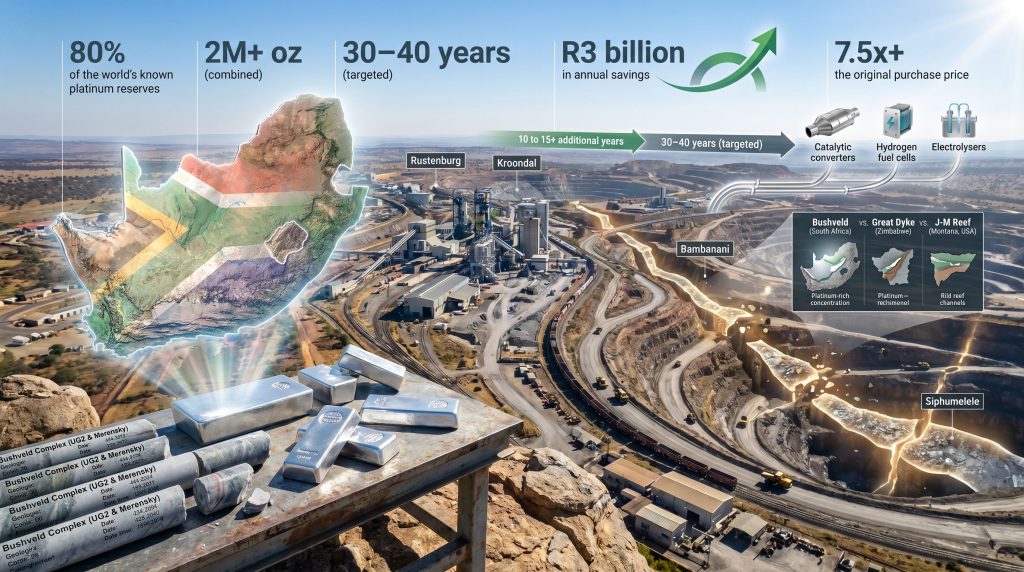
According to the US Geological Survey, the Bushveld holds about 80% of the world's identified platinum reserves. That is not just an impressive statistic. Instead, it means producers with meaningful Bushveld exposure occupy a geological position that rivals cannot easily reproduce.
This advantage is structural rather than temporary. A company cannot simply spend its way into a similar geological endowment elsewhere. In addition, rival formations often suffer from limitations in scale, infrastructure or metal mix.
- Bushveld Complex, South Africa: dominant scale, but exposed to political and operating risk
- Great Dyke, Zimbabwe: significant, though constrained by infrastructure
- J-M Reef, Montana: very high grade, yet limited in scale
- Lac des Iles, Canada: palladium-rich, but relatively modest
The J-M Reef in Montana is often praised for its exceptional grade. However, grade alone does not determine long-term superiority. Processing integration, mine planning flexibility, mature infrastructure and orebody continuity matter just as much over several decades.
That is why the argument for Sibanye-Stillwater South African platinum assets world's best is grounded in far more than headline ounce grades. It rests on the depth and breadth of the Bushveld itself.
Three Mines, One Portfolio: How Contiguous Tenure Creates Compounding Advantages
Sibanye-Stillwater assembled its South African PGM portfolio through three major acquisitions. Each asset came with its own operating history, but together they created a rare belt of connected ground across the western limb.
- Rustenburg operations, acquired from Anglo American Platinum
- Kroondal operations, acquired from Aquarius Platinum
- Marikana operations, acquired from Lonmin
What makes this combination unusual is contiguity. These mines are not scattered holdings. Instead, they share boundaries, creating a connected operating platform rather than isolated assets.
That matters because orebodies do not follow legal property lines. Under fragmented ownership, resources crossing those lines can become stranded. Under unified ownership, those restrictions can be removed, allowing a much more efficient mining plan.
The combined platform produces more than 2 million PGM ounces annually. Moreover, its scale and continuity give the company unusual production flexibility compared with many global peers. This is especially relevant when considering wider platinum and palladium market dynamics.
The Hidden Value Nobody Priced Into the Original Acquisitions
At first, the acquisition logic seemed straightforward: extract synergies, lower costs and streamline operations. That first phase has worked. The integrated business has delivered roughly R3 billion in annual recurring savings.
According to a report by Mining Weekly citing CEO Dr Richard Stewart at the 23 June 2026 Capital Markets Day, the portfolio has generated more than 7.5 times the original acquisition price through synergy realisation alone.
“The original acquisition economics were built on life-of-mine projections and operational synergies. The value embedded in unified mine boundary dissolution was never priced into the transaction.”
That quote captures the deeper point. The first value phase has already been realised. However, the second phase, unlocking historical boundary barriers, is only now becoming visible.
External company disclosures also help frame the scale of the platform. For instance, Sibanye-Stillwater’s 2025 integrated report outlines operational positioning across the group. In addition, the company’s overview of its South African PGM sites provides useful background on the regional asset base.
Mine Boundary Dissolution: The Technical Mechanism Behind Decades of Additional Mine Life
In mining, a sterilised resource is mineralised material that has been identified geologically but cannot be mined economically under existing ownership or infrastructure conditions. Across the western Bushveld, this problem persisted for years at historical property lines.
Once Sibanye-Stillwater gained full ownership of the contiguous portfolio, that obstacle changed materially. Consequently, the company could begin dissolving old mine boundaries and redesigning extraction plans.
Two operations illustrate the benefit clearly:
- Bambanani was once expected to close in about two years. Now, mine life could extend by 10 to 15 years or more.
- Siphumelele faced a similar outlook, but boundary changes are now opening access to previously stranded reef sections.
Importantly, earlier operators had already identified this ore. The issue was never geological ignorance. Rather, it was ownership fragmentation. Under one owner, the economics improve and previously stranded ounces can become viable.
This also ties into broader industry issues around PGM supply constraints. When supply is tight, long-life optionality becomes more valuable.
Benchmarking the Portfolio Against Global PGM Competitors
Against global competitors, the portfolio compares strongly on several dimensions:
- Annual production: more than 2 million ounces
- Formation: the globally dominant Bushveld Complex
- Mine life target: roughly 30 to 40 years
- Boundary dissolution optionality: active and meaningful
- Cross-orebody flexibility: high
By comparison, some rivals may offer larger total output or better grade in individual areas. However, few combine scale, geological continuity and ownership integration in the same way. Therefore, the claim that Sibanye-Stillwater South African platinum assets world's best deserves consideration as a long-duration asset thesis, not a short-term earnings call.
The Demand Uncertainty Variable: Why Optionality Is the Portfolio's True Moat
Any long-term PGM assessment must address demand uncertainty. Most platinum and palladium demand still comes from autocatalysts. Yet the energy transition could reshape that over the next two decades.
Three broad scenarios remain plausible:
- Stable demand, supported by hybrid vehicles
- Moderate decline, driven by faster battery electric uptake
- Upside demand, linked to hydrogen technologies
Because these outcomes remain uncertain, optionality matters more than precise forecasting. A portfolio that can scale and adjust across multiple orebodies is inherently stronger.
Beyond vehicles, platinum demand also has support from:
- green hydrogen systems
- industrial glass applications
- medical and laboratory uses
- investor demand for undervalued mining stocks
Hydrogen is especially relevant. In particular, future PEM technology expansion could support platinum use in electrolysers and fuel cells.
Financial Reality: Separating Cyclical Pressure from Asset Quality
Sibanye-Stillwater has faced severe financial pressure during the recent PGM downturn. The company reported a net loss of roughly $2 billion in 2023, versus profit of about $1.2 billion in 2022. In addition, first-half 2024 recorded an after-tax loss near $379 million.
During parts of 2024 and 2025, both platinum and palladium traded below $1,000 per troy ounce. Dividends were suspended and workforce restructuring followed. These are serious developments.
However, falling prices do not erase ore. They also do not reverse mine life extensions already created by boundary dissolution. Likewise, they do not remove the relevance of cut-off grade economics, which become even more critical in weak price periods.
A commodity cycle measures performance across two to five years. A generational mining asset is evaluated across thirty to forty years.
That distinction is central. Asset quality and market pricing are related, but they are not identical.
Phase Three: What Comes After Synergies and Boundary Dissolution
With synergies already captured and boundary dissolution under way, the next phase is capital allocation within the unified resource base. That means investing into deeper reefs, redesigning development plans and extending infrastructure to support multi-decade output.
This is where the 30 to 40-year mine life target matters most. Longer-duration assets are valued differently by institutional investors because they offer more strategic resilience and greater flexibility across cycles.
If supportive prices return, then the investment case strengthens further. Even so, the underlying geological proposition exists regardless of short-term market sentiment.
Frequently Asked Questions: Sibanye-Stillwater South African PGM Assets
What makes these assets stand out globally?
The key factors are contiguous tenure, unified ownership, more than 2 million ounces of annual production, and meaningful mine life extension through boundary dissolution.
How important is the Bushveld Complex?
It is crucial. With around 80% of identified global platinum reserves, the Bushveld remains the dominant platinum geological setting worldwide.
Why does boundary dissolution matter so much?
Because it converts previously stranded cross-boundary ore into economic mine plans, extending operating life and improving extraction efficiency.
Are the assets profitable today?
Group profitability has been hit by weak PGM prices. However, the geological endowment and strategic optionality remain intact.
Applying the Full Framework: Is the World's Best Designation Justified?
When evaluated across geology, scale, flexibility, cost efficiency and long-term mine life, the label Sibanye-Stillwater South African platinum assets world's best is defensible. It is weakest if judged only on short-term earnings. Yet that is also the narrowest framework.
The stronger view is that cyclical pressure will change, while structural geology will not. The Bushveld will still matter decades from now. The boundary-linked ounces at Bambanani and Siphumelele will still exist. And the R3 billion in annual synergies already achieved remains real.
For long-duration investors, those facts carry more weight than the latest downcycle.
Want To Catch The Next Major ASX Mineral Discovery Before The Market Does?
Discovery Alert's proprietary Discovery IQ model delivers real-time alerts on significant ASX mineral discoveries — cutting through complex data across more than 30 commodities to surface actionable opportunities the moment they are announced. Explore historic discoveries and their exceptional returns, then start your 14-day free trial at Discovery Alert to position yourself ahead of the broader market.