June 22, 2026
The Engineering Limits of Conventional Manganese Processing
Every industrial metal has a processing ceiling, a point where the economics of extraction become structurally unviable for a significant portion of the available resource base. For manganese, that ceiling is arriving faster than the mining industry anticipated. As battery cathode demand for high-purity manganese accelerates and legacy smelting infrastructure strains under carbon compliance costs, the gap between what conventional processing can handle and what the market actually needs has widened considerably.
Understanding why the manganese bioleaching process is attracting serious scientific and commercial attention requires starting not with the technology itself, but with the fundamental limitations it is designed to solve.
The Pyrometallurgical Problem: Energy, Cost, and Ore Quality Constraints
Traditional manganese extraction relies on three core approaches: pyrometallurgical smelting, reductive roasting, and chemical leaching. Each carries a distinct set of economic and environmental burdens.
Smelting is energy-intensive by design, requiring sustained high-temperature environments that generate significant carbon dioxide and sulphur dioxide emissions. Reductive roasting similarly depends on elevated temperatures and reducing agents, typically coal or other carbonaceous materials, which add both cost and carbon liability. Chemical leaching, while operating at lower temperatures, demands substantial volumes of sulphuric acid or other aggressive reagents that create environmental compliance complexity and ongoing reagent procurement costs.
The ore grade constraint is perhaps the most commercially significant limitation. Conventional pyrometallurgical and chemical routes are economically viable only above certain manganese concentration thresholds. As higher-grade deposits are progressively depleted, the growing inventory of low-grade manganese ore and historical mine tailings remains stranded, inaccessible to conventional economics. Furthermore, the critical minerals demand surge anticipated through 2025 and beyond is placing additional pressure on these already strained processing routes.
Manganese is classified as a critical mineral across U.S., EU, and Australian frameworks, essential for lithium-ion battery chemistries including LMFP and NMC cathodes, high-strength steel alloys, and aluminium production. Yet processing innovation has historically lagged well behind the strategic importance of the metal itself.
This is precisely where the manganese bioleaching process enters the equation.
When big ASX news breaks, our subscribers know first
What Is the Manganese Bioleaching Process?
At its core, manganese bioleaching is the use of naturally occurring microorganisms to convert insoluble manganese compounds, primarily manganese dioxide (MnO₂) and manganese carbonate (MnCO₃), into soluble manganese ions (Mn²⁺) that can be recovered through downstream processing.
Unlike copper or gold bioleaching, which have been commercially deployed at scale for decades, manganese presents unique biochemical challenges. Manganese oxides are thermodynamically stable and resistant to straightforward oxidative attack, requiring either acid-mediated dissolution or reductive biochemical pathways to bring the metal into solution.
Two fundamental dissolution mechanisms are available depending on the microbial system deployed:
- Acid-mediated oxidative dissolution — fungi or aerobic bacteria produce organic acids that chemically attack manganese oxide surfaces while complexing dissolved Mn²⁺ in solution to prevent re-precipitation.
- Reductive dissolution — anaerobic or facultatively anaerobic bacteria use manganese oxide as a terminal electron acceptor in their respiratory chain, enzymatically reducing Mn⁴⁺ to soluble Mn²⁺ under low-oxygen or anoxic conditions.
| Parameter | Chemical Leaching | Manganese Bioleaching |
|---|---|---|
| Reagent input | High (acids, reductants) | Low (nutrients, carbon source) |
| Ore grade requirement | Medium to high | Low-grade and tailings viable |
| Operating temperature | Elevated (some processes) | Ambient or near-ambient |
| Carbon footprint | High | Significantly lower |
| Capital intensity | High | Moderate to low |
| Mn²⁺ precipitation risk | Managed chemically | Requires biological pH control |
How the Process Works: A Five-Stage Technical Breakdown
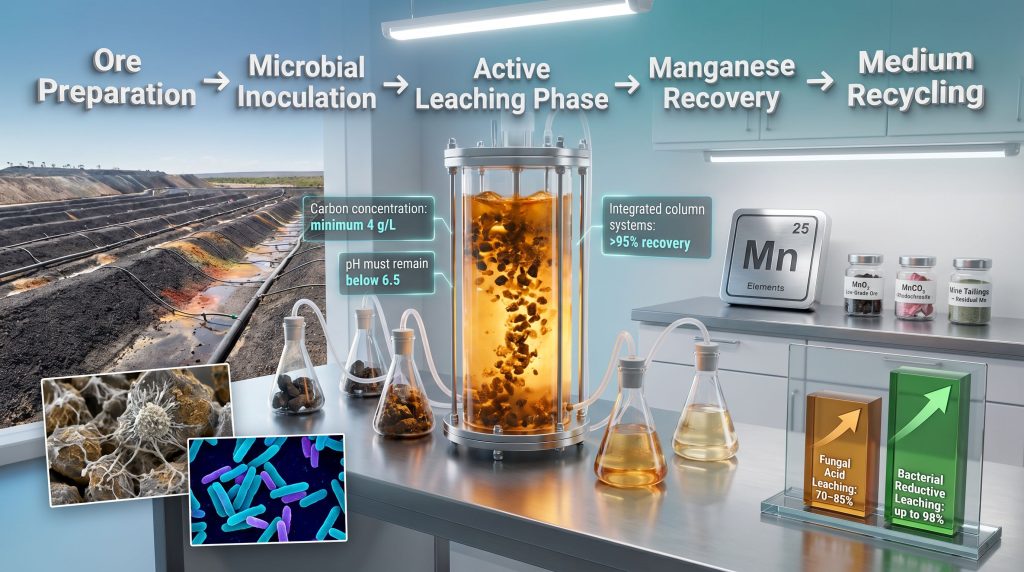
The manganese bioleaching process involves five core operational stages, from initial feed preparation through to metal recovery and medium recycling.
Stage 1 — Feed Preparation
Raw ore or tailings material is sized, classified, and loaded into the selected reactor format, which may be a heap, column, stirred-tank reactor, or laboratory flask depending on operational scale. Crushing, grinding, and moisture adjustment optimise microbial contact surface area and solution permeability through the ore mass.
Stage 2 — Microbial Inoculation and Nutrient Delivery
Microorganism selection depends on the target ore mineralogy and chosen leaching pathway. Nutrient carbon sources are introduced to sustain microbial populations. Options include molasses, cattail-derived organic matter, or synthetic growth media. Two critical operating thresholds govern this stage:
- Carbon concentration must remain above 4 g/L at all times. Below this threshold, microbial activity ceases and manganese solubilisation stops entirely.
- Solution pH must be maintained below 6.5 to support active manganese biosolubilisation. Rising pH dramatically accelerates the precipitation of manganese carbonate, locking dissolved manganese back into an insoluble phase.
Stage 3 — Active Leaching Phase
During the core leaching stage, microorganisms produce acids, organic ligands, or reductive metabolites that convert insoluble manganese minerals into Mn²⁺ ions in solution. The specific biochemistry varies by pathway:
- Acid/oxidative mechanism: Fungal or aerobic bacterial species release organic acids that dissolve manganese oxide surfaces while forming stable Mn²⁺ complexes that remain in solution.
- Reductive mechanism: Dissimilatory metal-reducing bacteria (DMRB) use MnO₂ as a terminal electron acceptor, enzymatically reducing Mn⁴⁺ to Mn²⁺ in a metabolic process that mirrors natural manganese cycling in sedimentary marine environments.
Stage 4 — Manganese Recovery from Solution
Once manganese is in solution as Mn²⁺ within the pregnant leach solution (PLS), several downstream recovery options are available:
- Chemical precipitation as manganese salts
- Oxidative re-precipitation as MnO₂ for direct product formation
- Ion exchange or solvent extraction for high-purity product streams
- Electrowinning for electrolytic manganese metal production
Preventing premature MnCO₃ precipitation within the leach circuit before the recovery stage is a critical operational control point, particularly in reductive systems where elevated bicarbonate activity can rapidly destabilise dissolved manganese. Research into recovering manganese from bioleaching solution highlights several practical approaches to managing this challenge at the circuit level.
Stage 5 — Medium Recycling and Circuit Closure
Spent leach medium is replenished with nutrients and recirculated in a closed-loop design that reduces water consumption, minimises reagent costs, and improves the overall environmental footprint of the operation. Well-optimised column systems operating under closed-loop conditions have demonstrated recovery of more than 95% of biosolubilised manganese from solution.
The Iron Reductant Innovation: A Process Chemistry Breakthrough
The most technically significant recent advance in the manganese bioleaching process involves the use of bio-solubilised iron as an intermediary chemical reductant rather than relying solely on direct microbial reduction of manganese oxide. This approach, detailed in a peer-reviewed paper published in Mining, Metallurgy & Exploration by researchers affiliated with Michigan Technological University, addresses one of the most persistent operational challenges in reductive bioleaching systems: manganese carbonate formation.
The mechanism works as follows. Iron-reducing microorganisms generate soluble ferrous iron (Fe²⁺) through their own respiratory activity. This bio-solubilised Fe²⁺ then acts as a chemical reductant for MnO₂, converting Mn⁴⁺ to Mn²⁺ while Fe²⁺ is oxidised back to Fe³⁺. Iron-reducing bacteria then re-reduce the Fe³⁺ back to Fe²⁺, creating a catalytic iron cycle that continuously drives manganese dissolution without requiring direct bacterial-mineral contact.
This coupled biogeochemical cycle mirrors the natural iron-manganese redox chemistry observed in stratified water columns and marine sediments, where iron and manganese cycling are tightly coupled through microbial mediation. The innovation is essentially borrowing from geochemistry to solve an industrial metallurgical problem.
The practical advantages of this approach are substantial:
- Maintains higher dissolved Mn²⁺ concentrations in solution by suppressing carbonate precipitation
- Enables processing of ore types and mineralogies previously unviable under single-stage direct bioleaching
- Creates a more controllable process chemistry that reduces dependence on tight pH management alone
- The dual-microorganism system provides redundancy, with iron cycling continuing even under conditions where direct manganese reduction may slow
The peer-reviewed paper, titled Leaching of Manganese Using Bio-solubilized Iron Reductant to Prevent Manganese Carbonate Formation, represents independent scientific validation of this approach and is accessible as an open-access publication in Mining, Metallurgy & Exploration (DOI: 10.1007/s42461-026-01506-2). In addition, recent academic research on manganese bioleaching from Michigan Technological University provides further foundational context for this emerging field.
Bacterial vs. Fungal Bioleaching: Comparing the Two Primary Approaches
The choice between bacterial and fungal bioleaching systems involves trade-offs across efficiency, operational complexity, and feedstock suitability.
| Feature | Fungal Bioleaching | Bacterial Bioleaching |
|---|---|---|
| Primary mechanism | Organic acid production and complexation | Reductive dissolution (Mn⁴⁺ to Mn²⁺) |
| Oxygen requirement | Aerobic | Anaerobic or microaerophilic |
| Typical extraction efficiency | 70–85% (ore-dependent) | 80–95% in optimised systems |
| Carbon source | Organic substrates | Biomass-derived organics, molasses |
| Carbonate precipitation risk | Lower | Higher, requires active pH management |
| Scale-up maturity | Laboratory to pilot | Laboratory to pilot (emerging) |
Fungal systems, particularly those employing Aspergillus and Penicillium species, produce citric, oxalic, and gluconic acids that dissolve manganese minerals through acid attack and metal complexation. These systems are generally more tolerant of variable conditions but tend to achieve lower maximum extraction efficiencies than optimised bacterial reductive systems.
Bacterial reductive systems, particularly those employing DMRB such as Shewanella and Geobacter species, can achieve higher extraction yields but require careful redox management to prevent Mn²⁺ re-precipitation. The bio-solubilised iron approach described above substantially reduces this operational sensitivity.
Key Performance Benchmarks
Extraction efficiency across manganese bioleaching systems varies significantly by configuration and optimisation level.
| System Type | Reported Mn Extraction Efficiency | Key Controlling Variable |
|---|---|---|
| Fungal acid leaching | 70–85% | Organic acid yield, pH |
| Bacterial reductive leaching | 80–95% | Redox potential, carbon supply |
| Integrated column (optimised) | Up to 98% solubilisation; >95% recovery | Carbon concentration, pH below 6.5 |
| Bio-solubilised iron-assisted | Emerging — peer-reviewed validation stage | Iron cycling efficiency, carbonate control |
Critical operating parameters and their thresholds can be summarised as follows:
- pH — Must remain below 6.5 for sustained manganese biosolubilisation
- Dissolved carbon — Minimum 4 g/L required; depletion halts microbial activity entirely
- Redox potential (Eh) — Low Eh conditions essential for reductive dissolution; oxidising conditions reverse Mn²⁺ back to insoluble MnO₂
- Temperature — Ambient or near-ambient operation substantially reduces energy costs
- Residence time — Varies by ore grade and reactor configuration; column systems typically require longer contact periods than stirred-tank designs
Process Failure Modes and Their Management
Understanding failure modes is as important as understanding optimal performance parameters, particularly for investors evaluating technical risk in bioleaching ventures.
- Carbon starvation — Managed through automated nutrient dosing systems that maintain dissolved carbon above the 4 g/L threshold at all times
- MnCO₃ precipitation — Controlled through active pH management, CO₂ purging, and real-time solution chemistry monitoring
- Microbial community collapse — Prevented through inoculum maintenance protocols, temperature control, and monitoring for toxic metal accumulation that can inhibit microbial function
- Channelling in heap and column systems — Mitigated through particle size optimisation, irrigation system design, and ore preparation protocols
The next major ASX story will hit our subscribers first
Feedstock Suitability: Why Tailings Are a Strategic Opportunity
One of the most commercially compelling aspects of the manganese bioleaching process is its ability to operate on feedstocks that are fundamentally uneconomic for conventional processing routes. This includes three primary ore types:
- Low-grade manganese oxide ores with MnO₂ as the dominant mineral phase
- Manganese carbonate ores (rhodochrosite, MnCO₃)
- Mixed oxide-carbonate mineralogy
- Historical mine tailings with residual manganese content
Mine tailings represent a particularly attractive feedstock for several converging reasons. No mining cost is incurred since material is already extracted and stockpiled. Environmental liability is converted to economic value through simultaneous remediation and metal recovery. In jurisdictions with legacy manganese operations, projects such as the Butcherbird manganese mine expansion demonstrate the scale of opportunity available when innovative processing approaches are applied to established resource bases.
Beyond manganese, optimised bioleaching circuits have demonstrated the ability to co-mobilise nickel, cobalt, and silver from the same ore matrix, substantially improving project economics and positioning the process within broader critical mineral supply chain considerations. Consequently, the energy transition's role in critical minerals is accelerating interest in exactly these kinds of flexible, low-footprint processing solutions.
Processing Route Comparison: Where Bioleaching Fits
| Processing Route | Energy Use | Reagent Cost | Ore Grade Flexibility | Environmental Impact | Scalability |
|---|---|---|---|---|---|
| Pyrometallurgy (smelting) | Very high | High | Low (high-grade only) | High (CO₂, SO₂) | Proven at scale |
| Acid hydrometallurgy | Moderate | High | Moderate | Moderate-high | Proven at scale |
| Fungal bioleaching | Low | Low-moderate | High | Low | Pilot to demonstration |
| Bacterial reductive bioleaching | Low | Low | High | Low | Laboratory to pilot |
| Bio-iron-assisted bioleaching | Low | Low | High (including tailings) | Very low | Emerging — peer-reviewed |
Bioleaching is not positioned as a wholesale replacement for conventional processing. Its strategic role is to unlock the large-volume, low-grade feedstock tier that conventional methods cannot economically address, effectively converting stranded resources into recoverable reserves. A hybrid flowsheet combining bioleaching pre-treatment with conventional downstream refining — solvent extraction, electrowinning — offers a practical integration pathway for commercial deployment. Furthermore, the economic benefits of decarbonising mining are increasingly relevant here, as bioleaching's lower carbon intensity becomes a financial advantage, not merely an environmental one.
Scale-Up Pathway and Commercial Challenges
The largest remaining gap in manganese bioleaching commercialisation is the transition from laboratory-validated science to engineered commercial operation.
Laboratory Flask → Bench-Scale Column → Pilot Plant (1 t/day)
→ Demonstration Plant (50–500 t/day) → Commercial Operation
A one-ton-per-day pilot plant represents the critical threshold at which process parameters can be validated under realistic engineering conditions, with sufficient throughput to generate the operational and economic data required for commercial investment decisions. Key engineering challenges at scale include:
- Maintaining uniform microbial distribution across large heap or column footprints where permeability variation creates preferential flow channels
- Managing heat generation and temperature gradients that emerge at commercial scale but are absent in laboratory systems
- Ensuring consistent carbon and nutrient delivery across ore masses with variable mineralogy and permeability
- Designing irrigation systems that maintain adequate solution-ore contact time without creating anaerobic dead zones in reductive systems
Intellectual Property and Competitive Positioning
In an emerging technology space where process differentiation is the primary competitive moat, patent protection and peer-reviewed scientific validation carry significant commercial weight. Publication in indexed journals such as Mining, Metallurgy & Exploration provides the independent scientific validation that institutional investors and potential strategic partners require before committing capital.
For companies operating in this space, the combination of patent-pending process protections, university research partnerships, and open-access peer-reviewed publication creates a defensible technical foundation that is difficult for competitors to replicate quickly. Tracking the manganese ore semi-carbonate index is, in addition, increasingly important for companies benchmarking their product economics against prevailing market pricing signals.
What Investors Should Evaluate in Manganese Bioleaching Ventures
Investor Readiness Checklist
- Core process chemistry published in peer-reviewed literature with independent institutional co-authors
- Patent protection filed or granted on critical process steps
- University or research institution collaboration providing independent scientific validation
- Pilot plant design completed or actively under construction (1 t/day minimum)
- Identified feedstock supply through either a defined ore body or a tailings processing agreement
- Downstream commercial pathway mapped through offtake discussions or strategic partnerships
- Regulatory and permitting pathway assessed for the target operating jurisdiction
The commercial outlook for manganese bioleaching is supported by several converging macro drivers. Growth in LMFP cathode chemistry is generating renewed demand for high-purity manganese supply chains. Carbon compliance pressure is increasing the relative cost disadvantage of pyrometallurgical processing. And the growing regulatory and social burden of legacy tailings management is creating economic incentives to deploy value-recovery technologies that simultaneously address environmental liabilities.
The United States currently imports the majority of its manganese requirements from South Africa, Gabon, and Australia. A domestic bioleaching-based processing capability could reduce this import dependency while leveraging existing low-grade domestic deposits previously considered uneconomic, particularly in the context of domestic content requirements emerging from battery supply chain policy frameworks.
Disclaimer: This article is intended for informational and educational purposes only. It does not constitute financial or investment advice. Statements regarding commercial performance, extraction efficiencies, and market projections involve forward-looking elements and should be independently verified. Readers should conduct their own due diligence before making any investment decisions related to companies or technologies discussed herein.
Want to Track the Next Major Manganese or Critical Minerals Discovery Before the Broader Market?
Discovery Alert's proprietary Discovery IQ model delivers real-time alerts the moment significant ASX mineral discoveries are announced, transforming complex geological data into actionable investment insights for both new and experienced investors — start your 14-day free trial today and explore historic discovery returns to understand just how transformative early positioning in critical minerals can be.