June 22, 2026
The Processing Problem That Defines PGM Project Economics
Fine-grained sulphide mineralization has long been one of the most persistent technical obstacles in platinum group metals processing. When target minerals are locked within particles smaller than 100 microns, conventional flotation technology frequently fails to generate adequate bubble-particle attachment, sending recoverable metal to the tailings stream and quietly eroding project economics before a single tonne of concentrate reaches a smelter. The gap between what a deposit contains and what a processing plant can actually recover is, in many cases, the difference between a viable project and a marginal one.
This processing reality sits at the centre of what makes the Jameson Cell at the Luanga project such a technically significant development. Early-stage laboratory results from Bravo Mining Corp.'s Luanga project in Brazil's Carajás Mineral Province have demonstrated that Glencore Technology's Jameson Cell outperforms conventional flotation cells across multiple key metrics, including platinum group metal (PGM) recoveries, nickel recoveries, and mass pull reduction. Understanding why these results matter requires unpacking both the metallurgical mechanics and the project economics they feed into.
When big ASX news breaks, our subscribers know first
Luanga's Mineral Profile and the Carajás Advantage
The Carajás Mineral Province in northern Brazil is one of South America's most geologically productive regions, hosting some of the world's largest iron ore deposits alongside substantial reserves of copper, gold, manganese, and nickel. Bravo Mining's Luanga project sits within this mineralised corridor and hosts a multi-commodity profile spanning platinum, palladium, gold, nickel, and copper. Furthermore, PGM supply constraints globally have elevated the strategic importance of new development assets such as Luanga.
What distinguishes Luanga from many other PGM development assets is the fine-grained nature of its sulphide mineralization. This characteristic creates a technically demanding processing environment but also establishes a clear opportunity: a flotation technology that handles fine particles more effectively than conventional alternatives could unlock materially better metallurgical performance. The project is being evaluated at a potential throughput of 10 million tonnes per year of run-of-mine ore, a scale that amplifies the financial consequences of even incremental recovery improvements.
Luanga has already completed a preliminary economic assessment (PEA) and is advancing toward a prefeasibility study (PFS), with a financial investment decision (FID) further along the horizon. Metallurgical optimisation is therefore a live and consequential workstream, with the findings directly informing PFS process design criteria.
How the Jameson Cell Works Differently from Conventional Flotation
The Mechanics Behind High-Intensity Flotation
In a conventional flotation cell, bubbles are generated through mechanical agitation or spargers, and mineral particles attach to rising bubbles within a relatively low-intensity contact zone. This approach works adequately for coarser particles but struggles when target minerals exist at sub-100-micron sizes, where the probability of a successful bubble-particle collision drops significantly.
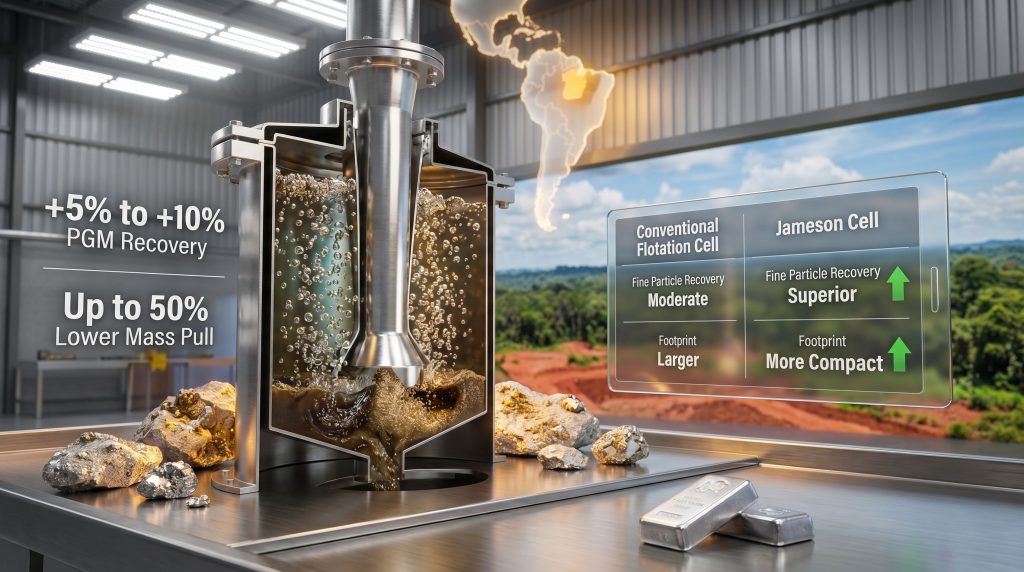
The Jameson Cell, developed and commercialised by Glencore Technology, operates on a fundamentally different principle. A plunging jet of slurry is directed into a vertical downcomer tube, where it entrains air and creates an intensely mixed zone with extremely high bubble-particle contact rates. The downcomer mechanism produces smaller, more uniform bubbles compared with mechanical agitation, and the contact intensity is substantially higher per unit volume of the cell.
This architecture directly addresses the fine-particle recovery problem. When mineralization is fine-grained, as it is at Luanga, the Jameson Cell's high-intensity contact zone generates the collision frequency needed to achieve meaningful bubble-particle attachment where conventional cells fall short. The processing technology benefits observed across comparable fine-grained sulphide ores further support this approach.
Technical Comparison: Jameson Cell vs. Conventional Flotation
| Parameter | Conventional Flotation Cell | Jameson Cell |
|---|---|---|
| Bubble generation method | Mechanical agitation / spargers | Plunging jet / downcomer |
| Fine particle recovery | Moderate | Superior |
| Mass pull | Higher | Up to 50% lower |
| Concentrate grade potential | Lower | Materially higher |
| Equipment footprint | Larger | More compact |
| Mechanical energy input | Higher | Lower |
"The Jameson Cell's downcomer mechanism generates smaller, more uniform bubbles, a critical advantage when processing fine-grained sulphide minerals where conventional agitation-based cells struggle to achieve adequate bubble-particle attachment rates."
What the L150 Test Work Actually Showed
Laboratory Rougher Flotation Results
Testing was conducted using a Jameson L150 test rig at laboratory scale, with the programme configured as a rougher flotation evaluation applied to Luanga's fine-grained ore samples. The results were compared directly against performance benchmarks established using traditional laboratory flotation cells on the same ore type.
The performance improvements recorded across all target metals were meaningful:
| Metal / Parameter | Improvement Recorded |
|---|---|
| PGM recovery (Pt, Pd, Au) | +5% to +10% |
| Nickel recovery | +5% to +30% |
| Mass pull reduction | Up to 50% lower |
| Concentrate grade potential | Materially higher |
The wide range in nickel recovery improvement, between 5% and 30%, reflects variability in how nickel sulphide minerals respond to flotation conditions across different ore samples. Nickel mineralogy can vary within a deposit, and some nickel-bearing phases are more amenable to high-intensity flotation than others. The upper end of that range is commercially significant, particularly given that nickel contributes to overall concentrate value and represents a meaningful revenue stream in its own right.
Understanding Mass Pull and Why a 50% Reduction Changes the Economics
Mass pull is one of the less-discussed but most commercially important metrics in flotation performance. It describes the proportion of total feed material that reports to the concentrate stream. A high mass pull means large volumes of gangue minerals, essentially waste rock, are being collected alongside the valuable metals, diluting the concentrate grade and inflating the costs associated with processing, transporting, and selling that material.
"Reducing mass pull by up to 50% does not simply produce a cleaner concentrate. It fundamentally restructures the cost base of every downstream step in the value chain, from treatment charges at the smelter to shipping costs per payable ounce."
When mass pull is cut by half, several things happen simultaneously:
- Concentrate volumes decrease, reducing shipping and handling costs on a per-tonne basis
- Concentrate grade improves, allowing better payability terms to be negotiated with smelters and refiners
- Smelter treatment charges per unit of payable metal decline because less total mass is being processed
- Tailings volumes per unit of recovered metal decrease, with potential environmental and closure cost benefits
At a planned throughput of 10 million tonnes per year, these compounding effects translate into substantial operating cost differences over a mine life measured in decades.
From Metallurgy to Financial Model: How Recovery Gains Scale Up
The Compounding Effect of Incremental Improvements
A 5% to 10% improvement in PGM recovery might appear modest in isolation, but at 10 million tonnes per year of run-of-mine feed, incremental recovery gains compound into material revenue differences. In a PGM price environment where platinum and palladium dynamics have experienced significant upward pressure through 2025 and into 2026, the revenue leverage from additional recovered ounces is amplified further.
The relationship between flotation recovery, concentrate grade, and net present value (NPV) is non-linear in commodity projects. Higher concentrate grades improve payability ratios, which effectively increase revenue per tonne of concentrate sold. Combined with lower concentrate volumes, the result is a structurally better revenue-to-cost ratio across the project's operating life.
Capital and Operating Cost Implications
Improved unit efficiency in flotation also carries potential CAPEX benefits. If the Jameson Cell requires fewer total cells to process the same throughput volume due to its more compact design and higher contact efficiency, the flotation plant's physical footprint and civil construction requirements could be reduced. Specific potential benefits include:
- Fewer flotation cells required per tonne of throughput, reducing equipment procurement costs
- Simplified plant layout with smaller civil and structural construction scope
- Lower reagent consumption per tonne of concentrate produced, given improved selectivity
- Reduced energy input relative to mechanical agitation-based systems
- Smaller tailings management requirements per unit of recovered metal
These factors collectively support the possibility of both lower capital expenditure and reduced operating costs per ounce of PGM produced, though this remains subject to confirmation through prefeasibility and feasibility-level engineering. Understanding cut-off grade economics is consequently an important parallel workstream as metallurgical data matures.
The Vertically Integrated Scenario
Bravo Mining has disclosed an optional vertically integrated project scenario as part of its broader development planning. Higher-grade concentrates produced through improved flotation selectivity are directly relevant to the economics of this pathway. Vertical integration, which could involve on-site or near-site refining rather than selling concentrate to third-party smelters, becomes more viable when concentrate quality is high enough to support downstream processing at lower volumes.
Improved metallurgical performance therefore does not just affect concentrate sale economics. It potentially alters the strategic optionality available in how the project is ultimately structured and financed.
Proven at Scale: Global Precedents for the Jameson Cell
Large-Scale Operating References
One of the most technically important aspects of the Jameson Cell at the Luanga project evaluation is the technology's established operating history at large-scale mines in directly comparable ore types:
- Mogalakwena PGM Mine, South Africa: Operated by Valterra Resources (formerly Anglo American Platinum), Mogalakwena is one of the world's largest open-pit PGM operations. The Jameson Cell has demonstrated commercial-scale performance at this operation in a PGM sulphide ore context, providing a direct analogue for Luanga's ore type and processing requirements.
- Mt. Isa Copper Mine, Australia: One of the world's most significant underground mining operations, Mt. Isa has applied Jameson Cell technology in a base metals sulphide context over many years, establishing the technology's long-term reliability and scalability credentials.
These precedents are significant because they substantially reduce the technical risk argument against adopting the technology at Luanga's planned scale. The jump from laboratory L150 test rig to a 10-million-tonne-per-year industrial application is a large one, but the existence of operating references at comparable scale in similar ore types means the scale-up pathway is well understood.
From Test Rig to Full-Scale Plant: The Scale-Up Pathway
The typical development pathway for Jameson Cell adoption moves through several defined stages:
- Laboratory scale: L150 test rig rougher flotation characterisation (current stage at Luanga)
- Extended circuit testing: Cleaner circuit, scavenger circuit, and locked-cycle test work to establish full circuit behaviour
- Pilot plant evaluation: Continuous pilot-scale testing to validate scale-up parameters and provide engineering design data
- Process simulation modelling: Circuit configuration optimisation using validated recovery and grade data
- PFS/feasibility integration: Formal adoption of Jameson Cell design criteria into the process plant engineering basis
Luanga is currently at stage one of this pathway, meaning substantial additional work is required before the technology can be confirmed in the PFS flowsheet. However, the direction of early results is clearly positive. A definitive feasibility study will ultimately be required to confirm project economics at bankable confidence levels.
The next major ASX story will hit our subscribers first
What Comes Next in the Metallurgical Programme
The current test work represents the first phase of a multi-stage metallurgical optimisation programme. Moving beyond rougher flotation, the programme is expected to progress through cleaner circuit testing, where rougher concentrates are upgraded to remove remaining gangue minerals, and scavenger circuit assessment, which evaluates how much additional value can be recovered from rougher tailings before final disposal.
Locked-cycle testing, which simulates steady-state continuous plant operation by recycling intermediate streams, will be particularly important in establishing reliable mass balance data for the PFS. The confidence threshold required before Jameson Cell technology can be formally included in PFS process design criteria will likely include completion of locked-cycle work and demonstration of consistent performance across representative ore samples from across the deposit.
"Results from each successive stage of testing will be integrated into updated metallurgical models, progressively refining the economic inputs that feed into Luanga's project valuation and feasibility assessments."
Frequently Asked Questions: Jameson Cell at Luanga Project
What metals does the Luanga project target?
Luanga's commodity profile includes platinum, palladium, and gold as the primary PGM suite, alongside nickel and copper as significant by-products. This multi-commodity structure provides concentrate market optionality and diversifies revenue exposure across several different metal markets.
Why does Luanga's ore type specifically suit the Jameson Cell?
The fine-grained nature of Luanga's sulphide mineralisation creates poor recovery conditions in conventional flotation environments. The Jameson Cell's high-intensity downcomer contact zone addresses this directly by generating the bubble-particle collision frequency needed to recover fine sulphide particles that would otherwise report to tailings.
What is the difference between rougher, cleaner, and scavenger flotation?
- Rougher circuit: Primary flotation stage capturing the bulk of target minerals from the feed slurry, prioritising recovery over grade
- Cleaner circuit: Reprocesses rougher concentrate to remove gangue and upgrade the final product grade
- Scavenger circuit: Treats rougher tailings to recover additional value before final disposal, improving overall circuit recovery
How does a 50% reduction in mass pull affect project economics?
Lower mass pull reduces the total volume of concentrate produced per tonne of ore, which lowers transport costs, improves smelter payability terms, and reduces treatment charges on a per-payable-ounce basis. At a 10-million-tonne-per-year operation, these effects compound into very large cumulative cost differences over a project's operating life.
Where has the Jameson Cell been proven at industrial scale in PGM applications?
The most directly relevant large-scale reference is Valterra's Mogalakwena PGM mine in South Africa, where the technology has demonstrated commercial performance in a PGM sulphide ore context comparable to Luanga's geological setting. Glencore Technology's published results provide further detail on this established performance record.
Key Takeaways for Technical and Investment Stakeholders
The early-stage Jameson Cell at the Luanga project results carry several commercially significant implications that extend beyond the test work itself:
- PGM recoveries improved by 5% to 10% and nickel recoveries by up to 30% compared to conventional flotation cells on the same ore
- Mass pull reduction of up to 50% represents a structural improvement in concentrate economics, affecting every downstream cost and revenue line
- Technology precedent at Mogalakwena and Mt. Isa substantially reduces scale-up risk for a 10-million-tonne-per-year application
- Potential CAPEX and OPEX benefits from a more compact, efficient flotation circuit could improve project economics independently of commodity price movements
- The optional vertical integration pathway is strengthened by higher-grade, lower-volume concentrate production
Metallurgical optimisation of this type represents a value-creation mechanism that operates independently of commodity prices. Whether PGM prices move higher or stabilise, a project that recovers more metal at lower cost per ounce is structurally more resilient and more valuable. The Jameson Cell test work at Luanga is still at an early stage, and investors and technical stakeholders should consequently interpret current results as directionally positive indicators rather than confirmed project parameters, with further validation required through subsequent circuit testing, pilot plant work, and PFS integration.
This article references industry reporting published by Engineering & Mining Journal at e-mj.com. This article does not constitute financial advice. Forward-looking statements regarding project economics, metallurgical performance, and development timelines are subject to technical, market, and operational risks. Readers should conduct their own due diligence before making investment decisions.
Want to Stay Ahead of Significant ASX Mineral Discoveries Before the Broader Market Does?
Discovery Alert's proprietary Discovery IQ model delivers real-time alerts on major ASX mineral discoveries, transforming complex geological and metallurgical data into actionable investment insights for both short-term traders and long-term investors. Explore how historic discoveries have generated extraordinary returns on Discovery Alert's dedicated discoveries page, and start your 14-day free trial today to secure a market-leading edge.