June 21, 2026
How Mineral Resource Estimates Work: The Technical Engine Behind Graphite Deposit Valuation
The global race to secure battery-grade graphite has fundamentally changed how investors, engineers, and policymakers evaluate early-stage graphite projects. Unlike commodity markets driven purely by price, graphite supply chains demand a specific combination of deposit scale, mineralogical quality, and jurisdictional reliability. Understanding how a mineral resource estimate is constructed, and what it actually measures, is the foundation for evaluating the Lac Tétépisca graphite project resource estimate within the broader critical minerals demand landscape.
What a Mineral Resource Estimate Actually Measures
A Mineral Resource Estimate, commonly abbreviated as MRE, is a formally structured quantification of mineralised material that meets defined geological and economic criteria. In Canada, MREs for publicly listed companies must comply with NI 43-101 standards, a regulatory reporting framework administered by the Canadian Securities Administrators. This standard requires an independent Qualified Person to verify all geological data, modelling methodology, and reported figures.
Within an MRE, resources are divided into confidence tiers:
- Indicated resources carry sufficient geological sampling density and spatial continuity to support reasonable assumptions about grade and tonnage. They are considered suitable for inclusion in preliminary economic studies.
- Inferred resources represent mineralised zones where data density is lower, meaning greater geological uncertainty exists. These cannot be used as the primary basis for economic assessments but signal expansion potential.
The distinction matters enormously for project financing. Indicated resources can anchor a Preliminary Economic Assessment (PEA) and eventually support the feasibility study pathway, while Inferred resources represent optionality rather than bankable certainty.
Cut-Off Grades and Pit Constraints: The Economics Built Into the Geology
One of the least understood aspects of an MRE is the cut-off grade, which defines the minimum mineralisation threshold at which material is considered economically viable to mine. For flake graphite deposits, this is expressed as a percentage of graphitic carbon (Cg), the mineralogical measurement that distinguishes crystalline graphite from surrounding rock. Furthermore, understanding cut-off grade economics is essential for contextualising what the reported tonnage figures actually represent.
Key Concept: A lower cut-off grade captures more tonnes but dilutes average grade. A higher cut-off grade produces a higher-grade, smaller resource. Selecting a conservative threshold produces a resource envelope that is defensible under a wider range of market conditions.
The Lac Tétépisca graphite project resource estimate applied a 3.5% Cg cut-off grade, paired with an economic assumption of US$1,200 per tonne for flake graphite concentrate. Industry practitioners generally consider this a conservative selling price assumption relative to historical and current market pricing for large-flake, high-purity graphite concentrate, which has traded materially higher during periods of battery minerals processing demand acceleration.
Using a conservative price floor means the resource boundary is defined under a stress-tested economic scenario, adding credibility to the reported tonnage. The resource is also described as pit-constrained, meaning all reported mineralisation sits within a theoretical open-pit shell where extraction is economically justifiable. Material outside this shell does not qualify under the reasonable prospects for eventual economic extraction requirement of NI 43-101, regardless of grade.
When big ASX news breaks, our subscribers know first
Breaking Down the Updated Lac Tétépisca Graphite Project Resource Estimate
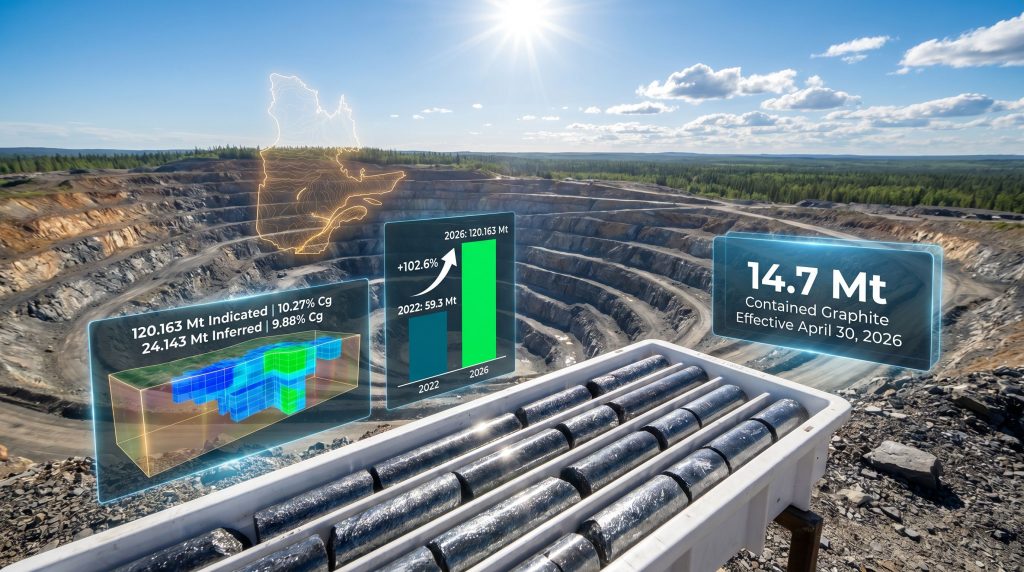
The updated MRE for Lac Tétépisca, effective April 30, 2026, was compiled by IOS Geosciences, a Canadian geological consultancy serving as the independent Qualified Person. The dataset incorporated results from 150 drill holes totalling 26,095 metres, including the 2022 campaign results that were integrated into the revised geological model.
Headline Resource Figures
| Resource Category | Tonnage | Grade (Cg%) | Contained Graphite |
|---|---|---|---|
| Indicated | 120.163 Mt | 10.27% | 12.345 Mt |
| Inferred | 24.143 Mt | 9.88% | 2.386 Mt |
| Combined Total | ~144.3 Mt | ~10.2% avg | ~14.7 Mt |
The combined figure of approximately 14.7 million tonnes of in-situ graphite is the number that commands attention at the global scale. In-situ graphite is the actual mineralised graphite contained within the deposit, distinct from recoverable concentrate volumes that would be determined through metallurgical testing. At the feasibility stage, metallurgical recovery rates, typically ranging from 85% to 95% for well-liberated flake graphite deposits, would determine what proportion of in-situ graphite becomes saleable product.
How the 2026 Numbers Compare to the 2022 Maiden Estimate
| MRE Version | Indicated Tonnage | Indicated Grade | Inferred Tonnage | Inferred Grade |
|---|---|---|---|---|
| 2022 Maiden MRE | 59.3 Mt | 10.61% Cg | 14.9 Mt | 11.06% Cg |
| 2026 Updated MRE | 120.163 Mt | 10.27% Cg | 24.143 Mt | 9.88% Cg |
| Change | +102.6% | -0.34% | +62.0% | -1.18% |
The doubling of Indicated resource tonnage between 2022 and 2026 reflects the cumulative effect of systematic step-out and infill drilling programmes. The marginal grade dilution visible in both categories is a well-understood geological phenomenon: as resource envelopes expand laterally and at depth into peripheral zones, average grade can moderate slightly.
This pattern is consistent across major flake graphite deposits globally and does not indicate deterioration of the deposit's core quality profile. Interpreting drill results correctly is therefore critical when assessing whether grade dilution represents a structural concern or simply reflects normal deposit geometry.
Industry Insight: In graphite resource development, growing the contained graphite figure while maintaining grade above 10% Cg across a deposit exceeding 100 million Indicated tonnes is a combination achieved by very few projects globally. Grade consistency at scale is the harder metric to sustain.
Where Lac Tétépisca Sits in the Global Graphite Deposit Hierarchy
Benchmarking Against World-Class Deposit Criteria
Not all graphite deposits are created equal. The critical minerals sector applies informal but widely recognised criteria to separate Tier-1 deposits from the broader development pipeline:
- Contained graphite exceeding 5 million tonnes
- Average grade above 8% Cg
- Demonstrated metallurgical suitability for spherical purified graphite (SPG) production
- Location in a jurisdiction with established mining codes, infrastructure access, and political stability
Lac Tétépisca satisfies each of these criteria. Its ~14.7 million tonnes of contained graphite at an average grade above 10% Cg places it comfortably within the upper tier of globally identified graphite deposits. For context, the vast majority of graphite projects currently in development carry contained graphite figures below 5 million tonnes, making deposits at this scale genuinely scarce.
The Québec Jurisdictional Advantage
Jurisdiction risk is one of the most consequential variables in critical mineral project valuation, yet it is frequently underweighted by retail investors. Québec consistently ranks among the world's top mining jurisdictions in surveys conducted by the Fraser Institute, owing to its transparent regulatory environment, mature geological survey infrastructure, and competitive energy cost profile anchored by hydroelectric generation.
For a graphite processing operation, energy costs are a material line item. Graphite beneficiation and the downstream production of purified spherical graphite for battery anodes are energy-intensive processes. Access to low-cost, low-carbon hydroelectric power in Québec provides a structural cost advantage compared to operations relying on fossil fuel-derived electricity, while simultaneously strengthening the environmental credentials of the supply chain.
Geographically, Lac Tétépisca sits within reach of major North American manufacturing corridors, including automotive and battery production hubs in Ontario, Michigan, and the broader Great Lakes region. Road access and proximity to rail networks further reduce the infrastructure development burden relative to remote deposit analogues.
The Open-Ended Expansion Case: What the Deposit Geometry Signals
A critical but underappreciated aspect of the Lac Tétépisca graphite project resource estimate is that the deposit remains open along strike to the southwest and at depth. In geological terms, an open deposit is one where mineralisation has not been closed off by drilling, meaning additional resource could be defined through targeted campaigns.
Two distinct value-creation pathways exist from this open geometry:
- Infill drilling between existing drill holes can convert Inferred resources to the higher-confidence Indicated category, directly improving the quality of the resource base for economic studies.
- Step-out drilling along the deposit's southwestern strike extension and at greater depths could materially increase total contained graphite beyond the current 14.7 million tonne figure.
Either pathway, or both in combination, could alter the project's economic profile significantly ahead of a PEA. For investors, the open geometry represents optionality that is not yet captured in the current MRE numbers.
Critical Minerals Supply Chain Context: Why Deposit Scale Matters Now
The China Concentration Problem
Approximately 65% to 70% of global natural graphite production originates from China, and China's dominance extends further downstream into graphite processing and battery anode manufacturing, where its share exceeds 90% according to the International Energy Agency. This structural concentration creates systemic vulnerability for Western battery supply chains, a risk that has become increasingly visible as trade policy and export control frameworks have evolved.
China implemented graphite export licensing controls in late 2023, which served as an early signal to battery manufacturers and automotive companies that securing non-Chinese graphite supply was no longer a theoretical priority but an operational one. Projects in politically stable jurisdictions with the scale to supply meaningful volumes to Western manufacturers are consequently evaluated differently today than they were five years ago.
From Flake to Anode: The Downstream Value Pathway
One aspect of graphite investing that many non-specialist investors miss is the distinction between raw flake graphite concentrate and the battery-ready product that lithium-ion manufacturers actually require. The downstream transformation involves:
- Beneficiation of run-of-mine ore into flake graphite concentrate, typically at 94% to 97% total graphitic carbon (TGC)
- Micronisation to reduce flake particle size
- Spheroidisation to produce spherical graphite (SG)
- Purification via thermal or chemical treatment to produce spherical purified graphite (SPG) at 99.95%+ TGC
Each stage adds value but also requires capital, energy, and technical expertise. Flake size distribution within the original deposit matters at this stage, as coarser flakes generally command premium pricing and offer better economics through the spheroidisation process. Metallurgical characterisation of Lac Tétépisca's flake size profile will be a key output from the upcoming metallurgical optimisation studies.
Development Risks and What Investors Should Understand
The Gap Between an MRE and a Bankable Project
Risk Callout: A Mineral Resource Estimate is a geological statement, not an economic one. It does not confirm that a project can be built profitably, that financing will be available, or that permitting will proceed on schedule. Investors must apply a realistic probability-weighted view to development timelines.
Several technical and economic uncertainties remain material at the current stage of Lac Tétépisca's development:
- The Inferred resource (24.143 Mt) carries inherent geological uncertainty and requires additional drilling before it can be relied upon in economic modelling
- Metallurgical variability across the deposit is not yet fully characterised at the scale required for a PEA
- The US$1,200/t concentrate price assumption used in the pit optimisation is sensitive to market movements, and graphite prices have experienced meaningful volatility over multi-year cycles
- Processing costs, capital expenditure estimates, and infrastructure requirements will not be formally quantified until engineering studies progress toward a PEA
The pathway from the updated MRE to a PEA involves metallurgical optimisation, process flowsheet development, and preliminary engineering work, with the stated objective of completing a PEA within approximately one year.
The next major ASX story will hit our subscribers first
Lac Tétépisca MRE at a Glance
| Parameter | Detail |
|---|---|
| Effective Date | April 30, 2026 |
| Indicated Resource | 120.163 Mt at 10.27% Cg |
| Inferred Resource | 24.143 Mt at 9.88% Cg |
| Total Contained Graphite | ~14.7 million tonnes |
| Cut-Off Grade Applied | 3.5% Cg |
| Price Assumption | US$1,200/t flake concentrate |
| Drill Database | 150 holes / 26,095 metres |
| Independent Compiler | IOS Geosciences (NI 43-101) |
| Resource Status | Open along strike and at depth |
Frequently Asked Questions: Lac Tétépisca Graphite Project Resource Estimate
What is the total resource size of the Lac Tétépisca graphite project?
The updated MRE defines 120.163 million tonnes of Indicated resources grading 10.27% Cg and 24.143 million tonnes of Inferred resources grading 9.88% Cg, with a combined estimated 14.7 million tonnes of in-situ contained graphite, effective April 30, 2026.
Who compiled the Lac Tétépisca mineral resource estimate?
The updated MRE was prepared by IOS Geosciences, a Canadian geological consultancy acting as the independent Qualified Person under NI 43-101 reporting standards.
What cut-off grade was applied and why is it considered conservative?
A 3.5% graphitic carbon cut-off grade was applied alongside a US$1,200/t graphite concentrate selling price assumption. Industry practitioners consider this conservative because large-flake, high-purity graphite concentrate has historically traded above this level during periods of elevated battery sector demand.
How much has the resource grown since the 2022 maiden estimate?
The Indicated resource tonnage has grown by approximately 102.6%, rising from 59.3 Mt in 2022 to 120.163 Mt in 2026, reflecting the results of expanded drilling campaigns. Inferred tonnage grew by approximately 62% over the same period.
Is the deposit open for further expansion?
Yes. The deposit remains open along strike to the southwest and at depth, with both infill and step-out drilling capable of extending the resource boundary and upgrading classification confidence levels ahead of a PEA.
What are the next development milestones?
The development pathway focuses on metallurgical optimisation studies, process flowsheet development, and preliminary engineering work, targeting advancement toward a Preliminary Economic Assessment within approximately one year.
This article contains forward-looking statements and references to mineral resource estimates that are subject to geological, technical, and economic uncertainty. Mineral resource estimates do not guarantee economic extraction and should not be interpreted as confirmed reserves. This content is for informational purposes only and does not constitute financial or investment advice. Readers should conduct their own due diligence and consult qualified financial advisors before making investment decisions.
Want To Be First When the Next Major Graphite Discovery Hits the ASX?
Discovery Alert's proprietary Discovery IQ model instantly scans ASX announcements across 30+ commodities — including critical minerals like graphite — delivering real-time alerts so subscribers can act on significant discoveries before the broader market reacts. Explore how historic mineral discoveries have generated substantial returns on the Discovery Alert discoveries page, then start your 14-day free trial at Discovery Alert to secure your edge in the critical minerals space.