June 18, 2026
The Geological Wager That Keeps Paying Off: Inside ExxonMobil's Next Frontier in Guyana
Few upstream bets in modern petroleum history have delivered returns quite like the Cretaceous turbidite play lurking beneath the deep waters off Guyana's coastline. When the first seismic surveys began painting a picture of what lay beneath the Stabroek Block in the mid-2000s, the resource potential was speculative at best. Today, that speculation has crystallised into one of the most consequential offshore oil provinces on the planet, and ExxonMobil is now moving to extend the story well into the 2030s with a sweeping new campaign of Exxon Guyana exploration wells in the Stabroek Block.
When big ASX news breaks, our subscribers know first
Understanding What Makes the Stabroek Block Geologically Unique
The Stabroek Block's extraordinary productivity is not accidental. It is rooted in a specific set of geological conditions that rarely align so favourably in a single acreage position. The play is anchored in Cretaceous-age deep-water turbidite sequences, which are sedimentary rock formations created by submarine avalanche events that transported organic-rich material from continental margins into deep basinal settings over tens of millions of years.
These turbidite systems serve as both the reservoir rock and, in many cases, the migration pathway for hydrocarbons generated from underlying source rocks. What makes the Stabroek system particularly productive is the combination of:
- High reservoir quality due to coarse-grained, well-sorted sands deposited in stacked channel-lobe complexes
- Robust structural and stratigraphic trapping geometries that have preserved hydrocarbons over geological time
- Excellent seal integrity provided by fine-grained overburden sediments
- Thick net pay intervals that sustain high well productivity rates
This stacking of geological advantages across an enormous acreage position spanning approximately 6.6 million acres helps explain why discovery after discovery has followed from a single contiguous block. The Stabroek Block has now yielded more than 11 billion barrels of oil equivalent in discovered recoverable resources, placing it firmly among the most prolific deepwater acreage positions in petroleum history.
From Exploration Permit to 900,000 Barrels Per Day: The Compressed Development Timeline
ExxonMobil commenced exploration on the Stabroek Block in 2008, a relatively recent entry point when measured against the scale of what has followed. The landmark Liza discovery was announced in 2015, triggering one of the fastest deepwater development sequences ever recorded.
| Milestone | Detail |
|---|---|
| Exploration Commenced | 2008 |
| First Major Discovery (Liza) | 2015 |
| First Oil (Liza Phase 1) | 2019 |
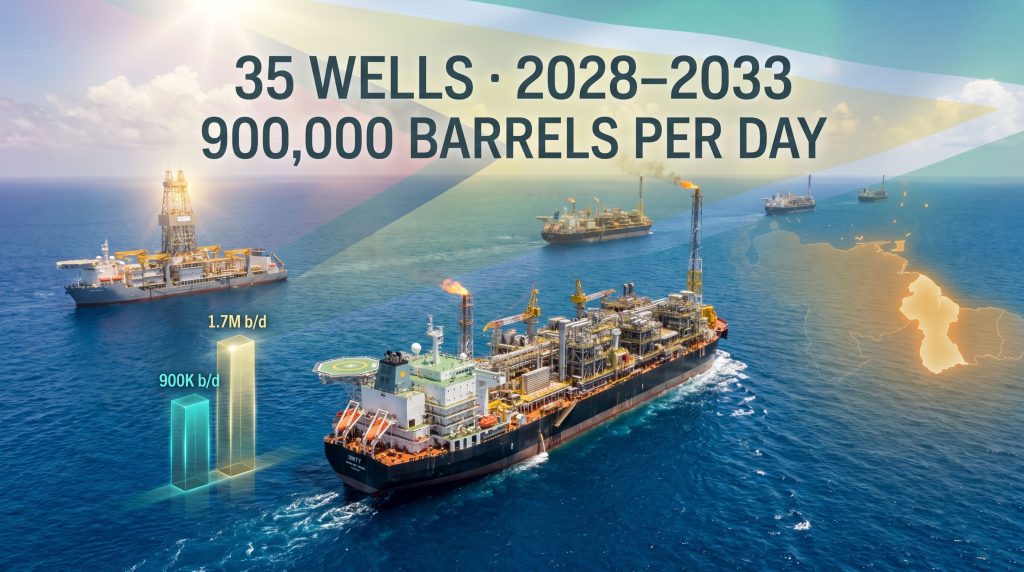
| Current Production Rate (Q1 2026) | Over 900,000 barrels per day |
| Target Production Rate (post-2030) | Approximately 1.7 million barrels per day |
| Total Sanctioned Co-venturer Investment | Over US$60 billion |
| FPSOs Currently Producing | 4 |
| FPSOs Planned by 2030 | 8 (total) |
The pace from discovery to sustained large-scale production compressed a process that historically takes three to four decades into roughly a decade. That compression reflects both the exceptional reservoir quality and ExxonMobil's operational capacity to mobilise capital and infrastructure at scale. Furthermore, understanding the current oil market overview helps contextualise why Guyana's rapid ramp-up has drawn so much global attention from investors and industry analysts alike.
The transition from first exploration permit to nearly one million barrels per day in under two decades represents one of the most accelerated ramp-up cycles in the history of deepwater oil development anywhere in the world.
The 35-Well Campaign: Architecture of a Long-Cycle Exploration Program
ExxonMobil has filed regulatory permits with Guyanese authorities proposing to drill up to 35 exploration and appraisal wells distributed across four distinct prospect areas within the Stabroek Block. If approved, the program is structured to commence in Q2 2028 and run through Q4 2033, representing a five-year continuous exploration window designed to systematically de-risk the block's remaining prospectivity.
The scope of operations covered under the permit filings is notably broad, encompassing far more than simple rotary drilling. The program includes:
- Exploration and appraisal drilling targeting new and partially delineated prospects across all four designated areas
- Vertical seismic profiling (VSP), a specialised technique in which geophones are lowered into the wellbore to record seismic signals from surface sources, producing significantly higher-resolution subsurface images than conventional surface seismic surveys
- Well testing operations to measure reservoir pressure, fluid composition, and flow rates, providing critical data for development planning
- Sidetracking, which involves drilling a new wellbore trajectory from within an existing well to access additional reservoir intervals or bypass mechanical problems
- Plugging and abandonment (P&A) operations to properly decommission wells upon completion
For rig logistics, ExxonMobil has indicated that any of the five drillships currently operating offshore Guyana could be deployed for the new campaign. The absence of a committed rig assignment at this stage is deliberate and consistent with how major operators manage long-lead deepwater programs, preserving scheduling flexibility while regulatory review proceeds. According to ExxonMobil's Guyana project overview, this flexibility is a core feature of how the operator has structured its long-range planning for the block.
The Strategic Logic Behind Extending the Exploration Runway
A question worth interrogating carefully is why ExxonMobil would commit to a five-year, 35-well exploration campaign when the block already holds more than 11 billion barrels of discovered resources and has eight FPSOs either producing or scheduled. The answer lies in the structural economics of long-cycle deepwater development.
Each FPSO vessel that enters service has a productive life measured in decades. The eight vessels targeting 1.7 million barrels per day by 2030 will still be operating well into the 2040s and potentially beyond. To sustain production at scale through that period, the development pipeline must be continuously replenished with new sanctioned projects, which in turn require discovered, appraised, and commercially characterised resources.
The 35-well program is therefore not a response to resource scarcity. It is a forward-loading of the appraisal work necessary to support a third generation of Stabroek development projects that will feed production volumes through the 2040s and potentially the 2050s. This is a fundamentally different strategic calculus than drilling to replace declining output. In addition, oil's global importance means that a sustained Guyanese supply base carries consequences well beyond a single operator's balance sheet.
The Named Discovery Portfolio: Stabroek's Geological Depth
The breadth of the existing discovery inventory illustrates the point. The block currently hosts more than 15 named discoveries, spanning a wide spectrum from mature producing assets to early-stage discoveries still awaiting full appraisal.
| Discovery Name | Current Status |
|---|---|
| Liza | Producing (Phases 1 and 2) |
| Payara | Producing |
| Yellowtail | Under Development |
| Hammerhead | Sanctioned |
| Longtail | FEED Stage |
| Turbot | Discovered |
| Ranger | Discovered |
| Pacora | Discovered |
| Snoek | Discovered |
| Pluma | Discovered |
| Tilapia | Discovered |
| Haimara | Discovered |
| Tripletail | Discovered |
| Mako | Discovered |
| Lau Lau | Discovered |
The substantial number of discoveries that remain in early-stage or unevaluated status reflects the reality that a block of this scale cannot be fully appraised within a single exploration phase. The new 35-well program will progressively work through this inventory while simultaneously testing entirely new prospect areas.
The Venezuela-Guyana Territorial Dispute: A 30% Constraint on Potential
One of the most consequential and least widely understood factors shaping the Stabroek Block's future involves a geopolitical constraint rather than a geological one. Approximately 30% of the Stabroek Block is currently subject to a force majeure declaration, meaning exploration and development activities in that portion of the block are suspended pending resolution of the long-running territorial dispute between Venezuela and Guyana over the Essequibo region.
ExxonMobil's senior vice-president Neil Chapman, addressing the Bernstein 42nd Annual Strategic Decisions Conference, stated that ExxonMobil anticipates resolution of the dispute within approximately a 12-month timeframe, and that the company would follow the direction of the Guyanese government regarding any future activity in the currently restricted zone, according to reporting by Oil & Gas Journal (June 18, 2026).
The significance of this constraint is difficult to overstate from a resource potential perspective. Furthermore, those following oil geopolitics and logistics will recognise that territorial disputes of this nature have historically created both prolonged uncertainty and, when resolved, significant upside for operators positioned within affected acreage. If the force majeure is ultimately lifted:
- A substantial additional acreage position within the same proven geological fairway would become available for exploration
- The same turbidite play system that has already yielded more than 11 billion barrels in the unconstrained 70% of the block would extend into the newly accessible area
- Exploration well locations that were previously legally inaccessible could be incorporated into future drilling programs
- The total discovered and prospective resource base for the Stabroek Block could expand materially beyond current estimates
The unlocking of the remaining 30% of the Stabroek Block would represent the single largest incremental acreage addition to an already proven deepwater play system, with no additional geological risk on the play-level thesis.
This is a speculative but analytically grounded observation. The geological play does not recognise the border. If the same Cretaceous turbidite system extends into the force majeure zone at comparable thickness and quality, the resource addition potential could be substantial, though specific estimates would require seismic and well data not yet publicly available. Meanwhile, Venezuela's power crisis continues to add a further layer of instability to regional energy dynamics that may indirectly influence the pace at which bilateral negotiations advance.
The next major ASX story will hit our subscribers first
A Regional Geological Thesis: From Guyana to Trinidad
ExxonMobil's strategic ambitions in the northern South American offshore extend beyond the Stabroek Block itself. Chapman articulated to the Bernstein audience a coherent regional geological hypothesis: that the Cretaceous turbidite play system responsible for Stabroek's discoveries does not terminate at any national maritime boundary, but instead extends northward through Guyanese waters and potentially into the offshore acreage of Trinidad. ExxonMobil has secured an acreage position offshore Trinidad specifically to test this thesis, according to Oil & Gas Journal.
| Parameter | Stabroek Block (Guyana) | Trinidad Offshore Position |
|---|---|---|
| Exploration Status | Mature, 15-plus named discoveries | Early-stage exploration |
| Geological Basis | Proven Cretaceous turbidite system | Inferred northward extension of same play |
| Production Status | Active, over 900,000 b/d | Pre-production |
| Strategic Value | Core long-term production asset | Long-range exploration optionality |
The Trinidad play concept is speculative but scientifically grounded. Deepwater turbidite systems are known to extend over hundreds of kilometres along continental margin fairways, and the Cretaceous-age systems of the southern Caribbean have produced hydrocarbons elsewhere in the region. Whether the Stabroek-equivalent facies and source rock configuration persist into Trinidad's offshore zone is the central question that exploration drilling will ultimately resolve.
Guyana's Economic Transformation and the FPSO Infrastructure Backbone
The commercial scale of the Stabroek development program has fundamentally restructured Guyana's national economy. The over US$60 billion committed by co-venturers represents one of the largest single-block upstream capital concentrations in modern petroleum history, and the revenue flows from Stabroek production have enabled Guyana to accumulate significant reserves within its Natural Resource Fund. Consequently, tracking global crude shipments out of Guyana has become increasingly relevant to analysts monitoring broader supply balances across Atlantic Basin markets.
The FPSO vessels at the centre of this production system are sophisticated standalone facilities capable of receiving wellstream fluids, processing crude oil and associated gas, storing production, and offloading to shuttle tankers, all without any fixed seabed infrastructure connecting them to shore. Each vessel represents an independent production hub.
The Liza 2 FPSO, one of the four currently producing vessels, carries nameplate processing capacity of approximately 220,000 barrels per day, illustrating the scale of individual units within the fleet. The progression from four operating FPSOs to eight by 2030 is a sequential capacity expansion tied directly to the pace of reservoir appraisal and project sanctioning, making the new Exxon Guyana exploration wells in the Stabroek Block a direct input into the long-term production growth trajectory.
Frequently Asked Questions: Exxon Guyana Exploration Wells in the Stabroek Block
How many wells is ExxonMobil planning to drill in the Stabroek Block?
ExxonMobil has filed permits to drill up to 35 exploration and appraisal wells across four prospect areas within the Stabroek Block, subject to regulatory approval by Guyanese authorities.
When will the new Stabroek drilling campaign begin?
If approved, drilling is scheduled to commence in Q2 2028 and continue through Q4 2033.
What is the current production rate from the Stabroek Block?
As of Q1 2026, the four producing FPSOs on the Stabroek Block were delivering combined output exceeding 900,000 barrels per day.
What is ExxonMobil's production target for Guyana by 2030?
With four additional FPSOs scheduled to enter service by 2030, the combined eight-vessel fleet is targeting approximately 1.7 million barrels per day.
What is the Venezuela-Guyana border dispute's impact on the Stabroek Block?
Approximately 30% of the Stabroek Block is currently under force majeure due to the territorial dispute over the Essequibo region. ExxonMobil has indicated it expects this matter to be resolved within approximately 12 months. The final resolution will be pivotal for the next phase of Exxon Guyana exploration wells in the Stabroek Block.
What is vertical seismic profiling and why does it matter for the new campaign?
Vertical seismic profiling is a well-based geophysical technique in which sensors placed inside the borehole record seismic energy, producing subsurface images of significantly higher resolution than conventional surface seismic methods. In complex deepwater turbidite systems, VSP data is critical for accurately mapping reservoir boundaries and guiding development well placement.
This article contains forward-looking statements, production targets, and resource estimates that are subject to material risks, uncertainties, and regulatory approvals. Readers should not rely on any projections as guarantees of future outcomes. All financial figures, resource estimates, and production targets cited reflect publicly available reporting as of the date of publication. This content does not constitute investment advice.
Want to Track the Next Major Mineral Discovery Before the Market Does?
While ExxonMobil's deepwater campaign unfolds over years, Discovery Alert's proprietary Discovery IQ model delivers real-time alerts the moment significant ASX mineral discoveries are announced — turning complex data across 30-plus commodities into clear, actionable insights for investors at every level. Explore historic discoveries and their remarkable returns to understand the opportunity, then begin your 14-day free trial to position yourself ahead of the broader market.