June 21, 2026
How Biology Is Quietly Rewriting the Rules of Metal Extraction
The global mining industry is facing a paradox. Demand for specialty and critical metals has never been higher, yet the conventional pathways for extracting them are becoming more constrained, more expensive, and more environmentally contentious with each passing decade. Ore grades at established mines are declining. New project development timelines stretch into decades. Regulatory scrutiny over environmental impact continues to intensify. Against this backdrop, researchers are increasingly turning to an unexpected resource: the plant kingdom.
The concept of using leafy vegetables as metal mining tools sits at the frontier of applied geoscience and agricultural biology. It challenges the intuitive assumption that metal extraction requires heavy machinery, explosives, and massive capital expenditure. What emerges instead is a picture of biological precision, where certain plant species perform a form of natural metallurgy that scientists are only beginning to fully understand and harness.
When big ASX news breaks, our subscribers know first
The Supply Problem That Conventional Methods Cannot Fully Solve
The accelerating buildout of semiconductor fabrication plants, next-generation medical imaging systems, and renewable energy infrastructure is creating demand profiles for specialty metals that existing supply chains were never designed to meet. The critical minerals demand driven by these sectors is outpacing what conventional extraction alone can reliably deliver. Metals such as thallium, which plays a critical role in nuclear medicine, infrared optical systems, and certain semiconductor applications, are produced almost entirely as a byproduct of zinc smelting.
This means that thallium supply is fundamentally a function of zinc production decisions, not thallium demand, creating a structural disconnect between market need and available output.
Compounding this is the issue of contaminated land. Worldwide, millions of hectares of former industrial and post-mining terrain contain elevated concentrations of recoverable metals locked within surface soils. These sites are typically classified as environmental liabilities, requiring costly remediation rather than being viewed as low-grade metal inventories. Phytomining offers a conceptual reframe of that relationship, converting legacy pollution into a recoverable resource through biological means.
Phytomining is not a replacement for conventional mining. It is a complementary recovery mechanism particularly suited to contaminated or low-grade sites where traditional extraction is economically or environmentally impractical.
What Phytomining Actually Is: The Biological Mechanism Explained
Hyperaccumulation: Nature's Version of Metal Concentration
At the core of phytomining is a biological phenomenon called hyperaccumulation. Certain plant species have evolved specialised physiological traits that allow them to absorb metal ions from soil through root membrane transport proteins, translocate those metals upward through vascular tissue, and sequester them at concentrations far exceeding those found in ordinary plant species. In some documented cases, hyperaccumulators store metals at concentrations hundreds to thousands of times higher than surrounding vegetation.
The metals do not remain passively dissolved within plant tissue. In some species, they form distinct mineral structures within cellular compartments, a finding that has significant implications for how the recovered material can later be processed. This is not a marginal biochemical curiosity; it is a metallurgical event occurring at a microscopic scale inside leaf tissue.
Why Brassicaceae Vegetables Are Central to Current Research
Species within the Brassicaceae family, a botanical group encompassing familiar vegetables including kale, cabbage, and mustard greens, have been identified as particularly effective hyperaccumulators for specific heavy metals. The practical advantage of working within this plant family is substantial. Cultivation techniques, agronomic management protocols, harvest logistics, and biomass processing infrastructure already exist at commercial scale for these crops.
Researchers do not need to develop entirely new agricultural systems; they need to redirect existing ones toward a new purpose. Furthermore, research from the University of Queensland has placed these findings on a global scientific stage, validating the promise of Brassicaceae species as phytomining candidates.
The Six-Stage Phytomining Process
-
Site Assessment – Contaminated land is analysed to quantify soil metal concentrations, speciation, and bioavailability, determining which metals are present in forms accessible to plant root systems.
-
Species Selection – Hyperaccumulator plant species matched to the target metal and local growing conditions are identified from an expanding scientific database.
-
Cultivation – Selected plants are grown across the contaminated area over one or more growing seasons, progressively drawing metals from the soil into above-ground biomass.
-
Harvest – Above-ground biomass, primarily leaves and shoots, is harvested at peak metal concentration, which varies by species, soil chemistry, and growing conditions.
-
Thermal or Chemical Processing – Harvested plant material is processed through incineration or acid leaching to produce a metal-enriched ash or concentrated solution.
-
Metallurgical Recovery – Conventional metallurgical techniques are applied to the concentrated material to isolate and refine the target metal to marketable purity.
The University of Queensland Discovery That Changes Downstream Processing
Crystallized Thallium Inside Kale Leaves: What Was Found
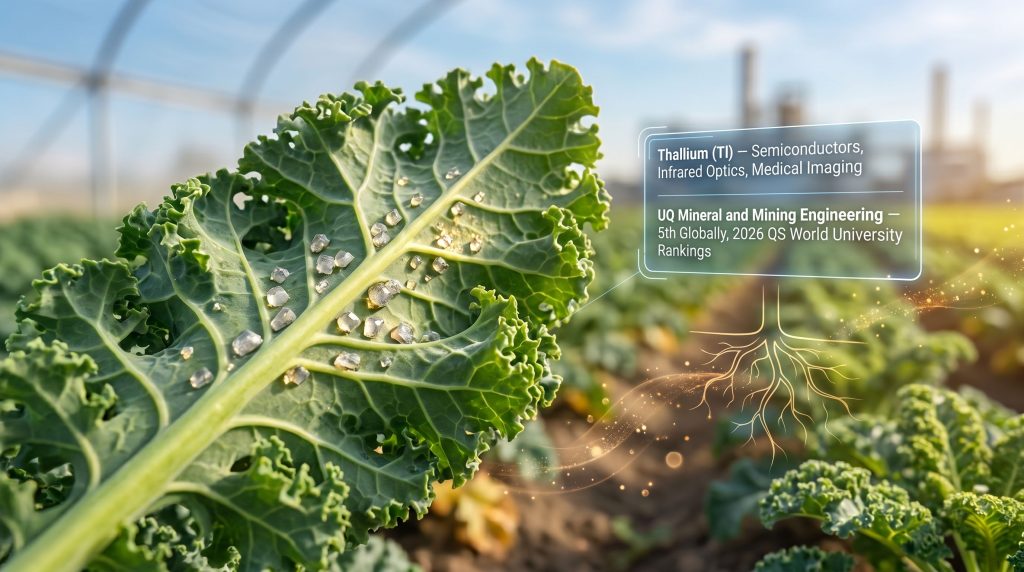
Research conducted through the University of Queensland's Sustainable Minerals Institute produced a finding that fundamentally alters the scientific understanding of how hyperaccumulator plants store certain metals. Kale plants cultivated in thallium-contaminated soil were found to store thallium not in dissolved ionic form dispersed uniformly throughout leaf tissue, but in a crystallised state, with thallium chloride deposits forming specifically along leaf veins.
This is a qualitatively different form of metal storage than researchers had previously documented in most hyperaccumulator studies. The localisation of metal deposits along vein structures creates discrete, high-concentration zones within the plant, rather than a diffuse distribution across bulk tissue.
Why Crystal Form Matters for Metal Recovery Efficiency
From a metallurgical standpoint, the distinction between crystalline and dissolved metal storage is meaningful in practical terms. Moreover, these findings point toward a more targeted and efficient approach to leafy vegetables as metal mining tools than was previously considered feasible:
- Crystalline metal compounds are generally more amenable to targeted physical separation than metals distributed uniformly through organic matter.
- Discrete deposit zones suggest that selective mechanical or chemical extraction methods could be applied to specific plant tissue fractions, rather than requiring whole-biomass incineration.
- Higher selectivity in processing typically translates to improved recovery yields and reduced processing costs per unit of metal recovered.
- This finding opens a research pathway toward optimising growing conditions, including soil chemistry manipulation, irrigation regimes, and harvest timing, to maximise crystalline metal deposition within plant tissue.
The discovery of crystalline thallium chloride deposits along kale leaf veins represents a meaningful advancement in understanding the physical form in which hyperaccumulators store metals, with direct implications for designing more efficient downstream recovery processes.
The Metals Phytomining Can Target
A Comparative View Across Key Hyperaccumulator-Metal Pairs
| Metal | Primary Industrial Applications | Hyperaccumulator Species | Recovery Form |
|---|---|---|---|
| Thallium (Tl) | Semiconductors, infrared optics, nuclear medicine | Kale, cabbage (Brassicaceae) | Crystalline thallium chloride |
| Nickel (Ni) | Battery cathodes, stainless steel, electronics | Alyssum spp., Noccaea spp. | Ionic/organic-bound |
| Zinc (Zn) | Galvanising, electronics, alloys | Thlaspi caerulescens | Ionic |
| Cadmium (Cd) | Batteries, specialty pigments | Thlaspi caerulescens | Ionic |
| Selenium (Se) | Solar cells, semiconductors | Astragalus spp. | Organic selenocompounds |
Thallium's Strategic Position in Critical Mineral Discussions
Thallium occupies a particularly interesting position in the energy transition minerals landscape because its supply is structurally decoupled from its demand. Primary thallium output is driven by zinc smelter production decisions, not by the technology sectors that consume it. This makes thallium supply inherently inelastic in the near term, and any meaningful increase in demand from the medical imaging or infrared optics sectors cannot easily be met by ramping up primary production.
Thallium-201, for instance, is used in nuclear medicine for myocardial perfusion imaging, a diagnostic procedure for evaluating coronary artery disease. Thallium compounds also feature in the production of specialised lenses used in infrared detection systems with defence and industrial sensing applications. The combination of high unit value and structurally constrained supply makes thallium one of the more economically compelling near-term targets for phytomining research.
How Phytomining Compares to Other Extraction Approaches
Method Comparison Across Key Dimensions
| Dimension | Conventional Mining | Phytomining | Urban/E-Waste Mining |
|---|---|---|---|
| Capital Intensity | Very High | Low to Moderate | Moderate to High |
| Environmental Footprint | High | Low to Moderate | Moderate |
| Metal Concentration Required | High-grade ore preferred | Low-grade/contaminated soil viable | Variable |
| Scale of Operation | Industrial | Small to Medium | Industrial |
| Applicable Metals | Broad | Selective | Broad |
| Remediation Co-benefit | None | Yes | None |
| Technology Readiness Level | Mature | Early to Mid Stage | Mid to Mature |
The remediation co-benefit column in this comparison deserves particular attention. No other extraction methodology simultaneously delivers progressive soil cleanup alongside metal recovery. In addition, biological recovery alternatives such as in-situ leaching share some environmental advantages but do not offer the same land rehabilitation outcomes. This dual-value structure has implications for project economics that extend well beyond metal revenue alone.
Remediation contract structures, environmental compliance savings, and emerging carbon credit frameworks could all contribute to a phytomining project's financial case in jurisdictions where such mechanisms exist.
The next major ASX story will hit our subscribers first
The Food Safety Boundary: A Critical Distinction
When Hyperaccumulation Becomes a Hazard
The same biological trait that makes certain leafy vegetables effective as phytomining tools creates a serious food safety risk if the distinction between phytomining crops and food crops is not rigorously maintained.
Critical Caution: Plants cultivated in metal-contaminated soils for phytomining purposes are designed to concentrate toxic metals including thallium, lead, cadmium, and arsenic within edible tissue. These crops are explicitly not for human or animal consumption. Consuming produce from a phytomining operation would pose severe health risks.
Phytomining applications are exclusively non-food industrial use cases. Strict operational protocols separating phytomining crop management from food production systems are not optional; they are fundamental to responsible deployment of this technology. As phytomining scales toward commercial application, regulatory clarity around crop use designation and chain-of-custody for harvested biomass will become increasingly important.
Current Limitations That Researchers Are Working to Overcome
The Technical and Commercial Constraints
| Challenge | Description | Research Status |
|---|---|---|
| Low biomass metal concentrations | Even hyperaccumulators store metals at parts-per-million levels, requiring large land areas and multiple harvest cycles | Active agronomic optimisation |
| Slow extraction rates | Growing seasons limit throughput versus conventional extraction methods | Ongoing research into soil amendment strategies |
| Species specificity | Individual hyperaccumulators target narrow metal ranges | Expanding validated species database |
| Processing infrastructure gaps | Metallurgical methods for plant-derived concentrates require further development | Early-stage R&D, informed by crystalline deposition findings |
| Regulatory uncertainty | Land use, waste classification, and metal recovery regulations vary significantly by jurisdiction | Policy frameworks gradually developing |
Economic viability currently remains highly sensitive to metal prices, the availability of remediation subsidies, and competition from established supply sources. Thallium's comparatively high unit value versus bulk metals like zinc or nickel improves the near-term economic case for phytomining operations targeting this element specifically. However, considerations around natural capital in mining are increasingly informing how project economics are assessed beyond direct metal revenue alone.
Where Academic Research Meets Industry Need
The University of Queensland's Sustainable Minerals Institute brings together geoscientists, plant biologists, metallurgists, and environmental engineers within a collaborative research environment ranked 5th globally in Mineral and Mining Engineering in the 2026 QS World University Rankings by Subject. This interdisciplinary structure is well suited to advancing phytomining from laboratory concept toward field application, because no single discipline contains the full range of expertise the problem requires.
Phytomining also maps closely onto circular economy principles that are gaining traction across the resources sector. It recovers value from a waste stream, contaminated land, rather than drawing on virgin geological resources. Furthermore, mine reclamation strategies are increasingly recognising phytomining as a viable tool for converting remediation obligations into recoverable assets. As ESG criteria increasingly influence capital allocation decisions, low-impact recovery technologies that demonstrate measurable environmental co-benefits are attracting growing institutional research interest.
The near-term research agenda for phytomining centres on several practical priorities:
- Developing soil amendment protocols to increase metal bioavailability and accelerate plant uptake rates without compromising plant health.
- Creating selective metallurgical processing methods specifically designed for crystalline metal deposits within plant tissue, building on the thallium chloride finding.
- Establishing field-scale pilot projects on post-industrial contaminated sites to generate the commercial viability data that laboratory research alone cannot provide.
- Expanding the validated hyperaccumulator species database to broaden the range of metals accessible through plant-based extraction.
Strategic Outlook: Phytomining represents one of several emerging low-impact metal recovery technologies that, if processing efficiencies continue improving and field-scale demonstrations succeed, could meaningfully contribute to diversifying critical mineral supply chains over the coming two to three decades, particularly for specialty metals with structurally constrained primary supply.
The trajectory of this research field will ultimately be shaped by whether crystalline metal storage within plant tissue, as documented in kale under thallium-contaminated conditions, proves to be a generalizable phenomenon across other hyperaccumulator-metal combinations. If it does, the efficiency gains available through selective tissue processing rather than whole-biomass incineration could substantially improve the economics of phytomining across a wider range of target metals. Notably, published peer-reviewed findings support the scientific basis for these efficiency projections, bringing this unconventional approach meaningfully closer to commercial viability.
Frequently Asked Questions: Leafy Vegetables as Metal Mining Tools
Can plants genuinely extract recoverable quantities of metal from soil?
Yes, through the phytomining process, validated hyperaccumulator species have demonstrated the ability to concentrate specific metals from contaminated soils into above-ground biomass at levels sufficient for metallurgical recovery. While commercial-scale deployment remains in early development for most metals, proof-of-concept has been established for thallium, nickel, and zinc, among others. In addition, researchers at Australian universities have been at the forefront of validating these outcomes in real-world conditions.
Which vegetables are being studied for metal extraction?
Species within the Brassicaceae family, including kale and cabbage, are the primary focus of current thallium phytomining research. These plants have demonstrated the capacity to store thallium in crystallised form along leaf veins, a discovery with potentially significant implications for recovery efficiency.
Is it safe to eat vegetables grown on contaminated land for phytomining purposes?
No. Plants grown specifically to accumulate toxic metals are industrial crops, not food crops. Consuming produce from a phytomining operation would expose the consumer to dangerous concentrations of toxic metals. This is an explicitly non-food industrial application.
What makes thallium a priority target for phytomining research?
Thallium's supply is structurally constrained because it is produced almost entirely as a byproduct of zinc smelting. This means supply cannot easily scale to meet growing demand from medical imaging, infrared optics, and semiconductor sectors. Its relatively high unit value also improves the economic case for phytomining recovery compared to bulk base metals.
How does phytomining benefit the environment beyond metal recovery?
Phytomining progressively reduces toxic metal concentrations in contaminated soils through the same process by which it accumulates metals for recovery. This phytoremediation co-benefit means that phytomining projects deliver measurable land rehabilitation outcomes alongside any metal revenue generated.
Disclaimer: This article contains forward-looking assessments of emerging technologies that remain largely at research and pilot scale. Statements regarding commercial viability, economic projections, and future development timelines are speculative in nature and subject to significant uncertainty. Readers should not interpret this content as financial or investment advice.
Want to Invest in the Minerals Powering Tomorrow's Critical Technologies?
Discovery Alert's proprietary Discovery IQ model delivers real-time alerts on significant ASX mineral discoveries — including those tied to the specialty and critical metals reshaping global supply chains — instantly translating complex geological data into actionable investment insights for traders and long-term investors alike. Explore Discovery Alert's discoveries page to understand how historic mineral discoveries have generated substantial market returns, and begin your 14-day free trial today to position yourself ahead of the broader market.