June 18, 2026
The Geology of Ambition: Why Libya's Reservoir Quality Makes Every Well Count
Among the world's oil-producing nations, few present a more striking paradox than Libya. The country sits atop more than 48 billion barrels of proven crude oil reserves, a geological endowment that comfortably positions it as Africa's most reserve-rich petroleum state. Yet for much of the past decade, Libya has produced a fraction of what its subsurface wealth would theoretically allow. Understanding why requires looking beyond barrel counts and into the deeper mechanics of how political architecture, reservoir geology, and institutional capacity interact in one of the world's most volatile petro-states.
It is within this context that well-level production announcements from assets like the Al-Khair oilfield carry weight far exceeding their individual output figures. Each new productive completion is, in effect, a referendum on whether Libya's upstream machinery is capable of sustained, bankable performance.
When big ASX news breaks, our subscribers know first
Libya Al-Khair Oilfield Production: Field Profile and Latest Results
What the Al-Khair Field Actually Represents
The Al-Khair oilfield is an onshore conventional oil asset operated by Sirte Oil Company, a subsidiary of Libya's National Oil Corporation (NOC). Conventional onshore fields of this type in Libya typically tap into the Sirte Basin, one of the most prolific petroleum systems in North Africa. The Sirte Basin's carbonate and sandstone reservoirs have long been recognised for their relatively low lifting costs and high-quality crude characteristics, factors that make rehabilitation economically attractive even after years of disruption.
The field's reserve recovery rate currently stands at approximately 22.19% of total recoverable reserves, which means the substantial majority of Al-Khair's resource base remains in the ground. With a projected operational life extending to approximately 2044, the asset offers a long-dated production runway that is commercially meaningful for any operator or partner evaluating long-term capital allocation.
Breaking Down the Production Numbers
One of the most important distinctions when analysing Libya Al-Khair oilfield production data is the difference between field-level output and individual well completions. Multiple figures circulate across reporting sources, and each represents a different unit of measurement:
| Report Type | Crude Output | Associated Gas | Context |
|---|---|---|---|
| Field-level commencement figure | ~10,000 b/d | Not specified | NOC announcement at production start |
| Latest well (conventional section) | 3,209 b/d | 1.948 MMcf/d | Most recent NOC well-level update |
| AI-assisted horizontal well section | 1,060 b/d | Partial data | Advanced drilling methodology test |
The most recently reported well is producing 3,209 barrels of crude oil per day alongside approximately 1.948 million cubic feet of associated gas daily, according to Reuters. This represents a single completion within a multi-well field, not total field output. The variation across figures reflects genuine differences in drilling methodology, targeted reservoir zones, and completion techniques rather than inconsistencies in reporting.
The Associated Gas Signal: More Than a Byproduct
The 1.948 MMcf/d of associated gas from the latest Al-Khair well is commercially and strategically significant in ways that often go underappreciated in crude-focused analysis. Associated gas volumes are a direct indicator of reservoir pressure and hydrocarbon richness. Fields with robust gas-to-oil ratios tend to maintain reservoir energy for longer, supporting sustained flow rates and extending economically productive well life.
Libya's gas ambitions extend well beyond domestic consumption. Furthermore, the country has been actively pursuing expanded natural gas export capacity into European markets, a strategy that gained urgency following the continent's rapid energy diversification push after 2022. Italy's Eni, which operates existing pipeline infrastructure connecting Libyan gas fields to Southern Europe via the Greenstream pipeline, sits at the centre of this export architecture.
Key Insight: Libya's challenge is not geological scarcity. The country holds Africa's largest proven reserves yet has consistently underproduced relative to its endowment. Al-Khair's well-level results are one data point in a much larger structural story about institutional capacity, not subsurface limitation.
Libya's Reserve Position vs. Its Production Reality
A Structural Gap Decades in the Making
Libya's reserve base of more than 48 billion barrels is not only the largest in Africa but ranks among the top ten globally. The crude quality is also noteworthy: much of Libya's output is classified as light, sweet crude, which commands premium pricing in international markets due to its lower sulfur content and higher yields of refined products like gasoline and jet fuel. This is a meaningful differentiator from heavier, sourer grades produced elsewhere in the region. Monitoring current crude oil prices is therefore especially relevant when assessing Libya's revenue potential.
Despite this geological advantage, actual output has been extraordinarily volatile:
- Output exceeded 1.1 million b/d in 2021 as recovery from earlier disruptions progressed
- Production fell below 700,000 b/d during parts of 2022 amid renewed political tensions
- Further disruptions occurred in 2024 before force majeure was lifted and output stabilised
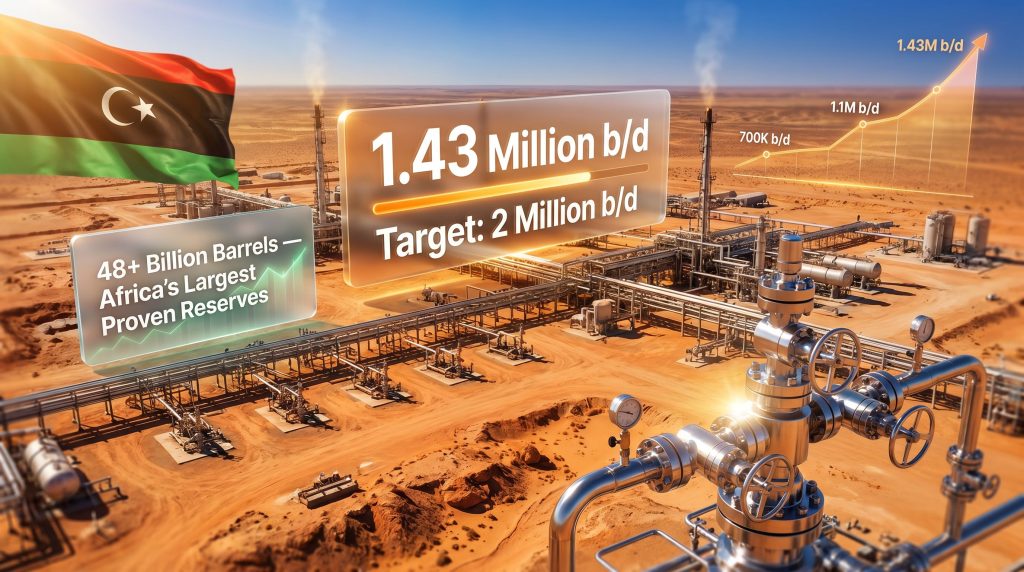
- Libya subsequently recovered to approximately 1.43 million b/d, the highest level recorded in more than a decade, according to NOC Chairman Masoud Suleiman
The delta between Libya's geological potential and its realised output is not a function of reservoir quality. It is a function of a governance environment where competing institutional authorities, physical infrastructure in varying states of disrepair, and recurring security incidents can collapse production within weeks.
Comparing Libya to African Peers
Libya's reserve position relative to other major African producers illustrates the scale of the productivity gap:
| Country | Proven Reserves (Approx.) | Current Production (Approx.) | Reserve-to-Production Ratio |
|---|---|---|---|
| Libya | 48+ billion barrels | ~1.43 million b/d | Very high upside potential |
| Nigeria | ~37 billion barrels | ~1.3-1.5 million b/d | More mature production base |
| Algeria | ~12 billion barrels | ~1.0 million b/d | Closer to reserve-production alignment |
| Angola | ~8 billion barrels | ~1.1 million b/d | Offshore-heavy, capital intensive |
Libya's reserve-to-production ratio implies decades of additional output potential under stable operating conditions, a fact that has not been lost on international energy companies reassessing their North African exposure.
The NOC's 2 Million Barrel-Per-Day Target: How Realistic Is It?
The Three-Pillar Expansion Strategy
Libya's National Oil Corporation has publicly committed to scaling national production to 2 million barrels per day, a target that would represent a 40% increase from the current output level of approximately 1.43 million b/d. Closing that gap of roughly 570,000 b/d requires execution across three strategic pillars simultaneously:
- New exploration drilling across underdeveloped acreage, including blocks that have seen minimal modern seismic and drilling activity
- Field rehabilitation programmes targeting legacy assets whose infrastructure was damaged or neglected during years of conflict
- Foreign direct investment secured through international licensing rounds and joint venture structures that bring both capital and technical expertise
The 2025 Licensing Round: An 18-Year Gap Closes
In early 2025, Libya launched its first oil and gas licensing round since 2007, ending an 18-year hiatus that reflected the full depth of sector disruption following the 2011 uprising. The round attracted a notably diverse consortium of international players:
- Chevron (United States)
- Eni (Italy)
- QatarEnergy (Qatar)
- Repsol (Spain)
- Aiteo (Nigeria)
The geographic breadth of this group is strategically meaningful. Western supermajors, Gulf state NOCs, and African energy companies have all signalled a willingness to accept Libya's risk profile at current terms. That consensus view represents a significant shift in international capital's posture toward Libyan upstream investment.
Scenario Modelling: Pathways to 2 Million b/d
| Scenario | Assumed Annual Growth Rate | Timeline to 2 Million b/d |
|---|---|---|
| Conservative (political disruptions persist) | 3-5% per annum | 2031-2034 |
| Base Case (current momentum sustained) | 7-9% per annum | 2028-2030 |
| Optimistic (full IOC investment and stability) | 12-15% per annum | 2026-2027 |
Disclaimer: These scenarios are illustrative projections based on current production trajectories and historical growth rates. They should not be interpreted as forecasts or investment advice. Force majeure risk remains the single largest variable in any production modelling exercise for Libya.
Operational Risks That Could Derail Libya's Recovery
Political Fragmentation as a Structural Production Hazard
Libya's dual-government structure, with competing authorities in Tripoli and the east of the country, creates persistent uncertainty over NOC operational authority, revenue distribution arrangements, and the enforceability of contracts signed under one administration but potentially disputed by another. This is not an abstract institutional concern. It has translated into physical production blockades that have caused output to collapse within weeks on multiple occasions since 2011.
The 2024 disruption episode, before force majeure was eventually lifted and production resumed, serves as a recent case study in how rapidly operational gains can be reversed. International buyers and project financiers increasingly price this risk into their commercial modelling, and the broader oil price shock dynamics of 2025 have only reinforced the importance of supply reliability in long-term contracting decisions.
Infrastructure Deficit: The Hidden Constraint
Beyond political risk, Libya faces a substantial infrastructure rehabilitation challenge that is frequently underweighted in production target discussions. Decades of underinvestment, compounded by conflict damage to pipeline networks, processing facilities, and export terminals, have created a physical capacity ceiling that cannot be resolved through drilling activity alone.
The gap between announcing new licensing deals and achieving actual incremental production is often measured in years rather than months, largely because the surface infrastructure required to process and export new volumes must be rebuilt or upgraded in parallel with subsurface development.
Force Majeure as Libya's Recurring Wildcard
Risk Callout: For global energy markets, Libya's production figures should always be assessed alongside a force majeure risk premium. The country's reserve base is world-class; its operational reliability has not yet matched that geological quality.
Libya has declared force majeure on oil exports multiple times since 2011. Each declaration triggers immediate output disruption, creates uncertainty for downstream buyers, and incrementally damages Libya's credibility as a reliable long-term supply source. Consequently, international offtake negotiations increasingly incorporate explicit force majeure probability assumptions, which effectively discount the commercial value of Libyan supply commitments relative to more stable producers. The broader context of sanctions on oil trade affecting competing producers has, however, partially offset this reputational disadvantage by tightening global supply alternatives.
Libya's Strategic Position in European Energy Markets
Geographic Proximity as a Structural Advantage
Libya's geographic position relative to Southern Europe is a frequently underappreciated commercial asset. Short Mediterranean shipping routes and existing pipeline infrastructure, including the Greenstream gas pipeline connecting Libya to Italy, give Libyan hydrocarbons a structural cost and logistics advantage over supply from the Middle East or further afield.
As European energy policy has accelerated its focus on supply diversification since 2022, Libya's proximity and existing infrastructure have moved it up the priority list for energy security planners in Rome, Madrid, and Brussels. Eni's deeply embedded presence in Libya's upstream sector positions the Italian major as the most direct conduit between Libyan production growth and European consumption. For a broader view of how these dynamics interact with oil geopolitics analysis across the Mediterranean region, the interplay between supply politics and pricing signals has rarely been more consequential.
What Market Participants Should Monitor
For analysts and investors tracking Libya Al-Khair oilfield production as part of a broader view on Libyan upstream momentum, the following indicators provide the most actionable signals:
- Monthly NOC production updates as leading indicators of field-level and national output trends
- Force majeure declarations as immediate red flags requiring reassessment of supply assumptions
- Licensing round capital deployment timelines from Chevron, Eni, QatarEnergy, Repsol, and Aiteo as medium-term indicators of committed upstream investment
- European gas import data from Libya as a proxy for infrastructure progress on the gas monetisation side of the recovery thesis
In addition, tracking WTI and Brent futures provides an essential pricing backdrop against which Libyan production economics must be evaluated, particularly as the NOC pursues its ambitious expansion targets.
The next major ASX story will hit our subscribers first
Key Data Summary: Libya Al-Khair Oilfield and National Production
| Metric | Data Point |
|---|---|
| Libya proven oil reserves | 48+ billion barrels (largest in Africa) |
| Al-Khair reserve recovery rate | ~22.19% of recoverable reserves |
| Al-Khair projected production life | Through approximately 2044 |
| Al-Khair peak production year | 2022 |
| Latest single-well output (crude) | 3,209 b/d |
| Latest single-well output (gas) | 1.948 MMcf/d |
| Libya national output (recent high) | ~1.43 million b/d |
| NOC national production target | 2 million b/d |
| Years since last licensing round (pre-2025) | 18 years |
| 2025 licensing round participants | Chevron, Eni, QatarEnergy, Repsol, Aiteo |
Frequently Asked Questions: Libya Al-Khair Oilfield
What is the Al-Khair oilfield's current production rate?
The most recent well-level data indicates a single well producing 3,209 barrels of crude oil per day alongside approximately 1.948 million cubic feet of associated gas daily, as reported by Reuters. Field-level output is higher, with NOC announcements citing approximately 10,000 b/d at initial production commencement.
Who operates the Al-Khair oilfield?
The field is operated by Sirte Oil Company, a wholly owned subsidiary of Libya's National Oil Corporation (NOC).
How much of Al-Khair's reserves remain in the ground?
With a recovery rate of approximately 22.19%, the field still retains roughly 77.8% of its total recoverable reserve base, representing substantial remaining resource potential through its projected life to 2044.
Why does Libya produce so far below its reserve potential?
Political instability stemming from competing governmental authorities, physical infrastructure damaged by years of conflict, chronic underinvestment in rehabilitation, and recurring force majeure declarations have collectively kept output well below what Libya's 48+ billion barrel reserve base would otherwise support. The constraint is institutional and operational, not geological.
Which international companies participated in Libya's 2025 licensing round?
Exploration acreage was awarded to Chevron, Eni, QatarEnergy, Repsol, and Aiteo, marking Libya's first upstream licensing activity since 2007 and representing the broadest international participation in the country's upstream sector in nearly two decades. Industry analysts have noted this as a pivotal signal of renewed institutional confidence in the Libyan upstream environment.
This article contains forward-looking statements and scenario projections that are based on publicly available data and analytical frameworks. They should not be construed as investment advice or production guarantees. Libya's oil sector carries significant geopolitical and operational risks that can materially affect outcomes. Readers should conduct independent due diligence before making any investment decisions related to Libyan energy assets or companies operating in the region.
Want to Capitalise on the Next Major Resource Discovery Before the Broader Market?
Discovery Alert's proprietary Discovery IQ model delivers real-time alerts on significant ASX mineral discoveries, instantly transforming complex resource data into actionable investment insights for both short-term traders and long-term investors — explore historic discoveries and their exceptional returns to understand what early positioning can mean, then begin your 14-day free trial at Discovery Alert to secure your market-leading edge.