June 26, 2026
Gravity Separation at the Frontier: Why Ultrafine Recovery Is Redefining PGM and Chromite Processing
For decades, mineral processing engineers operating in South Africa's Bushveld Complex have accepted a frustrating economic reality: a measurable portion of platinum group metal-bearing particles, concentrated in the ultrafine size fraction, simply disappears into tailings streams during conventional gravity separation. The physics were not in their favour. Standard spiral concentrators, despite their efficiency across medium and coarse fractions, lose their separation effectiveness as particle size drops below 100 microns. The result has been a chronic, industry-wide recovery gap that was treated more as an engineering constraint than a solvable problem.
That calculus is now changing. The deployment of Multotec spiral solutions for the Thaba JV chromite and PGM project in South Africa's Limpopo province represents one of the clearest illustrations of how next-generation gravity separation technology is beginning to close that gap, not through brute-force throughput increases, but through precision engineering at the particle level.
When big ASX news breaks, our subscribers know first
Understanding the Geological Stage: The Bushveld Complex and Its Processing Challenges
The Western Limb of the Bushveld Igneous Complex is not simply a mineral-rich geological province. It is arguably the most mineralogically concentrated region on Earth for platinum group elements, hosting an estimated 75% of global PGM reserves alongside world-class chromite endowment. The layered intrusion geology that created the Bushveld's famous reefs also created a processing paradox: PGM mineralisation is frequently associated with sulphide minerals distributed across a wide and uneven particle size range, making consistent recovery inherently difficult.
The Middle Group chromitite layers that define operations like the Limberg chrome mine within the Thaba JV project sit within this complex geological architecture. These layers deliver ore with dual economic value — chromite for the ferrochrome and stainless steel supply chain, and PGM-bearing particles for precious metals markets — but the separation requirements for each commodity pull in different directions. Furthermore, PGM supply constraints add commercial urgency to every percentage point of improved recovery. Chromite, with a density of approximately 4.5 g/cm³, responds well to density-based gravity separation. PGM-bearing sulphide particles are fine, unevenly distributed, and require far tighter hydraulic control to capture.
This dual-commodity tension is what makes Bushveld processing technically demanding. Any circuit that optimises purely for chromite bulk recovery will systematically under-recover fine PGM particles, and vice versa.
The Thaba JV Structure and Its Dual-Feed Complexity
The Thaba JV project is structured as an equal partnership between Sylvania Metals, a wholly owned South African subsidiary of Sylvania Platinum, and Limberg Mining Company, a subsidiary of ChromTech Mining. Located near Thabazimbi in Limpopo province, the operation feeds a high-efficiency processing plant from two distinct ore sources:
- Run-of-mine middle group chrome ore extracted from the opencast Limberg chrome mine
- Approximately 2 million tonnes of current and historic chrome tailings stockpiled from prior operations
This dual-feed architecture is significant beyond its operational complexity. The inclusion of historic tailings introduces a feed stream with a markedly different particle size distribution compared to fresh RoM ore. Legacy tailings typically carry a disproportionate concentration of fine and ultrafine material — the very fraction where conventional spiral circuits underperform. Simultaneously retreating both ore types through a shared plant infrastructure demands a circuit design that can accommodate this variability without compromising recovery across either stream.
The broader trend toward tailings retreatment across the Bushveld Complex reflects both economic and environmental logic. Processing historic tailings reduces the environmental liability associated with large surface stockpiles while unlocking revenue from material that was previously considered sub-economic. As ultrafine-capable separation technology improves, the residual value locked in legacy tailings becomes increasingly accessible.
How Spiral Concentrator Technology Works — and Where It Has Historically Fallen Short
Spiral concentrators operate on the combined principles of gravitational acceleration, centrifugal force, and differential fluid drag. As mineral slurry flows down a helical trough, particles stratify according to density, with heavier minerals migrating to the inner edge of the spiral and lighter gangue material reporting to the outer edge. Splitters at the base of the spiral separate the stratified bands into concentrate, middlings, and tailings streams.
The technology is cost-effective, mechanically simple, and highly suited to minerals with significant density contrasts against their gangue matrix. Chromite, with its elevated specific gravity, is a natural fit. However, the challenge arises at the fine end of the particle size spectrum.
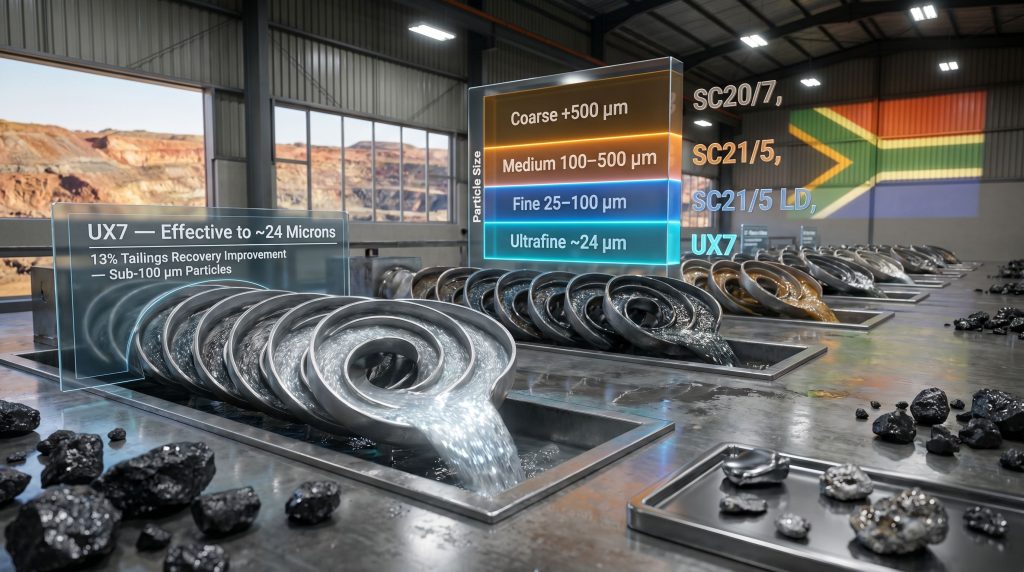
| Particle Size Range | Processing Challenge | Spiral Solution Required |
|---|---|---|
| Coarse (+500 µm) | High throughput, density contrast | Standard high-capacity spirals |
| Medium (100–500 µm) | Balanced recovery and grade | Proven mid-range spiral models |
| Fine (25–100 µm) | Increased hydraulic sensitivity | Specialised fine particle spirals |
| Ultrafine (~24 µm) | Conventional spiral inefficiency | Ultrafine-specific spiral geometry |
As particle size decreases below approximately 100 microns, the ratio of surface forces to gravitational forces increases, disrupting the clean density-driven stratification that makes spirals effective at coarser sizes. The result is that fine and ultrafine particles behave unpredictably in conventional spiral troughs, leading to systematic misplacement of valuable material into tailings.
For PGM recovery in the Bushveld context, this is not a marginal issue. A substantial proportion of economically significant PGM-bearing particles report to the fine and ultrafine fractions, meaning that conventional spiral circuits are structurally disadvantaged at recovering one of the two commodities the Thaba JV plant is designed to produce. Understanding ore mineralogy and economics is therefore essential when designing circuits intended to handle such complex, multi-commodity ore bodies.
The Four-Model Spiral Circuit: Precision Engineering Across the Full Size Distribution
Multotec's response to the Thaba JV processing challenge was not to select a single high-performing spiral and apply it universally. Instead, the engineering approach centred on deploying four distinct spiral models, each matched to a specific section of the circuit and a specific separation objective. This modular philosophy avoids the performance compromises that arise when a single spiral geometry is asked to operate across an incompatible range of particle sizes.
SC20/7: High-Volume Reliability for Bulk Chromite Recovery
The SC20/7 is an established model within Multotec's spiral concentrator portfolio, with a track record across commercial South African chromite operations. Its geometry is optimised for reliable density separation across medium-to-coarse chromite fractions, delivering consistent throughput performance under high-volume feed conditions. In a dual-feed plant processing both fresh RoM ore and retreated tailings, the SC20/7 anchors the primary rougher circuit.
SC21/5: Operational Versatility Across Variable Feed Conditions
The SC21/5 provides the baseline separation capability for circuit sections where feed grade and density vary. Its design accommodates fluctuating ore characteristics without requiring frequent operational adjustments, making it well-suited to a processing plant managing the inherent variability between two distinct feed sources.
SC21/5 LD: Optimised Cleaning Stage Performance
The SC21/5 LD is a purpose-engineered variant developed specifically for cleaning stage applications. By refining the spiral trough geometry relative to the standard SC21/5, the LD configuration improves product grade at the cleaning stage without a corresponding reduction in throughput. Internal development studies on spiral geometry for South African chromite processing demonstrated that this optimised geometry delivers an additional 2% improvement in mass yield and recovery compared to conventional spiral configurations. At commercial plant throughput scales processing millions of tonnes annually, a 2% recovery gain translates directly into measurable increases in saleable concentrate output.
UX7 Ultrafine Spiral: The Critical Innovation for PGM Fine Fraction Recovery
The UX7 represents the most technically significant component of the Thaba JV spiral circuit. Developed specifically for ultrafine particle recovery, the UX7's spiral geometry has been redesigned from first principles to maintain effective density separation at particle sizes down to approximately 24 microns — well below the operational floor of conventional spiral technology.
The performance data associated with the UX7 is notable. The design has demonstrated improvements of up to 13% in recovery from tailings streams for particles below 100 microns. In the context of PGM processing, where fine-fraction losses have historically been treated as an unavoidable cost of doing business, a 13% recovery improvement in that size fraction represents a material shift in plant economics.
What makes the UX7 commercially significant is not simply that it recovers finer particles, but that it does so using the same low-capital, low-operating-cost gravity separation platform that makes spiral technology economically attractive in the first place. There is no penalty in capital intensity or reagent consumption to achieve this finer recovery threshold.
Circuit Configuration, Modular Design, and the Engineering Collaboration Behind the Project
Multotec's contribution to the Thaba JV project extended beyond equipment supply into full circuit configuration, sizing specification, and ongoing technical collaboration. The application engineering team embedded within the project from early development stages worked alongside Multotec's internal process engineers to validate spiral selection against real feed data and ensure circuit architecture was correctly matched to the plant's throughput targets and mineralogical profile.
The modular nature of the spiral circuit was an explicit engineering priority. Processing both fresh RoM ore and historic tailings through the same plant introduces feed variability that a rigid, single-purpose circuit cannot accommodate over an extended operating life. A modular layout allows sections of the circuit to be reconfigured as ore sources shift across the project's life without requiring wholesale redesign.
Multotec's scope of supply at Thaba JV also included cyclones and samplers alongside the spiral circuit, reflecting a comprehensive flowsheet contribution that reduces interface risk between suppliers and simplifies technical accountability during commissioning. This integrated approach — where a single technology partner covers multiple unit operations within the same circuit — is increasingly valued in projects of this complexity. For instance, ore sorting technology represents another area where integrated flowsheet thinking is advancing recovery outcomes across similar operations.
The next major ASX story will hit our subscribers first
Comparing Gravity Separation Against Alternative Recovery Technologies
Spiral concentrators are not the only tool available for chromite and PGM recovery. Understanding why gravity separation was selected as the primary technology for the Thaba JV circuit requires comparing it against the alternatives.
| Technology | Applicable Size Range | Capital Intensity | Operating Cost | Chromite Suitability | PGM Fine Recovery |
|---|---|---|---|---|---|
| Spiral Concentrators | ~24 µm – 2,000 µm | Low–Medium | Low | Excellent | Good (ultrafine models) |
| Dense Media Separation | +1 mm | High | Medium | Good (coarser fractions) | Limited |
| Flotation | Below 150 µm | Medium–High | Medium–High | Limited | Excellent |
| Shaking Tables | 50 µm – 3 mm | Medium | Medium | Good | Good |
Flotation offers superior fine-fraction PGM recovery but carries higher capital and reagent costs, and performs poorly for chromite concentration. Dense media separation is effective for coarse chromite but is operationally intensive and does not address fine-fraction recovery. Shaking tables provide reasonable performance across a useful size range but are limited in throughput capacity at commercial scales.
For a plant processing millions of tonnes annually across a broad size distribution and targeting two distinct commodities simultaneously, spiral concentrators offer the most favourable combination of throughput capacity, low operating cost, size range coverage, and dual-commodity applicability — particularly when ultrafine-capable models are incorporated to address the fine fraction.
Key Technical Principles for Plant Designers and Metallurgists
Several technical principles emerge from the Thaba JV circuit design that carry broader applicability across Bushveld Complex processing operations. Consequently, these findings are relevant to any team applying mineral exploration methods and subsequently designing recovery circuits for similar multi-commodity deposits:
- Multi-model spiral circuits consistently outperform single-design approaches when feed particle size distributions are broad or where dual-commodity recovery is required
- Ultrafine spiral technology effective to approximately 24 microns is now commercially deployable and directly addresses the historically persistent fine-fraction PGM recovery gap
- Modular circuit architecture is essential for operations processing both fresh ore and historic tailings, where feed characteristics differ significantly between streams
- The 2% mass yield improvement demonstrated by optimised cleaning-stage spiral geometry compounds meaningfully at commercial throughput volumes
- Historic tailings retreatment creates an opportunity that ultrafine gravity separation technology is uniquely positioned to exploit cost-effectively
- Integrated technology partnerships covering circuit design, equipment supply, commissioning support, and operational optimisation reduce project risk and improve recovery consistency over the asset life
In addition, rigorous check sampling reliability throughout commissioning and early plant operations is critical to validating that the performance targets established during circuit design are being achieved consistently at scale.
The deployment of Multotec spiral solutions for the Thaba JV chromite and PGM project illustrates how purpose-engineered spiral technology, applied through a structured multi-model circuit architecture, can address processing challenges that have historically been treated as unavoidable limitations. As the Bushveld Complex continues to evolve toward deeper ore sources, finer mineralisation profiles, and the retreatment of accumulated tailings stockpiles, the ability to recover value at the ultrafine particle frontier will become an increasingly decisive factor in processing plant economics. A detailed technical overview of the Thaba JV spiral circuit further contextualises the engineering decisions discussed throughout this article.
This article contains references to performance data and technical specifications derived from publicly available industry sources. Forward-looking statements regarding recovery improvements and plant performance outcomes are based on available technical data and should not be construed as guarantees of future operational results.
Ready to Identify the Next Major PGM or Critical Minerals Discovery Before the Market Does?
Discovery Alert's proprietary Discovery IQ model scans ASX announcements in real time, instantly converting complex mineral data into actionable investment insights — whether you're tracking PGM plays, chromite operations, or the next transformative resource discovery. Explore historic examples of exceptional discovery returns and begin your 14-day free trial today to position yourself ahead of the broader market.