July 22, 2026
Advanced Computational Intelligence Transforms Resource Extraction Economics
Global mining operations face unprecedented operational complexity as traditional extraction methodologies encounter declining ore grades and escalating environmental compliance requirements. The convergence of artificial intelligence technologies with resource extraction represents a fundamental shift toward data-driven mining operations, creating new competitive dynamics across mineral supply chains.
Mining executives increasingly recognise that AI in mining industry transformation extends beyond simple automation, encompassing predictive analytics frameworks, autonomous equipment deployment, and real-time decision support systems. These technologies enable operators to extract maximum value from increasingly challenging geological formations while maintaining economic viability in volatile commodity markets.
Market Transformation Metrics:
| Investment Category | 2025 Value | 2032 Projection | Annual Growth |
|---|---|---|---|
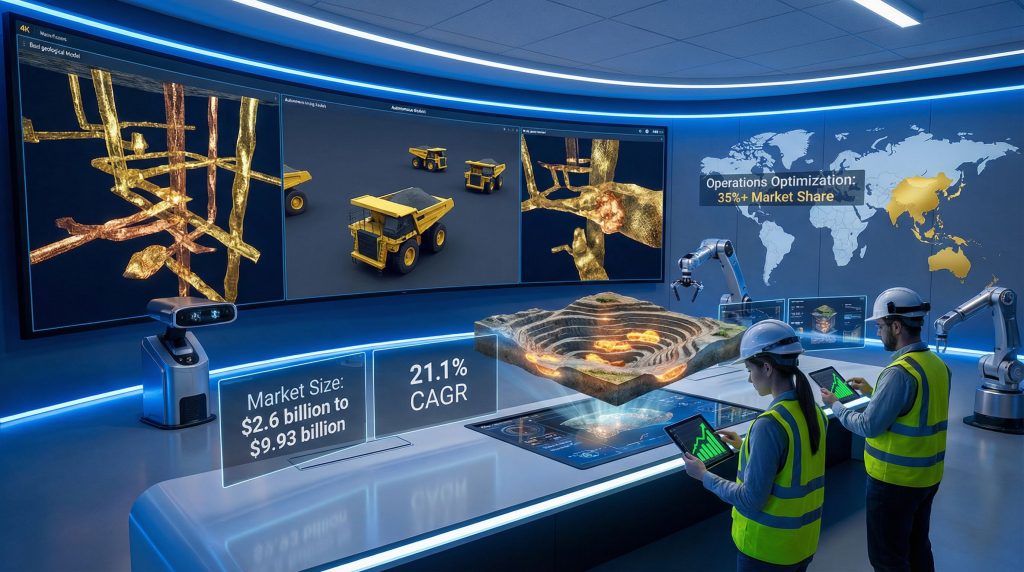
| Total AI Mining Market | $2.6 billion | $9.93 billion | 21.1% CAGR |
| Operations Optimization | 35% share | 40%+ projected | Market leader |
| Safety & Environmental | Fastest growth | High expansion | Regulatory driven |
The Asia-Pacific region dominates deployment patterns through substantial government investment programs and large-scale operational requirements. Chinese smart mining initiatives and Australian autonomous systems lead technological adoption across global markets.
When big ASX news breaks, our subscribers know first
Economic Pressures Accelerating Mining Digitisation
Resource extraction companies confront a fundamental economic equation where operational expenditures continue ascending while commodity price volatility creates persistent profitability challenges. This dynamic generates compelling financial rationale for efficiency-enhancing technology investments that directly address cost structure optimisation.
Critical Mineral Demand Dynamics:
- Lithium supply chains supporting electric vehicle battery production require enhanced extraction efficiency
- Copper infrastructure needs for renewable energy systems create sustained demand pressure
- Cobalt and nickel processing capabilities must scale rapidly for green technology deployment
- Rare earth element dependencies create strategic vulnerabilities requiring domestic production enhancement
Advanced AI systems enable companies to maintain economic viability from lower-grade ore bodies through yield optimisation algorithms. Furthermore, predictive maintenance protocols reduce unplanned downtime by 30-50%, whilst autonomous equipment deployment minimises labour-intensive operations in hazardous environments.
Geopolitical Strategic Considerations
Western economies increasingly acknowledge mineral supply chain vulnerabilities, particularly regarding Chinese processing dominance in rare earth elements. AI in mining industry transformation offers strategic advantages by accelerating domestic resource development timelines, improving extraction efficiency from previously uneconomical deposits, and reducing dependency on foreign processing capabilities.
These technological capabilities become essential as governments implement critical mineral security policies supporting domestic production infrastructure. Mining companies deploying advanced AI systems position themselves advantageously for government contracts and strategic partnership opportunities in national resource security initiatives.
Operational Impact Assessment Across AI Applications
Operations & Process Optimisation represents the largest market segment, focusing on maximising resource recovery from existing operations through advanced analytical capabilities. This technology enables companies to extract higher yields from lower-quality deposits, addressing the industry's fundamental challenge of declining ore accessibility.
Advanced algorithms process multi-dimensional datasets including geological characteristics, equipment performance signatures, environmental conditions, and quality specifications. Consequently, these systems continuously optimise extraction workflows. The capability to maximise value from marginal ore bodies directly addresses economic pressures from rising extraction costs.
Autonomous Equipment Performance Metrics
Major Australian iron ore operations report 15-20% productivity improvements through autonomous haulage systems. Some facilities operate 300+ autonomous trucks simultaneously across multiple sites. These systems enable continuous operation cycles without labour constraints, equipment maintenance limitations, or operator fatigue considerations.
Technical Implementation Framework:
- Ore body modelling: 3D geological modeling with predictive mineral distribution analysis
- Blasting optimisation: Precise explosive placement based on rock properties and geological formations
- Grinding processes: Real-time mill parameter adjustment based on incoming ore characteristics
- Material handling: Autonomous fleet coordination using GPS and operational constraint optimisation
Safety Technology Integration
The Safety, Security & Environmental segment demonstrates the highest growth trajectory. This is driven by regulatory mandates requiring real-time monitoring and ESG investor requirements imposing transparency standards on environmental stewardship performance.
Computer vision analytics deployed at high-risk operational zones identify safety violations, equipment anomalies, and environmental hazards. Machine learning models trained on extensive mining footage databases enable these systems. Detection systems operating at sub-second intervals enable immediate alert generation to operators and supervisory personnel.
Wearable IoT sensor networks transmit vital signs, precise geolocation data, environmental exposure measurements, and fatigue indicators derived from movement pattern analysis. These systems identify when workers enter hazardous zones, experience physiological stress, or deviate from established safety protocols.
Regional Market Leadership and Adoption Strategies
The Asia-Pacific region commands the largest share of AI in mining industry transformation markets. This position results from converging structural factors including massive production scale economics, regulatory alignment supporting automation investment, and established technology partnerships enabling rapid deployment pathways.
Chinese Smart Mining Implementation
China's adoption patterns reflect government-directed smart mining initiatives operating as coordinated policy programmes rather than individual company decisions. These initiatives specifically target fatality reduction in underground operations, environmental performance improvement, and integration with broader industrial digitisation strategies.
Government-mandated safety improvements following industrial incidents create compliance requirements. These requirements directly incentivise automation investment across China's extensive coal and mineral sectors. State-supported technology development programmes accelerate deployment timelines through coordinated research and implementation frameworks.
Australian Technology Testing Ground
Western Australian iron ore operations serve as established testing environments for autonomous technologies. BHP and Rio Tinto are positioned as early adopters demonstrating sustained deployment across multiple mine sites. These operations move millions of tons of iron ore with minimal human intervention, proving commercial viability of autonomous systems at industrial scale.
Regional Success Factors:
- Production scale economics: Large operational volumes create immediate ROI for efficiency investments
- Regulatory frameworks: Supportive policies without restrictive compliance barriers
- Technology partnerships: Pre-existing relationships enabling rapid pilot-to-production scaling
- Operational expertise: Established mining knowledge facilitating technology integration
North American Market Characteristics
North American mining companies prioritise AI applications addressing labour shortages and environmental regulation compliance. They focus on skilled worker replacement through autonomous systems, environmental compliance automation for regulatory reporting, and remote operation capabilities for harsh climate conditions.
These markets demonstrate different adoption patterns compared to Asia-Pacific. They emphasise safety risk mitigation and regulatory compliance over pure productivity optimisation, reflecting distinct operational priorities and stakeholder requirements.
Investment Architecture and Partnership Models
Mining companies increasingly adopt partnership approaches rather than internal development strategies. This approach recognises the complexity of AI system implementation and the advantage of specialised technology provider relationships.
Major Technology Partnerships (2024-2025):
| Mining Operator | Technology Provider | Application Focus | Strategic Scope |
|---|---|---|---|
| BHP | Microsoft, Partners | Copper exploration optimisation | Multi-year development |
| Barrick Gold | Fleet Space Technologies | 3D subsurface mapping | Exploration acceleration |
| Evolution Mining | AspenTech | Predictive maintenance | Safety risk mitigation |
Capital Allocation Strategic Framework
Mining executives prioritise AI investments based on several key factors. These include immediate ROI potential through operational efficiency gains, risk mitigation value particularly in safety and environmental compliance, strategic positioning for future mineral demand cycles, and regulatory compliance requirements in key operating jurisdictions.
Investment decisions reflect a balance between short-term operational improvements and long-term competitive positioning. This ensures AI in drilling and blasting capabilities align with evolving commodity markets, regulatory requirements, and stakeholder expectations across multiple operational jurisdictions.
Implementation Challenges and Technical Barriers
Mining operations encounter unique AI deployment challenges. These include legacy system integration with decades-old equipment and established processes, harsh operating environments affecting sensor reliability and data quality, connectivity limitations in remote mining locations, and data standardisation requirements across multiple sites and equipment manufacturers.
Workforce Transition Management
AI in mining industry transformation requires substantial organisational change management. This encompasses skills retraining for existing workforce, cultural resistance management to technology-dependent operations, labour relations negotiations regarding job displacement concerns, and knowledge transfer protocols from experienced operators to AI systems.
Technical Integration Complexities:
- Legacy equipment compatibility with modern sensor and communication systems
- Environmental durability requirements for harsh operational conditions
- Data communication infrastructure in remote mining locations
- System standardisation across diverse equipment manufacturers and operational sites
These challenges require coordinated implementation strategies addressing both technical integration requirements and organisational change management across all operational levels.
The next major ASX story will hit our subscribers first
Future Evolution Through 2032
Next-generation mining applications will incorporate generative AI capabilities for complex mine planning scenarios and optimisation modelling. Additionally, geological interpretation assistance for exploration teams, maintenance procedure generation based on equipment-specific conditions, and regulatory reporting automation with compliance documentation will emerge.
Integrated Digital Ecosystem Development
Future mining operations will deploy comprehensive digital platforms. These combine digital twin technology for entire mine site simulation, blockchain integration for supply chain transparency, carbon footprint tracking for ESG compliance, and predictive market analysis for production planning optimisation.
Emerging Technology Integration:
- Digital twin platforms: Complete operational simulation and scenario testing
- Blockchain transparency: Supply chain verification and traceability
- Environmental monitoring: Real-time emissions and resource usage tracking
- Market intelligence: Predictive analysis for production planning optimisation
These integrated systems will enable mining operations to optimise across multiple variables simultaneously. These variables include operational efficiency, environmental compliance, market positioning, and stakeholder requirements.
Strategic Industry Transformation Implications
The AI in mining industry transformation represents more than technological upgrade—it constitutes a fundamental shift toward data-driven resource extraction methodologies. Companies successfully navigating this transition achieve sustainable competitive advantages through enhanced operational efficiency, improved safety performance, and reduced environmental impact.
Mining executives must balance immediate operational improvements with long-term strategic positioning. This ensures AI investments align with evolving commodity markets, regulatory requirements, and stakeholder expectations. Furthermore, industry innovation trends indicate that organisations mastering this balance will define industry leadership through the next decade.
In addition, comprehensive analysis by industry analysts projects that mining companies deploying comprehensive AI systems will demonstrate measurably superior performance. This includes operational efficiency metrics, safety incident reduction, environmental compliance scores, and stakeholder satisfaction benchmarks compared to traditional operations.
The transformation extends beyond individual mine sites to encompass entire supply chain optimisation. This spans from geological exploration through final product delivery, creating new value creation opportunities and competitive dynamics across global mineral markets. Moreover, mine reclamation innovations are becoming increasingly important as companies adopt comprehensive AI-driven approaches to environmental stewardship.
This analysis reflects market conditions and technological developments as of December 2025. Mining industry stakeholders should consider engaging qualified technology advisors and conducting thorough feasibility assessments before implementing AI systems across operational environments.
Want to Stay Ahead of the Next Mining Technology Breakthrough?
Discovery Alert's proprietary Discovery IQ model delivers real-time alerts on significant ASX mineral discoveries, including emerging AI and technology-driven mining companies positioned to benefit from this industry transformation. Start your 30-day free trial today and gain immediate access to actionable investment opportunities before the broader market recognises their potential.