
August 14, 2026
Why the Talkeetna Arc Is a Global Reference Point for Subduction Initiation Science
Understanding how tectonic plates begin their descent into Earth's mantle remains one of the most contested problems in geodynamics. Talkeetna arc subduction initiation is rarely preserved in the geological record because erosion, metamorphic overprinting, and tectonic reworking typically destroy the earliest evidence before scientists can examine it. Yet one ancient arc system in south-central Alaska has defied this tendency, preserving a near-complete record of the entire subduction initiation sequence across hundreds of kilometres of exposed crust.
The Core Scientific Problem: How Does Subduction Begin?
Two fundamentally different conceptual models have emerged to explain how subduction starts. The first proposes spontaneous initiation, where gravitational instability alone drives an old, cold, dense oceanic plate to sink without any external forcing. The second model, forced initiation, requires an external tectonic driver, such as regional compression or collisional stress, to physically push the lower plate beneath the upper plate until density-driven sinking takes over.
Most ancient arc systems preserve only fragments of this story, making it difficult to test either model rigorously. The Talkeetna Arc is a critical exception. Initiating at approximately 232 Ma during the Late Triassic, it offers a geochemically intact, multi-stage record of forced subduction initiation that spans from the pre-arc extensional phase through to mature calc-alkaline magmatism, all exposed across accessible field sections in Alaska.
The Talkeetna Arc represents one of the most geochemically intact records of forced subduction initiation currently documented in the geological literature, with its preservation across the Kodiak Archipelago and Alaska Peninsula offering a rare, multi-stage window into a process that typically gets overprinted or destroyed.
When big ASX news breaks, our subscribers know first
Where Is the Talkeetna Arc Located, and Why Does Geography Matter?
Mapping the Arc's Structural Footprint Across South-Central Alaska
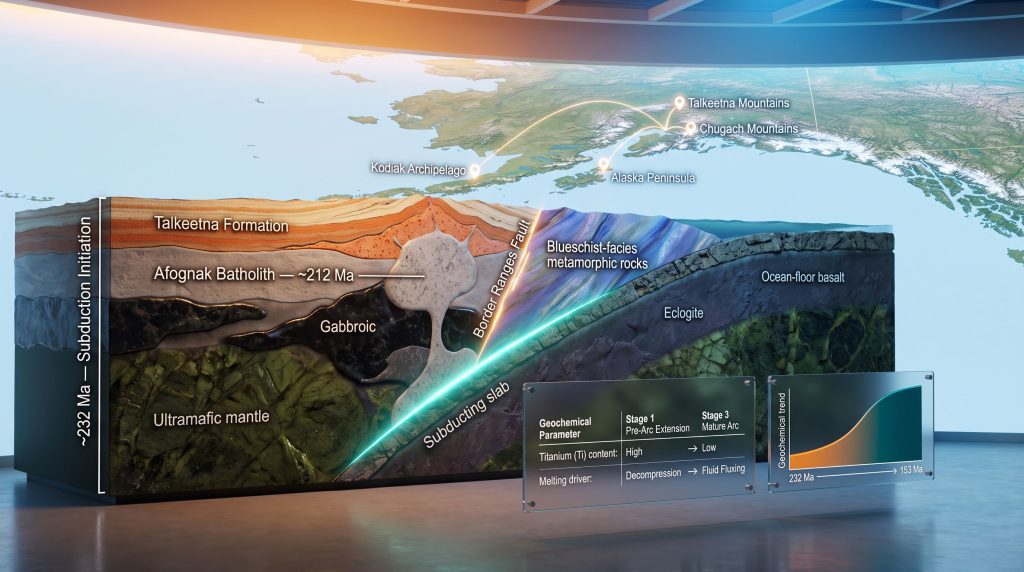
The Talkeetna Arc's geological expression extends across a substantial portion of south-central Alaska, from the Kodiak Archipelago in the southwest, through the Alaska Peninsula, into the Chugach Mountains, and northward into the Talkeetna Mountains. Each segment of this transect records a different phase of arc evolution, making the geographic distribution as scientifically significant as the rocks themselves.
The Border Ranges Fault serves as the primary structural divide, separating arc lithologies from the outboard Chugach accretionary complex. Critically, the oldest arc material is found in the southwest, particularly across the Kodiak Archipelago, while progressively younger magmatic phases are preserved toward the northeast in the Talkeetna Mountains. This southwest-to-northeast age progression reflects the arc's inboard migration through time, driven by subduction erosion and changes in slab geometry.
A key concept for interpreting this system is along-strike variability — the recognition that arc character, crustal thickness, and the nature of the substrate all change systematically along the length of the arc. Furthermore, this variability has important implications for how global subduction initiation models are applied. Understanding supercontinent cycles also provides essential context for interpreting the broader plate tectonic framework in which arcs like the Talkeetna system evolved.
The Crustal Cross-Section: Reading the Arc From Mantle to Surface
One of the most scientifically valuable aspects of the Talkeetna Arc is its exposure of a near-complete crustal cross-section, from upper mantle lithologies at the base through to extrusive volcanic sequences at the top. This vertical range is rarely accessible in a single arc system globally. The structural layering, moving from depth to surface, includes:
- Ultramafic upper mantle rocks exposed along the northern margin of the Border Ranges Fault
- Lower crustal gabbroic intrusions representing crystallised magma at depth
- Intermediate to felsic middle and upper crustal plutons that record evolving magma compositions through time
- Volcanic and volcaniclastic surface stratigraphy, most notably the Talkeetna Formation exposed near Sheep Mountain in the Matanuska Valley
The Talkeetna Formation itself, visible in the striking reds, oranges, and greens of heavily altered volcanic stratigraphy at Sheep Mountain, comprises volcanic flows, volcanic breccias, and volcaniclastic turbidites. Importantly, research by Peter Clift and colleagues concluded that throughout most of its history, the Talkeetna Arc was extensional enough that it never substantially emerged above sea level, operating predominantly as a submarine arc system with only minor subaerial exposure, much like many modern intraoceanic arcs.
What Is the Three-Stage Geochemical Evolution of the Talkeetna Arc?
Stage 1: Pre-Arc Extension and Decompression Melting (232+ Ma)
Before any arc magmatism was established, the upper plate was placed into a state of regional extension. The magmas produced during this phase carry geochemical signatures that bear no resemblance to typical arc volcanics. Instead, they resemble mid-ocean ridge basalts (MORB) and ocean island basalts (OIB), characterised by high titanium contents and an absence of the fluid-derived trace element enrichments that define arc lavas.
The driving mechanism was decompression melting: as the upper plate extended and thinned, the underlying mantle upwelled passively and melted in response to the pressure decrease, not because of fluid input from a subducting slab. This phase is recorded in the Lower Shuyak Formation of the Kodiak Archipelago, which preserves the oldest geochemical evidence for this pre-arc extensional event.
Stage 2: Slab Deepening and the Geochemical Transition (232 to 217 Ma)
As the underthrusted lower plate descended to approximately 40 km depth, a critical physical transformation occurred. Oceanic crustal minerals underwent eclogite-facies phase transitions, converting basaltic crust into the dense, garnet-bearing rock called eclogite. This conversion is pivotal: eclogite is significantly denser than the surrounding asthenospheric mantle, providing the gravitational driving force needed for free slab descent.
Simultaneously, the deepening slab released aqueous fluids derived from hydrated minerals breaking down under increasing pressure and temperature. These fluids infiltrated the overlying mantle wedge, lowering its melting point and triggering fluid-fluxed melting. The resulting magmas began acquiring the geochemical fingerprints of arc lavas, most notably rising thorium (Th) enrichment and a shift toward island arc tholeiite (IAT) compositions. The metamorphism of ore deposits associated with these fluid-driven processes can also significantly alter the distribution and character of mineralisation in arc settings.
Stage 3: Mature Arc Magmatism and Inboard Migration (217 to 153 Ma)
By the Early Jurassic, the arc had transitioned into full calc-alkaline magmatism, the hallmark of a mature subduction system. The Afognak Batholith, intruded at approximately 212 Ma, marks the onset of mature arc conditions on the Kodiak Archipelago. Plutons dated between 212 and 206 Ma on Kodiak are interpreted as intrusions into newly formed forearc oceanic crust generated during slab rollback, not into pre-existing continental basement.
From approximately 180 Ma onward, the arc front migrated progressively northward and inboard. Two processes are considered responsible:
- Subduction erosion: the ongoing removal of upper plate crust at the trench progressively shortened the arc-trench gap, driving the arc's thermal centre inboard
- Slab shallowing: a progressive decrease in slab dip angle shifted the critical 100 km slab-depth isotherm inboard, relocating the zone of fluid-fluxed melting away from its original position
Geochemical Signature Comparison Across Arc Stages
| Geochemical Parameter | Stage 1: Pre-Arc Extension | Stage 3: Mature Arc |
|---|---|---|
| Titanium (Ti) content | High (MORB/OIB-like) | Low (depleted arc signature) |
| Thorium (Th) enrichment | Absent | Present (slab fluid input) |
| Magma series | Enriched MORB to E-MORB | Island Arc Tholeiite to Calc-alkaline |
| Melting driver | Decompression (mantle upwelling) | Fluid fluxing (slab-derived volatiles) |
| Subduction influence | Minimal to absent | Dominant |
How Did Forced Subduction Initiation Actually Work? The Operational Mechanism
Step-by-Step Breakdown of the Forced Subduction Model
The Talkeetna Arc's initiation is best understood as a sequential mechanical process, each stage creating the conditions necessary for the next.
-
Permo-Triassic Regional Shortening: In the period leading up to arc initiation, the region experienced crustal compression. Pre-existing Paleozoic arc basement of the Peninsular and Wrangellia terrains provided the structural framework. This shortening episode produced a regional unconformity, interpreted as a record of tectonic stress driving compressional thickening before extensional collapse.
-
Upper Plate Extension and Basin Subsidence: Following the shortening phase, the upper plate transitioned into extension as the tectonic stress regime shifted. At Paleybay on the Alaska Peninsula, carbonates of the Kamishak Formation record progressive deepening of the overlying basin, a direct stratigraphic proxy for upper plate subsidence during extension.
-
Underthrusting and Eclogite Conversion: The lower plate was mechanically driven beneath the extending upper plate. At approximately 40 km depth, the basalt-to-eclogite phase transition rendered the lower plate denser than the surrounding mantle, removing the buoyancy that had previously resisted subduction.
-
Slab Rollback and Forearc Spreading: Once free sinking commenced, the slab naturally rolled back, retreating trenchward and placing the entire upper plate into intense extension. This extension generated proto-oceanic crust in the forearc region through a process analogous to seafloor spreading. The Lower Shuyak Formation basalts geochemically record this forearc spreading event.
-
Arc Front Localisation: As slab-derived fluids penetrated the mantle wedge at sufficient depth, magmatic productivity concentrated above the ~100 km slab depth contour. The upper portion of the Shuyak Formation records this transition from forearc basalts to arc-front volcaniclastics.
The forced subduction model differs fundamentally from spontaneous initiation in one critical way: an external tectonic force is required to initiate the descent of the lower plate. Without that external driver, the density contrast alone would be insufficient to overcome lithospheric strength at the initiation stage.
What Does the Stratigraphy of the Kodiak Archipelago Reveal About Arc Initiation?
The Shuyak Formation as a Geochemical Archive
The Lower Shuyak Formation is the primary stratigraphic record of the pre-arc extension phase, preserving the geochemical transition from enriched mantle-derived basalts to depleted, fluid-fluxed arc basalts at approximately 232 Ma. This upward chemostratigraphic shift is geochemically diagnostic of subduction initiation timing and represents one of the clearest records of this transition anywhere in the geological record.
The Upper Shuyak Formation records the next phase, comprising volcaniclastic sequences that mark the first arc-front localisation event. Together, the lower and upper Shuyak Formation capture the complete transition from a spreading-dominated forearc setting to an arc-dominated volcanic regime. In addition, studies of volcanogenic massive sulfide deposits in comparable arc environments demonstrate that such settings can also be highly prospective for significant mineralisation.
Late Triassic Plutons: Anchoring the Initiation Timeline
The oldest confirmed arc plutons in the Talkeetna system are dated at 212 to 206 Ma and occur on the Kodiak Archipelago, intruding into the basaltic crust of the Shuyak Formation. Their structural position along the outboard trend of the Border Ranges Fault is significant: the oldest plutons are systematically the furthest outboard (trenchward), consistent with progressive inboard arc migration.
Importantly, zircon hafnium-oxygen isotope data distinguish these early intrusions from pre-initiation volcanic activity, confirming they represent genuine arc-stage magmatism rather than remobilisation of older crustal material.
The Missing Arc Front: Where Did the Earliest Axis Sit?
A less commonly appreciated aspect of Talkeetna Arc research concerns what is not preserved. Based on the distribution of early plutons and the geometry of subduction erosion, the original arc axis is interpreted to have been positioned further outboard of present-day Kodiak exposures. Subduction erosion progressively removed the outermost arc crust over tens of millions of years.
This means the 232 Ma initiation event is recorded in geochemistry rather than in a preserved arc edifice — a subtle but critical distinction. The physical structures that first formed during arc initiation no longer exist at the surface.
How Did the Talkeetna Arc's Upper Plate Evolve Through Time?
Basin Evolution: From Back-Arc Extension to Forearc Sedimentation
One of the more counterintuitive findings from the Talkeetna Arc research concerns the behaviour of sedimentary basins in the upper plate. Basins are often conceptualised as static features with stable tectonic identities, however, the Talkeetna record demonstrates that basins can undergo complete polarity reversal as arc systems evolve.
At Paleybay, the basin record begins as a back-arc extensional setting, characterised by subsidence and mafic volcanism. As the arc migrated inboard through subduction erosion and slab shallowing, the same basin transitioned into a forearc setting, now receiving coarse volcaniclastic sediment shed from the trenchward flank of the new arc position.
Consider a sedimentary basin sitting behind a volcanic arc. As subduction erosion and slab shallowing drive the arc progressively inward, that basin shifts from receiving back-arc mafic lavas to receiving coarse volcaniclastic debris from the arc's new rear flank. This transition fundamentally changes the basin's sedimentological and geochemical character without any change in its geographic position.
Subduction Erosion and Its Role in Shaping the Preserved Record
Oceanic arc systems like the Talkeetna deliver minimal sediment to the trench because they lack the large rivers and continental landmasses that feed sediment to continental margin trenches. Consequently, the trench operates in subduction erosion mode: upper plate crust is progressively scraped off and recycled into the mantle rather than building an accretionary prism.
This process has two consequences for the geological record. First, the outboard portions of the arc are systematically destroyed over time. Second, high-pressure metamorphic rocks derived from eroded upper plate material are carried to depth, explaining why blueschist-facies metamorphic rocks dated at approximately 204 Ma occur directly adjacent to early arc plutons along the Border Ranges Fault.
The next major ASX story will hit our subscribers first
How Does the Talkeetna Arc Compare to Other Global Subduction Initiation Records?
Comparison Table: Global Forced Subduction Initiation Systems
| Arc System | Location | Initiation Age | Mechanism | Preservation Quality | Key Diagnostic Feature |
|---|---|---|---|---|---|
| Talkeetna Arc | South-central Alaska | ~232 Ma | Forced (shortening-driven) | Exceptional | Full crustal cross-section and chemostratigraphy |
| Izu-Bonin-Mariana | Western Pacific | ~52 Ma | Forced (plate reorganisation) | Good | Forearc basalt sequence |
| Wrangellia-related systems | Pacific margin | Permo-Triassic | Variable | Moderate | Flood basalt to arc transition |
| Vancouver Island (Sicker Group) | British Columbia | Early Jurassic | Direct intrusion into Paleozoic crust | Moderate | Arc built on pre-existing basement |
Along-Strike Variability: What the Vancouver Island Comparison Reveals
The Vancouver Island section provides one of the most instructive along-strike comparisons to the Kodiak Archipelago record. At Vancouver Island, Early Jurassic arc plutons intrude directly into Paleozoic arc crust of the Sicker Group and Late Triassic flood basalts of the Karmutsen Formation, with no intervening forearc oceanic crust of the type documented at Kodiak.
This contrast points to genuine variability in how far rollback-driven extension propagated along the margin during subduction initiation. Furthermore, in regions where the margin was older or stronger, the arc may have been constructed directly on pre-existing basement. This distinction matters because:
- The geochemical character of early arc plutons will differ depending on what crust they intruded
- Isotopic signatures of arc magmas will reflect the nature of the substrate, potentially masking the initiation signal
- Along-strike variability in subduction initiation style is likely a common but systematically underappreciated feature of ancient arc systems globally
For comparison, IOCG deposit formation in similarly aged arc and back-arc environments illustrates how magmatic-hydrothermal systems generated during subduction initiation can leave economically significant mineral footprints.
What Is the Significance of the Border Ranges Fault in Talkeetna Arc Research?
Structural Role: The Ancient Subduction Boundary
The Border Ranges Fault functions as the primary tectonic suture preserving the relationship between the Talkeetna Arc and the Chugach accretionary complex. The fault places early arc plutons in direct contact with blueschist-facies metamorphic rocks dated at approximately 204 Ma, confirming that high-pressure subduction conditions were operating within roughly 8 million years of confirmed arc magmatism at 212 Ma.
Post-Arc Overprinting: Flat-Slab Subduction and Its Effects
From approximately 30 Ma onward, a phase of flat-slab subduction beneath Alaska significantly modified the preservation state of the Talkeetna Arc record. The primary effect was substantial exhumation of deeper crustal levels, bringing lower crustal and upper mantle lithologies to the surface and enabling detailed petrogenetic studies. Research published by the USGS on Alaskan arc geology provides valuable supplementary context for understanding how post-arc tectonic overprinting affects the accessibility and interpretation of such records.
However, the same period introduced a complicating factor. Horizontal displacement along the Border Ranges Fault, Castle Mountain Fault, and numerous smaller structures fragmented the upper plate record in the Matanuska Valley into discontinuous blocks. This structural dissection is a principal reason why the Kodiak Archipelago and Alaska Peninsula transect provides a more coherent and interpretable record of early arc history than the classic Matanuska Valley section.
Understanding the broader economic implications of these arc systems also requires attention to ore mineralogy, as the mineral assemblages preserved in ancient arc settings carry important information about hydrothermal fluid histories and potential resource endowment. Comprehensive tectono-thermal studies, such as those examining the Cenozoic tectono-thermal history of southern Alaska, further illuminate how post-arc overprinting shapes what geologists can ultimately observe and sample.
Frequently Asked Questions: Talkeetna Arc Subduction Initiation
What age did the Talkeetna Arc initiate?
Geochemical and geochronological evidence anchors the onset of subduction-related magmatism at approximately 232 Ma during the Late Triassic. This date is defined by the chemostratigraphic transition within the Lower Shuyak Formation from MORB-like basalts toward fluid-fluxed arc compositions.
Why is the Talkeetna Arc considered better preserved than other ancient arc systems?
Three factors contribute to its exceptional preservation status. First, the near-complete crustal cross-section exposed from upper mantle to volcanic surface is virtually unparalleled globally. Second, the chemostratigraphic record in the Shuyak Formation captures the geochemical transition through subduction initiation in continuous stratigraphy. Third, the geographic extent of exposures from Kodiak through to the Talkeetna Mountains allows the full temporal and spatial evolution of the arc to be examined in a single system.
What is the difference between spontaneous and forced subduction initiation?
Spontaneous initiation proposes that gravitational instability alone drives a dense oceanic plate to sink without external forcing, while forced initiation requires a tectonic driver such as regional compression to physically push the lower plate to the depth where eclogite formation creates self-sustaining negative buoyancy. The Talkeetna arc subduction initiation record is interpreted as a product of forced initiation, with the Permo-Triassic shortening event providing the required external driver.
What makes the Border Ranges Fault so important to Talkeetna Arc studies?
The fault preserves the original contact between the arc system and the subduction complex, juxtaposing early arc plutons against high-pressure blueschist metamorphic rocks of comparable age. This relationship provides direct evidence that subduction was actively reaching significant depths within a few million years of arc establishment, constraining the timescale of the Talkeetna arc subduction initiation process with unusual precision.
Disclaimer: This article presents geological interpretations based on published research and field observations from the Talkeetna Arc region. Geochronological dates, geochemical interpretations, and tectonic models represent current scientific consensus and ongoing research, and may be subject to revision as new data emerge. This content is intended for educational and informational purposes only.
Want to Position Yourself Ahead of the Next Major ASX Mineral Discovery?
Discovery Alert's proprietary Discovery IQ model delivers real-time alerts on significant ASX mineral discoveries — transforming complex geological data into actionable investment insights, just as the science of arc systems transforms raw field observations into economic opportunity. Explore how historic discoveries have generated substantial returns on Discovery Alert's dedicated discoveries page, and begin your 14-day free trial today to gain a market-leading edge.