August 5, 2026
Understanding Advanced Defense Materials in Military Applications
Modern warfare demands materials that can perform under extreme conditions while maintaining reliability in critical defense systems. The 13 critical minerals defense strategy has become a cornerstone of national security planning, as the intersection of materials science and military readiness creates dependencies that extend far beyond traditional procurement. Furthermore, these dependencies reach deep into global supply chains that underpin semiconductor manufacturing, precision weaponry, and advanced detection systems.
The distinction between critical minerals and strategic materials lies in their applications and supply chain vulnerabilities. Critical minerals are those essential for defense applications with limited domestic production and concentrated global supply chains. Strategic materials, meanwhile, encompass a broader category including materials stockpiled for economic security and industrial base maintenance.
Semiconductor Technology Integration
Defense electronics require materials with specific properties that commercial-grade alternatives cannot match. High-frequency radar systems, infrared detection equipment, and guidance systems all depend on materials with precise electrical, optical, and magnetic characteristics that must perform reliably in combat environments.
Military-grade specifications often require purity levels exceeding 99.99%, processing conditions that eliminate specific contaminants, and testing protocols that verify performance under temperature extremes. In addition, these specifications must account for vibration and electromagnetic interference conditions that commercial applications never encounter.
When big ASX news breaks, our subscribers know first
The Pentagon's Strategic Element Framework
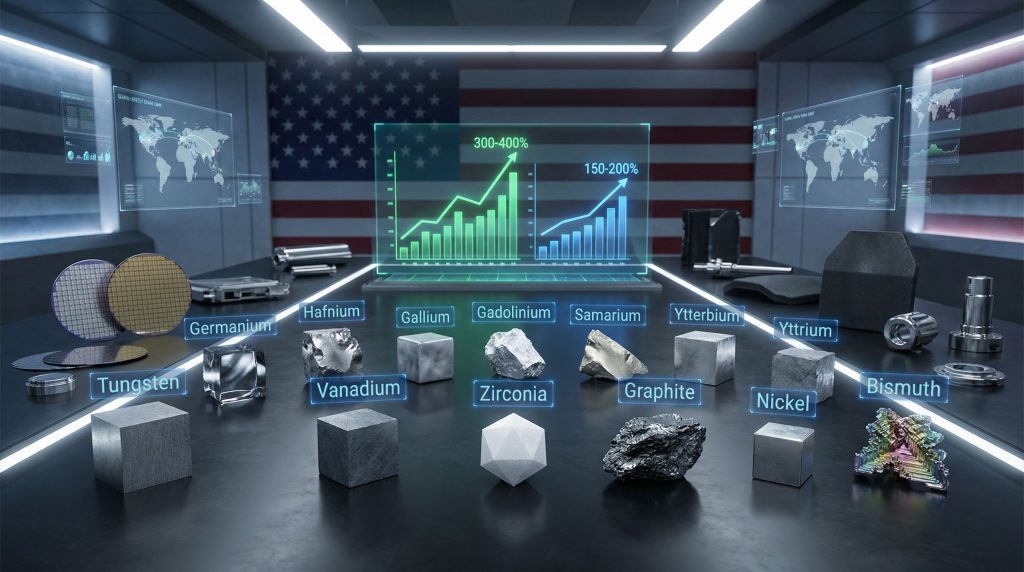
The Defense Department's focus on the 13 critical minerals defense strategy reflects a careful analysis of supply chain vulnerabilities across multiple defense systems. Each mineral serves specific functions that cannot be easily substituted without compromising system performance or reliability.
High-Technology Warfare Components
Germanium enables infrared optics systems used in night vision equipment and thermal imaging systems. Its semiconductor properties make it essential for high-frequency electronics operating above standard silicon limitations. However, military applications require germanium processed to eliminate impurities that would cause signal degradation in battlefield conditions.
Hafnium serves dual purposes in nuclear reactor control systems and advanced metallurgy for aerospace applications. Its neutron absorption properties make it irreplaceable in naval reactor designs, while its high melting point and corrosion resistance support advanced jet engine components operating at temperatures exceeding 2000°C.
Gallium forms the foundation for high-frequency electronics operating in radar systems, electronic warfare equipment, and satellite communications. Gallium arsenide semiconductors provide performance characteristics that silicon cannot match for applications requiring high speed and low power consumption.
Advanced Materials for Defense Systems
Tungsten applications extend beyond armor-piercing ammunition to include radiation shielding, electrical contacts in high-current applications, and heat-resistant components in rocket nozzles and jet engines. Defense applications require tungsten with specific grain structures and purity levels that commercial suppliers rarely maintain.
Vanadium strengthens steel alloys used in military vehicle armor, submarine hulls, and aircraft structural components. Military specifications require vanadium-steel alloys that maintain strength and toughness at temperatures ranging from Arctic conditions to desert heat while resisting corrosion from saltwater exposure.
Zirconium provides ceramic armor components and nuclear applications requiring materials that maintain structural integrity under extreme conditions. Military ceramic armor specifications demand zirconium compounds with controlled crystal structures that maximise energy absorption while minimising weight.
Precision System Rare Earth Elements
Gadolinium supports both military medical applications and neutron detection systems used in nuclear security operations. Its magnetic properties make it essential for specialised imaging systems used in military medical facilities and forward operating bases.
Samarium creates permanent magnets for guidance systems, precision actuators, and miniaturised motors in military equipment. Samarium-cobalt magnets maintain magnetic strength at temperatures where other permanent magnet materials lose effectiveness, making them essential for aerospace applications.
Ytterbium enables laser systems and atomic clock technology used in GPS systems, precision timing networks, and advanced communication systems. Military specifications require ytterbium with isotopic purity levels that commercial applications rarely demand.
Yttrium provides phosphor materials for displays and high-temperature superconductor applications in advanced electronic systems. Aerospace industry alerts regarding yttrium scarcity have highlighted its critical role in high-temperature coatings for jet engines and turbine systems that must operate reliably in combat conditions.
Supply Chain Vulnerability Assessment Under Chinese Market Control
China's dominance over 13 critical minerals defense strategy materials creates multiple layers of vulnerability beyond simple production capacity. The concentration of processing facilities, technological expertise, and refined material production within Chinese borders establishes chokepoints that could disrupt military production within weeks of supply interruption.
Processing Capacity Concentration Risks
Secondary processing represents the most vulnerable point in critical mineral supply chains. While alternative mining sources exist globally, the specialised facilities required to process raw materials into defense-grade specifications remain concentrated in China. Converting raw germanium ore into electronic-grade germanium requires facilities with controlled atmospheres, precise temperature management, and specialised purification equipment that takes years to construct and certify.
Export restriction precedents from 2023-2024 demonstrated how quickly mineral availability can change. Germanium export controls implemented during this period caused immediate shortages in semiconductor manufacturing facilities, forcing defence contractors to seek alternative suppliers at premium prices while managing production delays.
Graphite processing facilities capable of producing battery-grade anodes and nuclear moderator materials require specialised equipment and environmental controls that few nations possess outside Chinese territories. The construction timeline for equivalent facilities ranges from 3-5 years under accelerated development scenarios.
Strategic Vulnerability Metrics
| Mineral Category | U.S. Import Dependency | Chinese Processing Control | Alternative Source Availability |
|---|---|---|---|
| Rare Earth Processing | 85% | 90% | Limited |
| Tungsten Concentrate | 75% | 85% | Moderate |
| Graphite Processing | 80% | 85% | Limited |
| Germanium Refining | 90% | 95% | Minimal |
The timeline for supply disruption impacts varies by mineral type and existing stockpile levels. Critical defense applications could face material shortages within 30-90 days of complete supply cutoff, depending on current inventory levels and production rates at affected facilities.
Defense Funding Mechanisms and Project Support Structure
The Pentagon's approach to securing critical mineral supplies combines multiple funding streams designed to support different stages of development, from initial extraction through final processing and recycling operations. Moreover, these mechanisms align with the defense critical materials strategy to strengthen supply chain resilience.
Defense Industrial Base Consortium Framework
The Defense Industrial Base Consortium (DIBC) represents over 1,500 companies, universities, and defence suppliers positioned to submit proposals for critical mineral development projects. Funding ranges from $100 million to $500+ million per project, with March 20, 2026 representing the submission deadline for initial proposals.
Project categories include:
- Extraction operations focused on domestic mining development
- Processing facilities designed to convert raw materials into defence-grade specifications
- Recycling systems that recover critical materials from end-of-life military equipment
- Supply chain integration projects connecting multiple stages of material development
Multi-Agency Financial Support
The Export-Import Bank's $12 billion strategic stockpiling initiative launched in February 2026 provides long-term material security through government-backed purchases and storage facilities. This represents a shift from project-based funding toward strategic reserve accumulation designed to buffer against supply disruptions during international crises.
Defence Logistics Agency emergency procurement requests during the week of March 3, 2026 focused on lithium, chromium, and tellurium acquisition for military reserves, indicating immediate concern over material availability during potential conflict scenarios.
Strategic Reserve Analysis: The combination of project development funding and strategic stockpiling suggests a dual approach to mineral security, addressing both long-term supply chain development and short-term material availability during crisis periods.
Risk-Sharing Financial Structures
Government funding mechanisms include several risk-mitigation approaches designed to encourage private sector participation in strategic mineral development. These initiatives complement global efforts such as the critical raw materials facility in Europe.
Loan guarantee programs that reduce financing costs for mining and processing facility construction
Offtake agreements providing guaranteed purchases at predetermined prices for specified quantities and timeframes
Tax incentive structures including accelerated depreciation schedules and research credit programs that improve project economics
Insurance mechanisms that protect against political risks and force majeure events that could disrupt international operations
Company Positioning for Defense Contract Opportunities
Several domestic companies have positioned themselves to capture defence mineral development contracts through strategic project development and facility expansion programs targeting the Pentagon's priority materials list. Furthermore, these developments support broader mining technology innovation initiatives across the industry.
Domestic Production Development Programs
Guardian Metal Resources has developed tungsten projects in Nevada designed to meet defence-grade specifications for armor-piercing ammunition and heat-resistant components. The company's proposal submissions focus on extraction and preliminary processing capabilities that could supply domestic defence contractors within 24-36 months of funding approval.
American Tungsten operates Idaho-based development projects targeting both commercial and defence applications. Their strategic positioning includes existing relationships with defence contractors and preliminary environmental approvals that could accelerate production timelines compared to greenfield developments.
Energy Fuels Inc. has announced facility expansion programs targeting rare earth processing by 2027, specifically focusing on gadolinium and samarium processing capabilities while evaluating yttrium production potential. The company's existing uranium processing infrastructure provides a foundation for expanding into related strategic materials.
Processing Infrastructure Requirements
Defence-grade material specifications require processing facilities with capabilities that exceed commercial standards:
- Controlled atmosphere processing that eliminates atmospheric contamination during production
- Purity verification systems capable of detecting impurities at parts-per-million levels
- Quality certification protocols meeting defence contractor requirements and government specifications
- Security clearance procedures protecting sensitive production processes and material specifications
The capital investment required for defence-grade processing facilities typically ranges from $50-200 million depending on material type and production capacity, with construction timelines extending 18-30 months under expedited development scenarios.
Allied Partnership Networks for Mineral Security Enhancement
The development of multinational supply chain partnerships represents a strategic shift from purely domestic production toward alliance-based material security encompassing over 50 allied nations in preferential trading arrangements. This approach recognises the global nature of the energy security supply chain and the importance of diversified sourcing.
Strategic Alliance Development
The proposed preferential trading bloc structure creates material-specific agreements designed to prioritise allied nation access to critical minerals during supply shortages or international crises. This framework extends beyond simple trade agreements to include technology sharing, joint development projects, and coordinated stockpiling programs.
Canada-U.S. joint initiatives focus on rare earth processing facility development and cross-border material transportation agreements that treat North American mineral resources as integrated supply chains rather than separate national assets.
Australian processing partnerships target rare earth separation and refining capabilities that complement U.S. downstream processing facilities, creating redundant supply pathways that reduce dependence on Chinese processing capacity.
Comparative Production Analysis
| Allied Nation | Primary Mineral Focus | Processing Capacity | Development Timeline |
|---|---|---|---|
| Canada | Rare earths, nickel | Medium | 2-3 years |
| Australia | Lithium, rare earths | High | 1-2 years |
| Japan | Processing technology | High | 1 year |
| South Korea | Battery materials | Medium | 2 years |
Technology Transfer and Investment Protection
Allied partnerships include provisions for sharing processing technology, joint facility development, and cross-border investment protection that encourage multinational companies to develop strategic mineral capabilities across alliance boundaries. Consequently, this approach reduces the risk of concentrating production in single locations.
Intelligence sharing agreements enable coordinated responses to supply disruptions and early warning systems that alert alliance partners to potential material shortages before they impact defence production schedules.
The next major ASX story will hit our subscribers first
What Are the Benefits of Recycling in Defense Applications?
Military equipment lifecycle management provides opportunities for critical material recovery that can supplement primary mining and processing operations while reducing dependence on foreign suppliers. These efforts support the development of a strategic minerals reserve through circular economy principles.
Defense Equipment Material Recovery
End-of-life military systems contain significant quantities of critical materials that can be recovered and reprocessed for new applications:
Rare earth magnets from decommissioned guidance systems, radar equipment, and motor assemblies
Tungsten components from retired ammunition, aerospace components, and electronic systems
Specialised alloys from aircraft structures, submarine components, and armoured vehicles
Electronic components containing germanium, hafnium, and other semiconductor materials
Secondary Material Quality Standards
Defence applications require recycled materials that meet the same specifications as virgin materials, necessitating specialised processing techniques that can remove contamination introduced during initial use cycles. Military-grade recycling facilities must demonstrate:
- Contamination removal capabilities that restore materials to original purity levels
- Composition verification systems ensuring recycled materials meet defence specifications
- Security protocols protecting sensitive information contained in recovered equipment
- Traceability systems documenting material origins and processing history
The economics of critical material recycling often favour recovery operations due to high material values and processing cost advantages compared to primary mining and refining operations.
Geopolitical Acceleration Factors and Strategic Timing
The timing correlation between Pentagon mineral security initiatives and Middle East military operations illustrates how international tensions accelerate strategic material priority development beyond peacetime planning schedules. However, this acceleration must balance immediate needs with long-term sustainability goals.
Conflict-Driven Demand Analysis
Extended military operations create material demand profiles that differ significantly from peacetime requirements:
Ammunition consumption increases tungsten demand by 300-400% above baseline levels during active conflicts
Electronic warfare systems require germanium and gallium-based components at rates exceeding normal replacement schedules
Surveillance and communication equipment deployment accelerates rare earth permanent magnet consumption
Maintenance and repair operations in field conditions consume materials at higher rates than controlled facility environments
Strategic Material Emergency Protocols
| Scenario Type | Material Priority | Stockpile Activation | Production Acceleration |
|---|---|---|---|
| Regional Conflict | Tungsten, germanium | 30-day trigger | 6-month ramp-up |
| Extended Operations | Rare earths, nickel | 60-day trigger | 12-month ramp-up |
| Global Disruption | All 13 materials | Immediate | 18-month ramp-up |
Long-Term Strategic Planning Integration
Pentagon mineral security initiatives extend beyond immediate conflict preparation to address long-term strategic competition scenarios where material access could determine military capability advantages. Planning frameworks consider 10-15 year development timelines for domestic production capacity that could operate independently of international supply chains during extended periods of strategic competition.
How Does Domestic Mineral Production Impact the Economy?
The transition toward domestic critical mineral production creates economic effects that extend beyond defence applications into broader industrial base strengthening and regional economic development. These impacts align with Australia's critical minerals strategy for comprehensive economic security.
Cost-Benefit Framework Analysis
Domestic production typically commands premium pricing compared to international sources, reflecting higher labour costs, environmental compliance requirements, and smaller production scales. However, strategic value calculations must include:
Supply security premiums that justify higher costs during international crises
Economic multiplier effects from domestic mining, processing, and manufacturing job creation
Technology development spillovers that benefit civilian industries utilising similar materials
Regional development benefits in mining-capable areas experiencing economic diversification
Market Stabilisation Mechanisms
Strategic reserve management provides government tools for moderating price volatility during international supply disruptions while supporting domestic producers during market downturns through guaranteed purchase agreements and minimum price supports.
Long-term contract structures between government purchasers and domestic producers create predictable revenue streams that justify capital investment in processing facilities and extraction operations. For instance, these structures might not be economically viable under purely market-driven conditions.
Technological Innovation Supporting Strategic Independence
Advanced extraction and processing technologies enable domestic production from ore bodies and secondary sources that were previously considered uneconomical, expanding the potential resource base for critical mineral development. These innovations support research into critical minerals for sustainable development across multiple sectors.
Substitution Research Development
Defence contractors are investigating alternative materials that could reduce critical mineral intensity in military systems while maintaining performance specifications. Research areas include:
Advanced composite materials that replace traditional metal alloys in structural applications
Synthetic alternatives to rare earth permanent magnets using abundant element compositions
Processing efficiency improvements that reduce material waste and increase recovery rates from existing ore bodies
Miniaturisation technologies that reduce absolute material requirements in electronic systems
Extraction Technology Enhancement
Modern mining and processing techniques enable domestic operations to achieve competitive production costs while meeting environmental compliance standards that international competitors may not maintain. Advanced technologies include automated extraction systems, precision processing controls, and waste minimisation techniques that improve both economics and environmental performance.
Regulatory Framework Acceleration for Strategic Development
Federal regulatory modifications designed to accelerate critical mineral project development balance national security requirements with environmental protection and community impact considerations. These modifications streamline the path to achieving 13 critical minerals defense strategy objectives.
Expedited Permitting Protocols
| Regulatory Stage | Standard Processing | National Security Track | Time Reduction |
|---|---|---|---|
| Environmental Impact | 36 months | 18 months | 50% |
| Mining Permits | 24 months | 12 months | 50% |
| Processing Facilities | 18 months | 9 months | 50% |
| Transportation Rights | 12 months | 6 months | 50% |
National security exemptions provide regulatory pathways for projects demonstrating critical importance to defence applications while maintaining environmental protection standards appropriate to project scale and potential impacts.
Federal land access prioritisation enables strategic mineral development on public lands through expedited lease agreements and reduced bureaucratic processing times compared to conventional mining applications.
Success Measurement and Strategic Objective Assessment
The effectiveness of critical mineral security initiatives requires measurable benchmarks that demonstrate progress toward supply chain independence while maintaining cost-effectiveness and environmental responsibility. These measurements ensure the 13 critical minerals defense strategy achieves its intended objectives.
Performance Indicator Framework
Domestic production percentage increases tracked by mineral type and year, with targets for reducing import dependence below strategic vulnerability thresholds
Supply chain resilience testing through simulated disruption scenarios that measure how quickly domestic production can replace interrupted international supplies
Strategic stockpile adequacy assessments evaluating reserve levels against consumption requirements during different conflict duration and intensity scenarios
Allied partnership production capacity measuring combined alliance capability to meet strategic material requirements without dependence on potentially hostile suppliers
Long-Term Strategic Milestones
Strategic objectives for 2030-2035 include achieving domestic production capacity sufficient to meet 75% of defence-related critical mineral requirements while maintaining alliance partnerships capable of supplying remaining material needs during emergency conditions.
Technology substitution milestones target reducing absolute critical mineral requirements in defence systems by 25-40% through advanced materials research and system design optimisation. Consequently, this approach reduces overall supply chain vulnerability regardless of production location.
This analysis is based on publicly available information and does not constitute investment advice. Readers should conduct independent research and consult qualified professionals before making investment decisions related to critical mineral development or defence contracting opportunities. Market conditions and government policies may change, affecting the viability and profitability of strategic mineral investments.
Want to Position Yourself for the Critical Minerals Boom?
Discovery Alert's proprietary Discovery IQ model delivers real-time notifications on significant ASX mineral discoveries, including critical defence materials like rare earths, lithium, and tungsten. With substantial government funding flowing into strategic mineral development projects, subscribers gain immediate insights into actionable opportunities as major mineral discoveries emerge, ensuring quick and informed decisions ahead of the broader market.