June 4, 2026
The Processing Bottleneck That Could Decide the Next Conflict
Every major technology transition of the past century has been gated by a single, hard-to-replicate industrial input. For the current era of precision warfare, electric mobility, and AI-driven computing, that input is not silicon, not lithium, and not oil. It is the family of elements sitting in the lanthanide series of the periodic table, and the industrial capacity to transform them into functional metals. Building a credible REalloys rare earth supply chain outside China has consequently become one of the most strategically urgent industrial challenges of our time.
The West does not lack rare earth deposits. What it lacks, critically, is the ability to do anything useful with them at scale. That distinction is the central strategic problem of our time, and it is only now receiving the industrial investment it demands.
When big ASX news breaks, our subscribers know first
Why Geology Alone Does Not Create Strategic Security
The Processing Gap That Three Decades Built
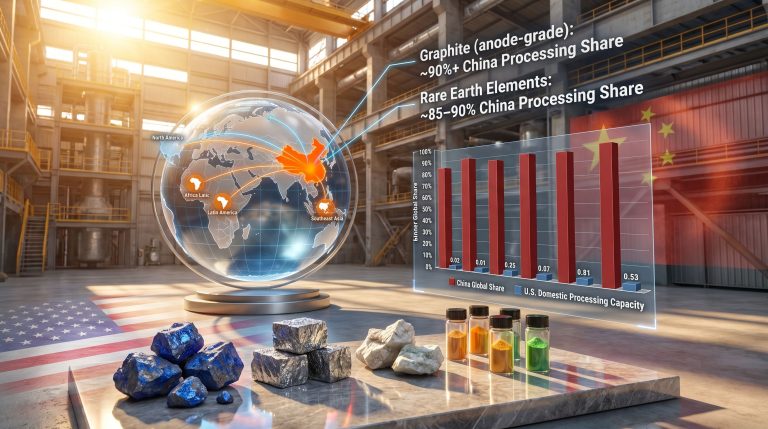
China's dominance in rare earth supply chains is not primarily geological. Estimates consistently place China's share of global rare earth processing capacity at between 85% and 90%, a figure that far exceeds its share of known mineral reserves. This imbalance was constructed deliberately through sustained industrial policy, state-subsidised infrastructure investment, and tolerance for environmental externalities that Western regulators would not permit domestically.
The consequence is a supply chain vulnerability that is architecturally different from resource scarcity. Western nations are not short of rare earth atoms. They are short of the separation plants, oxide refineries, metal reduction furnaces, and alloy casting facilities that convert raw mineralogy into defence-grade materials.
Understanding why this matters requires clarity on what the rare earth processing challenges actually involve:
- Mining and ore concentration – extracting rare earth bearing rock and producing a mineral concentrate
- Separation and refining – chemically isolating individual rare earth elements into high-purity oxides
- Metallization – reducing oxides into metallic form through energy-intensive electrochemical processes
- Alloying – combining metals such as neodymium, dysprosium, and iron into magnetic alloys
- Magnet manufacturing – forming, sintering, and magnetising finished permanent magnets for end-use applications
Each stage compounds the dependency. A nation that controls only the first stage possesses raw material but cannot produce a single permanent magnet without routing its output through Chinese industrial infrastructure at steps two through five.
Why Heavy Rare Earths Represent a Separate and Sharper Crisis
Not all rare earths carry equal strategic weight. The industry broadly divides into light rare earths, which include elements such as lanthanum and cerium, and heavy rare earths, which include dysprosium and terbium. The light variety are more abundant, more widely distributed geologically, and face competition from multiple non-Chinese sources. The heavy rare earths are rarer, more geographically concentrated, and far more difficult to replace in high-performance applications.
Dysprosium and terbium are added to neodymium-iron-boron permanent magnets specifically to maintain magnetic performance at elevated temperatures. Without dysprosium, a magnet that performs adequately at room temperature degrades significantly once installed in a running electric motor, jet engine, or missile guidance system. This makes heavy rare earths not a luxury additive but a functional requirement for defence-grade magnet performance.
Key Insight: The strategic premium on dysprosium and terbium is not driven by their volume in the supply chain — it is driven by their irreplaceability in high-temperature, high-performance magnetic applications. There is currently no commercially viable substitute for either element in advanced permanent magnet systems.
Building a REalloys Rare Earth Supply Chain Outside China: The Architecture
Stage One: Feedstock From Western-Aligned Geology
The foundation of any sovereign Western rare earth supply chain is a consistent feedstock source carrying the right elemental profile. Most commercially developed rare earth deposits globally are dominated by light rare earths, with heavy rare earth fractions typically representing less than 10% of the total rare earth profile.
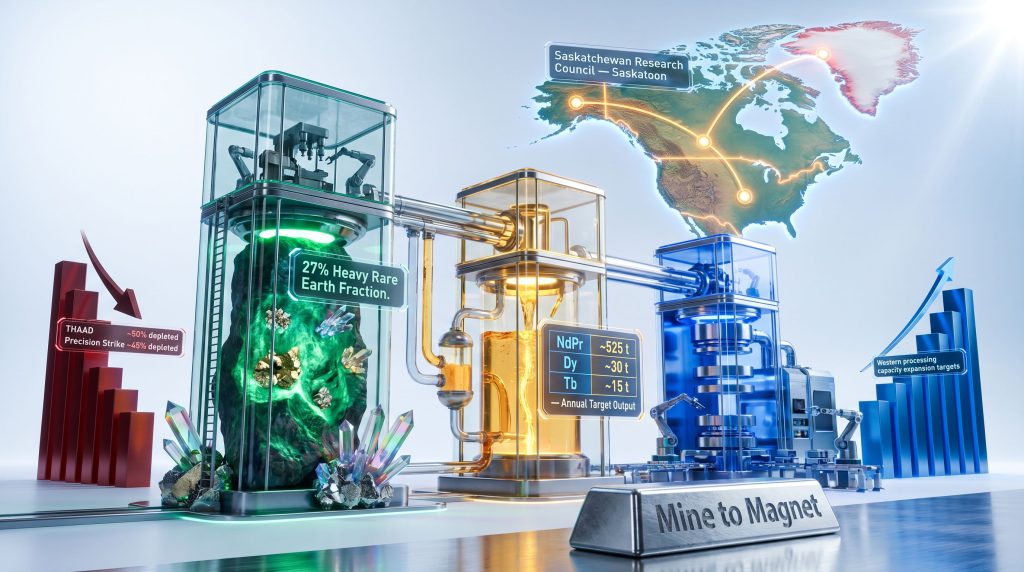
Greenland critical minerals have emerged as a distinctly different geological proposition. Select deposits on the island carry heavy rare earth fractions approaching 27% of total rare earth content, a concentration that is atypical by global standards and strategically significant given the demand premium on dysprosium and terbium. The Tanbreez rare earth deposit in southern Greenland, one of the largest known heavy rare earth deposits in the world, has disclosed Phase 1 production capacity of up to 15,000 metric tonnes of rare earth concentrate annually.
REalloys (NASDAQ: ALOY) has secured a definitive 15-year offtake agreement covering 15% of Tanbreez Phase 1 production, with priority rights tied specifically to dysprosium- and terbium-rich concentrate streams and a right of first refusal on additional volumes. The Western alignment of the project has been reinforced by Greenland's government approving Critical Metals Corp.'s move to 92.5% ownership, while Washington previously applied diplomatic pressure to prevent the asset from passing into Chinese-linked ownership.
Other non-Chinese feedstock geographies under active development include:
- North America – domestic deposits in the United States and Canada with varying heavy rare earth content
- Brazil – carbonatite-hosted deposits with predominantly light rare earth profiles
- Kazakhstan – significant rare earth mineralisation within existing phosphate processing infrastructure
- Material recycling streams – urban mining from end-of-life magnets and electronic waste, currently limited in recovery efficiency but growing as a supplementary source
Stage Two: The Saskatchewan Processing Node
The Saskatchewan Research Council (SRC) facility in Saskatoon, Canada, represents one of the most significant investments in Western rare earth processing infrastructure currently underway. Furthermore, REalloys' heavy rare earth metallization plant — the largest of its kind outside China — is now formally underway. The company has committed approximately $20.6 million toward targeted upgrades, engineering, permitting, commissioning, and expanded throughput capacity at the facility.
The investment delivers a specific and measurable capacity uplift:
| Rare Earth Element | Annual Target Output | Primary Strategic Application |
|---|---|---|
| NdPr (Neodymium-Praseodymium) | ~525 tonnes | Permanent magnets, EV motors, wind turbines |
| Dysprosium | ~30 tonnes | High-temperature magnet performance, defence guidance systems |
| Terbium | ~15 tonnes | Magnet coercivity enhancement, advanced electronics |
The upgrades are projected to increase NdPr output by a further 25% while doubling dysprosium and terbium production capacity from existing levels. In exchange for this capital commitment, REalloys has secured exclusive preferred rights to up to 80% of the facility's expanded commercial output under long-term commercial agreements.
A critical and often overlooked element of this arrangement is the commissioning of a standalone commercial-scale heavy rare earth metallization system dedicated specifically to dysprosium and terbium metal production. Once completed, this system is to be transferred to REalloys' facility in Euclid, Ohio, creating a physical metallization asset anchored within U.S. sovereign territory.
Stage Three: Ohio and the Downstream Manufacturing Gap
The Ohio facility represents the terminal node of a vertically integrated North American supply chain. SRC handles the separation and refining side, while the Euclid operation is designed to manage the more technically demanding downstream step of converting rare earth oxides into defence-grade metals, alloys, and ultimately permanent magnets.
This metallization stage is the least-developed link in the Western industrial base. The conversion of a rare earth oxide into a pure metal involves high-temperature electrochemical reduction processes that require specialised equipment, process chemistry expertise, and quality control infrastructure capable of producing materials that meet defence procurement specifications.
REalloys is sourcing this equipment through Western and allied-nation suppliers, with Japanese supplier relationships forming part of a non-Chinese procurement strategy for downstream manufacturing inputs. Japan maintains meaningful metallization expertise developed partly through its own decades-long effort to reduce dependence on Chinese rare earth supply following the 2010 export restriction crisis.
The 2027 Deadline: Scenarios and Strategic Exposure
What the Pentagon's Chinese-Origin Ban Actually Covers
A point of widespread confusion in public reporting on this topic is the scope of what constitutes Chinese origin under the Pentagon's January 2027 sourcing prohibition. The ban does not apply solely to materials physically mined in China. It applies to materials that have been processed or refined in China at any stage of the supply chain.
This has profound implications for defence contractors whose current supply chains route through Chinese separation or refining facilities, even when the raw ore originates elsewhere. A neodymium magnet produced from Australian-mined ore that passed through a Chinese oxide refinery before metallization would fail to qualify under the rule. The compliance challenge for contractors with legacy supply chains is consequently substantially larger than a simple country-of-origin mineral audit would suggest.
A recent analysis by economists at Johns Hopkins estimated the following depletion of U.S. precision weapons inventories:
| Weapons System | Estimated Inventory Drawdown | Rare Earth Dependency |
|---|---|---|
| Precision Strike Missiles | ~45% depleted | NdPr and heavy rare earth magnets in guidance |
| THAAD Interceptors | ~50% depleted | Dysprosium-enhanced permanent magnets |
| Tomahawk Cruise Missiles | ~30% depleted | Rare earth magnets in propulsion and guidance |
| Long-Range JASSMs | ~20% depleted | NdPr magnets in actuators and seekers |
Replenishing these inventories requires defence-grade rare earth magnets and metals, and the rate of restocking is gated almost entirely by available Western processing capacity.
Strategic Warning: Multiple U.S. defence contractors have reportedly sought extensions to the 2027 deadline through private diplomatic channels. The systemic risk implied by that lobbying effort is significant. It indicates that large portions of the defence industrial base currently lack compliant rare earth supply, and that timeline pressure is real rather than theoretical.
The Geopolitical Leverage Scenario
China's rare earth export restriction of 2010, directed at Japan during a territorial dispute, served as an early case study in how processing dominance can be converted into geopolitical leverage. At that time, restrictions on light and heavy rare earth export quotas caused prices for certain elements to increase by several hundred percent within months, disrupting Japanese electronics and automotive manufacturers who had built supply chains around Chinese refinery output.
The 2010 episode was economically painful but not existentially threatening. However, a comparable restriction applied to heavy rare earth elements in a defence context would carry materially different consequences. As China's rare earth dominance illustrates the strategic failure of the West, military analysts have described a theoretical scenario in which a single administrative decision in Beijing could interrupt the supply of dysprosium and terbium required to produce guidance magnets for precision weapons systems at a moment of active geopolitical tension. The leverage available in that scenario requires no military action whatsoever.
Demand Convergence: Why Every Sector Needs This Supply Chain Simultaneously
Defense, Technology, and Energy Transition in Competition
America's rare earth supply chain faces a demand problem that goes well beyond defence procurement. Multiple major industrial transitions are scaling simultaneously, and each draws on overlapping rare earth element profiles.
- Electric vehicles require NdPr-based permanent magnets in traction motors. Global EV production growth through 2030 is expected to be the single largest driver of NdPr demand expansion in the coming decade.
- Wind turbines, particularly direct-drive offshore designs, use large-format permanent magnets with significant NdPr content per installed megawatt.
- Consumer electronics embed rare earth magnets in speakers, haptic actuators, camera stabilisation systems, and headphone drivers across billions of devices annually.
- AI data centre infrastructure requires rare earth inputs in advanced computing hardware, cooling systems, and the power electronics that manage high-density server loads.
- Aerospace and defence manufacturers such as GE Aerospace rely on rare earth magnets in jet engines, avionics, and weapons systems across both commercial and military platforms.
What makes this demand convergence unusual is that it is not sequential. These transitions are not occurring in a staggered timeline that would allow Western processing capacity to scale to serve each sector in turn. They are arriving simultaneously, competing for a supply base that is still being built.
The 15-Year Offtake Model as a Capital Unlock
One of the least-discussed dynamics in Western rare earth supply chain development is the relationship between long-term commercial agreements and capital availability for processing infrastructure. Rare earth separation and refining facilities are capital-intensive, technically complex, and exposed to commodity price cycles that have historically undermined investment cases before projects reach commercial scale.
The 15-year offtake structure REalloys has secured with the Tanbreez project addresses this problem directly. Long-duration volume commitments provide the revenue visibility required to justify infrastructure investment to lenders and equity investors who would otherwise face unacceptable uncertainty in project cash flow modelling. In this sense, long-term offtake agreements do not simply lock in supply — they function as the financial instrument that makes processing investment economically rational.
The next major ASX story will hit our subscribers first
The Supply Chain as Strategic Infrastructure
From Mine to Magnet: A Continental Architecture
The mine-to-magnet framework that is emerging across North America and allied nations involves a geographic distribution of capability designed to eliminate single points of failure:
- Greenland provides heavy rare earth concentrate with an atypically high dysprosium and terbium fraction
- Saskatchewan, Canada provides separation, refining, and oxide production through the SRC facility
- Ohio, United States provides metallization and downstream manufacturing on sovereign U.S. territory
This tri-node architecture — spanning Greenlandic geology, Canadian midstream chemistry, and American downstream manufacturing — is functionally integrating allied-nation industrial capacity into a coherent supply chain. Each node contributes a capability the others cannot replicate, and the combination produces a supply chain that no single country in the alliance needs to own entirely.
Forward Scenario: The rare earth supply chain being assembled across North America and allied nations is not a contingency plan. It is an active infrastructure buildout with a hard commercial deadline. Whether it reaches sufficient scale before January 2027 will determine how exposed Western defence procurement remains to Chinese processing dominance in the near term, and how quickly that exposure can be retired in the medium term.
The processing bottleneck that decades of underinvestment created cannot be resolved overnight. However, the combination of capital deployment, long-term commercial agreements, allied-nation coordination, and a forcing-function deadline is producing genuine industrial momentum in a sector that has historically struggled to attract sustained private investment. The REalloys rare earth supply chain outside China is not a policy aspiration — it is a construction project measured in tonnes, timelines, and offtake contracts.
This article contains forward-looking statements and references to projected timelines, capacity figures, and inventory estimates. Readers should conduct their own due diligence and consult a qualified financial adviser before making any investment decisions. Past performance is not indicative of future results. Investing in critical minerals and early-stage industrial companies carries a high degree of risk.
Want to Track the Next Major Rare Earth Discovery Before the Market Does?
Discovery Alert's proprietary Discovery IQ model delivers real-time alerts on significant ASX mineral discoveries — cutting through complex data across 30+ commodities to surface actionable opportunities the moment they are announced. Start your 14-day free trial at Discovery Alert today, or explore how historic mineral discoveries have generated extraordinary returns for early-positioned investors.