August 24, 2026
Advanced Engineering Systems Driving Middle Eastern Export Capabilities
Complex crude oil transportation networks across the Middle East represent some of the world's most sophisticated energy infrastructure investments. Furthermore, oil price movements demonstrate how strategic pipeline engineering can transform regional export capabilities while providing critical supply chain resilience during geopolitical disruptions. The Habshan–Fujairah pipeline integration of advanced pumping stations, marine terminals, and storage facilities creates operational flexibility that extends far beyond basic transportation functions.
Modern pipeline infrastructure requires careful consideration of multiple engineering variables, from terrain elevation changes to corrosion prevention systems. The most effective installations incorporate redundancy mechanisms and automated monitoring technologies that ensure continuous operations even during maintenance periods or unexpected disruptions.
Pipeline Infrastructure and Operational Specifications
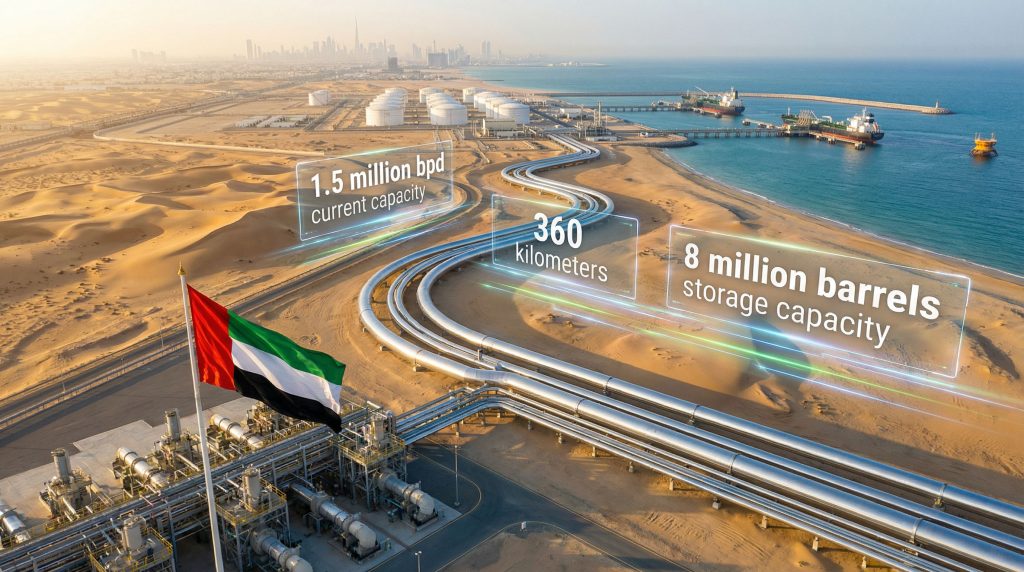
The Habshan–Fujairah pipeline demonstrates advanced engineering principles through its 360-kilometer route connecting inland production facilities with coastal export terminals. This 48-inch diameter system maintains operational throughput of 1.5 million barrels per day with design capacity extending to 1.8 million bpd under optimised conditions.
| Specification Category | Current Operations | Maximum Potential |
|---|---|---|
| Daily Throughput | 1.5 million bpd | 1.8 million bpd |
| Annual Volume Capacity | 547.5 million barrels | 657 million barrels |
| Export Route Share | Approximately 50% | Up to 60% capability |
| Marine Loading Rate | 80,000 barrels/hour per SPM | 240,000 bbl/hr combined |
The system architecture incorporates three critical operational nodes that optimise flow management and provide operational flexibility. The primary Habshan pump station features buffer tank storage enabling surge capacity management during production variations. Consequently, an intermediate booster facility at Sweihan maintains optimal pressure across the pipeline's full distance, while the Fujairah marine terminal provides comprehensive storage and loading capabilities.
Engineering redundancy systems ensure operational continuity through multiple backup mechanisms. Moreover, buffer tank configurations allow maintenance scheduling without disrupting export operations, while distributed pumping stations prevent single-point failures from affecting the entire system.
Strategic Route Optimisation and Geographic Advantages
Route selection for major pipeline projects requires balancing multiple factors including terrain challenges, environmental considerations, and operational accessibility. The Habshan–Fujairah system follows an eastward trajectory that maximises efficiency whilst minimising environmental impact across diverse geographic regions.
The carefully engineered path extends from Abu Dhabi's inland processing facilities through the Sweihan industrial corridor, avoiding major urban centres whilst maintaining proximity to existing transportation networks. This routing strategy provides several operational benefits:
- Terrain optimisation: Strategic path selection minimises elevation challenges and construction complexity
- Maintenance accessibility: Proximity to road networks enables efficient pipeline monitoring and repair operations
- Environmental mitigation: Route design reduces impact on sensitive ecological areas whilst maintaining operational integrity
- Urban avoidance: Path selection west of Al Ain's urban areas reduces construction constraints and safety considerations
However, the pipeline's strategic importance extends beyond simple routing efficiency. The direct connection to Gulf of Oman shipping lanes provides significant logistical advantages compared to traditional Persian Gulf export routes. This alternative pathway eliminates dependence on the Strait of Hormuz, a critical maritime chokepoint through which approximately one-fifth of global oil transit occurs along with substantial liquefied natural gas volumes.
Recent geopolitical events have validated this strategic routing decision, with regional disruptions demonstrating the vulnerability of Hormuz-dependent export systems. In addition, the pipeline's operational resilience during these periods highlights the value of diversified export infrastructure.
Marine Terminal Capabilities and Storage Infrastructure
The Fujairah marine terminal represents state-of-the-art crude oil export infrastructure designed to accommodate the world's largest tanker vessels. The facility's three single-point mooring systems enable simultaneous loading operations, significantly reducing port congestion and vessel waiting times during peak export periods.
Terminal storage architecture provides crucial operational flexibility through eight dedicated storage tanks offering 8 million barrels of working inventory capacity. This configuration enables several critical functions:
- Crude oil blending operations: Separate storage for different crude grades enables custom blending to meet specific customer requirements
- Quality assurance protocols: Dedicated storage allows comprehensive testing and certification before export shipments
- Inventory management: Strategic stock levels ensure continuous export operations during maintenance or production variations
- Surge capacity handling: Storage systems accommodate production fluctuations from upstream facilities
The terminal's design accommodates vessels ranging from medium-sized tankers to very large crude carriers (VLCCs), with loading rates reaching 80,000 barrels per hour per single-point mooring. Furthermore, combined SPM capacity enables total loading rates of 240,000 barrels per hour, providing efficient vessel turnaround and reduced demurrage costs.
Export Route Diversification and Risk Management
Alternative export routing provides measurable risk reduction compared to traditional Hormuz-dependent systems. The Habshan–Fujairah pipeline's capacity to maintain operations during regional maritime disruptions demonstrates the strategic value of diversified transportation infrastructure.
| Export Route Category | Daily Capacity | Chokepoint Vulnerability | Alternative Access |
|---|---|---|---|
| Hormuz-dependent routes | 3.2 million bpd | High geopolitical risk | Limited bypass options |
| Direct Gulf of Oman access | 1.8 million bpd | Minimal vulnerability | Multiple shipping corridors |
| Combined system capacity | 5.0 million bpd | Diversified risk profile | Enhanced operational flexibility |
This dual-route capability ensures approximately 36% of UAE crude exports can continue flowing during complete Hormuz disruptions, providing critical supply stability for international markets. In fact, commodity market volatility has demonstrated this capability's real-world value, with export operations continuing despite regional maritime tensions.
The direct Gulf of Oman access eliminates several cost factors associated with traditional routing:
- Insurance premium reductions: Direct ocean access eliminates high-risk zone surcharges
- Shipping distance optimisation: Alternative routes reduce transportation time to major Asian markets
- Market access enhancement: Direct routing provides access to different customer bases and pricing mechanisms
- Operational cost savings: Reduced transit time decreases overall transportation expenses
Integration with National Energy Infrastructure Networks
The pipeline system integrates seamlessly with Abu Dhabi's broader energy infrastructure, connecting upstream production facilities with downstream processing and export capabilities. This integration enables flexible supply management based on market conditions and operational requirements.
Operational integration benefits include:
- Flexible supply allocation: Crude can be directed to export or domestic refining based on market conditions
- Enhanced processing support: Direct pipeline connection supports expanded refining operations at Fujairah
- Strategic reserve capability: System integration supports national petroleum reserve management requirements
- Downstream coordination: Pipeline operations coordinate with petrochemical and refining facilities
The Fujairah hub has evolved beyond simple export functionality, becoming one of the world's major marine fuel bunkering centres. Additionally, US oil production trends highlight how the facility serves thousands of vessels transiting between Asia, Europe, and Africa, producing substantial volumes of marine fuel oil and low-sulfur bunker fuel for international shipping operations.
Expansion Potential and Technological Enhancement Opportunities
Current engineering assessments indicate substantial potential for capacity expansion through targeted infrastructure improvements. Several technical modification scenarios could increase system throughput and operational efficiency through industry innovation trends.
Primary expansion opportunities:
- Enhanced pumping systems: Upgraded pump station capacity could increase throughput to 2.0 million bpd
- Expanded storage infrastructure: Additional tank farms could support increased inventory management capabilities
- Smart pipeline integration: Advanced monitoring systems could optimise flow rates and reduce operational costs
- Loading system expansion: Additional single-point moorings could further reduce vessel waiting times
These enhancement opportunities reflect ongoing technological advancement in pipeline operations and marine terminal management. Implementation of advanced monitoring systems enables real-time optimisation of flow rates, pressure management, and maintenance scheduling.
Comparative Analysis with Global Pipeline Systems
The Habshan–Fujairah pipeline ranks amongst the world's most strategically significant crude oil transportation systems, comparable to other major bypass pipelines in terms of geopolitical importance and operational capability.
| International System | Capacity (million bpd) | Strategic Function | Bypass Capability |
|---|---|---|---|
| Saudi East-West Pipeline | 7.0 | Hormuz bypass | Red Sea access |
| Habshan–Fujairah System | 1.8 | Regional stability | Gulf of Oman direct |
| Russia's Druzhba Pipeline | 1.6 | European supply | Multiple route options |
| Iraq-Turkey Pipeline | 1.6 | Mediterranean access | Regional export |
The system's strategic positioning provides the UAE with enhanced export capabilities that extend beyond transportation efficiency. However, UAE's strategic energy infrastructure demonstrates how the pipeline's ability to maintain crude oil flows during regional disruptions, combined with integration into broader energy infrastructure networks, establishes it as a critical component of global energy supply chain resilience.
What Makes This System Operationally Resilient During Regional Disruptions?
Recent events have validated the pipeline's strategic design philosophy, with continued operations during periods when traditional export routes faced significant challenges. The facility's ability to resume operations quickly following disruptions demonstrates both infrastructure resilience and operational expertise.
The terminal's role becomes particularly critical during regional maritime tensions, when shipping companies require safe refuelling points and reliable cargo loading facilities. Consequently, this dual functionality as both export terminal and marine services hub provides additional operational value during crisis periods.
Furthermore, OPEC market influence continues to shape regional pipeline utilisation patterns. As international energy markets continue evolving toward greater complexity and volatility, strategic infrastructure investments like the Habshan–Fujairah pipeline provide measurable competitive advantages for resource-rich nations. The combination of operational efficiency, geographic advantages, and integration capabilities establishes this system as a model for strategic energy infrastructure development in other regions facing similar geopolitical challenges.
This analysis is based on publicly available information and industry assessments. Operational specifications and capacity figures should be verified against official sources for investment or operational planning purposes.
Looking to Invest in Energy Infrastructure Companies?
Discovery Alert's proprietary Discovery IQ model delivers real-time alerts on significant mineral and energy sector discoveries across the ASX, instantly empowering subscribers to identify actionable opportunities ahead of the broader market. Understand why historic discoveries can generate substantial returns and begin your 14-day free trial today to position yourself ahead of the market.