June 10, 2026
Advanced Fleet Coordination Technology Transforms Mining Operations
Underground mining operations face inherent challenges with vehicle coordination across multiple depth levels, narrow passages, and complex routing requirements. Traditional fleet management systems have operated primarily within single-level frameworks, limiting their ability to optimise traffic flow across the vertical dimensions of modern mine architectures. The Epiroc autonomous truck haulage 3D technology represents a significant technological advancement in autonomous mining operations.
Modern underground mines increasingly feature complex multi-level ramp systems that require sophisticated coordination between autonomous vehicles operating at different depths simultaneously. The integration of real-time spatial mapping, advanced sensor networks, and intelligent traffic management algorithms enables seamless coordination across these challenging environments.
When big ASX news breaks, our subscribers know first
Understanding Autonomous Mining Technology Evolution
The progression from manual to automated mining operations has followed a predictable trajectory, beginning with simple guidance systems and evolving toward comprehensive autonomous fleet management. Early automation focused on predetermined routes within confined areas, typically operating on single levels with limited vehicle interaction requirements.
Traditional automation limitations in underground environments include:
• Restricted to horizontal plane operations without vertical integration
• Limited real-time coordination capabilities between vehicles
• Manual intervention required for complex routing decisions
• Inability to optimise traffic flow across multiple mine levels simultaneously
The technological leap to three-dimensional coordination systems addresses these fundamental limitations by enabling autonomous vehicles to operate across multiple vertical levels with real-time awareness of fleet positioning throughout the entire mine network. This advancement represents more than an incremental improvement in existing technology.
Surface mining operations have successfully implemented large-scale autonomous vehicle coordination for several years, demonstrating the viability of comprehensive fleet management systems. However, underground environments present unique challenges including limited GPS availability, confined spaces, and complex three-dimensional routing requirements that surface systems cannot address directly.
Furthermore, the mining industry evolution has accelerated the adoption of autonomous technologies across various operational aspects. This trend emphasises the growing importance of integrated automation solutions that can handle complex underground environments.
Technical Architecture of 3D Autonomous Systems
The core technological framework underlying three-dimensional autonomous haulage differs fundamentally from traditional two-dimensional systems through its ability to process and coordinate vehicle movements across multiple vertical planes simultaneously.
Real-Time Spatial Mapping and Navigation
Advanced 3D systems employ sophisticated spatial mapping algorithms that maintain continuous awareness of vehicle positioning across all active mine levels. These systems process positioning data from multiple sensor sources to create comprehensive three-dimensional maps of vehicle locations, destinations, and optimal routing paths.
The navigation algorithms continuously calculate optimal routes for each vehicle while considering the positions and intended paths of all other autonomous vehicles operating within the mine network. This real-time processing capability enables dynamic route adjustments based on changing operational conditions.
Moreover, 3D geological modelling techniques integrate with navigation systems to provide accurate representations of mine structures and terrain variations that autonomous vehicles must navigate.
Multi-Level Terrain Recognition
Underground autonomous systems must navigate complex terrain variations across multiple depth levels, including varying gradients, narrow passages, and designated meeting points. Advanced terrain recognition capabilities enable vehicles to identify and adapt to these environmental challenges automatically.
Key terrain recognition capabilities include:
• Identification of narrow drift configurations where passing is impossible
• Recognition of designated meeting points for coordinated vehicle encounters
• Adaptation to varying ramp gradients and surface conditions
• Real-time obstacle detection and avoidance protocols
Advanced Sensor Fusion for Underground Positioning
Underground mining environments present unique positioning challenges due to limited GPS availability and complex electromagnetic interference patterns. Advanced sensor fusion techniques combine multiple positioning methodologies to maintain precise vehicle location awareness.
These systems integrate data from inertial navigation systems, wheel odometry, laser scanning sensors, and proprietary positioning beacons installed throughout mine infrastructure. The combination of multiple positioning sources ensures continuous location accuracy even in challenging underground conditions.
Operational Framework Components
The operational framework supporting Epiroc autonomous truck haulage 3D encompasses multiple integrated systems working in coordination to manage fleet operations across complex underground environments.
Fleet Orchestration Protocols
Comprehensive fleet orchestration requires sophisticated protocols for managing vehicle interactions across multiple levels and routing scenarios. These protocols govern vehicle prioritisation, route assignment, and coordination at designated meeting points.
According to industry implementation reports, intelligent traffic management logic eliminates deadlocks and delays by orchestrating meet-and-pass events at predefined meeting points. This approach ensures that autonomous mine trucks proactively avoid encounters in narrow drifts where passing is impossible, maintaining smooth traffic flow and uninterrupted operations.
Advanced orchestration protocols include:
• Dynamic priority assignment based on load status and destination requirements
• Predictive scheduling of vehicle encounters at optimal meeting locations
• Real-time route optimisation based on current fleet positioning
• Emergency response protocols for equipment failures or unexpected obstacles
Traffic Management Algorithms
Sophisticated traffic management algorithms prevent bottlenecks and collisions through predictive analysis of vehicle movements and proactive intervention when potential conflicts are identified. These algorithms continuously monitor fleet positioning and adjust vehicle speeds or routes to maintain optimal traffic flow.
The algorithms process multiple variables simultaneously, including vehicle load status, destination priorities, current positioning, and infrastructure constraints to make real-time routing decisions that optimise overall fleet efficiency.
Communication Systems Integration
Continuous communication between autonomous vehicles and central control systems enables coordinated operations across vertical mine levels. These communication networks provide real-time data exchange regarding vehicle status, positioning, and operational objectives.
Modern underground communication systems utilise robust wireless networks designed to operate reliably in challenging underground environments. The communication infrastructure supports both vehicle-to-vehicle coordination and centralised fleet management oversight.
Multi-Level Ramp Operations and 3D Automation Benefits
Complex multi-level ramp systems represent one of the most challenging environments for autonomous vehicle coordination, requiring sophisticated management of vehicle interactions across multiple vertical levels with varying access points and routing constraints.
Enhanced Traffic Flow Management
Three-dimensional automation systems provide significant improvements in traffic flow management through predictive coordination of vehicle movements across multiple ramp levels. This capability eliminates many of the delays and inefficiencies associated with traditional manual or two-dimensional automated systems.
Predictive coordination mechanisms include:
• Automated scheduling of meet-and-pass events at optimal waypoints
• Dynamic route adjustment based on real-time fleet positioning data
• Elimination of manual intervention requirements in narrow drift scenarios
• Coordinated vehicle speed adjustments to prevent traffic congestion
Real-world implementation at Agnico Eagle's Odyssey Mine in Canada demonstrates the practical effectiveness of these coordination capabilities. According to mine automation leadership, trials have progressed successfully and demonstrate tangible progress toward more efficient and safer operations.
Safety Improvements Through Intelligent Systems
Advanced autonomous systems provide substantial safety improvements through proactive collision avoidance and reduced human exposure to hazardous underground environments. These safety benefits extend beyond simple accident prevention to encompass comprehensive risk reduction across all operational scenarios.
Key safety enhancement features include:
• Proactive collision avoidance in confined underground spaces
• Reduced human operator exposure to hazardous mining environments
• Automated emergency response protocols for equipment failures
• Predictable vehicle behaviour eliminating human factor variability
Industry experts confirm that autonomous systems make fast, intelligent decisions to boost safety, reduce downtime, and increase overall efficiency. Whether vehicles are sharing ramps or collaborating on joint assignments, advanced automation ensures optimal task completion while maintaining safety protocols.
Performance Metrics for 3D Autonomous Haulage
Comprehensive performance measurement requires evaluation of multiple operational parameters that demonstrate the effectiveness of three-dimensional autonomous systems compared to traditional mining operations.
Operational Efficiency Metrics
| Performance Indicator | Traditional Operations | 3D Autonomous Systems | Improvement Potential |
|---|---|---|---|
| Fleet Utilisation Rate | 65-75% | 85-95% | 20-30% increase |
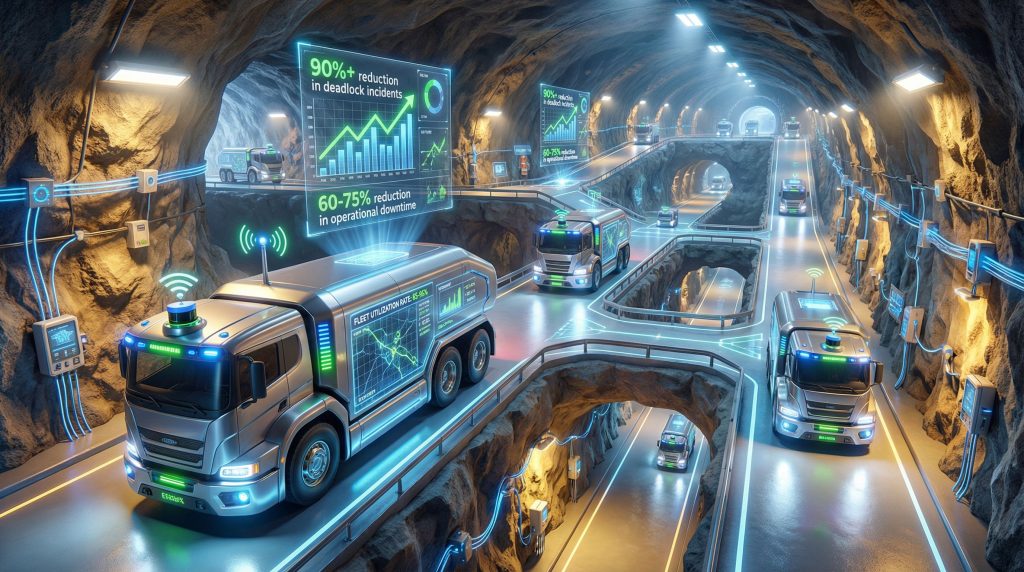
| Traffic Coordination Incidents | 15-25 per shift | 0-2 per shift | 90%+ reduction |
| Operational Downtime | 8-12 hours/week | 2-4 hours/week | 60-75% reduction |
| Safety Performance | Variable | Consistently high | Significant improvement |
Note: Performance metrics vary significantly based on mine configuration, operational scale, and implementation methodology. These figures represent potential improvements observed in controlled testing environments and may not reflect all operational scenarios.
Productivity Enhancement Factors
The implementation of 3D autonomous systems enables several productivity enhancement factors that compound to deliver substantial operational improvements:
Continuous Operations Capability:
• 24/7 operations without shift breaks or human factor delays
• Consistent operational parameters regardless of external conditions
• Elimination of human-factor inefficiencies and decision delays
Optimised Resource Utilisation:
• Improved ore grade control through precise material handling protocols
• Enhanced mine planning accuracy with real-time operational data integration
• Reduced equipment wear through consistent operational parameters
In addition, AI in mining automation continues to enhance these productivity factors through machine learning algorithms that optimise operations over time.
The next major ASX story will hit our subscribers first
Optimal Mining Operations for 3D Automation Implementation
Certain underground mining characteristics provide optimal conditions for successful Epiroc autonomous truck haulage 3D implementation, maximising the return on investment and operational benefits.
Mine Configuration Requirements
Multi-level operations with complex ramp systems represent the ideal implementation environment for 3D autonomous technology. These configurations benefit most from sophisticated traffic coordination capabilities and real-time fleet management across multiple vertical levels.
High-volume production operations requiring continuous haulage benefit substantially from 24/7 autonomous operations without human limitations. The consistent productivity enabled by autonomous systems provides significant advantages in high-throughput environments.
Deep underground workings where safety risks are elevated benefit from reduced human exposure and predictable autonomous vehicle behaviour. These environments often feature confined spaces and challenging navigation requirements that autonomous systems handle more effectively than human operators.
Narrow drift configurations limiting manual passing manoeuvres represent ideal applications for automated meet-and-pass coordination. Autonomous systems can coordinate vehicle encounters at predetermined locations, eliminating delays and safety risks associated with manual coordination.
Implementation Considerations
Successful implementation requires careful evaluation of existing fleet compatibility and infrastructure requirements. Modern autonomous systems support retrofit capabilities for existing fleet assets, enabling gradual transition to autonomous operations.
Equipment Compatibility Assessment:
Current autonomous-ready mining trucks include specific models designed for immediate automation implementation. Epiroc's Minetruck MT54 S and MT65 S models feature automation-ready configurations, forming powerful combinations for mines seeking to automate their underground fleets.
Infrastructure Modification Requirements:
Implementation typically requires infrastructure modifications for sensor networks and communication systems throughout the mine. These modifications support real-time vehicle positioning and coordination capabilities essential for 3D autonomous operations.
Staff Training and Operational Adaptation:
Transition to autonomous operations requires comprehensive staff training on new operational procedures and system oversight capabilities. Recent upgrades to Deep Automation systems are applicable for all underground Scooptram loaders compatible with the technology, requiring coordinated training across multiple equipment types.
However, implementing underground mining innovations alongside autonomous systems requires careful coordination to ensure compatibility between different technologies.
Intelligent Traffic Management in Practice
Real-world implementation of intelligent traffic management demonstrates the practical effectiveness of 3D autonomous coordination in challenging underground environments.
Predictive Coordination Algorithms
Advanced algorithms continuously analyse fleet positioning and destination routing to predict potential conflicts and proactively coordinate vehicle movements. This predictive approach eliminates reactive decision-making and ensures smooth traffic flow across complex multi-level ramp systems.
The algorithms automatically schedule meet-and-pass events at optimal locations based on vehicle load status, destination requirements, and current positioning data. This automated scheduling ensures that vehicles encounter each other only at designated waypoints where passing is safe and efficient.
Dynamic speed and route adjustments prevent congestion before it occurs by modifying vehicle operations based on real-time traffic conditions. These adjustments maintain optimal flow rates across the entire mine network without requiring manual intervention.
Communication Protocol Integration
Continuous data exchange between autonomous vehicles enables coordinated decision-making across the entire fleet. This communication integration supports both vehicle-to-vehicle coordination and centralised oversight capabilities.
Central control systems maintain oversight and intervention capabilities for unexpected operational scenarios while allowing autonomous systems to manage routine coordination tasks independently. Emergency override functions ensure human operators can intervene when necessary while maintaining normal autonomous operations.
Industry implementations confirm that evolved autonomous systems empower operators with real-time, three-dimensional visibility of their machines underground. This visibility enables comprehensive fleet management while reducing the burden on human operators.
Economic Implications of 3D Autonomous Haulage
The economic impact of implementing Epiroc autonomous truck haulage 3D systems extends across multiple operational areas, providing both direct cost reductions and productivity enhancements that compound to deliver substantial financial benefits.
Direct Cost Reduction Areas
Labour Cost Optimisation:
Autonomous systems reduce requirements for human operators while enabling existing personnel to focus on higher-value oversight and maintenance activities. This optimisation typically results in improved productivity per employee rather than workforce reduction.
Maintenance Efficiency Improvements:
Precision vehicle operation through automated systems reduces equipment wear and enables predictive maintenance scheduling based on actual operational data rather than estimated intervals.
Fuel Consumption Reduction:
Optimised routing algorithms and consistent operational parameters typically result in reduced fuel consumption compared to manual operations with variable human decision-making factors.
Equipment Longevity Enhancement:
Consistent operational parameters and reduced human factor variability often extend equipment service life through reduced wear and optimised operating conditions.
Productivity Enhancement Economics
The economic benefits of continuous 24/7 operations compound significantly over time, as autonomous systems eliminate shift breaks, human factor delays, and variable operational efficiency. These productivity improvements often exceed the direct cost savings in overall economic impact.
Improved ore grade control through precise material handling protocols can enhance overall mine value recovery by ensuring appropriate material classification and processing routing.
Enhanced mine planning accuracy with real-time operational data enables more effective resource allocation and production scheduling, reducing waste and optimising overall operational efficiency.
Mixed Fleet Operations and 3D System Integration
Modern mining operations typically feature diverse equipment from multiple manufacturers, requiring autonomous systems to coordinate effectively across different vehicle types and OEM platforms.
Multi-Manufacturer Compatibility
Advanced autonomous platforms support OEM-agnostic integration, enabling diverse equipment brands to operate within unified autonomous coordination systems. This compatibility ensures that mines can implement autonomous technology without requiring complete fleet replacement.
Standardised communication protocols across different vehicle types enable seamless coordination between trucks, loaders, and other autonomous equipment regardless of manufacturer. This standardisation reduces implementation complexity and costs while maximising fleet utilisation.
Retrofit capabilities for existing fleet assets enable gradual transition to autonomous operations without requiring immediate capital investment in new equipment. These capabilities support phased implementation approaches that align with operational requirements and budget constraints.
Scalability and Implementation Phases
Successful autonomous implementation typically follows a phased approach that enables gradual system integration and operational adaptation:
Phase 1: Collision Avoidance and Basic Automation
• Implementation of fundamental safety systems and vehicle coordination
• Basic autonomous operation in designated areas with limited complexity
• Staff training and procedural adaptation for autonomous systems oversight
Phase 2: Partial Autonomous Operation
• Expansion of autonomous zones to include additional mine areas
• Integration of traffic management algorithms for improved coordination
• Implementation of predictive maintenance and performance monitoring systems
Phase 3: Full 3D Autonomous Fleet Coordination
• Complete implementation of three-dimensional fleet coordination capabilities
• Integration across all mine levels and operational areas
• Advanced predictive algorithms for optimal traffic flow and productivity
Phase 4: Broader Mine Automation System Integration
• Integration with production planning and resource allocation systems
• Connection to broader mine automation and Industry 4.0 technologies
• Advanced analytics and machine learning implementation for continuous optimisation
Real-Time Data and Operational Intelligence
The foundation of effective 3D autonomous operations relies on comprehensive real-time data collection, processing, and analysis to enable intelligent decision-making across all operational scenarios.
Operational Intelligence Systems
Continuous monitoring of vehicle performance and positioning provides the data foundation for intelligent fleet coordination and predictive maintenance scheduling. These systems process vast amounts of operational data to identify patterns and optimise performance.
Real-time operational data integration with mine planning and production optimisation systems enables dynamic adjustment of operational parameters based on actual conditions rather than static planning assumptions.
Predictive maintenance scheduling based on actual operational data rather than estimated intervals reduces unexpected downtime and extends equipment service life through optimised maintenance timing.
Decision-Making Algorithms
Advanced algorithms process operational intelligence to make real-time decisions regarding route optimisation, load balancing, and emergency response coordination.
Route optimisation algorithms continuously evaluate current traffic conditions, vehicle positioning, and destination requirements to identify optimal routing for each vehicle in the fleet.
Load balancing protocols distribute traffic across multiple haulage circuits to prevent congestion and optimise overall throughput across the mine network.
Emergency response coordination algorithms automatically implement appropriate responses for equipment failures or infrastructure issues while maintaining operational continuity for unaffected systems.
Impact on Mine Planning and Design
The implementation of 3D autonomous haulage systems influences mine planning and design considerations, requiring infrastructure adaptations to support optimal autonomous operations.
Infrastructure Requirements
Enhanced communication network coverage throughout all mine levels ensures continuous connectivity for autonomous vehicle coordination. This infrastructure must provide reliable coverage in challenging underground environments with electromagnetic interference and physical obstacles.
Standardised meeting point design for autonomous vehicle coordination requires specific geometric configurations to enable safe and efficient vehicle encounters. These design standards ensure consistent coordination capabilities across all mine areas.
Integration with existing systems including ventilation and safety infrastructure ensures that autonomous operations complement rather than interfere with essential mine safety systems.
Operational Workflow Changes
The transition from reactive to predictive maintenance scheduling fundamentally changes maintenance workflow and resource allocation requirements. Autonomous systems provide detailed operational data that enables more effective maintenance planning.
Enhanced production planning accuracy through real-time operational data enables more precise scheduling and resource allocation based on actual rather than estimated operational capabilities.
Improved resource allocation based on autonomous fleet capabilities enables optimisation of personnel deployment and equipment utilisation across all operational areas.
Future Developments in Underground Autonomous Technology
The evolution of underground autonomous technology continues to advance through integration with emerging technologies and broader Industry 4.0 developments.
Emerging Technological Trends
Artificial intelligence integration for advanced decision-making capabilities represents the next evolution in autonomous mining technology. AI systems can process complex operational scenarios and identify optimisation opportunities beyond current algorithmic capabilities.
Machine learning algorithms enable continuous improvement in operational efficiency by analysing historical performance data and identifying patterns that inform future decision-making processes.
5G connectivity implementation enables faster data transmission and reduced response times, supporting more sophisticated real-time coordination and decision-making capabilities.
Digital twin technology for virtual mine operation modelling enables comprehensive testing and optimisation of autonomous systems before implementation, reducing risk and improving performance.
Industry-Wide Implications
The standardisation of autonomous vehicle communication protocols across the mining industry enables greater interoperability and reduced implementation costs as the technology matures.
Integration with broader Industry 4.0 mining technologies creates comprehensive automated mining ecosystems that optimise operations across all functional areas.
Enhanced sustainability through optimised energy consumption and reduced waste generation aligns with broader mining industry environmental objectives.
Improved worker safety through reduced underground exposure represents a fundamental shift in mining operational philosophy toward technology-enabled risk reduction.
According to Epiroc's latest developments, these technological advancements continue to drive the evolution of autonomous mining systems.
Investment Considerations:
The implementation of 3D autonomous haulage systems requires substantial capital investment and operational changes. Mining companies should carefully evaluate their specific operational requirements, existing infrastructure, and long-term strategic objectives before implementation. Economic benefits typically materialise over multi-year timeframes, requiring patient capital and comprehensive change management approaches.
The development of three-dimensional autonomous haulage represents a significant advancement in underground mining technology, enabling improved safety, productivity, and operational efficiency across complex multi-level mining operations. Successful implementation requires careful planning, appropriate mine characteristics, and comprehensive integration with existing operational systems.
Are You Positioned to Capitalise on Mining Automation Investments?
Discovery Alert's proprietary Discovery IQ model delivers instant notifications when ASX mining companies announce breakthrough automation technologies and operational enhancements that could drive significant share price movements. With mining automation investments transforming operations and creating substantial value, subscribers gain immediate market insights to identify actionable opportunities ahead of the broader investment community.