June 27, 2026
The Orange Basin's Geological Blueprint: Why This Margin Was Always Destined for Major Oil
Passive continental margins have a geological logic to them. Over tens of millions of years, rivers carry enormous volumes of sediment from continental interiors toward coastlines, where it accumulates in thick, submarine wedges. Under the right conditions of burial, heat, and organic richness, those sediments become the source rocks and reservoir systems that define world-class oil provinces. The Orange Basin, straddling the deepwater Atlantic margin of Namibia and South Africa, possesses precisely this architecture, and the industry has spent the better part of four years confirming what the geology always suggested was possible.
The basin's structural framework shares important characteristics with other passive margin systems that preceded major production phases. Brazil's pre-salt play, which transformed that country into a top-ten global oil producer, developed from analogous deepwater turbidite and carbonate systems along a conjugate South Atlantic margin. The Gulf of Mexico's deepwater renaissance followed a similar pattern of progressive geological de-risking before capital-intensive development phases commenced. These comparisons matter not because outcomes are guaranteed, but because they provide a credible developmental roadmap for what the Orange Basin could become over the next decade.
What distinguishes the Orange Basin from many comparable frontier plays is the quality signature of the hydrocarbons being encountered. Multiple wells across the basin have intersected light crude oil, typically above 35° API gravity, with limited volumes of associated natural gas. From a refining economics standpoint, this is a highly desirable combination. Light oil yields a higher proportion of premium refined products such as gasoline, jet fuel, and diesel per barrel processed, commanding pricing advantages in international markets relative to heavier crude grades. The low associated gas volumes simplify surface facility design, reduce flaring risks, and generally compress the complexity and cost of production system engineering.
Furthermore, understanding crude oil price trends in the Atlantic Basin context helps contextualise why operators are accelerating exploration activity here rather than in more mature, higher-cost provinces.
When big ASX news breaks, our subscribers know first
QatarEnergy's Namibia Portfolio: Four Licenses, One Strategic Conviction
From Domestic Dominance to Global Frontier Operator
QatarEnergy's transformation from a domestically focused liquefied natural gas giant into a globally active upstream explorer represents one of the more deliberate strategic pivots among national oil companies over the past decade. The financial capacity derived from its commanding position in global LNG markets has provided the capital base to pursue high-impact exploration opportunities across multiple continents simultaneously. Namibia sits at the intersection of several criteria that make frontier acreage attractive to a long-cycle investor: underexplored geology, a maturing regulatory environment, and the demonstrated presence of commercial-quality hydrocarbons.
The structure of QatarEnergy's Namibian holdings reflects a considered approach to risk distribution across a single basin. Holding interests in four separate licenses, each with a different equity stake, allows the company to spread geological and commercial risk while retaining meaningful exposure to the basin's full prospective upside. Indeed, the QatarEnergy oil discovery offshore Namibia at Merlin-1X is the latest in a sequence of results that continue to validate this strategic conviction.
QatarEnergy's Four Namibian Licenses at a Glance
| License | QatarEnergy Equity | Key Partners | Status |
|---|---|---|---|
| PEL 0039 | 45% | Shell, NAMCOR | Most active; four discoveries |
| PEL 0056 | 35.25% | Undisclosed | Active exploration |
| PEL 0091 | 33.03% | Undisclosed | Active exploration |
| PEL 0090 | 27.5% | Undisclosed | Active exploration |
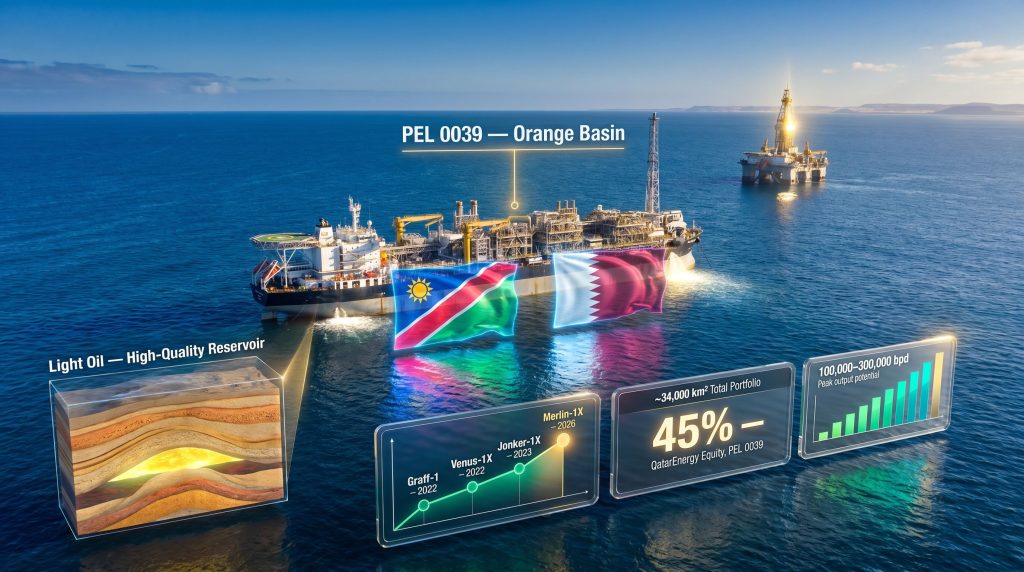
The combined acreage across all four licenses totals approximately 34,000 square kilometres, a substantial footprint by any deepwater exploration standard. PEL 0039, where QatarEnergy holds its largest equity position of 45%, has been the most productive license in the portfolio and the one delivering the most consistent discovery results to date.
The partnership structure in PEL 0039 is strategically significant beyond simple equity percentages. Shell's co-participation brings not only technical depth in deepwater drilling and subsea engineering, but also the kind of commercial credibility that influences future project financing discussions, offtake negotiations, and the construction of the multi-billion dollar FPSO vessels that deepwater fields ultimately require. NAMCOR, the National Petroleum Corporation of Namibia, participates as a carried interest partner, a common arrangement in frontier African acreage where host-country entities receive a working interest funded partly by their commercial partners through the exploration phase.
The Discovery Sequence: A Pattern of Progressive De-Risking
Understanding the Merlin-1X result in isolation misses the broader geological narrative unfolding across PEL 0039 and the wider Orange Basin. The discovery sequence tells a story of systematic basin evaluation:
- 2022 – Graff-1: The foundational discovery that validated commercial hydrocarbon presence in the Orange Basin and catalysed industry-wide attention toward Namibia's deepwater acreage.
- 2022 – Venus-1X: Confirmed the basin's prospectivity was not limited to a single structural trend, establishing that multiple play types coexist across the province.
- 2023 – Jonker-1X (PEL 0039): Drilled approximately 270 kilometres offshore, confirmed as a light oil discovery, and marked QatarEnergy's third Namibian find.
- 2026 – Merlin-1X (PEL 0039): The tenth well drilled under PEL 0039, delivering the most technically encouraging subsurface results in the license's entire drilling history.
Each successive well has not merely added discovered volumes to the tally. More importantly, each result has expanded the geological understanding of the Orange Basin's producibility, reservoir continuity, and commercial viability, progressively converting speculative prospectivity into investment-grade geological knowledge.
Decoding Merlin-1X: What the Subsurface Tells Us
The Technical Significance of Being the Tenth Well
In exploration geology, there is a well-understood concept called play maturation, which describes how geological uncertainty diminishes as more wells are drilled within a defined license or play fairway. Early wildcat wells in a new province carry maximum geological uncertainty because operators are testing unvalidated models of reservoir presence, trap geometry, and hydrocarbon charge. By the time a license reaches its tenth well, the geological model has been calibrated, refined, and pressure-tested across multiple data points.
This is precisely why Merlin-1X being described as the strongest subsurface outcome in PEL 0039's ten-well drilling history carries meaningful signal value. It suggests that the geological model underpinning the license is not only valid but is converging on its highest-quality targets. The practical implication is that remaining prospective structures within the license may be better understood and more accurately risked than comparable targets were when drilling first began.
Breaking Down the Reservoir Quality Indicators
Three technical characteristics of Merlin-1X deserve particular attention from an investment and development economics perspective:
- Good reservoir quality refers to the combination of porosity (the percentage of void space within the rock that can store fluids) and permeability (the capacity of those pores to transmit fluids to a wellbore). High values in both parameters translate directly into better well productivity and lower recovery costs per barrel.
- Light oil classification (typically above 35° API gravity) indicates a crude with a molecular composition that refinery operators globally prefer. Asian refineries in particular, many of which are configured for lighter crude slates, represent a natural market for Atlantic Basin light oil of this type.
- Limited associated gas reduces project complexity in ways that are not always obvious to non-technical observers. High gas-to-oil ratios in deepwater fields create significant engineering challenges around gas handling, compression, and disposal, all of which add capital and operating cost. A predominantly oil system with minimal gas simplifies the production architecture considerably.
What Did QatarEnergy Discover at Merlin-1X? QatarEnergy confirmed a new oil discovery at the Merlin-1X exploration well within PEL 0039, offshore Namibia. As the tenth well drilled under this license, Merlin-1X delivered the most technically promising subsurface results in the license's history, characterised by high-quality reservoir rock, light crude oil, and minimal associated gas volumes. The result further consolidates the Orange Basin's standing as an emerging world-class hydrocarbon province.
Namibia's Energy Economy: The Long Road From Frontier to Producer
Fiscal Transformation and Infrastructure Prerequisites
Namibia currently relies heavily on energy imports to meet domestic demand, a structural vulnerability that successful offshore oil development could fundamentally alter. However, the path from exploration discovery to production-stage revenue generation in deepwater African contexts typically spans seven to ten years, encompassing appraisal drilling, pre-front-end engineering design studies, final investment decisions, FPSO procurement and construction, and subsea installation campaigns.
Guyana's trajectory following ExxonMobil's Liza discovery in 2015 provides the most instructive recent parallel. First oil from the Liza Phase 1 project arrived in late 2019, roughly four years after discovery, an unusually rapid timeline driven by exceptional reservoir quality and investor urgency. For Namibia, where infrastructure is absent and multiple appraisal campaigns remain ahead, a more conservative timeline pointing toward the early-to-mid 2030s appears realistic.
That said, the accumulating discovery density across the Orange Basin creates a compelling argument for shared infrastructure development, where multiple fields utilise common FPSO assets and subsea tieback networks, a model that could compress per-barrel development costs meaningfully. Consequently, the role of oil in the global economy ensures that international capital will continue to flow toward basins demonstrating this level of geological consistency.
A Hypothetical Production Scenario for Namibia by 2035
The following scenario is speculative and based on analogous basin development trajectories. It does not represent confirmed production forecasts.
| Scenario Variable | Assumption |
|---|---|
| Fields entering production (2031-2035) | 3-4 across PEL 0039 and adjacent licenses |
| Peak production estimate | 100,000 to 300,000 barrels per day |
| Reference oil price | $70 per barrel |
| Gross revenue at 150,000 bpd | ~$3.8 billion per annum |
| Infrastructure requirement | 2-3 FPSO vessels, subsea tieback networks |
| Development capex range | $10-20 billion across all operators |
These numbers are broadly consistent with analyst speculation published across energy industry media, though actual outcomes will depend heavily on appraisal drilling results and prevailing oil market conditions.
Geopolitical and Regional Energy Dynamics
The Orange Basin's emergence is reshaping Southern Africa's energy geopolitics in ways that extend well beyond Namibia's borders. South Africa's offshore exploration activity has accelerated in response to discoveries on its side of the basin boundary. Angola, the region's established producer, is monitoring basin developments with interest as it seeks to extend production plateau from its own mature deepwater fields.
For global commodity markets, the prospect of Namibia emerging as a meaningful Atlantic Basin light oil exporter during the 2030s is particularly relevant to Asian refinery buyers seeking diversification away from Middle Eastern supply. In this context, oil price movements will play a critical role in determining when operators commit to final investment decisions across the basin. The geographic positioning of Namibian production on the Atlantic coast also provides flexible routing optionality toward both European and Asian markets.
Key Risks and Uncertainties Facing the Orange Basin Development Thesis
No honest assessment of this opportunity can bypass the substantial risks that sit between current exploration success and future commercial production. Investors and observers should weigh the following carefully:
- Appraisal risk: Exploration discoveries confirm the presence of hydrocarbons, not their commercial recoverability. Appraisal wells must confirm reservoir lateral continuity, net pay thickness across the field, and fluid contact depths before recoverable volumes can be estimated with investment-grade confidence.
- Infrastructure gap: Namibia possesses no deepwater production infrastructure. Every barrel produced will require purpose-built FPSO vessels, subsea wellhead trees, flowlines, and export systems, representing billions of dollars in capital that must be committed before a single barrel reaches market.
- Regulatory maturity: Namibia's petroleum fiscal regime, including production sharing agreement terms, royalty structures, and local content requirements, is still developing. Fiscal terms may evolve as the country's negotiating leverage increases with the confirmation of larger reserve volumes.
- Energy transition scenario risk: Deepwater projects with long development timelines must be evaluated against scenarios where peak global oil demand arrives before production commences, a risk that is particularly acute for projects targeting first oil in the 2032–2035 window.
- Project financing complexity: FPSO-based deepwater developments routinely require between $5 billion and $15 billion in capital expenditure. Securing that financing requires robust oil price assumptions, creditworthy project partners, and stable host-country fiscal terms, none of which can be fully guaranteed years in advance.
Furthermore, oil market stagnation driven by macroeconomic headwinds or geopolitical disruption could delay the commercial timelines for even the most technically promising projects in the basin.
Frequently Asked Questions: QatarEnergy Oil Discovery Offshore Namibia
What is PEL 0039 and where is it located?
PEL 0039 is an offshore petroleum exploration license situated in the deepwater Orange Basin, located roughly 270 kilometres from the Namibian coastline. It has hosted ten exploration wells and produced four oil discoveries, making it the most active and productive license in QatarEnergy's Namibian portfolio.
Who are the equity partners in PEL 0039?
QatarEnergy holds a 45% interest, Shell participates as a co-partner, and NAMCOR (the National Petroleum Corporation of Namibia) holds a carried interest position in the block.
How many oil discoveries has QatarEnergy made in Namibia to date?
As of mid-2026, QatarEnergy has announced four oil discoveries in Namibia: Graff-1 and Venus-1X in 2022, Jonker-1X in 2023, and Merlin-1X in 2026, all within the Orange Basin.
What does light oil with limited associated gas mean commercially?
Light crude, generally above 35° API gravity, yields a higher proportion of premium refined products per barrel and commands price premiums in global markets. Minimal associated gas reduces surface facility complexity, lowers capital costs, and minimises flaring-related regulatory and environmental exposure, collectively improving project economics relative to heavier, gassier crude systems.
When might Namibia realistically begin producing oil from these discoveries?
Based on comparable deepwater African development timelines, first oil from the Orange Basin is unlikely before the early-to-mid 2030s. Development milestones including appraisal drilling, concept selection, front-end engineering, and FPSO construction must all be completed sequentially before production can commence.
The next major ASX story will hit our subscribers first
The Strategic Calculus: What Comes After Merlin-1X
The QatarEnergy oil discovery offshore Namibia at Merlin-1X does not exist in isolation. It is the fourth data point in a discovery sequence that has consistently validated the Orange Basin's geological prospectivity while progressively improving the quality of subsurface information available for development planning. The fact that the tenth well in PEL 0039 delivered the strongest result in the license's history is a geological signal that deserves attention: it suggests the best targets within the license may not yet have been tested.
The next phase is critical. Appraisal drilling programmes must be designed to define recoverable volumes with sufficient confidence to support final investment decisions. Concept selection studies will need to evaluate whether individual discoveries warrant standalone development or whether a hub-and-spoke model, centralising multiple smaller accumulations around shared FPSO infrastructure, offers superior economics. Monitoring WTI and Brent futures will remain essential throughout this period, as project economics are directly sensitive to prevailing benchmark crude prices at the time of final investment decisions. These are multi-year processes that will unfold through the late 2020s before development decisions crystallise.
The cumulative evidence from four discoveries across the Orange Basin represents a structural shift in how the global upstream industry perceives Namibia's long-term production potential. QatarEnergy's portfolio, anchored by a 45% position in the basin's most active and prolific license, has evolved from a speculative frontier commitment into a multi-discovery asset cluster with genuine world-scale optionality. Whether that optionality is converted into production-stage value depends entirely on what the appraisal phase reveals, and on the oil market conditions that prevail when final investment decisions must be made.
Disclaimer: This article contains forward-looking statements, scenario projections, and speculative analysis based on publicly available information and analogous industry case studies. None of the production estimates, fiscal projections, or development timelines presented should be interpreted as confirmed forecasts or investment advice. Readers should conduct their own due diligence before making any investment decisions related to companies or assets discussed herein.
Want to Track the Next Major Energy or Mineral Discovery the Moment It Hits the ASX?
Discovery Alert's proprietary Discovery IQ model scans ASX announcements in real time, instantly transforming complex geological and commodity data into actionable investment insights — explore historic discoveries and the returns they generated, then begin your 14-day free trial at Discovery Alert to position yourself ahead of the broader market.