June 29, 2026
Advanced Geological Frameworks Define Strategic Antimony Development
Mineralisation systems hosted within complex geological environments require sophisticated analytical approaches to unlock their full resource potential. Australia's critical minerals strategy presents unique opportunities where legacy mining districts can be transformed through modern exploration methodologies and processing technologies. The integration of historical mining data with contemporary geophysical techniques creates pathways for significant resource expansion in previously developed areas.
The antimony sector represents one of the most strategically important segments within the critical minerals framework, with global supply chains facing substantial concentration risks. Understanding the technical complexities of antimony-gold systems requires comprehensive analysis of metallurgical properties, structural controls, and economic optimization strategies that extend far beyond conventional single-commodity approaches.
When big ASX news breaks, our subscribers know first
Geological Architecture of High-Grade Mineralisation Systems
New England Fold Belt Structural Controls
The New England Fold Belt provides the fundamental geological framework for understanding complex antimony-gold mineralisation patterns. This structural province hosts numerous high-grade deposits where mineralisation is controlled by intersecting fault systems, contact zones, and hydrothermal alteration processes.
Key Geological Features:
-
Structural complexity: Multiple deformation phases create intersection zones favourable for ore concentration
-
Lithological diversity: Contrasting rock types provide chemical and physical traps for mineralising fluids
-
Hydrothermal pathways: Regional fault networks channel metal-bearing solutions over extensive areas
-
Depth continuation: Structural controls suggest mineralisation extends significantly below historical mining depths
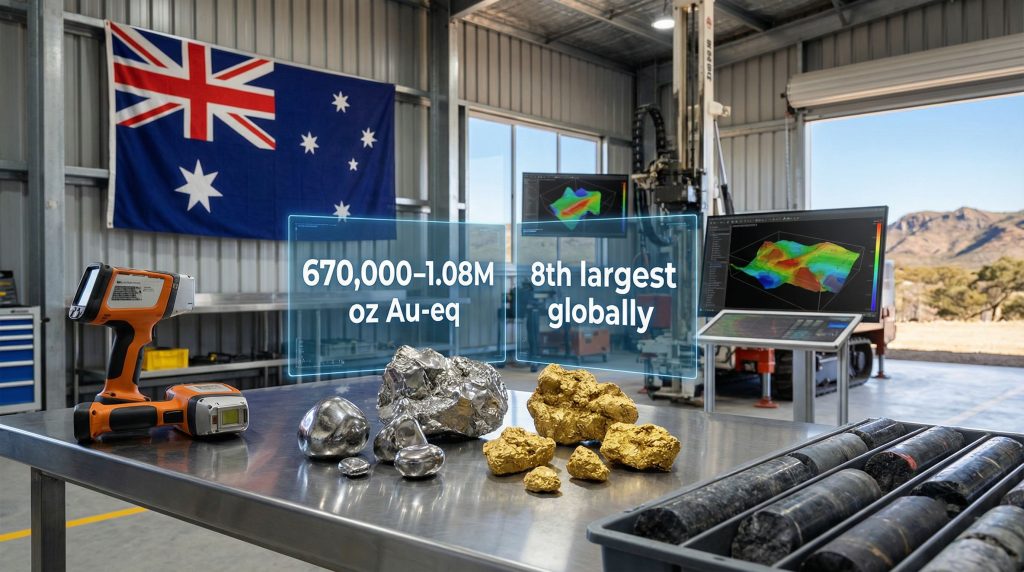
Resource classification within these systems requires careful consideration of geological continuity, grade distribution patterns, and structural influences on ore shoot development. The 670,000 to 1.08 million ounce exploration target at grades of 7.4-9.46 g/t gold equivalent demonstrates the scale of mineralisation potential beneath existing workings.
Antimony-Gold Geochemical Associations
Complex polymetallic systems present unique challenges for resource evaluation and metallurgical processing. The geochemical behavior of antimony in association with gold creates opportunities for dual-commodity extraction while requiring specialized approaches to ore characterization and processing design.
Geochemical Zonation Patterns:
| Depth Zone | Primary Mineralogy | Grade Characteristics | Processing Implications |
|---|---|---|---|
| Near-surface | Antimony-enriched oxides | Higher antimony ratios | Simplified metallurgy potential |
| Intermediate | Mixed sulfide assemblages | Balanced Au-Sb content | Complex separation required |
| Deep zones | Gold-dominant sulfides | Higher gold concentration | Conventional gold processing |
The 20km strike length potential across multiple mineralised zones indicates systematic geological controls operating at district scale. This extensive mineralisation suggests deep-seated hydrothermal systems with significant metal endowment extending well beyond currently defined resources.
Modern Exploration Technologies Transforming Legacy Districts
Integration of Historical and Contemporary Datasets
The digitisation and reinterpretation of approximately 19,000 historical drill holes represents a fundamental shift in understanding complex mineralised systems. Furthermore, modern geostatistical techniques combined with 3D geological modeling enable identification of mineralisation patterns that were not apparent using historical methods.
Data Integration Advantages:
-
Enhanced geological continuity understanding through advanced interpolation techniques
-
Identification of previously unrecognised structural controls via 3D modeling
-
Grade continuity analysis across multiple geological domains
-
Systematic target generation using combined historical and contemporary datasets
Historical operators focused primarily on gold extraction, leaving antimony-rich zones largely undeveloped despite comprising significant tonnage at grades that may now be economically viable. This creates unique opportunities for resource expansion through reinterpretation of existing data combined with targeted exploration programs.
Advanced Geophysical Survey Applications
Contemporary geophysical methods provide unprecedented detail in mapping subsurface geological structures and identifying extensions to known mineralisation. In addition, the integration of magnetic, gravity, and induced polarisation surveys with LiDAR-derived structural interpretations enables comprehensive district-scale exploration.
Three-dimensional induced polarisation surveys can identify sulfide concentrations associated with antimony-gold mineralisation at depths exceeding 800 metres, providing direct targeting capability for deep exploration programs.
Geophysical Method Effectiveness:
-
Magnetic surveys: Define regional structural architecture and alteration zones
-
Gravity analysis: Identify density contrasts associated with mineralised zones
-
Induced polarisation: Direct detection of sulfide mineralisation hosting antimony-gold
-
Electromagnetic methods: Map conductive zones related to graphitic alteration and sulfide concentrations
The four drilling rigs currently operating across the Hillgrove gold antimony project demonstrate systematic exploration scaling from discovery to resource definition. This multi-rig approach enables simultaneous evaluation of multiple target areas while maintaining continuous geological data acquisition.
Critical Mineral Supply Security and Strategic Positioning
Global Antimony Market Dynamics
Antimony's classification as a critical mineral reflects fundamental supply-demand imbalances and geopolitical concentration risks. Australia's position as a potential major producer outside of traditional supply regions creates strategic value beyond conventional commodity economics.
Supply Security Factors:
-
Geographic concentration: Traditional production concentrated in limited jurisdictions
-
Industrial demand growth: Expanding applications in flame retardants, batteries, and specialty alloys
-
Strategic stockpiling: Government agencies maintaining reserves for national security purposes
-
Processing capacity constraints: Limited refining infrastructure outside established producers
The projected 7% global antimony supply contribution at full production capacity positions Hillgrove antimony exploration as a significant factor in Western supply security. This market position creates potential premium pricing opportunities relative to benchmark commodity markets.
Australian Critical Minerals Policy Framework
Government recognition of antimony's strategic importance through critical minerals classifications provides policy support for development projects. However, this recognition should not be interpreted as project-specific government backing or funding commitment.
Policy Environment Factors:
-
Critical Minerals Strategy: National framework prioritising supply chain resilience
-
Regulatory pathways: Established approval processes for strategic mineral projects
-
Infrastructure development: Potential for shared logistics and processing facilities
-
International partnerships: Bilateral agreements supporting critical mineral trade
Metallurgical Complexity in Dual-Commodity Systems
Processing Technology Requirements
Antimony-gold separation presents significant metallurgical challenges requiring specialized processing approaches. The optimization of recovery rates for both commodities while managing environmental compliance creates complex engineering requirements.
Processing Circuit Considerations:
-
Primary grinding: Optimized size distribution for both antimony and gold liberation
-
Flotation selectivity: Sequential flotation stages for commodity separation
-
Metallurgical balance: Recovery optimization across both product streams
-
Environmental management: Specialized handling for antimony-containing waste streams
The historical focus on gold extraction means that antimony-rich near-surface zones remain largely untested for modern metallurgical processing. Consequently, this creates opportunities for enhanced project economics through dual-commodity production strategies.
Environmental Compliance Frameworks
Antimony processing operations require comprehensive environmental management due to the potential for acid rock drainage generation and specialized waste handling requirements. Modern processing design must incorporate environmental protection from initial planning phases.
Environmental Management Requirements:
-
Acid-base accounting: Comprehensive waste rock characterization
-
Water treatment systems: Specialized treatment for antimony-containing process water
-
Workplace safety: Enhanced ventilation and monitoring for antimony exposure
-
Waste containment: Engineered storage facilities for antimony-containing tailings
Resource Definition Through Systematic Exploration
Drill Program Scaling Strategies
The transition from exploration to resource definition requires systematic drilling approaches that optimize geological understanding while managing exploration costs. Step-out drilling for strike and depth extensions combined with infill drilling for resource category upgrades creates comprehensive resource documentation.
Drilling Campaign Objectives:
-
Strike extensions: Testing mineralisation continuity across 20km+ of prospective geology
-
Depth evaluation: Systematic testing to 800m+ depths based on structural projections
-
Resource upgrades: Infill drilling to improve resource classification confidence
-
Metallurgical sampling: Representative samples for processing optimization studies
Recent drilling success includes 31 metres at 65.8 g/t gold, demonstrating grade continuity at depth and supporting geological models that predict extensive deep mineralisation. This result validates systematic exploration approaches targeting structural intersections and geological controls.
Resource Estimation Methodologies
Modern resource estimation techniques incorporate geological understanding, grade continuity analysis, and statistical validation to produce robust resource calculations. The integration of historical and contemporary drilling data requires sophisticated geostatistical approaches.
Estimation Technique Applications:
| Method | Application | Advantages | Limitations |
|---|---|---|---|
| Kriging | Grade interpolation | Statistical rigor | Assumes normality |
| Inverse distance | Simple interpolation | Computational efficiency | Limited geological input |
| Block modeling | 3D resource definition | Geological integration | Data density dependent |
| Conditional simulation | Uncertainty analysis | Risk quantification | Computational intensity |
The next major ASX story will hit our subscribers first
Economic Evaluation Frameworks
Project Economics and Market Positioning
Dual-commodity projects require complex economic modeling that accounts for price correlations, processing optimization, and operational flexibility. The mid-2026 production timeline creates advantageous market entry timing during anticipated strong commodity pricing.
Economic Optimization Factors:
-
Revenue diversification: Reduced dependence on single commodity pricing
-
Processing flexibility: Ability to optimize production mix based on market conditions
-
Capital efficiency: Shared infrastructure for dual-commodity processing
-
Operational scalability: Expansion potential through exploration success
Investment Risk Assessment
Mining investment decisions require comprehensive risk evaluation covering geological, technical, environmental, and market factors. The combination of established infrastructure with expansion potential creates a balanced risk-return profile.
Risk Categories:
-
Geological risks: Resource continuity and grade variability
-
Technical risks: Metallurgical processing complexity
-
Environmental risks: Regulatory compliance and community acceptance
-
Market risks: Commodity price volatility and demand fluctuations
-
Operational risks: Mining method selection and processing efficiency
What Does the Future Hold for Technology Applications?
Emerging Exploration Technologies
Technological advances in geological interpretation, drilling automation, and real-time data analysis continue transforming exploration efficiency and effectiveness. AI in mining exploration applications in geological modeling and automated drilling systems reduce costs while improving data quality.
Technology Integration Opportunities:
-
AI-powered geological interpretation: Pattern recognition in complex datasets
-
Automated drilling systems: Improved efficiency and safety in exploration programs
-
Real-time analytical techniques: Immediate geological decision-making capability
-
Digital twin modeling: Integrated mine planning and operational optimization
Processing Innovation Pathways
Advances in hydrometallurgical processing and selective extraction techniques offer potential alternatives to conventional processing approaches. These innovations may enable enhanced recovery rates and reduced environmental impacts through data-driven mining operations.
Innovation Areas:
-
Selective leaching: Targeted extraction of antimony or gold components
-
Biotechnology applications: Microbial processing for complex mineralogy
-
Circular economy integration: Antimony recycling and recovery systems
-
Energy efficiency: Reduced processing energy requirements through advanced technologies
The Hillgrove antimony exploration represents a convergence of geological opportunity, technological capability, and strategic market positioning that creates significant potential for resource development. For instance, this strategic antimony update demonstrates how projects are positioning themselves within Australia's critical minerals sector.
Recent developments indicate strong momentum, with Larvotto set to shake up antimony supply through systematic exploration and development programs. However, investors should note that all mining projects involve inherent risks and uncertainties.
This analysis is based on publicly available information and should not be considered investment advice. Readers should conduct independent research and consult qualified professionals before making investment decisions. Resource estimates and production timelines are subject to technical, environmental, and regulatory approvals.
Ready to Identify the Next Major Critical Minerals Discovery?
Discovery Alert's proprietary Discovery IQ model delivers instant notifications on significant ASX mineral discoveries, empowering subscribers to identify actionable opportunities in strategic sectors like antimony ahead of broader market recognition. Explore Discovery Alert's discoveries page to understand how major mineral breakthroughs generate substantial returns, then begin your 14-day free trial today to secure your competitive market advantage.