June 28, 2026
The Energy Crisis Hiding Inside Every Mine Site
The global mining industry has quietly become one of the most energy-intensive industrial sectors on earth, not because of drilling or blasting, but because of what happens after the rock is out of the ground. The process of crushing and grinding ore, collectively known as comminution, consumes an estimated 30 to 40 percent of total mine site energy. As ore grades continue their long-term structural decline, processing plants must move ever-larger volumes of rock to extract the same quantity of metal, compounding this energy burden year after year.
This is not a new problem. The core mechanical physics underpinning conventional ball mills, SAG mills, and compression crushers has remained fundamentally unchanged for well over a century. Incremental efficiency gains have been made, but no mechanical approach has solved the underlying challenge: conventional crushing treats all rock the same way, regardless of where the valuable minerals actually sit.
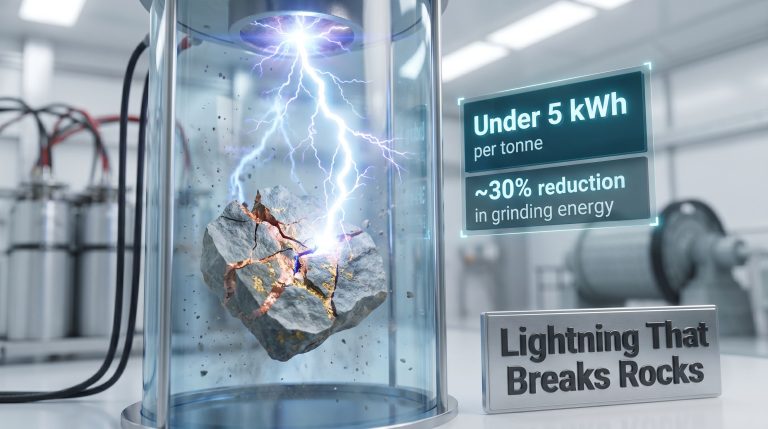
The consequences extend far beyond electricity bills. Grinding inefficiencies inflate water consumption, increase reagent use in downstream flotation circuits, and raise carbon footprints across the entire processing plant. It is precisely this gap between industry need and available technology that has placed High Voltage Pulse (HVP) technology, sometimes described as lightning that breaks rocks mining research, at the centre of serious commercial and academic attention.
When big ASX news breaks, our subscribers know first
What HVP Technology Actually Is, And Why the Lightning Analogy Fits
The Physics of Controlled Electrical Rock Fracture
Natural lightning breaks rock through a well-understood mechanism: moisture trapped within rock vaporises explosively under the thermal shock of an electrical discharge, causing spalling, fracturing, and surface disruption. This process is geologically real but entirely uncontrolled, and it produces indiscriminate fragmentation with no preference for mineralised zones over barren waste rock.
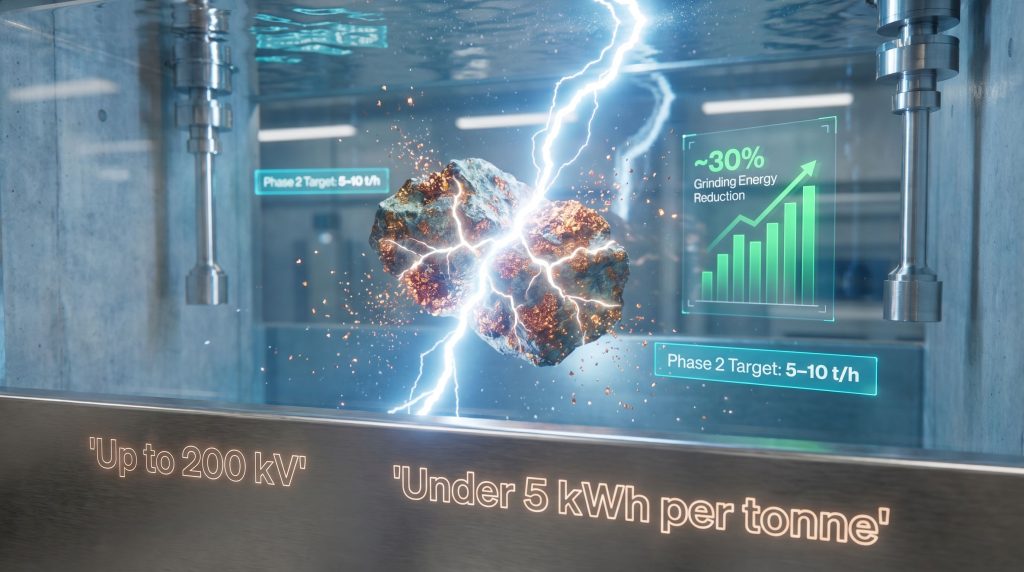
HVP technology takes this raw natural phenomenon and engineers it into a precise, repeatable industrial process. The system delivers electrical pulses of up to 200 kilovolts (kV), lasting only nanoseconds, across ore samples submerged in water. The water serves a dual function: it transmits the electrical pulse and provides hydraulic confinement that intensifies fracture propagation within the rock.
The critical mechanism is I²R heating, meaning the energy deposited within a material scales with the square of the current multiplied by its electrical resistance. Because different minerals have vastly different electrical conductivities, the energy absorption is not uniform across the rock. Conductive mineral particles, such as copper sulphides and gold-bearing sulphides, absorb disproportionately more energy than the surrounding resistive gangue rock. This differential creates intense stress concentrations precisely at mineral grain boundaries, causing fractures to propagate along the natural weak points between valuable mineral and host rock.
The result is not simply broken rock. It is selectively broken rock, where valuable mineral grains are liberated in a near-pristine state while gangue material remains comparatively intact. Furthermore, research published on ResearchGate examining laboratory lightning experiments using impulse high-current generators has helped establish the scientific foundations underpinning this controlled approach.
How HVP Compares to What Came Before
| Feature | Conventional Crushing | High Pressure Grinding Rolls | HVP Technology |
|---|---|---|---|
| Fracture mechanism | Mechanical compression | Mechanical compression | Electrical discharge (I²R heating) |
| Mineral selectivity | None | None | High (targets conductive minerals) |
| Grain boundary preservation | Poor | Moderate | High |
| Energy consumption | High (baseline) | 10-25% reduction vs. SAG | Under 5 kWh per tonne |
| Downstream grinding reduction | Baseline | Up to ~25% | Up to ~30% |
| Secondary applications | Ore only | Ore only | PCBs, solar panels, e-waste |
Step-by-Step: How HVP Rock Breakage Works in Practice
Stage 1 – Ore Preparation and Chamber Submersion
Ore samples are loaded into a water-filled treatment vessel. The water medium is not incidental; its dielectric properties and hydraulic confinement characteristics are fundamental to how the technology performs. The chamber geometry and water chemistry can both influence treatment outcomes, which is one reason ore-type variability remains an active area of PhD-level research.
Stage 2 – Nanosecond Pulse Discharge
A high-voltage capacitor bank releases pulses of up to 200 kV over durations measured in nanoseconds. The extreme brevity of each discharge is engineered deliberately. If the pulse lasted longer, thermal energy would diffuse into surrounding rock before fracture could propagate, dramatically reducing selectivity. The nanosecond window concentrates energy delivery within conductive mineral particles before diffusion can blunt the effect.
Stage 3 – Preferential Grain Boundary Fracture
The differential conductivity between sulphide minerals and silicate gangue rock drives disproportionate energy absorption in the mineral phase. Stress concentrations build at grain boundaries and cause fractures to follow the natural interface between mineral and host rock. This is fundamentally different from mechanical crushing, which fractures rock according to its bulk strength properties, often shattering valuable mineral grains in the process.
Stage 4 – Pre-Weakened Ore Entering Grinding Circuits
HVP-treated ore is structurally pre-weakened before it enters conventional ball mills or SAG mills. This pre-weakening reduces the mechanical work required to achieve target particle sizes, translating into grinding energy savings of approximately 30 percent. Critically, because minerals are already partially liberated at coarser particle sizes, flotation circuits may also operate more efficiently, improving overall metal recovery rates.
HVP functions simultaneously as a pre-weakening tool and a pre-liberation tool, delivering two distinct process benefits within a single treatment step. This dual function is what separates it conceptually from all purely energy-focused comminution alternatives.
Which Minerals and Materials Respond Best to HVP Treatment
Primary Metallurgical Applications
The strongest HVP performance has been demonstrated on copper and gold sulphide ores, where the high electrical conductivity of sulphide minerals creates near-ideal conditions for selective electrical fracture. The technology's effectiveness is closely tied to the conductivity contrast between valuable minerals and gangue rock. Ores with strong contrast respond most dramatically, while ores dominated by oxide mineralogy or very fine-grained sulphides present more complex treatment scenarios.
This ore-type dependency is not a weakness of the technology so much as a design parameter. Understanding which ore domains within a given deposit are most amenable to HVP treatment is becoming a standard component of feasibility-level assessment. Future mine planning may incorporate HVP amenability mapping as a routine geometallurgical tool, identifying which portions of an ore body should be prioritised for HVP pre-treatment versus sent directly to conventional circuits.
Beyond the Mine: Circular Economy and Electronic Waste
One of the less widely appreciated aspects of HVP technology is its applicability outside traditional ore processing. The same selectivity that liberates sulphide minerals from silicate gangue can separate conductive metal components from non-conductive substrates in industrial waste streams. In addition, this versatility directly supports growing critical minerals demand by improving recovery from both primary and secondary material streams.
- Printed circuit board (PCB) recycling: HVP can selectively fracture metal components away from plastic substrates without the chemical dissolution processes that generate hazardous waste streams in conventional e-waste processing.
- Solar panel delamination: As the global installed base of photovoltaic panels approaches end-of-life at scale over the coming decade, recovering high-purity silicon, glass, and polymer materials becomes commercially significant. HVP can delaminate panel layers without the thermal degradation that reduces material quality in competing approaches.
- Battery material recovery: The same conductivity-contrast principle may have relevance in processing end-of-life battery cathode materials, though this application remains at an earlier research stage.
These secondary applications position HVP within the broader critical minerals supply chain, not merely as a mining efficiency tool but as an enabler of circular economy material flows that feed directly back into battery and renewable energy manufacturing.
Energy, Emissions, and the Grade-Energy Paradox
Quantifying the Efficiency Case
HVP processing operates at under 5 kWh per tonne of treated ore. On its own, that figure requires context. When the downstream grinding circuit is consuming 15 kWh per tonne at baseline and HVP reduces that by 30 percent, the net system-level energy saving per tonne processed is approximately 4.5 kWh. Against a treatment input of under 5 kWh, the net energy position depends on the specific ore and grinding conditions, but at scale the arithmetic becomes compelling.
For a processing operation handling 5 million tonnes per annum, a 30 percent grinding energy reduction on a 15 kWh per tonne baseline represents roughly 22.5 million kWh in annual electricity savings. The carbon emission reduction associated with that figure depends on the grid energy source, but in coal-heavy power markets, it translates to thousands of tonnes of avoided CO₂ per year from a single processing plant. Consequently, the integration of renewable energy in mining operations could amplify these emissions benefits even further.
The Grade Decline Problem HVP Partially Solves
Global copper ore grades have fallen from an average above 2 percent in the early twentieth century to below 0.5 percent in many major producing regions today. This structural decline means mining operations must process progressively more rock per tonne of copper produced. Every unit of improvement in liberation efficiency partially offsets this trend by extracting more metal from the same tonne of ore.
HVP directly addresses what might be called the grade-energy paradox: as grades fall, processing energy per unit of metal recovered rises, precisely when environmental and economic pressures demand the opposite. By improving liberation at coarser particle sizes, HVP partially decouples metal recovery from grinding intensity.
The Commercialisation Pathway and Academic Infrastructure
Where HVP Stands in Its Development Journey
| Development Stage | Status | Key Metric |
|---|---|---|
| Bench-scale proof of concept | Completed | Selective fracture demonstrated |
| Energy efficiency validation | Completed | Under 5 kWh/t; approximately 30% grinding reduction |
| Australian Government funding | Secured | Pilot plant scale-up support |
| Phase 2 pilot capacity target | In progress | 5 to 10 tonnes per hour |
| Full industrial deployment | Future | Dependent on pilot outcomes |
The progression from bench-scale validation to a pilot plant targeting 5 to 10 tonnes per hour represents the most critical threshold in any comminution technology's development history. This throughput range is where industrial viability either proves out or reveals its constraints, and it is where questions about electrode wear rates, pulse repetition frequency, chamber geometry, and ore handling logistics all converge into engineering reality.
The Research Institution Driving HVP Forward
The Julius Kruttschnitt Mineral Research Centre (JKMRC), operating within the University of Queensland's Sustainable Minerals Institute, is among the most respected comminution and mineral processing research facilities in the world. UQ's Mineral and Mining Engineering program was ranked fifth globally in the 2026 QS World University Rankings by Subject, providing significant academic credibility to research outputs emerging from this institution.
PhD candidates such as Joy Maniaul are conducting frontline research into HVP fundamentals at JKMRC, advancing understanding of pulse parameters, ore-type variability responses, and the engineering challenges associated with scale-up. This pipeline of research talent is not merely producing academic publications; it is building the technical knowledge base that commercial deployment will ultimately draw upon.
UQ's broader Collaborative Consortium for Coarse Particle Processing Research (CPR Program) reflects the same philosophy: bringing together competing industry participants to share the cost and risk of fundamental research that no single company could justify funding alone.
The next major ASX story will hit our subscribers first
HVP in the Context of Mining's Broader Technology Transition
Where HVP Sits Among Competing Technologies
- High Pressure Grinding Rolls (HPGR): Established technology with documented energy savings of 10 to 25 percent versus conventional SAG/ball mill circuits, but no mineral selectivity and significant capital cost.
- Microwave pre-treatment: Exploits differential thermal expansion between minerals, with selectivity potential but throughput scalability and energy input challenges that have limited commercial adoption.
- Sensor-based ore sorting: Removes waste rock before grinding, reducing mill feed volumes, but does not improve liberation within the ore fraction itself.
- HVP technology: The only approach that combines electrical selectivity, grain boundary fracture precision, and dual pre-weakening and pre-liberation functionality in a single step.
The differentiating value of HVP lies not solely in energy savings but in the quality of the fracture it produces. Preserving mineral grain integrity at the liberation stage has compounding downstream value across flotation recovery rates, tailings grades, and overall metal yield. Energy-only comparisons with HPGR or microwave methods fundamentally understate what HVP offers.
Implications for Future Mine Design
Processing plant architecture has remained relatively stable for decades. The conventional flowsheet of primary crushing, SAG milling, ball milling, and flotation has been optimised extensively but not fundamentally redesigned. HVP introduces the possibility of an electro-mechanical hybrid comminution circuit, where electrical pre-treatment reduces the mechanical burden on downstream grinding equipment.
In practical terms, this could allow future processing plants to operate smaller-diameter ball mills, reduce steel grinding media consumption, and achieve target liberation sizes at coarser grind settings. Each of these outcomes carries both capital and operational cost implications that extend well beyond the energy saving calculation alone.
Perhaps more significantly, improved liberation efficiency at coarser grind sizes could bring previously uneconomic low-grade deposits within the range of viable development. As high-grade ore bodies become scarcer and the world's demand for copper, gold, and battery metals intensifies through the energy transition, the economics of lower-grade development will depend increasingly on processing innovation. The broader mining electrification transition will, furthermore, provide the clean power infrastructure that makes HVP's energy advantages most commercially compelling.
Frequently Asked Questions: Lightning That Breaks Rocks and HVP Mining Technology
What does lightning that breaks rocks mean in mining research?
The phrase refers to High Voltage Pulse (HVP) technology, which replicates the electrical discharge mechanism of natural lightning in a precisely controlled industrial format. Pulses of up to 200 kV lasting only nanoseconds are delivered to submerged ore, fracturing rock selectively along mineral grain boundaries. Researchers studying lightning that breaks rocks mining research have drawn directly on laboratory findings to develop this controlled industrial process, as detailed in coverage by the Institute of Materials, Minerals and Mining.
How energy-efficient is HVP compared to conventional grinding?
HVP treatment operates at under 5 kWh per tonne. When the approximately 30 percent reduction in downstream grinding energy it enables is included, the system-level energy benefit becomes substantially larger than the treatment input alone. In addition, flash joule heating technology represents a complementary electrical processing approach that further illustrates the direction processing innovation is heading.
Which ore types respond best to HVP treatment?
Copper and gold sulphide ores show the strongest treatment response due to the high electrical conductivity contrast between sulphide minerals and resistive silicate gangue. Ore characterisation for HVP amenability is expected to become a standard component of feasibility studies as the technology matures.
Can HVP process materials other than mining ore?
Yes. HVP has demonstrated applicability to printed circuit board recycling, solar panel delamination, and potentially battery material recovery, extending its relevance into circular economy and critical minerals supply chain applications. However, these secondary uses are still maturing through ongoing research at institutions such as JKMRC.
What is the current commercialisation status of HVP?
Australian Government funding has been secured for pilot plant scale-up, with Phase 2 targeting a processing capacity of 5 to 10 tonnes per hour. Full industrial deployment will depend on the outcomes of this pilot phase. The progression of mining efficiency technologies across the sector suggests that HVP will find a receptive commercial environment as it moves towards full-scale deployment.
Key Technology Metrics at a Glance
| Metric | Value |
|---|---|
| Maximum pulse voltage | Up to 200 kV |
| Pulse duration | Nanoseconds |
| HVP treatment energy | Under 5 kWh per tonne |
| Downstream grinding energy reduction | Approximately 30% |
| Phase 2 pilot throughput target | 5 to 10 tonnes per hour |
| Primary ore applications | Copper and gold sulphide ores |
| Secondary applications | PCB recycling, solar panel recovery |
| Leading research institution | JKMRC, University of Queensland SMI |
| UQ Mining Engineering global ranking | 5th (2026 QS World University Rankings) |
This article contains forward-looking statements and scenario projections based on current research data and pilot-stage technology performance. Actual commercial outcomes will depend on pilot plant results, ore-specific response characteristics, and broader market conditions. Readers should conduct independent research before drawing investment or operational conclusions.
Want to Identify the Next Major Mineral Discovery Before the Market Does?
Discovery Alert's proprietary Discovery IQ model scans ASX announcements in real time, instantly transforming complex mineral data into actionable investment insights across 30-plus commodities — giving both traders and long-term investors a decisive edge the moment a significant discovery is announced. Explore historic discoveries and the extraordinary returns they have generated, then start your 14-day free trial at Discovery Alert to position yourself ahead of the broader market.