June 28, 2026
The Comminution Crisis Hiding Inside Every Mine on Earth
Every tonne of copper, gold, or lithium that reaches a refinery first passes through one of the most energy-wasteful industrial processes ever scaled to global proportions. Crushing and grinding ore, collectively known as comminution, consumes between 30 and 40 percent of a mine's total energy budget, making it the single largest energy cost centre in mineral extraction. Lightning that breaks rocks mining research is now challenging decades of unchanged physics in this space. Yet for decades, the fundamental physics underlying this process have remained unchanged. Steel grinding media pulverises rock through brute mechanical force, indiscriminately shattering both valuable mineral grains and worthless host rock alike.
As global ore grades continue their long-term structural decline, this inefficiency compounds at scale. A copper mine processing ore at 0.4 percent grade must move and grind roughly twice the rock volume compared to a mine working a 0.8 percent deposit to produce the same quantity of metal. The energy intensity of production therefore rises inversely with grade, a dynamic that threatens both mine economics and mining decarbonisation benefits simultaneously.
The question driving a new generation of comminution researchers is whether the physics of rock breakage can be fundamentally reimagined rather than merely refined. One answer, currently being developed at the doctoral research level within one of the world's top mineral engineering institutions, draws its inspiration from one of nature's most dramatic energy-release events: lightning.
When big ASX news breaks, our subscribers know first
What the Phenomenon of Lightning Reveals About Rock Breakage
Natural lightning fractures rock through a mechanism that has nothing to do with mechanical force. When a lightning discharge passes through rock containing conductive minerals, the electrical current encounters resistive pathways and rapidly converts electrical energy to heat through a process known as I²R heating, where current squared multiplied by electrical resistance produces thermal energy. This heating occurs so rapidly, within nanoseconds, that the surrounding silicate minerals cannot equilibrate thermally, generating extreme internal stress gradients that fracture the rock from within.
The most vivid evidence of this phenomenon is the fulgurite: a glassy tube or crust formed when lightning melts silica-rich material such as sand or rock along the exact path of the discharge. Fulgurites are direct physical records of lightning-induced selective heating, and they illustrate a principle that ore processing researchers have spent years attempting to harness industrially. Furthermore, research published on ScienceDirect confirms that laboratory experiments using impulse high-current generators have successfully replicated these destructive effects on rock samples.
Crucially, conductive mineral impurities within a rock act as preferential absorption sites for electrical energy. Metallic mineral grains, including copper sulphides, gold-bearing pyrite, and aluminium-bearing phases within granite, have significantly lower electrical resistivity than the surrounding silicate gangue. When an electrical discharge passes through such a composite rock, energy concentrates at the conductive mineral sites, initiating fracture precisely where the valuable material resides.
This selectivity is what separates electrical breakage from every mechanical comminution technology ever developed. Mechanical force distributes energy across an entire rock mass. Electrical discharge concentrates energy within the ore mineral fraction itself.
High Voltage Pulse Technology: Engineering a Controlled Lightning Strike
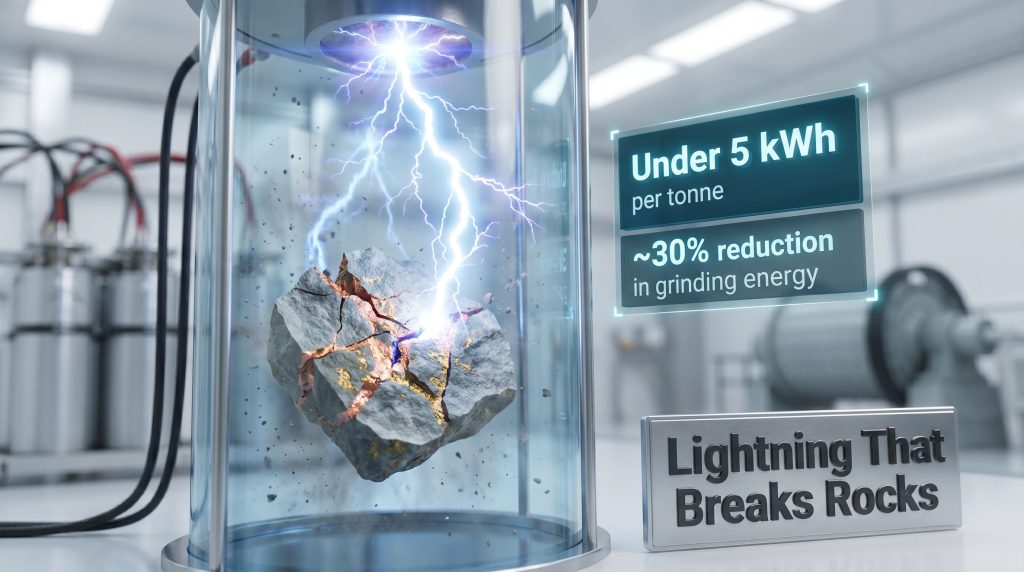
High Voltage Pulse (HVP) technology replicates the electrical physics of a natural lightning strike within a controlled, repeatable industrial process. HVP systems discharge electrical pulses of nanosecond duration at voltages reaching up to 200 kV, directed through ore submerged in a water medium. The water serves a critical function: it has a higher dielectric breakdown strength than rock, meaning the electrical pulse is forced to propagate through the ore rather than around it, maximising energy delivery to the target mineral fraction.
The four-stage breakage sequence proceeds as follows:
- A high-voltage capacitor bank charges to operational voltage before releasing stored energy in a precisely controlled nanosecond-duration pulse.
- Conductive mineral grains within the ore matrix absorb electrical energy preferentially, due to their lower resistivity relative to the surrounding silicate host rock.
- Rapid I²R heating generates localised thermal expansion within the conductive mineral phase at a rate that prevents thermal equilibration with adjacent material, producing extreme stress concentrations at mineral-gangue grain boundaries.
- Fractures propagate along crystallographic planes of weakness, liberating target mineral grains from the host rock matrix at coarser particle sizes than mechanical crushing typically achieves.
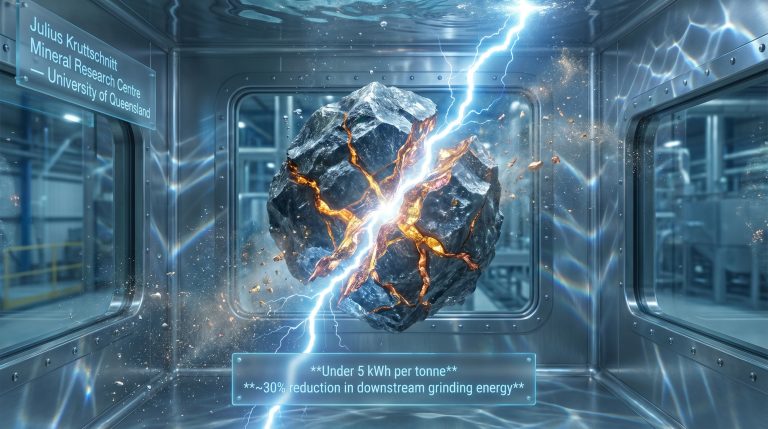
The commercial significance of stage four is frequently underappreciated. Liberation at coarser particle sizes directly reduces the proportion of ore that must pass through fine grinding circuits, which are the most energy-intensive unit operations in the entire comminution chain. Pre-weakening ore through HVP upstream of conventional grinding has been shown to reduce downstream grinding energy requirements by approximately 30 percent.
How HVP Compares to Every Other Comminution Technology
| Technology | Breakage Mechanism | Selectivity | Energy Demand | Commercial Maturity |
|---|---|---|---|---|
| High Voltage Pulse (HVP) | Electrical discharge | High | Under 5 kWh/t | Pilot stage |
| HPGR | Compressive force | None | Moderate | Fully commercial |
| Ball Mill | Mechanical impact | None | 30-40% mine energy | Fully commercial |
| Microwave Comminution | Dielectric heating | Partial | Moderate | Research/pilot |
| Ultrasonic Comminution | Acoustic cavitation | None | Low throughput | Laboratory |
HPGR, or High Pressure Grinding Roll technology, is often cited as the most significant comminution advancement of recent decades. Yet even HPGR operates within the same mechanical breakage paradigm as the ball mills it supplements. It improves energy efficiency at the margins without altering the fundamental physics. HVP, however, does not refine the existing paradigm; it replaces it entirely.
In addition, flash joule heating represents a related emerging approach to energy-selective mineral processing, further illustrating how the broader field is moving beyond purely mechanical solutions.
The Research Institution Behind Lightning That Breaks Rocks Mining Research
Active doctoral research into HVP comminution is being conducted at the Julius Kruttschnitt Mineral Research Centre (JKMRC), which operates within the University of Queensland's Sustainable Minerals Institute. The JKMRC holds one of the longest and most distinguished track records in global comminution science, having developed foundational modelling tools used by mining operations worldwide, including the Julius Kruttschnitt Rotary Breakage Tester and the JKSimMet simulation platform.
The University of Queensland's standing in this field is independently validated. UQ's Mineral and Mining Engineering program was ranked 5th in the world in the 2026 QS World University Rankings by Subject, reinforcing the institution's position at the frontier of both fundamental and applied mineral processing research.
PhD candidate Joy Maniaul is among the researchers currently advancing understanding of HVP breakage mechanics at the JKMRC. Research programs at this level are focused on expanding scientific knowledge of how different ore types respond to HVP treatment, how pulse parameters should be optimised for specific mineralogies, and how HVP units can be integrated into existing processing circuits. These are not trivial engineering questions. Ore variability is one of the central challenges in comminution research, and the interaction between pulse characteristics and ore mineralogy requires systematic experimental investigation before reliable commercial performance predictions can be made.
Research at the doctoral level fills a critical knowledge gap that pilot plant engineering alone cannot address. Understanding why HVP works differently across ore types is a prerequisite for designing circuits that perform reliably at scale.
Furthermore, AI-powered mining efficiency tools are increasingly being explored in parallel to help optimise circuit design decisions, creating opportunities for HVP integration to be modelled and tested digitally before physical deployment.
Energy Benchmarks and What a 30 Percent Grinding Reduction Actually Means
The headline figures for HVP performance deserve closer examination because their industrial implications are substantial:
- HVP direct energy consumption: under 5 kWh per tonne of ore processed
- Conventional comminution share of total mine energy: 30 to 40 percent of site energy budget
- Downstream grinding energy reduction from HVP pre-treatment: approximately 30 percent
To contextualise these numbers, consider a large copper operation processing 50,000 tonnes of ore per day. If grinding accounts for 35 percent of total site energy consumption and HVP pre-treatment reduces grinding energy demand by 30 percent, the net reduction in total site energy consumption approaches 10 percent. At scale, this represents millions of dollars in annual operating cost savings and a material reduction in Scope 2 greenhouse gas emissions.
Beyond direct energy savings, HVP pre-treatment generates secondary operational benefits that compound its value proposition:
- Improved mineral liberation at coarser sizes reduces reagent consumption in downstream flotation circuits
- Pre-weakened ore feed reduces wear rates on grinding media, lowering consumable costs
- Reduced water requirements associated with fine grinding operations
- Potential for improved recovery rates through more precise mineralogical liberation
Consequently, the broader integration of renewable energy in mining could amplify these savings even further, particularly for remote operations where energy costs are disproportionately high.
Beyond Mining: HVP as a Circular Economy Enabling Technology
One of the less-discussed dimensions of HVP technology is its direct applicability to two of the most challenging waste streams created by the global energy transition itself.
Printed circuit board recycling presents a separation challenge structurally analogous to ore comminution. The goal is to recover conductive metals, including copper, gold, silver, and palladium, from non-conductive polymer substrates. Conventional PCB recycling involves thermal processing or mechanical shredding, both of which degrade metal quality and generate hazardous by-products. HVP's selective targeting of conductive material within a composite matrix translates directly to this application, enabling cleaner metal-polymer separation and higher precious metal recovery rates.
End-of-life solar panel processing represents an emerging waste challenge of significant scale. The International Renewable Energy Agency has projected that cumulative solar panel waste could reach 78 million tonnes by 2050. Each panel contains recoverable quantities of silver, aluminium, and semiconductor-grade silicon, all embedded within a laminated glass-polymer composite. HVP can selectively target the conductive silver and aluminium elements within a panel structure, enabling non-destructive component separation that preserves both metal and glass quality for reuse.
For instance, the battery recycling process faces similar material separation challenges, and HVP's principles could inform future approaches to recovering critical minerals from spent energy storage systems. This dual applicability positions HVP not merely as a mining efficiency tool but as infrastructure for the broader circular economy of energy technology materials.
The next major ASX story will hit our subscribers first
Ore Variability: The Technical Challenge That Will Determine Commercial Success
A dimension of HVP research that receives insufficient attention outside specialist circles is the problem of ore variability and its effect on pulse parameter optimisation. Not all conductive minerals respond identically to HVP treatment. The electrical resistivity of ore minerals varies considerably across sulphide species, oxide species, and native metal phases. Chalcopyrite, bornite, pyrite, galena, and gold all exhibit different resistivity profiles, meaning the optimal voltage, pulse duration, and pulse frequency settings for a copper sulphide ore will differ from those required for a refractory gold ore.
This variability creates a mineralogy-specific calibration challenge. Getting the pulse parameters wrong in either direction — too low and selective liberation is incomplete, too high and the energy advantage over mechanical grinding narrows — means that commercial deployment cannot rely on a single universal pulse recipe. Research at institutions like the JKMRC is actively building the ore characterisation databases and breakage models needed to address this challenge systematically.
The practical implication for potential commercial adopters is important: HVP circuits will require upfront ore characterisation work comparable to what is currently standard practice for flotation circuit design. This is not a barrier to adoption, but it is a factor that should be incorporated into pilot plant planning and capital cost estimation. Researchers at the IOM3 have also highlighted the significance of these material-specific variables in assessing HVP's broader industrial potential.
The Investment Logic and Commercialisation Trajectory
Note: The following section contains forward-looking observations and speculative analysis. Readers should not interpret this as financial advice. Commercialisation timelines and cost outcomes involve significant uncertainty and may differ materially from expectations.
HVP technology currently sits at the transition point between research prototype and industrial demonstration. Australian Government funding has been committed to support scale-up to pilot plant level, a stage that will generate the performance data necessary for capital cost benchmarking against conventional comminution circuits.
The commercialisation risk profile differs from most emerging mining technologies in one important respect: the fundamental science is not speculative. The physics of HVP breakage are well understood, experimentally validated, and grounded in established electrical engineering principles. The primary uncertainties are engineering and economic rather than scientific, specifically around the capital cost of pulse generation equipment, the durability of electrode systems under continuous industrial operation, and the integration complexity of inserting HVP units into existing processing flowsheets.
Mining operators considering early engagement with HVP technology should weigh these factors:
- Pilot plant data will provide the first reliable basis for estimating capital expenditure per tonne of installed throughput capacity
- Operations with high grinding energy costs, particularly remote sites dependent on diesel generation, stand to benefit disproportionately from a 30 percent reduction in grinding energy demand
- The modular architecture of HVP systems may allow staged deployment, reducing upfront capital commitment relative to a full circuit replacement
- First-mover adoption creates the possibility of a structural operating cost advantage in energy-intensive processing environments as energy prices continue their long-term upward trend
Frequently Asked Questions: Lightning That Breaks Rocks Mining Research
What does lightning that breaks rocks mean in the context of mining research?
The phrase describes High Voltage Pulse technology, which reproduces the electrical mechanism of a natural lightning strike to selectively fracture mineralised rock within a controlled industrial setting. Researchers at the JKMRC use this description because HVP discharges at voltages comparable to lightning, up to 200 kV, to break ore along the boundaries between conductive mineral grains and host rock.
How does HVP differ from conventional crushing and grinding?
Conventional crushing applies mechanical force uniformly across a rock mass, breaking valuable and worthless material at equal rates. HVP concentrates electrical energy within conductive mineral phases, causing those phases to fracture preferentially while leaving barren silicate gangue largely intact. This selectivity reduces both energy consumption and the volume of material requiring downstream fine grinding.
What ores is HVP currently being developed for?
Current research and application focus centres on copper and gold ores, though the technology's physics are applicable to any ore containing conductive mineral phases. E-waste streams, including printed circuit boards and solar panels, represent parallel application streams under active investigation.
Where is this research being conducted?
The primary institutional home for lightning that breaks rocks mining research in Australia is the Julius Kruttschnitt Mineral Research Centre at the University of Queensland's Sustainable Minerals Institute, currently ranked 5th globally in Mineral and Mining Engineering by the 2026 QS World University Rankings by Subject.
Can natural lightning fracture rock?
Yes. Natural lightning fractures rock through rapid I²R heating and produces fulgurites — glassy structures formed along the discharge path — as direct physical evidence of this mechanism. Industrial HVP systems apply the same physics in a controlled and repeatable manner that natural lightning cannot provide.
Want To Know Which ASX Mining Companies Are Pushing The Boundaries Of Discovery?
Discovery Alert's proprietary Discovery IQ model delivers real-time alerts the moment significant mineral discoveries hit the ASX, instantly translating complex geological data into actionable opportunities for investors at every level — explore Discovery Alert's discoveries page to understand how historic finds have generated substantial returns, and begin your 14-day free trial today to position yourself ahead of the broader market.