July 15, 2026
Global supply chain vulnerabilities in advanced materials manufacturing continue to reshape strategic thinking across Western industrial economies. The concentration of critical mineral production in single geographic regions creates systemic dependencies that echo throughout aerospace, defence, and clean energy sectors. For scandium, these vulnerabilities represent both significant risks for dependent industries and compelling opportunities for diversification-focused investors seeking exposure to advanced global scandium supply chain rebalancing initiatives. Furthermore, the defence supply chain crisis has intensified strategic planning across military and civilian applications.
Strategic Applications Driving Advanced Global Scandium Supply Demand
Scandium's unique metallurgical properties position it as an irreplaceable component in high-performance applications where alternative materials cannot replicate its strength-to-weight characteristics. The aerospace industry utilises aluminium-scandium alloys for structural components requiring exceptional durability while minimising weight penalties, with each kilogram saved translating to substantial fuel efficiency improvements over aircraft operational lifecycles.
Solid oxide fuel cell technology represents the fastest-growing demand segment, requiring aerospace-grade scandium purity for electrode applications. These systems demand specific thermal expansion coefficients and ionic conductivity parameters that only scandium can provide within commercial cost constraints. Defence applications further intensify demand through lightweight armour systems and aerospace components where performance specifications exceed civilian requirements.
Current market projections demonstrate accelerating growth patterns:
| Metric | 2024 Baseline | 2031 Forecast | CAGR |
|---|---|---|---|
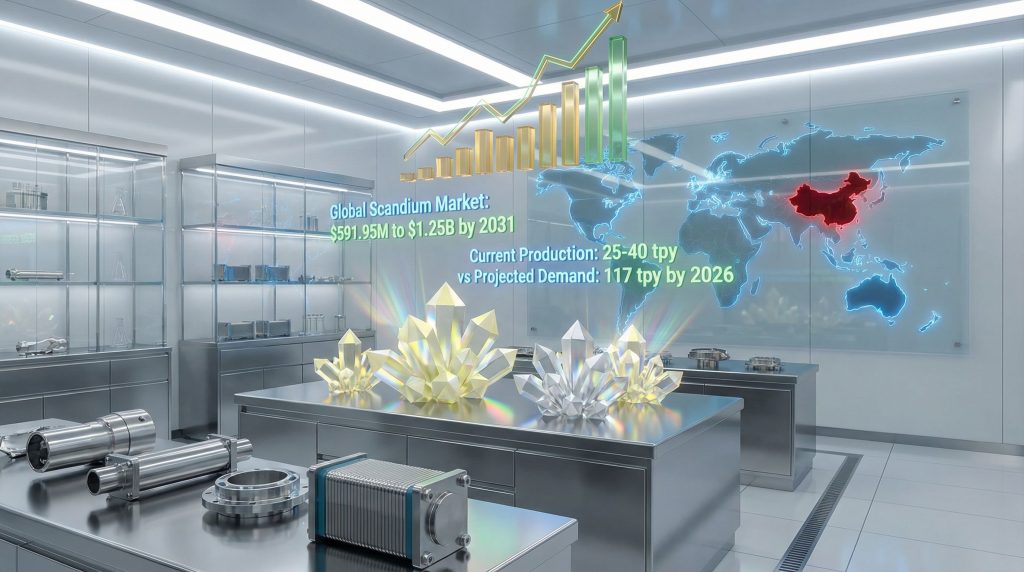
| Market Value (Conservative) | $591.95M | $1.25B | 8.7% |
| Market Value (Aggressive) | $1.02B | $2.01B | 14.53% |
| Metal Segment Value | $14.93B | $39.97B | 9.5% |
Technical Specifications Creating Market Dependency
Manufacturing specifications for aerospace applications require scandium oxide purity exceeding 99.99%, with trace element controls meeting military standards. Processing facilities must achieve consistent quality across production batches while maintaining supply continuity for multi-year aerospace development cycles.
The substitutability challenge intensifies market dynamics, as no commercially viable alternative materials can replicate scandium's performance characteristics in critical applications. Research initiatives exploring alternative materials have consistently demonstrated performance gaps that make scandium irreplaceable for demanding aerospace and defence applications.
When big ASX news breaks, our subscribers know first
Production Capacity Versus Consumption Analysis
Global scandium production currently operates at approximately 25-40 tonnes annually against installed capacity of roughly 80 tonnes, indicating significant underutilisation despite projected 2026 demand exceeding 117 tonnes. This capacity-demand mismatch creates supply deficit scenarios ranging from 37-92 tonnes annually, depending on production efficiency improvements and demand acceleration patterns.
The capacity utilisation rate of 31-50% reflects market dynamics where producers optimise for primary commodities (rare earth elements, nickel, uranium) while treating scandium as a byproduct. This operational approach limits scandium supply responsiveness to independent demand signals, creating price volatility and supply security concerns for dependent industries.
Key production constraints include:
- Byproduct recovery methodology limits independent capacity expansion
- Specialised separation chemistry requires proprietary expertise
- Quality control systems for aerospace-grade specifications demand substantial capital investment
- Long-term contracting practices reduce spot market availability
Geographic Production Vulnerabilities
Asia-Pacific consumption represents 39.48% of global demand in 2025, with regional production concentration creating additional supply chain risks. Western manufacturers face double vulnerability through both Chinese production dominance and regional consumption concentration within Chinese-controlled supply geography.
Production facility expansion requires capital investments estimated at $2-5 million per tonne of annual capacity, with operational complexity increasing significantly for standalone scandium operations versus integrated byproduct recovery systems. However, developments like the planned European CRM facility demonstrate growing Western commitment to supply chain diversification.
Chinese Market Control Mechanisms
China maintains control over approximately 80-85% of advanced global scandium supply through vertical integration with rare earth processing operations and recent capacity expansions. The commissioning of a 20-tonne annual high-purity oxide facility in Hebei province demonstrates strategic commitment to maintaining supply dominance while serving growing domestic demand.
Export control mechanisms operate through Foreign Direct Investment Review licensing requirements, creating administrative barriers for Western purchasers similar to restrictions implemented across rare earth elements. These controls enable China to prioritise domestic consumption while limiting Western access during supply constraints or geopolitical tensions, particularly amid escalating US‑China trade tensions.
Secondary producer analysis reveals limited alternative sources:
| Country | Production Method | Annual Capacity | Strategic Limitations |
|---|---|---|---|
| Russia | RUSAL byproduct recovery | 1.5 tpy pilot scale | Export sanctions, technology constraints |
| Philippines | HPAL nickel processing | 2-5 tpy variable | Tied to nickel price cycles, ore quality variability |
| Kazakhstan | Uranium processing waste | 0.5-1.5 tpy estimated | Emerging technology, capital limitations |
| Ukraine | Industrial byproduct | Disrupted operations | Military conflict impact |
Western Supply Security Initiatives
Government policy responses across Western jurisdictions increasingly prioritise critical mineral supply diversification through strategic partnerships and development funding. The European Union's €3 billion RESourceEU program specifically targets rare earth and critical mineral supply chain development, while the US critical minerals policy supports domestic production capabilities.
These policy frameworks create investment environments favouring Western scandium projects through accelerated permitting processes, strategic partnerships, and long-term government contracting commitments that reduce project financing risks. In addition, initiatives like the Australia mineral reserve provide additional supply security measures.
Processing Technology Barriers and Opportunities
Scandium recovery from host materials requires sophisticated separation chemistry due to concentration levels typically below 0.01% in primary ores. High-pressure acid leaching technology enables extraction from nickel laterite operations, while solvent extraction and ion exchange systems provide purification pathways to aerospace-grade specifications.
Technical processing challenges include:
- Complex separation chemistry requiring specialised organic solvents
- Multi-stage purification systems for contaminant removal
- Quality control protocols meeting aerospace certification requirements
- Specialised equipment procurement and maintenance
Processing cost structures indicate separation and purification represent 40-60% of total cash production costs, with energy-intensive acid leaching and multiple purification stages driving operational expenses. Sunrise Energy Metals' projected operating cost of $534 per kilogram demonstrates competitive positioning against existing Chinese producers while offering Western supply security.
Recovery Methodology Optimisation
Byproduct recovery from rare earth processing offers the most established pathway, utilising existing infrastructure while adding scandium extraction stages. Nickel HPAL operations provide emerging opportunities through laterite ore processing, with scandium recovery integrated into existing nickel purification systems.
Uranium processing waste streams represent developing recovery pathways, particularly in Kazakhstan where pilot operations demonstrate technical feasibility. Titanium dioxide production waste offers additional recovery potential, with scandium present in ilmenite processing solutions requiring specialised extraction techniques.
Market Dynamics and Pricing Mechanisms
Scandium markets operate through direct producer-consumer negotiations rather than standardised commodity exchanges, creating price discovery challenges and limiting market transparency. Lead times extending up to six months for specialised grades reflect limited supplier bases and production scheduling constraints tied to primary commodity operations.
Off-exchange trading characteristics create both opportunities and risks for market participants, as limited price transparency enables premium pricing for guaranteed supply security while increasing procurement complexity for dependent industries.
Price volatility stems from supply concentration combined with limited inventory holdings across the supply chain. Unlike commodities with substantial above-ground stocks, scandium's specialised applications and limited production create tight supply-demand balances vulnerable to production disruptions or demand spikes.
Demand Sector Evolution
Solid oxide fuel cells represented approximately 55% of scandium consumption in 2022, with projected demand growth toward 50 tonnes annually within five years. Aerospace applications continue expanding through next-generation aircraft platforms requiring improved fuel efficiency, while defence sector requirements grow through lightweight armour development programs.
Clean energy applications extend beyond fuel cells into grid-scale energy storage systems and electric vehicle battery research, though commercial deployment timelines remain uncertain. These emerging applications could substantially increase total demand while creating additional supply security concerns for established aerospace and defence users.
Western Project Development Timeline
Strategic development projects across Western jurisdictions target supply diversification through coordinated timelines designed to reduce import dependency by 2030. These initiatives combine government policy support with private sector development capital to create viable alternatives to Chinese supply.
Major Western scandium development projects:
| Project | Location | Projected Output | Target Production | Strategic Value |
|---|---|---|---|---|
| ScaVenger | European Union | 21 tpy Sc oxide | 2026 | TiO₂ waste utilisation |
| Syerston | Australia | 60 tpy Sc oxide | Mid-2028 | Largest Western project |
| NioCorp | Nebraska, USA | Under development | Ongoing studies | DoD strategic interest |
| Sorel-Tracy | Quebec, Canada | 12 tpy Sc oxide | Expansion phase | North American supply |
Investment Risk Assessment Framework
Market entry barriers include substantial capital requirements for processing infrastructure, technical expertise scarcity limiting new entrants, and long development timelines extending 5-7 years from feasibility to production. Strategic partnerships with end-users become essential for project financing and revenue security.
Key investment considerations:
- Capital intensity: $2-5 million per tonne annual capacity
- Technical expertise requirements limiting operational teams
- Long-term contracting essential for project economics
- Geopolitical supply concentration creating policy support opportunities
The Syerston project demonstrates viable economics with $120 million development costs targeting 60 tonnes annual production, implying $2 million per tonne capital intensity. Operating costs of $534 per kilogram position the project competitively against Chinese suppliers while offering Western supply security premiums.
The next major ASX story will hit our subscribers first
What Are The Future Supply Chain Evolution Scenarios?
Strategic scenario analysis reveals multiple pathways for advanced global scandium supply development through 2030, each creating distinct investment implications and risk profiles. These scenarios incorporate geopolitical developments, technological breakthroughs, and demand evolution patterns that could reshape market dynamics.
Scenario A: Continued Chinese Dominance
- Limited Western project development due to financing constraints
- Increasing export controls creating supply security premiums
- Defence and aerospace sectors developing strategic stockpiles
- Price volatility increasing with geopolitical tensions
Scenario B: Western Supply Diversification Success
- Major projects achieve production targets by 2028-2030
- Import dependency reduces from 85% to 60% for Western economies
- Competitive pricing environment develops with multiple suppliers
- Strategic stockpiling transitions to commercial inventory management
Scenario C: Recycling Technology Breakthrough
- Advanced recycling systems enable secondary scandium recovery
- Aerospace industry develops closed-loop material systems
- Primary production growth moderates while recycling expands
- Supply security improves through domestic recycling capabilities
Scenario D: Accelerated Demand Growth
- Clean energy applications exceed current projections
- Total demand reaches 200+ tonnes annually by 2030
- All planned Western projects insufficient for demand growth
- Emergency strategic mineral policies activate government interventions
Strategic Recommendations for Market Participants
Industry stakeholders require diversified approaches addressing both supply security and cost competitiveness considerations. Long-term contracting strategies become essential for securing supply while Western project development creates partnership opportunities for end-users seeking supply chain resilience.
Recommended strategies include:
- For Aerospace Companies: Develop strategic partnerships with Western projects during development phases to secure long-term supply commitments
- For Defence Contractors: Support government strategic stockpiling initiatives while diversifying supplier bases beyond Chinese sources
- For Clean Energy Developers: Monitor scandium supply constraints as fuel cell deployment accelerates, considering alternative materials research
- For Investors: Focus on projects with government policy support, established end-user partnerships, and competitive cost structures
Investment in recycling technology development and alternative material research provides additional diversification while supporting supply chain resilience initiatives across dependent industries. Furthermore, NSW Priority Metals initiatives and J.P. Morgan commodities research offer additional insights into market development opportunities.
Disclaimer: This analysis contains forward-looking statements and projections based on current market conditions and announced development plans. Actual results may vary significantly due to technical, financial, regulatory, or geopolitical factors. Investment decisions should consider comprehensive due diligence and professional advisory services.
Ready to Capitalise on Critical Minerals Investment Opportunities?
Discovery Alert's proprietary Discovery IQ model delivers real-time alerts on significant critical minerals discoveries across the ASX, transforming complex mineral announcements into actionable investment insights before the broader market reacts. Explore Discovery Alert's dedicated discoveries page to understand how major mineral breakthroughs have generated exceptional returns for early investors, then begin your 14-day free trial to position yourself ahead of emerging scandium and strategic minerals opportunities.