July 15, 2026
The Rare Earth Recycling Breakthrough Western Supply Chains Have Been Waiting For
For decades, the global rare earth industry has operated under a structural imbalance that defence planners, technology manufacturers, and policymakers have struggled to resolve. The concentration of heavy rare earth separation capacity within a single geographic region has created a fragility that runs through every electric vehicle motor, every missile guidance system, and every industrial robot assembled in the Western world. The challenge has never simply been about mining more ore. It has been about separating, refining, and converting rare earth elements into usable oxides at commercial purity levels outside of Asia, and doing so reliably at scale. Rare earth supply chains have consequently become one of the most scrutinised topics in global strategic planning.
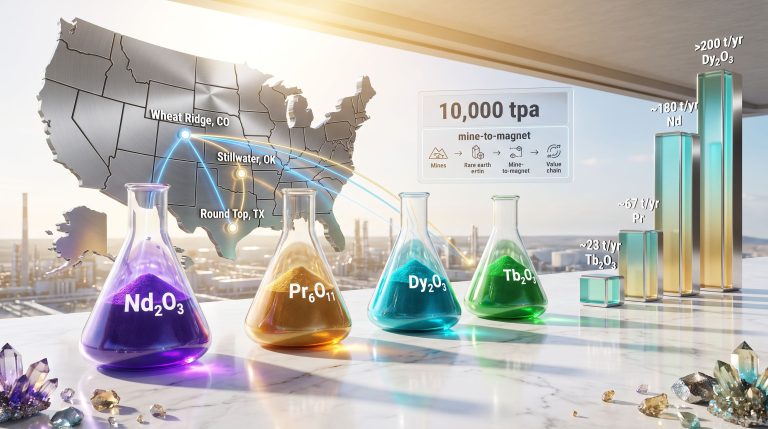
That challenge is now being addressed through an approach that many industry observers have underestimated: recycling. Specifically, the conversion of NdFeB magnet manufacturing scrap into commercial-grade rare earth oxides represents one of the most technically credible circular supply pathways to emerge in the Western critical minerals sector. USA Rare Earth recycled magnet scrap rare earth oxides are being produced at its Wheat Ridge, Colorado hydrometallurgical facility, yielding commercial-grade dysprosium (Dy) oxide and neodymium-praseodymium (NdPr) oxide from recycled magnet swarf sourced from its own magnet manufacturing operations in Stillwater, Oklahoma.
Understanding why this matters requires looking beyond the headline and into the technical and geopolitical mechanics of rare earth oxide production itself.
When big ASX news breaks, our subscribers know first
Why Heavy Rare Earth Separation Is the Hardest Problem in Critical Minerals
China's Structural Dominance in Rare Earth Oxide Production
China's position in rare earth processing is not simply a function of having abundant ore deposits. It reflects decades of deliberate infrastructure investment, subsidised energy costs, and the accumulation of highly specialised metallurgical knowledge that is extraordinarily difficult to replicate quickly. According to the United States Geological Survey, China accounts for the overwhelming majority of global rare earth processing capacity, even as other nations hold significant in-ground reserves.
The separation of heavy rare earth elements (HREEs) such as dysprosium, terbium, and holmium is markedly more complex than processing light rare earths like neodymium and praseodymium. Heavy rare earths occur in lower concentrations, often in more chemically similar groupings, and require more sophisticated solvent extraction circuits to isolate at high purity. Furthermore, China's export restrictions have intensified the urgency of developing independent separation capabilities in Western nations. This is why global Dy oxide production remains almost entirely concentrated within Chinese processing infrastructure.
What Commercial-Grade Purity Actually Requires
The term commercial-grade is frequently used but rarely explained in rare earth coverage. For rare earth oxides destined for magnet production, commercial-grade purity typically means achieving 99% or higher purity of the target oxide, with tightly controlled impurity profiles for elements like iron, calcium, and other rare earths that would degrade downstream magnet performance.
Achieving this standard for dysprosium oxide is particularly demanding because:
- Dy sits within the heavy rare earth group, which requires more extraction stages to separate from adjacent elements
- Impurity tolerances for magnet-grade applications are extremely tight, as even minor contamination affects coercivity and thermal stability in the final magnet
- The feedstock chemistry of recycled NdFeB scrap is complex, containing multiple rare earth elements, iron, boron, and surface oxides that must be managed through pre-treatment
Any producer outside Asia achieving Dy oxide at commercial purity from recycled feedstock is operating within an extremely small global cohort. The rare earth processing challenges involved in reaching these standards outside of established Asian infrastructure remain considerable.
Understanding NdFeB Magnet Swarf: The Feedstock Nobody Discusses
What Swarf Is and Why It Matters
Magnet swarf is the fine metallic residue generated during the machining, grinding, and finishing of sintered NdFeB magnets. When permanent magnets are cut to precise geometries for use in motors, actuators, and sensors, a significant proportion of material is lost as fine grinding scrap. This swarf retains the full rare earth content of the original magnet alloy, making it an immediately accessible and chemically well-characterised recycling feedstock.
Unlike end-of-life magnet recycling, which requires collection infrastructure, demagnetisation, disassembly from complex products, and handling of unknown alloy compositions, manufacturing swarf offers distinct processing advantages:
- Known chemistry: Swarf from a single manufacturing facility has a consistent and predictable rare earth composition
- Immediate availability: It is generated continuously as a by-product of ongoing production
- Lower pre-treatment burden: No disassembly or demagnetisation is required before hydrometallurgical processing
- Closed-loop potential: A manufacturer with both magnet production and oxide separation capacity can recycle its own waste stream internally
In addition, critical minerals demand is accelerating rapidly, making the ability to recover high-value elements from manufacturing waste streams an increasingly compelling economic and strategic proposition.
Feedstock Type Comparison
| Feedstock Type | Source | Processing Complexity | Strategic Value |
|---|---|---|---|
| NdFeB Magnet Swarf | Magnet machining operations | Moderate | High — consistent chemistry, immediate supply |
| End-of-Life Consumer Magnets | Decommissioned products | High | Very High — long-term circular potential |
| Mixed Rare Earth Carbonate | Primary mining operations | Moderate to High | High — primary ore processing pathway |
| Third-Party Oxide Concentrates | External suppliers | Low to Moderate | Medium — supply chain flexibility |
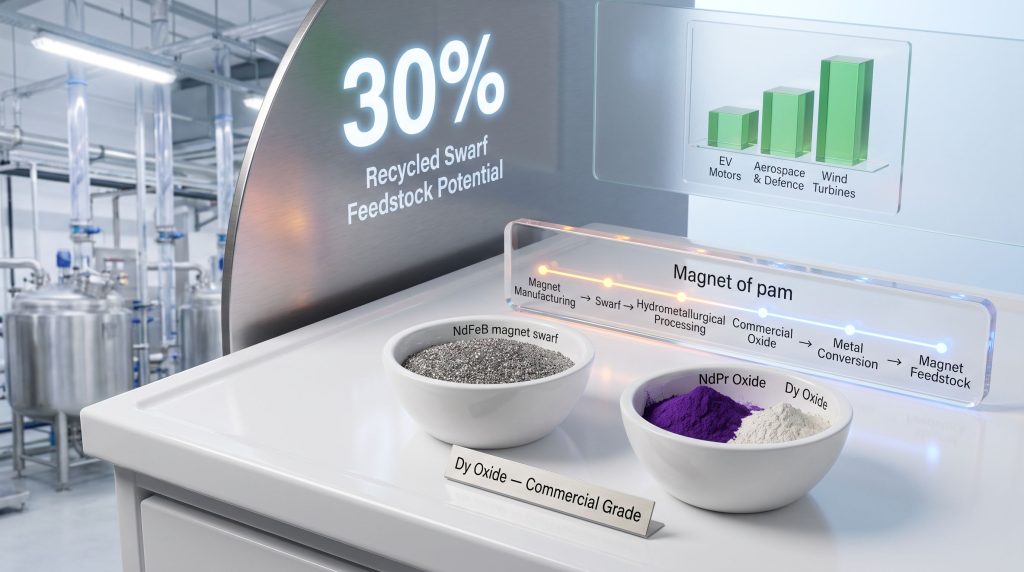
The 30% feedstock figure estimated by USA Rare Earth is particularly meaningful in this context. It establishes recycled swarf not as a marginal contribution but as a structurally significant component of a diversified rare earth oxide supply architecture, one that sits alongside primary ore carbonate processing rather than competing with it.
How Hydrometallurgical Processing Converts Magnet Scrap into Rare Earth Oxides
The Technical Pathway from Swarf to Certified Oxide
Hydrometallurgy, the use of aqueous chemistry to extract and separate metals, is the dominant processing route for rare earth element separation. The US Department of Energy has highlighted this approach as a priority pathway for rare earth recovery. The conversion of NdFeB magnet swarf into commercial-grade oxides follows a staged process that demands precise chemical control at each step:
- Swarf Collection and Characterisation — Fine grinding scrap is gathered from NdFeB machining operations and sampled for compositional analysis to inform downstream processing parameters
- Pre-Treatment and Dissolution — The swarf undergoes acid leaching to dissolve rare earth content into solution, while managing the iron and boron co-dissolution that complicates separation
- Solvent Extraction and Separation — Individual rare earth elements are isolated using selective organic extractant circuits, with dysprosium separation requiring additional extraction stages due to its chemical similarity to adjacent HREEs
- Precipitation and Calcination — Purified rare earth solutions are chemically precipitated as hydroxides or carbonates, then heat-treated at high temperatures to yield the final oxide powder
- Purity Verification and Quality Control — Oxide samples undergo independent analytical testing to confirm commercial-grade purity thresholds are met
- Downstream Qualification and Conversion — Certified oxides are forwarded to specialist processors for conversion into rare earth metals and alloy strip-cast products suitable for magnet manufacturing
The Value of 24/7 Facility Operation
One operationally significant aspect of the Wheat Ridge facility is its continuous, around-the-clock operation. This is not merely a production efficiency choice. Running a demonstration hydrometallurgical plant under sustained conditions generates the kind of real-time operating data — thermal profiles, reagent consumption rates, equipment wear patterns, and phase separation behaviour — that cannot be replicated through batch trials or modelling alone.
This data is directly used to inform the engineering design of a planned commercial-scale separation facility capable of processing both magnet swarf and mixed rare earth carbonate from primary ore sources. The demonstration plant essentially functions as a living design document for its larger successor.
The 30% Feedstock Ceiling and the Case for Multi-Source Architecture
Why Recycling Alone Cannot Close the Gap
Recycled NdFeB swarf from internal manufacturing operations is estimated to be capable of supplying approximately 30% of future magnetic rare earth oxide feedstock requirements. This ceiling reflects a fundamental arithmetic reality: the volume of swarf generated is bounded by the scale of magnet production itself, and manufacturing waste streams simply cannot outpace the demand they service.
This does not diminish the strategic value of the recycling pathway. Rather, it correctly positions swarf processing as one pillar within a broader, multi-source feedstock architecture that must also include:
- Primary ore carbonate processing from projects such as the Round Top deposit in Texas
- International ore concentrates from partner projects such as Serra Verde's Pela Ema mine in Brazil
- Cross-border recycling arrangements that recover manufacturing scrap from allied nation magnet producers
- Future end-of-life magnet recycling as collection infrastructure matures
Strategic Insight: Cross-border recycling arrangements linking US magnet manufacturing scrap to North American hydrometallurgical processing infrastructure represent an emerging architecture for building circular rare earth supply loops entirely outside Asian processing networks. This model is gaining traction as governments and manufacturers seek to establish supply resilience without waiting for new primary mining operations to reach production maturity.
However, recycling must be understood as one component of a larger strategic effort. America's rare earth supply chain requires coordinated development across mining, separation, recycling, and downstream manufacturing to achieve genuine resilience.
Applications Dependent on Dysprosium and NdPr Oxides
Why These Two Oxides Drive the Magnet Economy
NdPr oxide forms the fundamental building block of sintered NdFeB permanent magnets, the highest-performing magnet class available and the technology at the heart of virtually every high-efficiency electric motor and generator manufactured today. Dysprosium serves a different but equally critical function: it is added to NdFeB alloys in small proportions to dramatically improve the magnet's coercivity at elevated temperatures, preventing demagnetisation when the motor or actuator heats up during operation.
Without dysprosium addition, NdFeB magnets lose a significant proportion of their coercivity at temperatures above approximately 80 degrees Celsius, rendering them unsuitable for demanding applications in electric vehicle drivetrains, aerospace actuators, and industrial robotics.
| Application Sector | Key Rare Earth Required | Why It Matters |
|---|---|---|
| Electric Vehicles | NdPr, Dy | High-torque, thermally stable traction motors |
| Aerospace and Defence | Dy (critical) | Magnets must sustain performance under thermal stress |
| Industrial Robotics and Automation | NdPr, Dy | Precision servo motors operating at sustained temperatures |
| Wind Turbine Generators | NdPr | Direct-drive permanent magnet generator efficiency |
| Semiconductors and Advanced Electronics | NdPr | Miniaturised high-performance sensor magnets |
The next major ASX story will hit our subscribers first
Connecting Recycled Oxides to a Vertically Integrated Value Chain
From Scrap to Magnet: Closing the Loop
The strategic architecture being assembled around USA Rare Earth's operations illustrates what a genuinely integrated Western rare earth value chain can look like in practice. The flow runs as follows:
- NdFeB magnets are manufactured at the Stillwater, Oklahoma facility
- Machining and finishing operations generate swarf as a continuous by-product
- Swarf is transferred to the Wheat Ridge, Colorado hydrometallurgical facility
- Hydrometallurgical processing separates the swarf into USA rare earth recycled magnet scrap rare earth oxides at commercial grade
- Oxides are shipped to Less Common Metals (LCM) in the United Kingdom for qualification and metal conversion
- Converted rare earth metals and strip-cast alloys return as feedstock for magnet manufacturing in the United States
This circular architecture compresses the supply chain significantly compared to the conventional model, in which Western manufacturers purchase finished rare earth oxides from Asian processors and remain exposed to export quota changes, pricing volatility, and geopolitical disruption at every step.
The UK Link: Why Specialist Downstream Processing Matters
Less Common Metals, as a UK-based subsidiary with deep expertise in rare earth metal production and alloy casting, provides a critical technical bridge in this supply chain. The qualification of oxides at LCM before conversion ensures that the materials entering magnet production meet the exacting metallurgical specifications required for high-performance NdFeB alloys. This step is frequently overlooked in discussions of rare earth supply chain development, yet the ability to convert oxide to metal at the required purity and alloy composition is itself a scarce capability globally.
The Global Competitive Landscape for Non-Asian Dy Oxide Production
Who Else Is Producing Heavy Rare Earth Oxides Outside Asia?
The number of non-Asian producers capable of separating heavy rare earth elements at commercial purity remains vanishingly small. Australia's Lynas Rare Earths operates separation facilities in Malaysia and is constructing heavy rare earth processing capabilities, whilst MP Materials in California processes mixed rare earth carbonate but has historically focused on light rare earth production. Energy Fuels in Utah has demonstrated uranium-linked rare earth carbonate production but is still advancing toward full oxide separation capability.
The ability to specifically separate Dy oxide at commercial grade from recycled NdFeB feedstock, as demonstrated at Wheat Ridge, represents a distinct technical capability that few non-Asian operations have validated at any scale. Research published in peer-reviewed metallurgical literature confirms the technical complexity of achieving high-purity heavy rare earth oxide separation outside established processing hubs.
Rare Earth Recycling Pathway Maturity
| Recycling Pathway | Current Maturity | Scale Potential | Key Bottleneck |
|---|---|---|---|
| NdFeB Manufacturing Swarf | Commercial demonstration | Medium | Feedstock volume constrained by production scale |
| End-of-Life Consumer Magnets | Early stage | Very High | Collection, sorting, and disassembly infrastructure |
| Industrial Motor Magnets | Emerging | High | Demagnetisation processing and logistics costs |
| Electronic Waste Hard Drives | Pilot stage | Medium | Low magnet content per unit weight |
Frequently Asked Questions: USA Rare Earth Recycled Magnet Scrap and Rare Earth Oxides
What is rare earth magnet swarf and why is it valuable for recycling?
Magnet swarf is the fine metallic residue produced when sintered NdFeB magnets are machined to precise dimensions. Because it retains the full rare earth content of the original alloy and comes from a known, consistent feedstock source, it is highly suitable for hydrometallurgical processing into commercial-grade rare earth oxides.
How is dysprosium oxide different from neodymium-praseodymium oxide?
NdPr oxide is the primary structural ingredient in NdFeB permanent magnets, providing the fundamental magnetic performance. Dysprosium oxide is processed into a Dy metal addition that enhances the magnet's thermal stability, preventing performance degradation at elevated operating temperatures. Dy oxide is technically harder to separate at commercial purity and is produced in far smaller global volumes.
Why is it significant to produce commercial-grade Dy oxide outside of China?
The overwhelming majority of global Dy oxide production currently occurs within Chinese processing infrastructure. Any non-Asian producer achieving commercial-grade Dy oxide separation represents a genuine diversification of supply and reduces the exposure of Western defence, automotive, and technology manufacturers to single-source geopolitical risk.
What industries are most dependent on recycled rare earth oxide supply chains?
Electric vehicle manufacturers, aerospace and defence contractors, industrial robotics producers, wind turbine generator manufacturers, and advanced electronics producers all depend critically on reliable NdPr and Dy oxide supply for permanent magnet production.
Can recycled magnet scrap fully replace primary rare earth mining as a feedstock source?
No. Manufacturing swarf recycling is estimated to supply up to approximately 30% of future magnetic rare earth oxide feedstock requirements. Primary ore processing and additional external feedstock sources remain essential components of a complete supply architecture. Recycling is a complementary and strategically significant pillar, not a standalone solution.
What is hydrometallurgical processing and how does it apply to rare earth recycling?
Hydrometallurgy uses aqueous chemical processes — primarily acid leaching and solvent extraction — to dissolve, separate, and purify individual elements from complex material mixtures. In rare earth recycling, it enables the selective isolation of individual rare earth oxides from NdFeB magnet scrap at the purity levels required for commercial magnet manufacturing.
Key Takeaways: The Strategic Significance of Rare Earth Oxide Production from Recycled Magnet Scrap
- The production of commercial-grade Dy and NdPr oxides from USA rare earth recycled magnet scrap rare earth oxides at Wheat Ridge, Colorado represents a technically validated circular supply pathway with direct implications for Western supply chain resilience
- Magnet manufacturing swarf carries the potential to offset up to 30% of future magnetic rare earth oxide feedstock requirements, establishing recycling as a structurally significant but complementary supply lever
- Dysprosium oxide separation at commercial purity remains one of the most technically demanding and geographically concentrated processes in global critical mineral supply chains
- Integrated operations linking recycling, primary ore processing, and downstream metal conversion through specialist partners represent the most resilient supply architecture currently available to Western defence and technology industries
- The transition from demonstration-scale oxide production to commercial-volume separation facilities will be the defining factor in whether Western rare earth recycling achieves genuine structural competitiveness in global markets
- 24/7 operation of demonstration facilities is not merely a production milestone but a critical engineering data-gathering exercise that directly shapes the design parameters of future commercial-scale plants
Readers seeking to expand their understanding of rare earth processing and critical mineral supply chain dynamics can explore related industry reporting at AL Circle, which covers developments across the global critical minerals and advanced materials sectors.
Want to Track the Next Major Critical Minerals Discovery Before the Broader Market Does?
Discovery Alert's proprietary Discovery IQ model delivers real-time alerts on significant ASX mineral discoveries — including critical minerals driving the rare earth supply chain revolution — instantly converting complex geological data into actionable investment insights. Explore historic discoveries and their market-moving returns, then begin your 14-day free trial at Discovery Alert to position yourself ahead of the market.