July 15, 2026
The Separation Bottleneck That Defines Western Rare Earth Vulnerability
Few industrial dependencies carry as much strategic weight as the rare earth supply chains underpinning modern economies. While public discourse frequently focuses on mining output, the real chokepoint sits one step downstream: the hydrometallurgical separation facilities that convert mixed rare earth concentrates into individual, high-purity oxides. Without this capability operating domestically, every tonne of ore extracted from Western soil must eventually pass through foreign processing infrastructure before it can enter a magnet factory. For the United States, that foreign infrastructure is overwhelmingly Chinese.
Understanding this distinction is foundational to evaluating why USA Rare Earth magnet REE oxides production represents more than a corporate milestone. It signals a structural attempt to reconstruct a processing layer that Western supply chains have largely ceded over the past three decades.
When big ASX news breaks, our subscribers know first
Why Separation Capacity, Not Mining, Is the True Bottleneck
The Processing Gap That Mining Alone Cannot Solve
China's dominance in rare earth processing is not simply a function of having large ore deposits. It reflects sustained, deliberate investment in the chemical engineering infrastructure required to transform mixed rare earth concentrates into separated, purified oxide compounds. Estimates consistently place China's share of global rare earth separation and refining capacity at 85 to 90%, a figure that has remained largely stable even as Western nations have accelerated exploration activity.
This creates a paradox for countries attempting to build sovereign supply chains: even domestically mined ore frequently returns to China for processing before it can re-enter Western manufacturing pipelines. The result is a supply chain that is nominally domestic at the mining stage but functionally dependent on Chinese chemistry at every step thereafter.
The rare earth processing challenges most critical to permanent magnet manufacturing illustrate the scale of this dependency across four key oxides:
| Oxide | Chemical Formula | Primary Function in NdFeB Magnets | Criticality Classification |
|---|---|---|---|
| Neodymium oxide | Nd₂O₃ | Core magnetic remanence and field strength | Very High |
| Praseodymium oxide | Pr₆O₁₁ | Structural stability and field enhancement | Very High |
| Dysprosium oxide | Dy₂O₃ | High-temperature coercivity above 150°C | Extreme |
| Terbium oxide | Tb₂O₃ | Superior thermal stability at low addition volumes | Extreme |
What Makes Heavy Rare Earth Oxides Uniquely Difficult to Source
Dysprosium and terbium occupy a category of scarcity that goes beyond simple market concentration. Both elements are predominantly derived from ionic clay deposits distributed across southern China, and their chemical similarity to adjacent lanthanides makes clean separation technically demanding and capital-intensive.
Dysprosium oxide and terbium oxide are not optional performance additives in high-grade NdFeB magnets. They are functionally required for any magnet that must maintain coercivity above 150°C, which includes virtually every magnet destined for electric vehicle traction motors, defence guidance systems, and aerospace actuators. Without these oxides produced outside China, the concept of a sovereign magnet supply chain remains incomplete regardless of how much primary ore is mined domestically.
Terbium is particularly notable for its scarcity. It is produced in comparatively small commercial volumes globally, and its ability to deliver thermal stability at lower addition rates than dysprosium makes it a preferred but tightly constrained material for high-performance magnet producers.
From Ore to Oxide: Understanding the Hydrometallurgical Separation Process
Why Chemical Processing Is More Complex Than Mining
Rare earth elements do not occur in nature as neatly isolated compounds. They are geochemically associated elements that appear together in mineralised rock, each with subtly different chemical properties that must be exploited through multi-stage processing to achieve separation. The hydrometallurgical pathway used in commercial rare earth processing involves several sequential steps:
- Leaching: Crushed ore or concentrate is dissolved in acidic or alkaline solution to mobilise the rare earth fraction into a liquid phase.
- Solvent extraction: Organic solvents selectively extract individual or grouped rare earth elements based on differences in their chemical affinity, separating them from gangue and from each other.
- Stripping and precipitation: The extracted elements are transferred back into aqueous solution and precipitated as hydroxides or carbonates.
- Calcination: Precipitated compounds are thermally treated to drive off moisture and convert them into stable oxide form.
- Purity verification: Final oxide products are analysed to confirm they meet commercial-grade thresholds, typically 99% purity or higher for magnet-grade applications.
Heavy rare earths such as dysprosium present particular challenges in solvent extraction because their chemical behaviour is so similar to neighbouring elements like holmium and erbium. Achieving clean separation requires carefully tuned extractant chemistry and multiple processing stages, which is why most Western facilities that have attempted heavy rare earth separation have operated only at pilot or demonstration scale.
USA Rare Earth Magnet REE Oxides: Validating the Mine-to-Magnet Architecture
The Network Structure Behind the Oxide Production Milestone
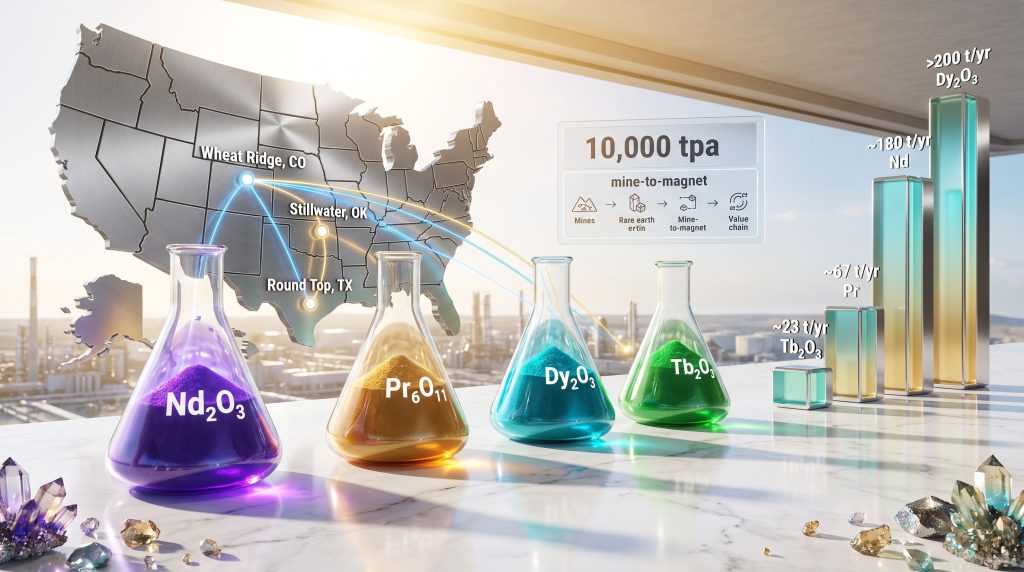
The recent production of commercial-grade neodymium-praseodymium and dysprosium oxides at the Wheat Ridge, Colorado hydrometallurgical demonstration facility marks a technically significant step in USA Rare Earth's effort to assemble a fully integrated supply chain. The feedstock for this initial production run was swarf sourced from the company's sintered NdFeB magnet manufacturing plant in Stillwater, Oklahoma, demonstrating that the recycling loop underpinning the company's circular supply chain model can function in practice.
The broader network USA Rare Earth is assembling spans multiple geographies and value chain stages:
- Round Top deposit, Sierra Blanca, Texas: Rhyolite-hosted rare earth resource with an unusually high proportion of heavy rare earth mineralisation relative to most Western deposits.
- Pela Ema operation, Brazil: Under acquisition, providing geographic diversification and an additional primary ore feedstock source for Wheat Ridge processing campaigns.
- Wheat Ridge hydrometallurgical demonstration facility, Colorado: The separation hub and technical linchpin of the entire network, capable of processing both primary ore and recycled scrap feedstocks.
- Stillwater magnet plant, Oklahoma: Operational sintered NdFeB magnet manufacturing facility and source of swarf feedstock for the recycling loop.
- Planned magnet and alloy complex, South Carolina: Under development to expand finished magnet manufacturing capacity.
- Less Common Metals subsidiary, United Kingdom: Rare earth metal and alloy conversion facility providing the final processing stage before materials return as magnet feedstock.
Why Wheat Ridge Is the Network's Irreplaceable Node
A vertically integrated rare earth model is structurally only as resilient as its weakest processing link. In the USA Rare Earth architecture, that link is separation. Without Wheat Ridge functioning as a commercial-grade oxide producer, the Stillwater magnet plant would remain dependent on externally sourced oxides, and the circular feedstock loop from swarf recovery would have no processing home.
The Wheat Ridge facility is significant not merely because it has produced oxides, but because it has done so from recycled magnet manufacturing scrap. This demonstrates that the facility can accept and process chemically complex secondary feedstocks, not just freshly mined concentrates, which substantially broadens its strategic utility within the network.
The Circular Supply Chain: How Magnet Swarf Becomes Strategic Feedstock
What Swarf Is and Why It Matters More Than Its Name Suggests
Swarf is a term borrowed from general machining practice, referring to the fine metallic debris generated when a workpiece is cut, ground, or shaped. In the context of NdFeB magnet manufacturing, swarf consists of dust, shavings, and machining residue produced during the cutting and finishing of sintered magnet blocks.
Because NdFeB magnets contain significant concentrations of neodymium, praseodymium, dysprosium, and sometimes terbium, this material is not industrial waste in the conventional sense. It is a concentrated secondary ore carrying exactly the elements most needed to produce more magnets.
The rare earth content of NdFeB magnet swarf typically reflects the composition of the magnets being processed. High-performance magnets destined for EV motors and defence applications carry elevated dysprosium and terbium additions, meaning the swarf they generate is correspondingly enriched in heavy rare earths that are otherwise difficult and expensive to source outside China.
Projecting the Feedstock Contribution from Recycling
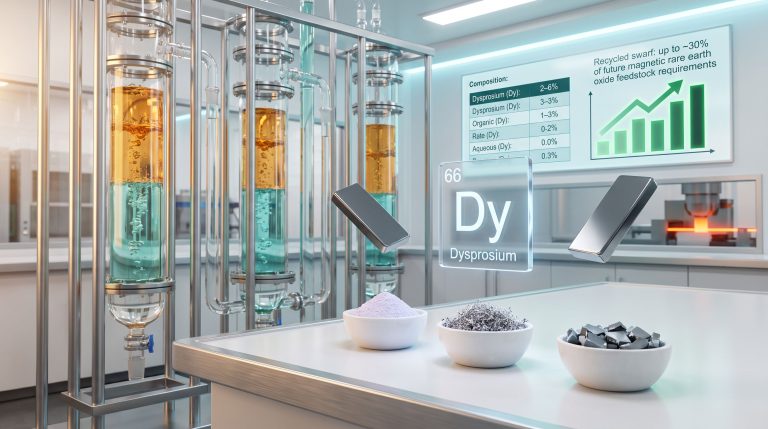
USA Rare Earth has indicated that swarf recovery is projected to contribute up to 30% of future magnetic rare earth oxide feedstock requirements within its integrated system. This is a materially significant figure for several reasons:
- It reduces the volume of primary ore that must be mined and processed to sustain a given level of magnet output.
- It creates a partially self-reinforcing feedstock supply that grows proportionally with magnet manufacturing volume.
- It reduces the unit cost of oxide inputs by substituting a recovered internal byproduct for purchased primary material.
- It demonstrates commercial circularity in a supply chain segment where such loops have been largely theoretical in the Western context.
The Step-by-Step Swarf-to-Oxide Conversion Pathway
The conversion of Stillwater swarf into qualified magnet feedstock involves a multi-stage process spanning multiple facilities and two countries:
- Swarf collection at the Stillwater, Oklahoma magnet manufacturing plant, where machining and finishing operations continuously generate NdFeB-bearing residues.
- Feedstock preparation, involving removal of non-rare-earth materials including iron, boron binder phases, and any surface coatings present on finished magnet stock.
- Hydrometallurgical processing at the Wheat Ridge, Colorado facility, where leaching and sequential solvent extraction separate the rare earth fraction and then resolve it into individual element streams.
- Individual oxide production, yielding separated NdPr oxide and dysprosium oxide at commercial purity grades consistent with magnet manufacturing specifications.
- Shipment to Less Common Metals in the United Kingdom for purity qualification and conversion into rare earth metals and alloys.
- Return of qualified alloy feedstock to U.S. magnet operations, completing the circular loop.
Round Top and Pela Ema: Building the Primary Ore Pipeline
Round Top's Unusual Mineralogy and Its Strategic Significance
The Round Top deposit in far west Texas hosts rare earth mineralisation within a rhyolite volcanic rock formation, which is geologically distinct from the carbonatite and monazite-bearing deposits that represent most of the world's known rare earth resources. The rhyolite-hosted character of Round Top contributes to its unusual enrichment in heavy rare earths relative to light rare earths, making it one of the few Western deposits capable of contributing meaningful dysprosium and terbium yields at scale.
Projected annual oxide production at full Round Top capacity illustrates the deposit's strategic profile:
| Oxide | Projected Annual Output at Full Capacity |
|---|---|
| Dysprosium oxide (Dy₂O₃) | Over 200 tonnes per year |
| Neodymium oxide (Nd₂O₃) | Approximately 180 tonnes per year |
| Praseodymium oxide (Pr₆O₁₁) | Approximately 67 tonnes per year |
| Terbium oxide (Tb₂O₃) | Approximately 23 tonnes per year |
Full-scale production from Round Top is projected around 2028, with Wheat Ridge serving as the designated separation hub for its ore. Furthermore, current campaigns at Wheat Ridge are processing Round Top material alongside Brazilian feedstock from the Pela Ema acquisition, with additional oxide varieties expected to be produced from these campaigns in the near term.
Bridging the Production Gap Before 2028
To sustain magnet manufacturing at Stillwater during the period before Round Top achieves full-scale output, USA Rare Earth secured an off-take agreement for approximately 900 metric tonnes per year of ultra-pure rare earth oxides from a U.S.-based separation partner. This bridging arrangement ensures that the Stillwater plant can pursue its targeted manufacturing ramp without waiting for primary ore production to reach commercial scale.
The long-term manufacturing capacity target is 10,000 metric tonnes per annum of finished sintered NdFeB magnets, a figure that would represent a substantial contribution to the domestic U.S. permanent magnet supply base. Consequently, this positions the company as a meaningful participant in America's rare earth supply chain at a scale that few Western developers have approached.
The next major ASX story will hit our subscribers first
Competitive Positioning: How USA Rare Earth Stacks Up Against Western Peers
A Comparative View of Integration Depth
Most Western rare earth development programmes remain structurally incomplete, addressing one or two stages of the value chain while remaining dependent on external parties for the rest. The depth of USA Rare Earth's integration distinguishes its model from most Western competitors:
| Capability | USA Rare Earth | Typical Western Rare Earth Developer |
|---|---|---|
| Domestic ore resource | Round Top (TX) and Pela Ema (Brazil) | Often single jurisdiction |
| Hydrometallurgical separation | Wheat Ridge demonstration facility (CO) | Frequently outsourced or absent |
| Heavy REE oxide production | Demonstrated (Dy₂O₃ from swarf) | Rarely demonstrated outside pilot stage |
| Magnet manufacturing | Operational, Stillwater (OK) | Rarely integrated |
| Recycling loop | Swarf-to-oxide validated | Largely theoretical |
| Metal and alloy conversion | Less Common Metals (UK) | Typically outsourced |
| Geographic diversification | USA, Brazil, UK, South Carolina expansion | Usually single country |
End-Use Markets Driving Demand for Magnet-Grade REE Oxides
The Application Landscape for NdPr and Heavy Rare Earth Oxides
The critical minerals demand growth for USA Rare Earth magnet REE oxides is being driven by structural expansion across several end-use segments simultaneously, which reduces the demand concentration risk that has historically affected single-application commodity markets:
- Electric vehicle traction motors represent the largest near-term growth driver, with each motor requiring between 1 and 2 kilograms of sintered NdFeB magnets. Fleet electrification at scale translates directly into sustained upward pressure on NdPr and dysprosium oxide consumption.
- Defence and aerospace systems require high-coercivity magnets capable of maintaining performance across wide temperature ranges. Precision-guided munitions, radar signal processing systems, submarine propulsion units, and advanced drone platforms all rely on rare earth permanent magnets enhanced with dysprosium.
- Industrial and collaborative robotics platforms use servo motors and actuators that require thermally stable, energy-dense magnets. Physical AI infrastructure, including the robotic systems underpinning warehouse automation and advanced manufacturing, is an emerging but rapidly scaling demand source.
- Direct-drive offshore wind turbines consume large quantities of NdFeB magnets per installed megawatt, with each turbine unit potentially containing over a tonne of magnet material.
- Consumer and industrial motors across appliance, HVAC, and industrial drive applications contribute persistent baseline demand for lighter rare earth oxides.
The U.S. Department of Defence has formally identified rare earth permanent magnets as a critical vulnerability within the defence industrial base. Domestic separation of magnet-grade oxides directly addresses this concern by ensuring that military supply chains do not route through processing infrastructure located in geopolitically adversarial jurisdictions at any stage.
However, the path to realising these opportunities is not without complication. The US critical minerals landscape continues to evolve rapidly, with tariff structures and trade policy shifts creating both tailwinds and uncertainties for domestic producers attempting to compete against established Chinese supply chains.
Key Milestones That Will Define the Next Phase of Development
What to Watch as the Mine-to-Magnet Model Matures
For investors and industry observers tracking USA Rare Earth magnet REE oxide development, several near-term milestones carry outsized informational value. According to USGS rare earths statistics, domestic processing capacity remains a critical gap in the U.S. supply base, making each of the following milestones particularly consequential:
- Qualification results from Less Common Metals for the Wheat Ridge-produced NdPr and dysprosium oxides, which would validate the commercial-grade specification of domestically separated heavy rare earth material.
- Expanded oxide variety production from ongoing Round Top ore and Pela Ema feedstock campaigns at Wheat Ridge, demonstrating that the facility can process primary ore sources in addition to recycled scrap.
- Progress toward the 10,000 tpa magnet manufacturing target at Stillwater, which defines the scale at which the circular recycling loop would generate meaningful swarf volumes.
- Development timeline clarity for the South Carolina magnet and alloy complex, which would substantially expand total U.S. finished magnet output capacity.
- Finalisation of the Pela Ema acquisition and its integration as a confirmed Wheat Ridge feedstock source, adding Brazilian ionic clay mineralisation to the ore processing pipeline.
Each of these milestones represents a validation event for a different segment of the integrated model. Collectively, their achievement would complete the first full commercial cycle of a mine-to-magnet network operating entirely outside Chinese processing infrastructure.
This article is intended for informational purposes only and does not constitute financial or investment advice. Projections regarding production timelines, oxide output volumes, and feedstock contributions are based on company statements and publicly available information and involve forward-looking assumptions that may not be realised. Readers should conduct their own due diligence before making any investment decisions.
Want to Track the Next Major Mineral Discovery Before the Market Does?
Discovery Alert's proprietary Discovery IQ model delivers real-time alerts on significant ASX mineral discoveries — including critical minerals powering the rare earth supply chain — turning complex data into actionable investment insights for both new and experienced investors. Explore historic discoveries and their returns, then start your 14-day free trial at Discovery Alert to position yourself ahead of the market.