July 14, 2026
The Hidden Bottleneck in the Clean Energy Transition: Why Heavy Rare Earth Separation Changes Everything
Most conversations about rare earth supply chains focus on mining. Where are the deposits? Who controls them? How quickly can they be permitted? These are legitimate questions, but they miss the deeper structural problem that has quietly undermined Western industrial independence for decades. The real chokepoint is not in the ground. It sits in the chemistry laboratories and solvent extraction circuits where individual rare earth elements are separated, purified, and converted into the oxide forms that downstream manufacturers actually need.
Of all the rare earth elements that flow through this process, USA Rare Earth dysprosium from magnet scrap presents the most formidable technical challenge and carries some of the highest strategic stakes. Understanding why requires a brief detour into the physics of permanent magnets, and what happens to them when temperatures rise.
When big ASX news breaks, our subscribers know first
Why Dysprosium Cannot Be Substituted in High-Performance Magnets
Neodymium-iron-boron (NdFeB) permanent magnets are the foundational components of modern electric traction motors, direct-drive wind turbines, precision servo systems used in industrial robotics, and guidance mechanisms in defence applications. Their extraordinary energy density, measured in maximum energy product (BHmax), makes them irreplaceable in applications where size and weight constraints are non-negotiable.
The vulnerability of NdFeB magnets, however, lies in their thermal sensitivity. As operating temperatures increase, the coercivity of a standard NdFeB magnet — meaning its resistance to demagnetisation — declines rapidly. Without additives, functional performance begins degrading at temperatures above approximately 80 degrees Celsius. For an electric vehicle drivetrain or a wind turbine generator, which routinely operate well above this threshold, an unmodified NdFeB magnet is simply inadequate.
Dysprosium directly addresses this limitation. When incorporated into NdFeB alloys, dysprosium dramatically elevates coercivity across the operating temperature range, enabling magnets to maintain their magnetic properties in demanding thermal environments. No commercially viable substitute has emerged that can replicate this function without significant performance compromise.
This non-substitutability, combined with dysprosium's extreme geographic concentration in supply, is the source of its strategic importance. The vast majority of global dysprosium originates from ionic clay deposits concentrated in southern China, a geographic reality that has created a persistent supply vulnerability for Western manufacturers. Furthermore, China's export restrictions have intensified the urgency of developing alternative separation capacity in the West.
The Chemistry That Makes Dysprosium So Difficult to Produce
Among the lanthanide series, dysprosium sits between holmium and terbium — elements with nearly identical ionic radii and chemical behaviour. This proximity is precisely what makes separation so demanding. Industrial rare earth separation relies primarily on liquid-liquid solvent extraction, a process in which rare earth ions partition between an aqueous phase and an organic extractant phase according to subtle differences in their distribution coefficients.
For light rare earths such as neodymium and praseodymium, these differences are sufficiently large that separation can be achieved with manageable numbers of extraction stages. Heavy rare earths, including dysprosium, terbium, and holmium, have distribution coefficients that are far closer together, requiring far more extraction stages, more precise pH control, and more sophisticated process engineering to achieve the purity thresholds that commercial buyers require. These rare earth processing challenges represent one of the most significant barriers to Western supply chain independence.
Commercial-grade dysprosium oxide (Dy₂O₃) specifications are exacting:
| Specification Parameter | Commercial Requirement |
|---|---|
| Total Rare Earth Oxide (TREO) purity | 99.5% minimum |
| Dysprosium as percentage of TREO | 99.0% minimum |
| Adjacent lanthanide impurities | Below 100 ppm |
These are not minor analytical thresholds. Meeting them consistently across production campaigns, using a recycled feedstock with a more complex mixed rare earth composition than a primary ore concentrate, represents a genuine technical achievement that very few Western operations have been able to demonstrate.
Magnet Swarf as a Strategic Feedstock: The Secondary Ore Body Nobody Talks About
Every NdFeB permanent magnet produced commercially must be machined and finished to precise dimensional tolerances before it can be installed in a motor or generator. This machining process generates fine metallic residue, known in the industry as swarf, that is chemically identical in composition to the parent magnet alloy.
What makes swarf particularly interesting from a supply chain perspective is its rare earth concentration. Unlike primary rare earth ore, which must be beneficiated from rock containing far more gangue material than rare earth mineral, swarf arrives as a pre-concentrated feedstock with no gangue to remove.
Typical NdFeB magnet swarf composition:
| Element | Approximate Content |
|---|---|
| Neodymium (Nd) | 22 to 26% |
| Praseodymium (Pr) | 5 to 7% |
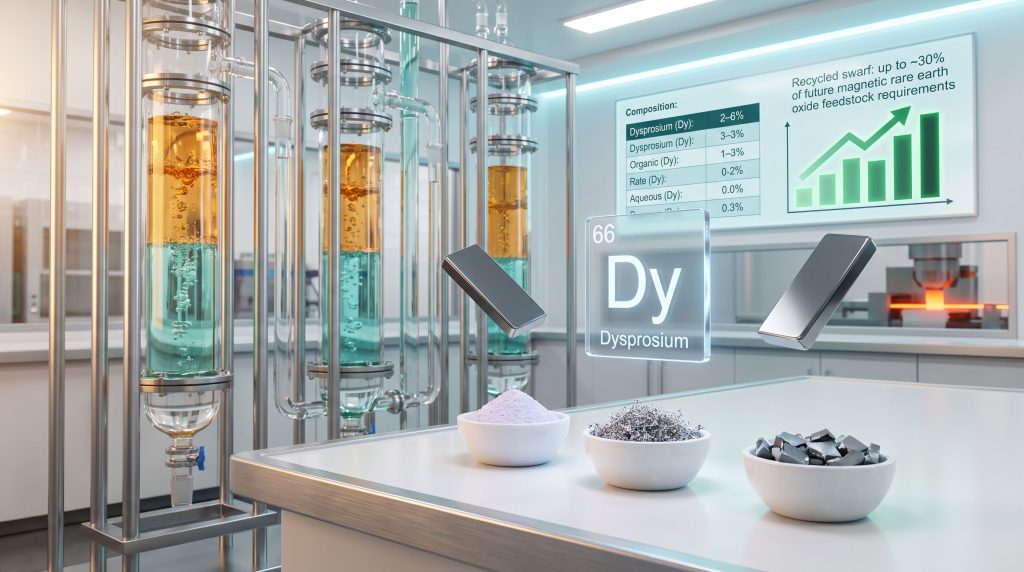
| Dysprosium (Dy) | 2 to 6% |
| Iron (Fe) | 60 to 65% |
| Boron (B) | approximately 1% |
The dysprosium concentration in swarf, ranging from 2 to 6 percent of total mass, is frequently comparable to or higher than the rare earth grades found in many primary ore deposits. This makes magnet swarf an exceptionally high-grade secondary feedstock by any industry benchmark.
Processing swarf eliminates the beneficiation and concentration steps required in primary mining, significantly reducing the hydrometallurgical burden and enabling a more efficient path to separated rare earth oxides.
There is an additional structural advantage that tends to be overlooked. Swarf generated at a magnet manufacturing facility is produced continuously, predictably, and at a geographically known location. It is immune to the geopolitical risks, weather disruptions, and permitting delays that can interrupt primary ore supply. For an integrated manufacturer, this means a portion of rare earth oxide feedstock can be secured from within the company's own production footprint, creating a closed loop that reduces external dependency.
From Scrap to Separated Oxide: The Hydrometallurgical Process in Practice
Converting NdFeB swarf into separated rare earth oxides requires a multi-stage hydrometallurgical process. The general sequence involves dissolution of the swarf material in acidic solution, followed by selective removal of non-rare-earth constituents including iron and boron, which must be precipitated or otherwise extracted before the rare earth separation stages can proceed effectively.
The core separation work is accomplished through solvent extraction cascades. In these systems, the mixed rare earth solution contacts an organic extractant phase in a series of mixer-settler units or pulsed columns. Rare earth elements partition between the two phases at slightly different rates, and by running sufficient numbers of extraction and scrubbing stages, individual lanthanides can be progressively purified to commercial-grade specifications.
The heavy rare earth fraction, which contains dysprosium alongside holmium and erbium, requires the most extensive extraction cascade to achieve the purity levels that downstream metal producers demand. Following separation, purified fractions are stripped from the organic phase, precipitated as oxalates or carbonates, and thermally converted to oxide form through calcination.
The key stages in sequence:
- Acid dissolution of swarf feedstock
- Iron and boron removal through selective precipitation
- Rare earth concentration and purification pre-treatment
- Multi-stage solvent extraction for individual lanthanide separation
- Stripping of purified fractions from organic phase
- Precipitation as rare earth oxalate or carbonate
- Calcination to produce final rare earth oxide product
A validated flowsheet that successfully achieves commercial-grade dysprosium oxide from recycled magnet swarf demonstrates that the same fundamental chemistry can potentially be adapted to process end-of-life magnet material recovered from retired electric vehicles, wind turbines, and consumer electronics. This is a considerably larger feedstock opportunity that will grow in scale as the installed base of NdFeB-dependent clean energy equipment ages through the 2030s and beyond.
USA Rare Earth's Integrated Architecture: What Sets It Apart
USA Rare Earth has achieved a milestone that highlights the depth of its integrated approach to the rare earth value chain. Operating its Wheat Ridge hydrometallurgical separation facility in Colorado, the company has successfully produced commercial-grade dysprosium oxide and neodymium-praseodymium oxide from magnet swarf generated at its own NdFeB magnet manufacturing operation in Stillwater, Oklahoma.
This internal feedstock loop — from magnet machining to oxide recovery and back into metal production — positions the company as one of the very few Western entities capable of demonstrating the complete circular arc of rare earth processing. The validation of this recycling flowsheet establishes that internally generated swarf could support up to approximately 30% of future magnetic rare earth oxide feedstock requirements for magnet production at scale. That represents a substantial reduction in the volume of primary ore that must flow through the separation circuit to sustain manufacturing output.
The oxides produced at Wheat Ridge are intended to progress to Less Common Metals (LCM), USA Rare Earth's UK-based subsidiary, for qualification and conversion into rare earth metals and NdFeB strip cast alloy. LCM is one of the very few commercial-scale rare earth metal, alloy, and strip cast producers operating outside of Asia, making it a critical node in any credible non-Asian permanent magnet supply chain.
Strip cast NdFeB alloy, the direct precursor material for sintered magnet production, is a capability that exists in only a handful of locations globally outside China and Japan. The presence of this capability in the United Kingdom represents a strategic asset for Western magnet manufacturing.
Beyond the internal recycling circuit, additional processing campaigns at Wheat Ridge are underway to process material from USA Rare Earth's Round Top project in Texas and from Serra Verde's Pela Ema mine in Brazil. These campaigns are designed to produce additional varieties of rare earth and critical mineral oxides, progressively validating the facility's capability across a diverse range of feedstock chemistries.
The next major ASX story will hit our subscribers first
The Full Value Chain: A Framework for Understanding Western Rare Earth Dependency
A genuinely complete Western rare earth supply chain must encompass all of the following stages, each of which has historically been concentrated in Asian processing infrastructure:
| Value Chain Stage | Description | Western Capability Status |
|---|---|---|
| Primary Mining | Extraction of rare earth ore | Developing, limited operational examples |
| Beneficiation | Concentration of rare earth minerals | Available but underutilised |
| Hydrometallurgical Separation | Individual rare earth oxide production | Very limited outside Asia |
| Metal and Alloy Production | Oxide conversion to metal and master alloy | Extremely rare outside Asia |
| Strip Casting | NdFeB alloy precursor production | Near-exclusively Asian |
| Magnet Sintering | Final permanent magnet manufacture | Emerging in US and Europe |
| Scrap Recycling | Recovery from manufacturing waste | Early-stage in Western markets |
Western rare earth development efforts have historically stalled at the separation and metal-making stages — not because the underlying chemistry is unknowable, but because building and operating these facilities requires sustained capital investment, highly specialised process expertise, and the patience to navigate lengthy downstream qualification timelines.
Heavy rare earth separation, in particular, demands capabilities that are structurally rarer than light rare earth processing in the Western world. This asymmetry means that even a successfully developed neodymium-praseodymium supply chain could leave a critical dysprosium dependency intact unless specific heavy rare earth separation infrastructure is established and qualified concurrently. Consequently, the US rare earth supply chain must address heavy rare earth separation as a distinct and urgent priority.
Feedstock Diversification as a Risk Management Strategy
A separation facility capable of processing multiple distinct feedstock types occupies a fundamentally more resilient commercial position than one dependent on a single input. The strategic logic of multi-source feedstock processing extends across several dimensions:
- Volume stability: If one feedstock stream is disrupted, capacity utilisation can be maintained by drawing on alternative sources
- Revenue diversification: Processing third-party concentrates generates toll-processing income that is independent of owned mining project timelines
- Technical validation breadth: Demonstrating separation capability across varied feedstock chemistries accelerates qualification with downstream metal producers and magnet manufacturers
- Market optionality: Access to diverse feedstocks creates the ability to shift product mix in response to pricing signals across the rare earth oxide market
At current dysprosium oxide market prices, which have historically traded in a range broadly between USD $200 and $400 per kilogram depending on market conditions, recovering dysprosium from internally generated swarf rather than purchasing it from external suppliers represents a meaningful cost advantage per kilogram of finished magnet. This internal recovery loop effectively converts a manufacturing byproduct into a partially self-funded raw material supply.
The End-of-Life Magnet Opportunity: Looking Beyond Manufacturing Swarf
Manufacturing swarf is the near-term recycling feedstock opportunity. However, the longer-term prize is considerably larger. The global stock of NdFeB magnets installed in electric vehicles, wind turbines, hard disk drives, and consumer electronics has grown substantially over the past decade. As this equipment ages and enters end-of-life decommissioning cycles, the volume of recoverable magnet material entering waste streams will increase dramatically through the 2030s.
End-of-life EV and wind turbine magnets typically contain dysprosium concentrations of 2 to 5 percent, making them commercially attractive recycling targets. The principal challenge is not chemistry. A validated flowsheet developed for manufacturing swarf provides the technical foundation to process end-of-life material through equivalent hydrometallurgical pathways.
The challenge is logistics. Unlike swarf, which is generated at a known point source within a manufacturing facility, end-of-life magnets must be collected from dispersed, geographically distributed sources through reverse logistics infrastructure that does not yet exist at commercial scale in most Western markets. In addition, the growing critical minerals demand from the energy transition makes developing these collection networks increasingly urgent.
Establishing a technically credible recycling programme for manufacturing swarf now creates the institutional knowledge, process equipment, and downstream qualification relationships that will be essential to capturing end-of-life feedstock volumes as they grow. In this sense, near-term swarf recycling is as much an investment in future capability positioning as it is an immediate feedstock solution.
What Constitutes a Commercially Credible Rare Earth Recycling Programme
Industry observers and downstream customers evaluate rare earth recycling programmes against a defined sequence of technical milestones. A programme that has not progressed through these stages cannot yet be considered commercially validated. For instance, magnet recycling initiatives in other jurisdictions illustrate both the promise and the complexity of scaling these operations:
- Bench-scale chemistry validation: Confirming that target feedstocks dissolve appropriately and that rare earth fractions can be selectively extracted under controlled laboratory conditions
- Pilot-scale flowsheet demonstration: Running the complete process sequence at sufficient scale to generate representative product samples for analytical and commercial evaluation
- Product purity verification: Confirming through third-party analytical testing that produced oxides consistently meet commercial-grade specifications
- Downstream qualification submission: Providing oxide samples to metal producers and magnet manufacturers for evaluation against their internal material specifications
- Continuous production demonstration: Operating the process continuously over an extended period to confirm process stability and product consistency
- Feedstock extension: Demonstrating that the validated flowsheet can process alternative feedstock types, such as end-of-life magnets in addition to manufacturing swarf
Industry experience suggests that the transition from pilot-scale demonstration to commercial qualification with a major downstream customer typically requires between 12 and 36 months and multiple production campaigns. Early milestone achievement is therefore critical to maintaining commercial momentum.
FAQ: USA Rare Earth Dysprosium from Magnet Scrap
What is dysprosium oxide and why is it produced from magnet scrap?
Dysprosium oxide (Dy₂O₃) is the primary commercial form in which dysprosium is traded and processed into downstream materials. It is recovered from magnet scrap because NdFeB magnets contain significant dysprosium concentrations, and extracting this material from manufacturing residue reduces cost, avoids primary mining dependency, and shortens the supply chain.
What is magnet swarf and how does it differ from end-of-life magnet scrap?
Magnet swarf is the fine metallic residue generated during the precision machining and finishing of NdFeB magnets in a manufacturing environment. It is chemically identical to the parent magnet alloy and arrives as a consistently characterised feedstock in fine particle form. End-of-life magnet scrap refers to whole or fragmented magnets recovered from retired products and requires additional processing steps to handle variable physical forms and potential contamination from non-magnet components.
How many Western facilities can currently separate dysprosium oxide at commercial scale?
As of mid-2026, the number of Western facilities with demonstrated commercial-scale dysprosium oxide separation capability remains in the low single digits globally. This scarcity reflects decades of underinvestment in heavy rare earth separation infrastructure outside Asia, combined with the significant technical complexity of producing heavy rare earth oxides at the purity levels that metal producers and magnet manufacturers require. Furthermore, the USA Rare Earth dysprosium from magnet scrap programme represents one of the most advanced demonstrations of this capability in the Western world.
Disclaimer: This article is intended for informational purposes only and does not constitute financial advice or an investment recommendation. Statements regarding projected feedstock contributions, market pricing ranges, and future processing campaign outcomes involve forward-looking assumptions that may not be realised. Investors should conduct their own due diligence before making any investment decisions.
Want to Stay Ahead of the Next Major Critical Minerals Discovery?
Discovery Alert's proprietary Discovery IQ model scans ASX announcements in real time, delivering instant alerts on significant mineral discoveries — including critical minerals driving the clean energy transition — so subscribers can identify actionable opportunities before the broader market reacts. Explore historic examples of major discovery returns or start your 14-day free trial today to gain a market-leading edge.