July 14, 2026
Processing Power, Not Geology, Decides Who Wins the Rare Earth Race
The global economy runs on magnets. Not the kind you find on a refrigerator, but extraordinarily powerful permanent magnets built from a narrow cluster of metallic elements that most people have never heard of. These materials sit inside every electric vehicle drivetrain, every offshore wind turbine nacelle, every precision missile guidance system, and a growing share of the robotics and AI hardware being deployed at scale. The countries that can convert raw ore into finished magnets hold leverage over industries worth trillions of dollars annually. Those that cannot are structurally exposed.
This is the lens through which India rare earths challenge China processing dominance must be understood. The challenge is not primarily about what lies underground. It is about what happens above ground, in the chemical separation plants, refining facilities, and magnet manufacturing lines that transform geological wealth into industrial and strategic power. And on that dimension, China's processing dominance is so complete that it reshapes the risk calculus for every nation that depends on these supply chains.
When big ASX news breaks, our subscribers know first
The 17 Elements and the Four That Matter Most
Rare earth elements form a chemically coherent group of 17 metals that share broadly similar atomic structures but differ meaningfully in their magnetic and physical properties. Within this group, four elements command the overwhelming majority of commercial value: neodymium, praseodymium, dysprosium, and terbium. Together, these are referred to in industry as the magnet rare earths, and according to the International Energy Agency, magnets produced from these four elements account for approximately 95% of the total value of rare earth consumption worldwide.
The workhorse product is the neodymium-iron-boron (NdFeB) permanent magnet, widely regarded as the most powerful class of permanent magnet available for industrial use. Its applications span a remarkable range:
- Electric vehicle traction motors and regenerative braking systems
- Offshore and onshore wind turbine generators
- Industrial robotics and precision automation
- Missile and drone guidance electronics
- Medical imaging equipment including MRI machines
- Hard disk drives, smartphones, and consumer electronics
- Fighter jet actuators and satellite systems
The critical minerals demand surge has already doubled since 2015, driven primarily by the acceleration of electric vehicle adoption and wind energy deployment. The IEA projects a further ~33% increase in demand by 2030 under current policy trajectories, with automation and AI-linked hardware expected to add further momentum beyond that horizon. This is not a niche market. It is a foundational input to the global clean energy and defence industrial base.
How Rare Earth Processing Actually Works, And Where the Bottlenecks Form
Understanding why China's processing dominance is so difficult to replicate requires a close look at the value chain itself. Transforming ore into an operational magnet involves six sequential stages, each presenting its own technical, environmental, and economic challenges.
| Stage | Process | Key Challenge |
|---|---|---|
| 1 | Mining and ore extraction | Deposit concentration, environmental permitting |
| 2 | Crushing and concentration | Radioactive co-occurrence (thorium and uranium) |
| 3 | Chemical separation | Near-identical elemental chemistry, the hardest stage |
| 4 | Refining into metals | Specialised industrial infrastructure required |
| 5 | Alloying | Precision manufacturing capabilities |
| 6 | Sintered magnet production | Scale-dependent cost competitiveness |
A critical but underappreciated feature of this chain is its interdependence. Losing capability at any single stage creates a complete bottleneck downstream. A country that mines ore but cannot chemically separate it is effectively a raw material exporter with no pricing power. A country that refines metals but lacks magnet manufacturing cannot capture the highest-value output.
The Chemical Separation Problem
Stage three, chemical separation, is widely regarded as the decisive chokepoint. The near-identical chemical properties of the 17 rare earth elements make industrial-scale separation extraordinarily difficult. Furthermore, the process requires decades of accumulated technical expertise, purpose-built infrastructure, and tolerance for environmental liability. Techniques such as in-situ leaching generate acidic leachate and radioactive tailings, since rare earth ores frequently co-occur with thorium and uranium.
High compliance costs and environmental management obligations deter new entrants, reinforcing the position of established processors. These rare earth processing challenges are also why reserve size is such a misleading indicator of supply chain influence. As the Director General of India's Geological Survey of India has noted, the principal bottlenecks in the global rare earth economy are no longer confined to geological discovery. The greater challenge lies in establishing large-scale beneficiation, separation, refining, and advanced materials manufacturing capabilities.
It is also worth noting that rare earth elements are not genuinely scarce in crustal terms. The USGS estimated global deposits at approximately 110 million tonnes in 2024, with most of the 17 elements more abundant in Earth's crust than gold or silver. What makes them commercially "rare" is the uncommon occurrence of economically extractable, concentrated deposits, and the extreme difficulty of separation once ore is in hand.
China's Processing Empire: The Numbers Behind the Monopoly
China's dominance across the rare earth value chain did not emerge from geology alone. It was constructed over roughly three decades through deliberate industrial policy, domestic demand scale, and sustained investment in processing technology. The outcome is a near-monopoly at the stages that matter most.
| Value Chain Stage | China's Global Share (2024) | China's Share in 2005 |
|---|---|---|
| Magnet rare earth mining | ~60-70% | ~50% |
| Rare earth refining | ~91% | ~50% |
| Sintered permanent magnets | ~94% | ~50% |
Sources: IEA, USGS
The shift from roughly half of all activity in 2005 to near-total dominance in refining and magnet manufacturing by 2024 reflects a self-reinforcing dynamic. China's enormous domestic demand for rare earth products in its own manufacturing sector created stable, high-volume throughput for its processors, driving unit costs down through scale. Non-Chinese processors face the inverse: smaller throughput volumes, higher per-unit costs, tougher environmental permitting regimes, and buyer risk aversion toward unproven suppliers. As explored in depth by CKGSB Knowledge, this structural advantage compounds over time in ways that make competitive entry increasingly costly.
The Export Control Escalation: A Chronology
China's willingness to deploy this processing dominance as economic statecraft became undeniable in 2025. China's export restrictions escalated rapidly, and the sequence of events below illustrates how quickly supply chain disruption can cascade:
- April 2025: Beijing restricts exports of seven heavy rare earth categories. Within weeks, downstream production in the United States and Europe is disrupted, with some automakers slowing or halting assembly lines.
- October 2025: China expands controls to 12 elements and introduces licensing requirements covering any product globally that contains Chinese-sourced rare earths or was manufactured using Chinese technology.
- November 2025: Controls are temporarily suspended.
- January 2026: China tightens separate dual-use controls on goods destined for Japan, signalling that underlying strategic tensions remain structurally unresolved.
The IEA estimates that a full rare earth supply disruption could cost economies outside China approximately $6.5 trillion annually, with automotives alone representing over $3 trillion of that exposure. The United States and Europe each face potential direct losses exceeding $1.5 trillion.
That figure is not a forecast of an imminent collapse. It is a risk quantification that explains why governments now treat rare earths as a strategic asset comparable to oil or semiconductors, with cascading exposure across automotive, electronics, aviation, defence, and data centre sectors.
Global Reserve Distribution: Who Has the Ore?
| Country | Estimated Reserves | Processing Status |
|---|---|---|
| China | ~44 million tonnes (USGS) | Dominant processor |
| Vietnam | Significant | Minimal processing |
| Brazil | Significant | Emerging |
| Russia | Significant | Limited non-domestic |
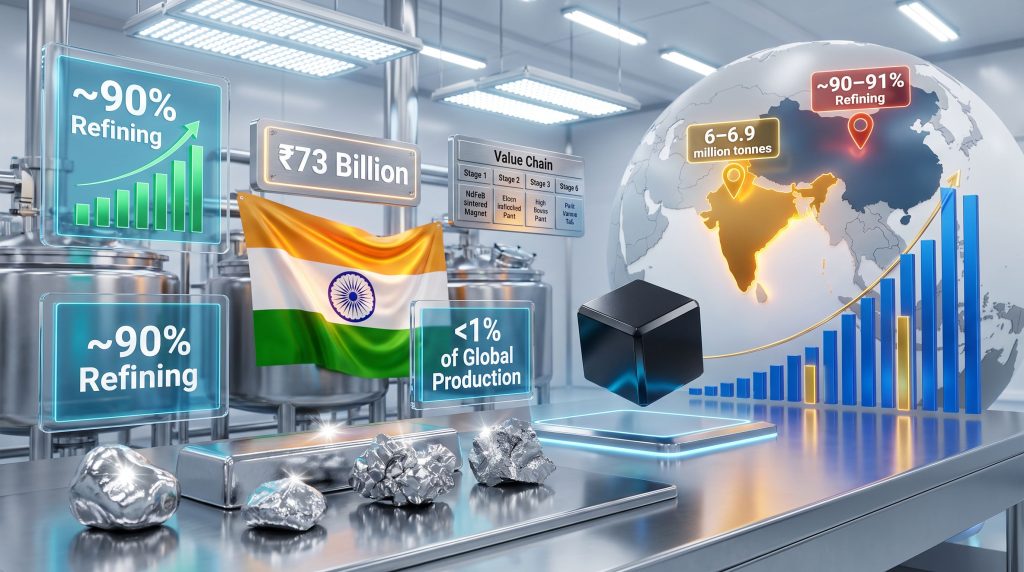
| India | ~6-6.9 million tonnes | Under 1% of global production |
| Australia | Prominent in pipeline | Growing mid-stream |
| United States | Prominent in pipeline | Rebuilding capability |
The table above illustrates a paradox that runs through the entire rare earth debate: reserve size bears little correlation to supply chain influence. Vietnam holds large reserves and produces almost nothing of downstream value. India ranks among the world's largest reserve holders and accounts for a fraction of a percent of global output. Meanwhile, the IEA notes that non-Chinese mining projects could push global mining capacity past 50 kilotonnes of rare earth content by 2035, led by Australia and the United States. However, mining diversification, whilst progressing, solves only the first stage of a six-stage problem.
India's Rare Earth Paradox: Vast Reserves, Negligible Output
India's position in the global rare earth map is one of the most striking mismatches between geological endowment and industrial capability anywhere in the world. With approximately 6 to 6.9 million tonnes of rare earth reserves, India is the third-largest reserve holder globally. Yet it accounts for less than 1% of global rare earth production. Understanding why requires examining four structural barriers simultaneously.
The Four Structural Barriers
1. Technology deficit. India currently lacks the downstream processing infrastructure needed to convert rare earth oxides into metals, alloys, and finished magnets at industrial scale. This is not a gap that can be closed through mining investment alone. It requires an entirely different category of technical capability.
2. Regulatory complexity around monazite. India's primary rare earth source is monazite sand, which contains significant concentrations of thorium. Because thorium is a central material in India's long-term nuclear energy programme, its extraction and processing is tightly regulated by the Department of Atomic Energy. This creates a structural bottleneck at the very first stage of the value chain, before separation or refining is even reached.
3. Ecosystem absence. Mid-stream and downstream industrial facilities, including alloy manufacturing, sintering plants, and magnet pressing operations, are largely non-existent at commercial scale within India. Building these requires not just capital but supplier networks, technical talent, and buyer relationships that take years to develop.
4. Resource quality differential. India's rare earth deposits are comparatively leaner in terms of grade and concentration than the richest Chinese deposits. This structural cost disadvantage means that even with equivalent processing infrastructure, Indian production would face higher per-unit costs than its dominant competitor.
India's Import Dependency by the Numbers
India's rare earth import bill grew from approximately $14.1 million in 2014 to $17.5 million in 2024, with over 45% sourced from China (IEEFA). In finished permanent magnets, China supplied between 59.6% and 81.3% of India's import value across the 2022-23 to 2024-25 period.
The finished magnet dependency is particularly strategically damaging. Raw material imports can, in principle, be redirected through alternative sources. However, dependence on finished magnets means that India's electric vehicle manufacturing targets, offshore wind rollout, defence procurement, and electronics sector are all structurally reliant on Chinese supply chains at the highest-value stage of the product.
As Kaira Rakheja, Energy Analyst at the Institute for Energy Economics and Financial Analysis (IEEFA), has observed, India's dependence on China spans from raw materials into downstream products and technologies, making diversification both an economic priority and a matter of industrial and national security. Rakheja has further noted that closing this gap is not simply a matter of mining more ore. India's real deficit lies in technology, environmental management capabilities, and downstream industries capable of absorbing processed materials at scale.
The next major ASX story will hit our subscribers first
India's Strategic Response: Policy and Investment Architecture
The National Critical Minerals Mission
Launched in January 2025, the National Critical Minerals Mission (NCMM) represents India's first comprehensive policy framework designed to address the full rare earth value chain from geological exploration through to domestic magnet manufacturing. India's minerals policy framework encompasses expanding survey activity, developing beneficiation and separation capacity, and incentivising downstream magnet manufacturing ecosystems. The state-owned entity IREL (India Rare Earths Limited) serves as the primary public sector vehicle for upstream processing development.
The 73 Billion Rupee Magnet Independence Initiative
In November 2025, the Indian government approved a programme valued at approximately 73 billion rupees (roughly $800 million USD) specifically designed to reduce structural dependence on Chinese permanent magnets. Target sectors include EV motors, wind turbine generators, and defence electronics. The programme's design incorporates incentives for private sector participation alongside direct public investment in processing infrastructure.
Diplomatic Realignment
India has also moved to redirect material flows previously committed to export. The suspension of its long-standing rare earth export arrangement with Japan signals a strategic prioritisation of domestic processing over foreign exchange earnings. Simultaneously, India is deepening engagement with Australia, the United States, Japan, and the European Union through frameworks oriented around technology transfer rather than purely financial cooperation. The Quad partnership represents a potential vehicle for supply chain cooperation extending to processing know-how and joint facility development.
The 8 to 10 Year Build Horizon: What Realistic Progress Looks Like
Expert consensus broadly places the timeline for establishing a functional, commercially competitive rare earth processing ecosystem in India at 8 to 10 years, assuming sustained capital deployment and uninterrupted policy continuity. This is not pessimism. It reflects the genuine complexity of building technical expertise, supply chains, and buyer relationships from a near-standing start.
| Scenario | India's Processing Share | China's Global Refining Share | Timeline |
|---|---|---|---|
| Status quo | Under 1% | ~91% | Ongoing |
| Moderate progress | 3-5% | ~75-80% | 2030-2032 |
| Optimistic build-out | 8-12% | ~55-60% | 2033-2035+ |
India's realistic near-term ambition is not to replicate Chinese scale. It is, consequently, to become a credible alternative processing node in an ex-China supply chain — one that provides sufficient volume and reliability to offer global buyers a genuine diversification option. That is a strategically valuable position even if it falls far short of Chinese output levels.
The global investment requirement is substantial. The IEA estimates that meaningfully diversifying rare earth supply chains globally requires approximately $60 billion over the next decade, with roughly 80% of that concentrated in refining and magnet manufacturing. India's approved 73 billion rupee programme is a meaningful starting point, but the full ecosystem build-out demands sustained multi-decade commitment at a scale that public investment alone cannot deliver.
Why Private Investment Is the Missing Catalyst
The Limits of State-Owned Enterprise Models
State-owned enterprises such as IREL play an essential role in anchoring early-stage processing development, particularly where regulatory complexity around thorium creates barriers that private capital is reluctant to navigate alone. However, technology-intensive processing sectors reward agility, iterative investment, and rapid capability accumulation in ways that government-owned entities are structurally less equipped to deliver. Building the downstream magnet manufacturing ecosystem India needs will require private capital, operating on commercial timelines, with clear visibility of returns.
What Would Actually Attract Private Capital
Several conditions would materially improve the investment case for private participation in Indian rare earth processing:
- Regulatory clarity on monazite processing and thorium co-product management, reducing compliance uncertainty for private operators
- Long-term offtake agreements with domestic EV manufacturers, wind developers, and defence procurement agencies, providing revenue visibility across multi-year investment horizons
- Technology transfer provisions embedded within international partnership frameworks, particularly through Quad-aligned agreements
- Production-linked incentive (PLI) scheme extensions covering mid-stream and downstream processing stages, not just mining
- Blended finance structures incorporating public-private co-investment and multilateral development bank participation to de-risk early-stage capital deployment
The Risk-Return Framework
The investor calculus on Indian rare earth processing is genuinely asymmetric. On the upside, first-mover positioning in a processing market that could represent tens of billions in annual revenue as India's clean energy sector scales represents a structural growth opportunity across decades. On the downside, capital payback periods are long, regulatory uncertainty around monazite remains real, and competition from established processors with entrenched cost advantages is formidable.
The $6.5 trillion annual disruption risk that a full supply chain failure would impose dwarfs the $60 billion investment needed to diversify. That arithmetic makes the case for action compelling at every level — national, multilateral, and private investor alike. For further context on how this dynamic is unfolding regionally, South China Morning Post's analysis of India's rising role in the critical minerals race offers a valuable perspective.
Frequently Asked Questions: India's Rare Earth Processing Challenge
What rare earth reserves does India hold?
India holds approximately 6 to 6.9 million tonnes of rare earth reserves, making it the third-largest reserve holder globally. Despite this, it currently accounts for less than 1% of global rare earth production.
Why can't India simply mine more rare earths to reduce dependence on China?
Mining addresses only the first stage of a six-stage value chain. India's core challenge lies in the absence of processing, refining, and magnet manufacturing infrastructure — the stages where China holds over 90% market share. Without downstream capability, mined ore cannot be converted into the finished products Indian industries require.
What is monazite sand, and why does it complicate India's rare earth strategy?
Monazite sand is India's primary rare earth source and contains elevated concentrations of thorium, a material central to India's nuclear energy programme. Thorium's extraction and processing is regulated by the Department of Atomic Energy, creating regulatory complexity that slows commercial rare earth development at the first stage of the value chain.
How much investment would India's rare earth processing ecosystem require?
The IEA estimates global supply chain diversification requires approximately $60 billion over the next decade, with around 80% concentrated in refining and magnet manufacturing. India's government has committed roughly $800 million as an initial step, but full ecosystem development will require sustained multi-decade investment well beyond that figure.
What is India's realistic timeline to become a meaningful rare earth processor?
Experts broadly estimate an 8 to 10 year horizon, assuming uninterrupted policy continuity and consistent capital deployment. India rare earths challenge China processing dominance in the foreseeable future remains unlikely at equivalent scale, but the country could become a meaningful alternative processing node by the mid-2030s.
What would a complete rare earth supply disruption cost the global economy?
The IEA estimates approximately $6.5 trillion annually across affected economies, with automotive supply chains alone representing more than $3 trillion of that exposure.
The Decade Ahead: Rare Earths as a Defining Strategic Battleground
The structural gap between India's geological endowment and its industrial processing capability will not be closed through policy announcements alone. Closing it requires coordinated regulatory reform on monazite, technology-inclusive international partnerships, and a private investment framework that translates government commitments into operational industrial capacity.
Several conclusions stand out for policymakers, investors, and industry participants:
- Processing capability is the decisive variable in rare earth supply chain influence, not reserve size
- India's clean energy transition in EVs, wind power, and defence modernisation creates the domestic demand anchor that can justify long-horizon processing investments
- The $6.5 trillion disruption risk dwarfs the $60 billion global investment required to diversify, making the economic case for action compellingly clear
- The window for establishing first-mover processing positions outside China is narrowing as other nations, particularly Australia and the United States, accelerate their own capability-building programmes
- India's talent pool and lower operational cost base relative to Western competitors represent genuine structural advantages, but only if regulatory and capital conditions are assembled within the available strategic window
India's path to rare earth processing relevance runs through three parallel tracks: regulatory reform on monazite that enables commercial development, technology-inclusive international partnerships through frameworks such as the Quad, and a private investment environment that transforms government financial commitments into operational refining and magnet manufacturing capacity. Whether those three tracks converge fast enough is the defining question of India rare earths challenge in the decade ahead.
Readers seeking additional context on India's critical minerals policy and energy sector developments can find related coverage at ET EnergyWorld, which tracks India's energy transition and mineral security strategy in depth.
Disclaimer: This article contains forward-looking projections and scenario analysis drawn from IEA, USGS, and IEEFA data. All forecasts and investment-related commentary reflect analyst estimates and should not be construed as financial advice. Market conditions, policy environments, and geological assessments are subject to change.
Want to Know Which ASX Companies Are Positioned in the Critical Minerals Race?
Discovery Alert's proprietary Discovery IQ model delivers real-time alerts the moment significant mineral discoveries — including critical and rare earth elements — are announced on the ASX, translating complex geological data into actionable investment insights for traders and long-term investors alike. Explore how major discoveries have historically generated extraordinary returns on Discovery Alert's dedicated discoveries page, and begin a 14-day free trial to position yourself ahead of the market.