July 11, 2026
The Resource Architecture Beneath the Arctic Ice
Trump Greenland rare earths rarely make headlines until the supply chains supporting them fracture. For decades, the concentrated geography of critical mineral processing went largely unnoticed by Western policymakers, treated as a technical procurement detail rather than a strategic vulnerability. That calculation changed when China demonstrated, through a series of export restrictions and processing bottlenecks, that controlling the refining stage of the rare earth supply chains was functionally equivalent to controlling the minerals themselves. This awakening is the direct consequence driving current geopolitical manoeuvring.
What makes the current moment distinctive is that the conversation has shifted from identifying the problem to physically acquiring the solution. Greenland is not simply a resource-rich territory that attracted attention. It is, from a Western supply chain security perspective, a near-perfect strategic asset: geologically extraordinary, politically proximate to NATO allies, and entirely outside Chinese jurisdiction. The question is no longer whether Western governments will compete for its mineral wealth, but who secures access first, on what terms, and at what diplomatic cost.
When big ASX news breaks, our subscribers know first
Why Greenland Sits at the Intersection of Two Strategic Crises
The Arctic island's significance flows from two converging pressures that have been building independently for years and have now collided with considerable force.
The first is China's structural position in rare earth processing. While much attention focuses on mining output, the more decisive chokepoint is refinement. Converting raw rare earth ore into separated oxides, and then into finished alloys and magnets, requires chemical processing infrastructure that China has spent thirty years building at scale. Furthermore, Western nations can identify deposits, fund exploration, and drill test holes, but they currently lack the downstream processing capacity to convert those discoveries into defence-grade permanent magnets without Chinese intermediaries at some stage in the chain.
The second pressure is the accelerating demand curve driven by the energy transition and defence modernisation. Dysprosium and terbium, both heavy rare earths found in meaningful concentrations in Greenland, are not optional components in high-performance permanent magnets. They are functional requirements. A wind turbine generator, a fighter jet actuator, and an electric vehicle traction motor all depend on neodymium-iron-boron magnets enhanced with heavy rare earth additions to maintain magnetic performance at elevated temperatures.
The Heavy Rare Earth Distinction: Why Does It Matter More Than Total Reserve Size?
A detail that receives insufficient attention in most coverage of the Trump Greenland rare earths dispute is the compositional distinction between light and heavy rare earth elements. Light rare earths, including cerium, lanthanum, and neodymium, are far more abundant globally and are found in meaningful quantities across multiple continents. Heavy rare earths, which include dysprosium, terbium, holmium, and erbium, are geologically scarcer and overwhelmingly concentrated in specific deposit types.
The Tanbreez rare earth project carries an unusually high heavy rare earth fraction, estimated at approximately 27% of the total deposit composition. For context, most rare earth deposits are dominated by light rare earths, with heavy rare earth fractions typically below 10%. This compositional profile is what elevates Tanbreez from a large deposit to a strategically irreplaceable one from a Western defence manufacturing perspective.
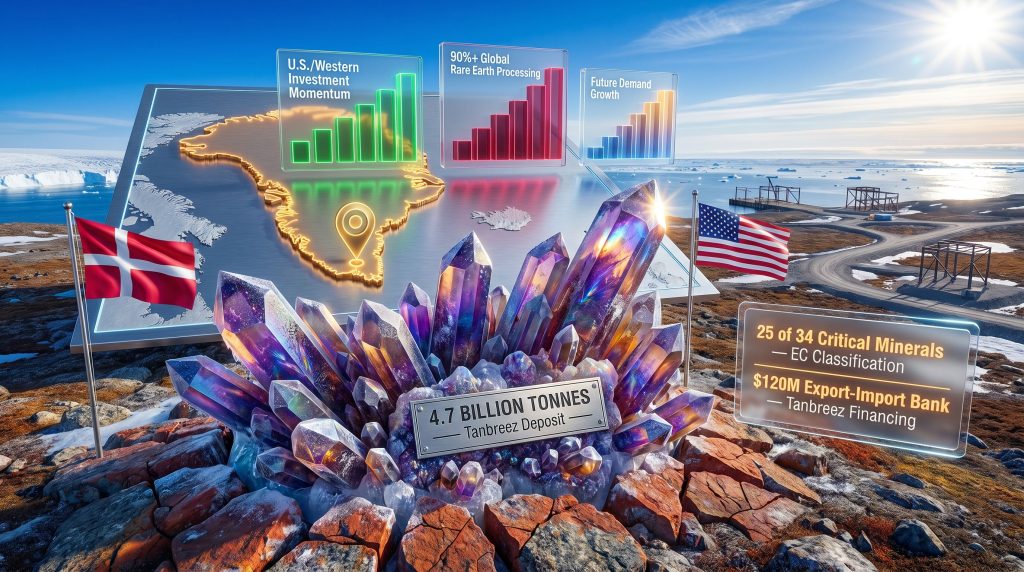
The deposit itself contains an estimated 4.7 billion tonnes of rare earth-bearing material, placing it among the largest known accumulations on Earth. At projected production rates of up to 85,000 tonnes per year of rare earth material, the project would represent a meaningful addition to Western supply capacity, though not an overnight solution to Chinese processing dominance.
Greenland's Resource Inventory: A Strategic Snapshot
The scale of what lies beneath Greenland's surface is difficult to overstate. The island hosts 25 of the 34 minerals the European Commission classifies as critical, encompassing not only rare earth elements but also graphite, cobalt, uranium, and titanium. Total rare earth element reserves are estimated at approximately 36 million tonnes, positioning Greenland among the world's most significant rare earth jurisdictions by volume. Greenland critical minerals, in this context, represent far more than a diplomatic talking point.
| Resource Category | Estimated Scale | Strategic Relevance |
|---|---|---|
| Total rare earth element reserves | ~36 million tonnes | Among world's largest single-jurisdiction inventories |
| Tanbreez deposit total material | ~4.7 billion tonnes | One of the largest rare earth deposits on Earth |
| Heavy rare earth fraction (Tanbreez) | ~27% of deposit | Critical for defence-grade permanent magnets |
| Critical minerals hosted | 25 of 34 EC-classified | Graphite, cobalt, uranium, titanium included |
| Projected Tanbreez annual output | Up to 85,000 t/y | Significant but not immediately transformative |
| Ex-Im Bank loan (Tanbreez) | US$120 million | First U.S.-backed overseas mining project under current administration |
The April 2026 decision by Greenland's autonomous government, the Naalakkersuisut, to approve the Tanbreez project operated by Critical Metals Corp marked a significant transition point. It demonstrated that resource development decisions in Greenland are proceeding through the island's own governance structures, independently of the sovereignty dispute at the diplomatic level. This distinction matters enormously for investors and policymakers attempting to assess project risk.
The Infrastructure Gap: Does Geological Wealth Equal Deliverable Supply?
There is a structural error embedded in much of the public commentary on Greenland's mineral wealth: conflating reserve quantity with accessible supply. The two are fundamentally different metrics, and the gap between them in Greenland's case is exceptionally wide.
Commercial mining in Greenland is effectively nonexistent at scale. The challenges are not primarily regulatory or political, though those add complexity. They are physical:
- Sustained operational temperatures falling below -40°C impose engineering requirements on equipment, lubricants, personnel protocols, and processing chemistry that add substantial cost and complexity to every stage of operation
- No dedicated mining transport infrastructure exists, meaning roads, port facilities, and logistics corridors would require construction from scratch before a single tonne of material could move to market
- Grid-scale power generation capacity is absent from the regions where major deposits are located, requiring either diesel generation at significant cost or the construction of renewable energy capacity in some of the world's most challenging terrain
- Processing facilities for rare earth ore separation and oxide production do not exist on the island, meaning early-stage production would require shipping raw ore to processing facilities elsewhere, reducing economic efficiency
These factors collectively push realistic production timelines into the multi-year to decade-plus range, even with financing committed. The U.S. Export-Import Bank's $120 million loan to the Tanbreez project represents early-stage development capital, not imminent production capacity. Consequently, investors treating this as a near-term supply solution are misreading the timeline.
The Defence-Mineral Bundling Strategy: A New Template for Resource Diplomacy
One of the more structurally significant developments in the Trump Greenland rare earths campaign is the deliberate linking of defence cooperation architecture with mineral access rights. The preliminary framework discussed between the Trump administration and NATO counterparts packages U.S. participation in Greenland's missile defence initiative alongside formal arrangements governing mineral access.
This bundling is strategically deliberate for several reasons. First, it creates interdependencies that make either component harder to unwind in isolation. A government that accepts U.S. missile defence infrastructure implicitly accepts a level of strategic partnership that makes outright refusal of associated mineral arrangements more diplomatically costly. Second, it frames resource access as a security contribution rather than an economic extraction, which is a more palatable framing for domestic audiences in both Greenland and Denmark.
The Trump critical mineral strategy appears to function on two simultaneous tracks: escalatory public positioning that establishes a maximalist negotiating ceiling, combined with structured diplomatic engagement that quietly advances the actual policy objectives of mineral access and defence cooperation. According to Arctic security analysts at CSIS, this dual-track approach reflects a broader reshaping of how Western governments are beginning to treat resource access as an instrument of strategic competition.
Historical precedent supports this reading. U.S. military installations in Greenland have existed since World War II, formalised through post-war treaty arrangements with Denmark. Washington already holds operational leverage on the island through those existing installations. The push for formal mineral access rights builds on that established presence rather than starting from zero.
Denmark's Position and Greenland's Own Agency
Danish Prime Minister Mette Frederiksen has maintained a consistent position throughout the dispute: Greenland is not for sale, and any determination of the island's future status belongs to Greenlanders themselves. Her reaffirmation at the NATO summit in The Hague that Denmark would defend every inch of NATO territory was directed as much at reassuring European allies as at signalling resolve to Washington.
What analysis of the diplomatic situation frequently overlooks is Greenland's own institutional agency. The Naalakkersuisut operates with substantial autonomous authority over resource licensing and economic development policy. Its April 2026 approval of the Tanbreez project was exercised entirely within that framework, without reference to the sovereignty dispute. This creates a practical pathway for mineral development that bypasses the diplomatic impasse.
Greenland's long-term trajectory toward potential independence from Denmark introduces a third negotiating variable whose interests may not align fully with either Copenhagen or Washington. An independent Greenland controlling the world's second-largest rare earth inventory would represent an entirely new sovereign actor in global resource geopolitics, with the leverage to invite competitive investment proposals from multiple directions.
Three Scenarios for Greenland's Rare Earth Future
Assessing what the Trump Greenland rare earths campaign ultimately produces requires modelling distinct outcome pathways rather than treating the current diplomatic standoff as a binary win-or-lose situation.
Scenario A: Negotiated Mineral Access Without Sovereignty Transfer
This is the most probable near-term outcome. The U.S. secures preferential investment access through bilateral financing arrangements and Export-Import Bank instruments, while Denmark and Greenland retain formal sovereignty. Critical Metals Corp advances Tanbreez with U.S. financial backing. All parties secure a face-saving outcome. However, this scenario does not resolve the long-term supply chain question because it does not address the absence of Western rare earth processing capacity.
Scenario B: Greenlandic Independence Accelerates the Bidding War
If Greenland moves toward formal independence over the coming decade, it would emerge as a sovereign state controlling one of the world's most significant rare earth inventories. An independent Greenland would face competing investment proposals from the U.S., EU, and potentially Chinese-backed entities, creating a resource diplomacy auction with consequences for global supply chain architecture far beyond what the current dispute involves.
Scenario C: Multilateral Western Coordination Distributes Risk and Access
Washington and Brussels formalise a critical minerals coordination framework that pools Western demand, financing capacity, and processing investment, reducing the incentive for unilateral U.S. action. This aligns with the 55-nation preferential trade zone framework that emerged from the February ministerial process and would be the outcome most favourable to European industrial interests.
The EU's Structural Dilemma and Mexico's Strategic Opening
The European Union faces an uncomfortable arithmetic in the Greenland situation. Greenland sits within what Brussels considers its strategic neighbourhood, yet U.S. capital and political momentum are driving project development in ways that may prioritise American industrial supply chains over European access. China's export restrictions have already demonstrated the consequences of single-source dependency, and the Tanbreez scenario risks replacing one form of dependency with another for the specific heavy rare earth fractions most critical to European defence and clean technology manufacturing.
As Le Monde has noted, what could not be seized by military force is increasingly being acquired via Wall Street, a framing that captures the financial mechanics now reshaping Arctic resource geopolitics. This dynamic is simultaneously reshaping investment calculations for North American supply alternatives. Mexico's northern mineral states, particularly Sonora, Chihuahua, and Durango, are positioned as USMCA-integrated alternatives offering political stability, existing infrastructure, and proximity to U.S. manufacturing without Arctic extraction challenges.
Mexico is simultaneously seeking guaranteed access to 13 critical minerals it lacks domestically, creating a complementary trade structure with genuine mutual benefit. Every escalation in Arctic resource competition, furthermore, strengthens the investment case for politically stable, infrastructure-ready mineral production in jurisdictions that can actually deliver material within commercially viable timeframes.
The next major ASX story will hit our subscribers first
Frequently Asked Questions: Trump, Greenland, and Rare Earths
Why does the Trump administration prioritise Greenland's rare earths specifically?
Greenland hosts one of the world's highest concentrations of rare earth elements, including heavy rare earths such as dysprosium and terbium that are essential for defence-grade permanent magnets and high-performance electric motors. With China controlling over 90% of global rare earth processing capacity, Greenland represents the most geopolitically accessible alternative supply source within the Western alliance framework at meaningful scale.
Can the U.S. secure mineral access without acquiring sovereignty?
Yes, and this pathway is already operational. Mineral access rights can be established through investment treaties, project financing, and licensing arrangements with Greenland's autonomous government entirely independently of any sovereignty transfer. The Export-Import Bank's $120 million commitment to the Tanbreez project demonstrates that the financing track is functioning in parallel with the sovereignty dispute.
When could Greenland rare earths realistically reach the market?
Given the complete absence of commercial mining infrastructure in Greenland, combined with Arctic operational challenges, environmental permitting requirements, and the capital intensity of building processing capacity from scratch, meaningful production output is realistically measured in years to decades. Early-stage financing does not translate to near-term supply availability.
What does the dispute mean for China's rare earth market position?
In the near term, China's dominance in rare earth processing remains structurally unchanged. Greenland's deposits represent a long-term strategic hedge rather than an immediate supply alternative. The more consequential near-term effect is on investment signalling and diplomatic positioning, both of which are already reshaping how Western governments approach critical mineral supply chain strategy.
How does gold pricing connect to the Greenland dispute?
Earlier escalations in U.S.-Greenland tensions contributed to gold reaching record price levels in January 2026, as financial markets priced in geopolitical risk premiums associated with Arctic resource competition and broader transatlantic friction. This correlation illustrates how resource geopolitics are increasingly functioning as macro market drivers with measurable effects on precious metals pricing.
Disclaimer: This article contains forward-looking scenario analysis and speculative assessments of geopolitical and resource development outcomes. These represent analytical frameworks rather than confirmed predictions. Investors should conduct independent due diligence before making decisions based on critical mineral sector developments. Reserve estimates, production timelines, and project financing figures are sourced from publicly available reporting and are subject to change as projects develop.
Want to Capitalise on the Next Major Mineral Discovery Before the Broader Market?
Discovery Alert's proprietary Discovery IQ model delivers real-time alerts on significant ASX mineral discoveries — instantly translating complex geological data into actionable investment insights for traders and long-term investors alike. Explore historic discoveries and their extraordinary returns, then begin your 14-day free trial at Discovery Alert to position yourself ahead of the market.