July 11, 2026
The ESG Imperative Reshaping Global Rare Earth Supply Chains
The critical minerals sector is undergoing a fundamental realignment, one driven not solely by geology or economics, but by the intensifying demands of environmental accountability. For decades, the rare earth industry operated in relative obscurity, tucked beneath the surface of the green energy transition narrative. Today, it sits at the centre of it. Industrial buyers from Stuttgart to San Francisco are no longer asking only where their rare earths come from. They are asking how they were extracted, what energy powered the process, and whether the land will ever recover.
This shift is not incremental. It is structural. And for countries with the geological endowment, regulatory frameworks, and technological readiness to meet these new standards, the market opportunity is generational.
Brazil sits at the intersection of all three.
When big ASX news breaks, our subscribers know first
Why ESG Has Become a Market Access Condition, Not a Marketing Tool
There is a meaningful difference between a company that describes its operations as sustainable and one whose entire extraction model is architecturally designed around sustainability. That distinction is becoming the dividing line between rare earth projects that can access Western markets and those that cannot.
The European Union's Critical Raw Materials Act and the United States' own legislative frameworks around critical minerals demand have formalised what was previously understood only informally: sourcing from a single dominant supplier carries both geopolitical and reputational risk. Regulatory instruments including the EU's Carbon Border Adjustment Mechanism and supply chain due diligence directives are progressively extending their reach into upstream raw material inputs. Rare earths, which are indispensable to permanent magnets used in EV motors and wind turbine generators, are firmly within scope.
For procurement teams at major EV manufacturers, wind energy companies, and defence contractors, the calculus has shifted. Three measurable dimensions now define what qualifies as a sustainable rare earth source:
- Extraction method: whether the technique disturbs surface land at scale and generates tailings waste
- Energy profile: the carbon intensity of the electricity grid powering extraction and processing
- Chemical reagent footprint: the toxicity and environmental persistence of leaching agents used in processing
Brazil's ionic clay rare earth sector is uniquely capable of performing well across all three dimensions simultaneously. That convergence is not accidental. It is the product of geology, geography, and a regulatory environment that has long maintained rigorous environmental licensing standards.
The Geological Foundation of Brazil's Sustainability Advantage
What Ionic Clay Deposits Actually Are
Understanding why Brazil holds a structural edge in sustainable rare earth production begins underground. Approximately 73% of Brazil's rare earth deposits are classified as ionic clay formations. These are not the hard, mineralised rock bodies that require blasting, crushing, and acid dissolution to liberate their rare earth content. Instead, ionic clay deposits are the product of millions of years of tropical weathering, during which rare earth ions have been naturally disaggregated from their host rock and adsorbed onto clay mineral surfaces.
This natural pre-processing has profound implications for mining economics and environmental performance. The energy intensity required to liberate rare earth elements from ionic clay is dramatically lower than that required for conventional hard-rock rare earth ore bodies. Less blasting. Less crushing. Less chemical dissolution. Each reduction translates directly into a lower operational carbon footprint per tonne of rare earth oxide produced.
Brazil's Reserve Scale vs. Its Production Reality
The gap between what Brazil holds and what it currently produces is one of the most striking anomalies in global critical mineral markets.
| Metric | Brazil | Global Context |
|---|---|---|
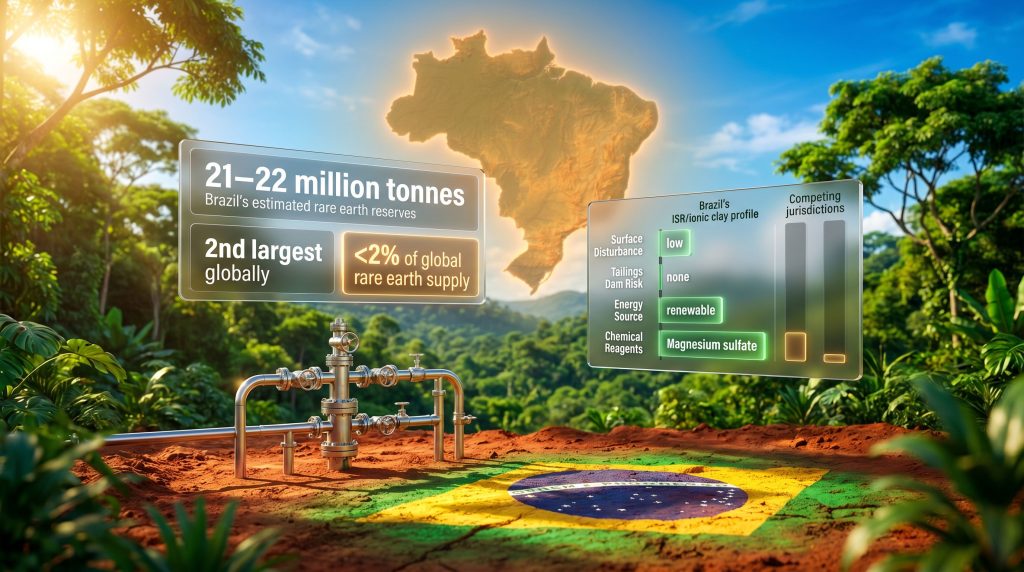
| Estimated Rare Earth Reserves | 21-22 million tonnes | 2nd largest globally |
| Current Share of Global Production | Less than 2% | Significant underperformance vs. reserve base |
| Dominant Deposit Type | Ionic clay (~73%) | Easier to process than hard-rock equivalents |
| Grid Energy Profile | Renewable-intensive | Lower Scope 2 emissions than most competitors |
| ESG Regulatory Framework | Stringent national environmental law | Aligned with EU and US import requirements |
Investor Perspective: A country holding the world's second-largest rare earth reserve base while supplying less than 2% of global production represents a structural supply gap. The question is not whether Brazil's rare earth sector will grow, but how quickly institutional capital and permitting frameworks can align to enable that growth.
This gap reflects historical constraints rather than geological limitations. Brazil's rare earth sector has been held back by permitting complexity, insufficient domestic refining capacity, and an underdeveloped midstream processing infrastructure. These are solvable problems. The geology is not a constraint; it is the competitive advantage.
In-Situ Recovery: The Technology That Changes the Environmental Calculus
How ISR Works in an Ionic Clay Context
In-situ recovery is a mining approach in which a chemical solution is injected into a deposit through a network of wells, dissolving target minerals underground before the mineral-rich solution is recovered at surface level for processing. There is no open-pit excavation. There is no removal of overburden. The host rock largely stays where it is.
In the context of Brazil's ionic clay deposits, ISR is not simply a preferable extraction option. It is the natural technological complement to the deposit type. The pre-weathered, loosely structured nature of ionic clay means that injected solutions can permeate the deposit efficiently, achieving high rare earth recovery rates without requiring the large-scale mechanical disruption associated with conventional mining.
The environmental engineering advantages of ISR in this geological setting are substantial:
- No open-pit excavation: Surface disturbance is reduced to wellhead infrastructure and surface processing circuits, preserving vegetation cover and topsoil integrity
- Elimination of tailings dams: The single most significant environmental liability in conventional rare earth mining is removed from the project risk profile entirely
- Reduced noise, dust, and heavy equipment reliance: ISR operations are operationally quieter and less visually intrusive, which materially simplifies community engagement and social licence maintenance
- Lower post-operation reclamation costs: Without large-scale earthworks to remediate, site rehabilitation after mine closure is substantially less complex and costly
The Magnesium Sulfate Advantage
One of the least publicly understood aspects of Brazil's rare earth sustainability profile is the nature of the chemical reagent used in ionic clay ISR operations. The primary leaching agent applicable to these deposits is magnesium sulfate, a compound more commonly associated with agricultural soil amendment than industrial mining.
This matters enormously from an ESG perspective. Magnesium sulfate supports photosynthesis and plant growth. It does not degrade soil chemistry or persist in the environment as a contaminant. Furthermore, this stands in direct contrast to the ammonium sulfate solutions historically used in Chinese ionic clay mining operations, which have been restricted or prohibited in many producing regions due to documented soil and groundwater contamination.
It also differs from the acidic or caustic leaching agents used in hard-rock rare earth processing, which generate hazardous waste streams requiring specialised containment infrastructure. The reagent profile of Brazilian ISR operations is not merely a technical footnote. It is a core component of the ESG certification case that Brazilian projects can make to European and North American industrial buyers.
Renewable Energy as a Structural Cost and ESG Advantage
Brazil operates one of the most renewable-intensive electricity grids of any major economy globally, with hydroelectric, wind, and solar generation forming the backbone of the national energy supply. For rare earth projects located in regions with strong grid access, this translates directly into a structurally lower Scope 2 emissions profile than equivalent operations in energy-constrained or fossil-fuel-dependent jurisdictions.
Competitors operating in arid environments face a compounding disadvantage: higher electricity costs and greater reliance on diesel or gas-fired generation. This creates both an economic and an ESG gap relative to Brazilian projects that can access low-cost renewable power.
The dual benefit of lower operating expenditure and lower operational emissions is rare in the critical minerals sector. It materially strengthens Brazil's positioning with green financing institutions, which increasingly require projects to demonstrate both financial viability and measurable environmental performance before committing capital. These factors also make Brazil a compelling example within broader critical raw materials transition discussions happening at a global policy level.
Comparing Brazil Against Global Rare Earth Producers
| Sustainability Dimension | Brazil (ISR/Ionic Clay) | Hard-Rock Producers (Typical) | Chinese Ionic Clay (Historical) |
|---|---|---|---|
| Surface Disturbance | Minimal (wellhead only) | Extensive open-pit | Moderate to significant |
| Tailings Dam Risk | Eliminated | High | Moderate |
| Energy Source | Renewable-capable | Mixed/fossil-dependent | Coal-heavy grid |
| Chemical Reagents | Magnesium sulfate (benign) | Acidic/caustic agents | Ammonium sulfate (restricted) |
| ESG Regulatory Framework | Stringent national law | Variable by jurisdiction | Limited enforcement history |
| Western Market Alignment | High | Moderate | Low (geopolitical friction) |
The next major ASX story will hit our subscribers first
Brazil's Institutional Momentum and the Sustainable Supply Chain Vision
What the 1st Brazilian Ecological Transformation Economic Forum Signalled
Industry engagement with Brazil's federal institutions around rare earths and critical minerals reached a notable threshold when the 1st Brazilian Ecological Transformation Economic Forum convened in Rio de Janeiro. The forum brought together senior government officials, including the Minister of Environment and Climate Change and the president of Brazil's national development bank (BNDES), alongside representatives from the productive sector, financial institutions, and technical specialists.
Rare earths and critical minerals featured as central pillars of the discussion around building a low-carbon economy. Significantly, BNDES signalled active interest in supporting rare earth projects that meet elevated ESG standards, framing this as an alignment between economic development objectives and sustainability performance requirements.
Meteoric Resources, through its executive director and vice-president of the Brazilian Critical Minerals Association, participated in the forum's panel on rare earths and critical minerals. The company's position, articulated during that panel, was that Brazil's primary competitive differentiator in the global rare earth market is its capacity to develop mining operations aligned with the highest international sustainability standards. This positioning, it was argued, could transform Brazil into a strategic supplier for Western markets, particularly Europe and the United States.
Strategic Framing: The forum represented more than a policy discussion. It was a signal that Brazil's institutional actors, across government, development finance, and the private sector, are converging around a shared vision of rare earth development as a sustainable economic pillar rather than a conventional extractive industry.
What a Fully Integrated Brazilian Rare Earth Supply Chain Would Look Like
The strategic objective articulated by industry participants and government stakeholders points toward a domestic supply chain spanning the full value-addition spectrum:
- Ionic clay deposit extraction via ISR at the mine site
- On-site primary processing of the mineral-rich leachate solution
- Rare earth oxide separation into individual element streams
- Midstream chemical production, including rare earth carbonate or oxide compounds
- Export of finished materials to allied industrial markets in Europe and North America
Capturing this full chain domestically would allow Brazil to extract significantly more economic value per tonne of rare earth material than a raw ore export model. It would also position the country as a value-added supplier rather than a commodity exporter, which carries substantially different pricing dynamics and strategic leverage in bilateral trade relationships. Consequently, the structure of rare earth supply chains globally could shift meaningfully if Brazil executes on this vision.
Remaining Challenges Brazil Must Confront
Permitting Timelines and Regulatory Complexity
Brazil's environmental licensing framework is internationally credible and substantively rigorous. These qualities are precisely what make Brazilian projects attractive to ESG-sensitive buyers. They are also, however, the reason permitting timelines can extend over several years, introducing project development risk that can deter early-stage capital.
The critical policy challenge is to streamline approval processes without undermining the environmental rigour that gives Brazilian projects their market differentiation. There is a rational argument that ISR-based projects, given their fundamentally lower surface disturbance profile, tailings elimination, and benign reagent use, present a categorically different risk profile to regulators compared to conventional open-pit rare earth mines. Whether this distinction translates into expedited review pathways remains an active area of institutional engagement.
The Midstream Processing Gap
Brazil currently lacks the domestic rare earth separation and processing infrastructure necessary to convert ionic clay leachate into market-ready separated rare earth oxides at commercial scale. This is the most significant structural gap between Brazil's geological potential and its actual position in the global supply chain. Indeed, the rare earth processing challenges facing Brazil mirror those confronting other emerging producers seeking to move beyond raw material export.
Closing this gap requires:
- Significant capital investment in separation plant infrastructure
- Technical expertise in rare earth hydrometallurgy, which remains concentrated in a small number of global operators
- Offtake agreements with Western industrial buyers willing to commit to long-term purchase arrangements that justify plant construction economics
- Access to green financing instruments structured around measurable ESG performance milestones
Without midstream processing capability built within Brazil, the country risks remaining a raw material exporter despite holding the world's second-largest rare earth reserve base.
Translating Institutional Support into Deployed Capital
BNDES and other national development finance institutions have signalled clear intent to support ESG-compliant rare earth projects. However, there is a meaningful gap between institutional expressions of support and capital deployed at project scale. Structured financing frameworks, clear ESG performance benchmarks, and sustained engagement between project developers and financing institutions are all prerequisites for closing this gap.
International green bond markets and multilateral development bank facilities represent additional capital sources, but accessing them requires projects to meet rigorous environmental and social performance standards across their full operational lifecycle.
Scenario Analysis: Brazil's Rare Earth Trajectory to 2030
| Scenario | Key Conditions | Probable Outcome |
|---|---|---|
| Accelerated Growth | ISR permitting streamlined; midstream processing investment secured; EU offtake agreements signed | Brazil captures 5-8% of global supply by 2030; established as preferred Western supplier |
| Moderate Expansion | Permitting timelines remain extended; partial midstream investment; spot market sales dominate | Brazil reaches 2-4% of global supply; builds credibility but misses strategic window |
| Constrained Development | Regulatory delays persist; financing gaps unresolved; geopolitical urgency diminishes | Brazil remains a minor producer despite world-class geological endowment |
Note: Scenario projections are speculative in nature and should not be interpreted as financial forecasts. Actual outcomes will depend on regulatory developments, capital market conditions, global rare earth demand trajectories, and geopolitical dynamics that cannot be predicted with certainty.
Frequently Asked Questions
Why does Brazil have a sustainability advantage in rare earth mining?
Brazil's advantage derives from three converging structural factors: the prevalence of ionic clay deposits that require significantly less processing energy than hard-rock alternatives, the suitability of ISR extraction technology which eliminates open pits and tailings dams, and access to a renewable-intensive electricity grid that reduces operational emissions. Together, these produce a rare earth supply profile that is architecturally more ESG-compliant than most global alternatives, without requiring trade-offs between environmental performance and economic viability.
What makes ISR different from conventional rare earth mining?
Conventional rare earth mining requires excavating and processing large volumes of ore, generating significant quantities of waste material, tailings, and surface disturbance. ISR injects a chemical solution into the deposit underground, dissolves the target minerals in place, and recovers the mineral-rich solution at surface for processing. The host rock remains largely undisturbed. For ionic clay deposits, where the rare earth ions are already loosely bound to clay surfaces, ISR achieves strong recovery rates with minimal surface impact.
How large are Brazil's rare earth reserves?
Brazil holds an estimated 21 to 22 million tonnes of rare earth reserves, placing it second globally. Despite this scale, Brazil currently supplies less than 2% of global rare earth production. This gap reflects historical constraints in permitting complexity and midstream infrastructure rather than any geological limitation.
Which export markets is Brazil prioritising?
Brazil's emerging rare earth sector is primarily targeting the European Union and the United States, where regulatory frameworks and industrial buyer requirements are generating strong demand for ESG-verified rare earth supply that is independent of single-nation sourcing dependency. The rare earth geopolitical impact of this strategic pivot is already reshaping how allied nations approach their critical mineral sourcing decisions. Brazil's environmental standards and ISR-based extraction methods are well-aligned with EU supply chain due diligence requirements.
The Strategic Outlook
Brazil's rare earth sector stands at an inflection point where geological endowment, extraction technology, energy infrastructure, and geopolitical demand alignment are converging simultaneously for the first time. The country's world-class reserve base, the ISR-ionic clay technology match, and access to renewable energy collectively constitute a competitive position that is not easily replicated by competing jurisdictions.
The foundational elements of the Brazil rare earths sustainability advantage are already in place. What remains is the harder work of execution: closing the midstream processing gap, navigating permitting timelines, and translating institutional intent into deployed capital at the scale required to make Brazil a consequential force in the global rare earth market. The window to establish that position, while Western industrial buyers are actively seeking alternatives to single-source dependency, will not remain open indefinitely.
For further context on Brazil's rare earth sector development, the Brazilian Rare Earths company website provides detailed information on active projects and strategic direction. In addition, a comprehensive academic perspective on the environmental dimensions of rare earth mining in Brazil is available via Chemical & Engineering News, which offers rigorous analysis of the sector's evolving sustainability profile.
Want to Identify the Next Major Mineral Discovery Before the Broader Market?
Discovery Alert's proprietary Discovery IQ model delivers real-time alerts on significant ASX mineral discoveries — instantly transforming complex mineral data into actionable investment insights for both short-term traders and long-term investors. Explore historic examples of exceptional discovery returns and start your 14-day free trial today to secure a market-leading edge.