July 10, 2026
The Market Failure That Built a $12 Billion Reserve
For decades, economists and policymakers treated critical mineral procurement as a logistics problem rather than a structural vulnerability. The assumption was simple: global markets would always deliver the materials that advanced economies needed, provided the price was right. That assumption has proven costly. Today, the United States finds itself dependent on mineral supply chains that run through geopolitical rivals, particularly China, which controls dominant shares of rare earth extraction, separation, and magnet manufacturing simultaneously.
This is not a problem that emerged overnight. It is the cumulative result of decades of offshoring decisions, each individually rational, collectively devastating to domestic industrial resilience. The Project Vault critical minerals reserve represents the most ambitious attempt yet to reverse that trajectory, not through protectionist rhetoric, but through a commercially structured, demand-driven mechanism designed to make supply security financially self-sustaining.
When big ASX news breaks, our subscribers know first
Why the U.S. Mineral Supply Chain Became a Strategic Liability
The core vulnerability is concentration. When a single country controls the majority of processing capacity for a material that has no viable substitute in a given application, the importer loses negotiating power entirely. China's position across the rare earth supply chains is the most cited example, but the problem extends well beyond rare earths.
Consider what the USGS 2025 Critical Minerals List reveals across its 60 designated materials:
- Gallium and germanium, both essential for semiconductors and critical minerals defence electronics, were subject to Chinese export controls imposed in 2023 and 2024 respectively, demonstrating how quickly access can be restricted.
- Cobalt supply is geographically concentrated in the Democratic Republic of Congo, with Chinese firms controlling a substantial portion of processing capacity.
- Rare earth elements including neodymium and dysprosium, critical for the permanent magnets used in EV motors and wind turbines, face processing bottlenecks almost entirely located outside the Western world.
- Lithium, while more geographically distributed at the mining stage, sees over 70% of its processing capacity concentrated in China.
Unlike petroleum, critical minerals cannot be blended, diluted, or substituted across applications without fundamentally redesigning the end product. A shortage of dysprosium does not merely raise costs for a magnet manufacturer — it can make high-performance permanent magnets physically impossible to produce at the required specifications.
The downstream consequences are severe. Defence systems require specific rare earth alloys. AI accelerator chips depend on gallium nitride substrates. EV drivetrains are engineered around neodymium-iron-boron magnets. These are not interchangeable components, and the industries that rely on them cannot pivot quickly when supply is disrupted.
What Is the Project Vault Critical Minerals Reserve?
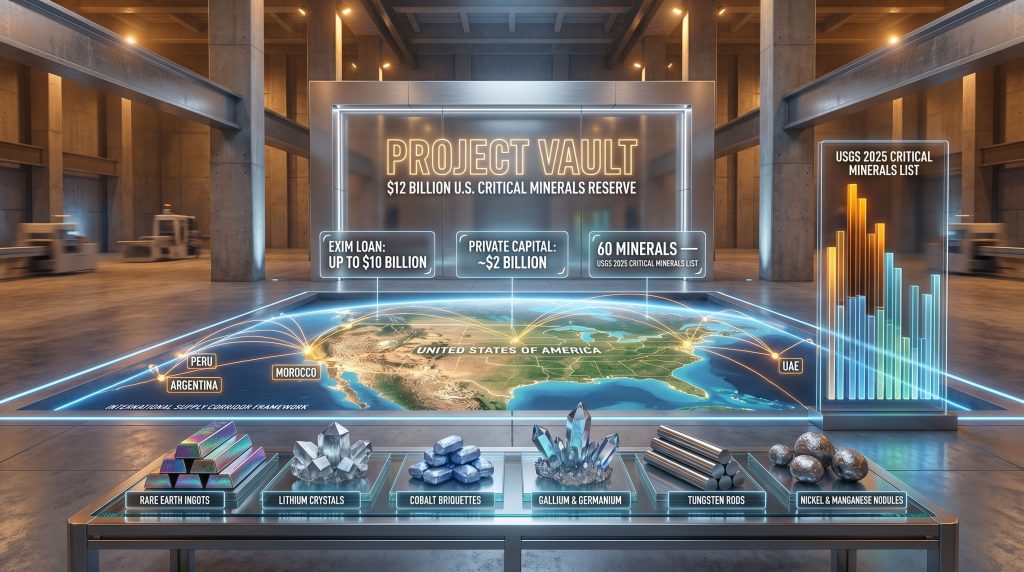
Announced by President Donald Trump on 2 February 2026, the Project Vault critical minerals reserve is a $12 billion public-private stockpiling initiative designed to address the market failure at the heart of U.S. mineral vulnerability. The programme operates through VaultCo LLC, an independently governed public-private partnership, rather than a federal agency — a structural choice with significant implications for how the reserve functions.
The financing architecture combines a direct loan of up to $10 billion from the Export-Import Bank of the United States (EXIM), representing more than double the largest single financing commitment in EXIM's institutional history, with approximately $2 billion in private capital. EXIM's mandate explicitly requires that the reserve deliver a net-positive financial return for U.S. taxpayers, distinguishing it from traditional government expenditure programmes.
How the Demand-Driven Model Works
The most architecturally significant feature of the Project Vault critical minerals reserve is its inversion of the traditional government stockpiling logic. Rather than bureaucrats forecasting what materials the country might need and purchasing accordingly, the reserve is built around commitments from the manufacturers who actually consume these minerals.
Here is how participating Original Equipment Manufacturers (OEMs) engage with the system:
- Specification — Manufacturers identify the precise mineral grades, purity levels, and volumes required for their production operations. This is technically non-trivial; different applications require different grades of the same mineral.
- Subscription commitment — OEMs pay a subscription fee functioning as an insurance premium, plus storage and financing costs, to secure guaranteed access to their specified materials.
- Procurement — VaultCo acquires and stores the designated inventory in advance of any disruption, calibrating purchases to the aggregate demand profile of its member base.
- Normal rotation — During periods without supply disruption, OEMs may withdraw a defined portion of their allocated inventory annually for routine production use, maintaining commercial relevance for the reserve.
- Mandatory replenishment — Withdrawn materials must be replaced to maintain agreed reserve levels, ensuring the stockpile does not erode during stable periods.
- Priority access — During a verified supply disruption, member manufacturers receive guaranteed priority access to their reserved inventory before spot market volatility can affect their operations.
This rotation mechanism is commercially elegant. It prevents the reserve from becoming a static, depreciating asset while ensuring the buffer exists precisely when it is most needed.
Comparing Project Vault to Existing Strategic Reserves
| Feature | Strategic Petroleum Reserve | Project Vault |
|---|---|---|
| Governance | Federal government agency | Independent public-private partnership (VaultCo LLC) |
| Procurement logic | Government forecast-driven | Demand-led by participating OEM manufacturers |
| Funding structure | Fully government-funded | $10B EXIM loan plus ~$2B private capital |
| Access mechanism | Emergency presidential release | Subscription-based guaranteed access |
| Inventory management | Static reserve | Rotating annual withdrawal and replenishment |
| Financial mandate | Public expenditure | Net-positive taxpayer return required |
| Primary beneficiary | National emergency response | U.S. industrial manufacturers |
The distinction matters enormously. A static government stockpile requires perpetual appropriations and political will to maintain. A subscription-funded rotating reserve is commercially self-sustaining, provided it attracts sufficient OEM participation.
Brett Lambert and the Leadership Imperative
On 9 July 2026, EXIM named Brett Lambert as Executive Chairman of VaultCo LLC. The appointment signals how seriously the initiative's architects take the operational complexity of converting a financing structure into a functioning minerals reserve.
Lambert's credentials span four decades across national security, defence industrial policy, and intelligence. During President Obama's first term, he served as Deputy Assistant Secretary of Defense for Manufacturing and Industrial Base Policy, a role that gave him direct authority over critical supply chain strategy, industrial capacity planning, and the implementation of the Defense Production Act. He subsequently served as Vice President of Corporate Strategy at Northrop Grumman before founding The Densmore Group, a national security and intelligence consultancy.
Most recently, Lambert co-chaired the Defense Science Board's 2025 Study on the 21st Century Industrial Base for National Security, placing him at the intellectual centre of current U.S. thinking on defence industrial resilience precisely as Project Vault was being architected.
What makes this appointment particularly instructive is what it reveals about the reserve's actual operational challenges. Sourcing minerals is straightforward relative to:
- Attracting sufficient OEM subscriptions to make the reserve commercially viable at scale
- Navigating the regulatory complexity of importing, storing, and rotating 60 different mineral categories
- Managing geopolitical relationships with supplier nations including those with bilateral frameworks covering Argentina, Morocco, Peru, and the UAE
- Providing the institutional credibility that unlocks private capital participation alongside the EXIM loan
Lambert's Pentagon background positions VaultCo to navigate all four simultaneously — an unusual combination of capabilities for what could otherwise become a purely financial instrument.
EXIM Chairman John Jovanovic characterised the appointment as a pivotal moment for Project Vault, stating that under Lambert's leadership, the reserve is positioned to strengthen America's industrial base and give manufacturers greater confidence that their required resources will be available when needed. Jovanovic has also described the initiative as exactly the kind of long-term, market-driven solution required to enhance American economic security and competitiveness.
Which Minerals and Industries Does Project Vault Prioritise?
The reserve's designed scope covers all 60 minerals on the USGS 2025 Critical Minerals List, but operational sequencing places rare earth elements at the front of the queue due to the acute concentration of processing capacity and the absence of near-term domestic substitutes.
| Industry Sector | Key Minerals Required | Supply Chain Vulnerability |
|---|---|---|
| Defence and Aerospace | Rare earths, tungsten, cobalt | High, limited domestic processing capacity |
| Electric Vehicles and Batteries | Lithium, cobalt, nickel, manganese | High, China controls over 70% of processing |
| Semiconductors and AI Hardware | Gallium, germanium, indium | Critical, subject to Chinese export controls 2023–2024 |
| Renewable Energy Infrastructure | Rare earths, silicon, silver | Moderate to high, growing domestic production gap |
| Advanced Manufacturing | Specialty alloy metals | High, concentrated in geopolitically sensitive regions |
A lesser-known dimension of the rare earth challenge is grade specificity. Heavy rare earths such as dysprosium and terbium, required for high-temperature magnet performance in EV motors and defence applications, are geologically rarer and more processing-intensive than light rare earths. The OEM-specification model within Project Vault directly addresses this by requiring manufacturers to identify the precise grades they need, rather than accepting a generalised commodity stockpile.
The Broader Industrial Strategy: Domestic Production and International Diversification
One of the least-discussed functions of the Project Vault critical minerals reserve is its role as a demand signal for domestic mining and processing investment. This matters because the primary reason the U.S. lacks domestic processing capacity for most critical minerals is not geological scarcity but economic uncertainty.
Building a rare earth separation facility or specialty mineral processing plant requires billions in capital expenditure and years of construction before revenue materialises. Furthermore, private capital demands certainty about future demand before committing to such investments. Without a credible buyer willing to commit to long-term purchasing agreements, domestic projects cannot achieve bankability regardless of their geological merit.
Project Vault changes this calculus by aggregating forward-committed demand from OEMs into a visible, contractual signal that domestic producers can present to lenders. This is arguably the reserve's most economically transformative potential, extending far beyond its immediate buffer function. For context on how this fits within broader policy, the critical minerals executive order signed earlier in 2025 laid much of the groundwork for this industrial strategy.
Internationally, the reserve operates alongside bilateral diplomatic frameworks with Argentina, Morocco, Peru, and the UAE, designed to develop alternative mineral supply corridors outside Chinese-dominated channels. America's rare earth supply chain strategy increasingly depends on these international partnerships providing a defined market for partner nation producers to supply into.
How Project Vault Compares to Allied Approaches
| Country or Bloc | Initiative | Scale | Structural Difference |
|---|---|---|---|
| United States | Project Vault (VaultCo LLC) | $12 billion | Demand-driven OEM subscription model |
| European Union | Critical Raw Materials Act | Regulatory framework | Quota-based government-mandated diversification |
| Japan | JOGMEC Strategic Reserve | Multi-billion yen | Government-owned, state-directed procurement |
| South Korea | KORES Strategic Stockpile | Ongoing expansion | State-owned enterprise model |
The U.S. model is structurally distinct in its reliance on commercial market mechanics rather than state ownership. This creates efficiency advantages but also introduces participation risk that purely government-funded programmes do not face. Independent analysis from the Columbia University Energy Policy centre highlights these tensions between ambition and execution as a key area to watch.
The next major ASX story will hit our subscribers first
Structural Risks and Honest Limitations
No analysis of the Project Vault critical minerals reserve is complete without acknowledging the genuine operational risks the programme faces:
- Participation concentration — If only a handful of large OEMs subscribe, the reserve may lack sufficient demand diversity to cover the full mineral spectrum, creating gaps in protection for smaller manufacturers and emerging technology sectors.
- Grade mismatch risk — Managing inventory across 60 mineral categories, each with multiple grade specifications, creates logistical complexity that has no precedent in U.S. stockpiling history.
- Price discovery friction — Fixed-price subscription commitments may create tensions during periods of rapid commodity price movement, potentially discouraging OEM participation in high-volatility mineral categories.
- Build-out timing gap — The reserve cannot provide immediate protection against near-term supply disruptions during its construction phase. The gap between announcement and operational readiness represents a period of continued vulnerability.
- Market distortion potential — Government-backed demand guarantees may, in theory, reduce the price signal that would otherwise incentivise private sector supply development. The subscription model attempts to minimise this by anchoring pricing to commercial dynamics, but the tension is real.
Disclaimer: This article discusses government policy initiatives, forecasts, and market projections. It does not constitute financial or investment advice. Readers should conduct independent research before making any investment decisions related to critical minerals markets or companies operating within them.
Frequently Asked Questions: Project Vault Critical Minerals Reserve
What is the Project Vault critical minerals reserve?
Project Vault is a $12 billion U.S. critical minerals stockpiling initiative structured as a public-private partnership. It combines a $10 billion EXIM Bank loan with approximately $2 billion in private capital to create a demand-driven reserve covering all 60 minerals on the USGS 2025 Critical Minerals List, with initial operational emphasis on rare earth elements. A detailed CSIS analysis describes it as a pillar of U.S. economic security strategy.
Who operates Project Vault?
VaultCo LLC, an independently governed public-private partnership, operates the reserve. Brett Lambert, a former Pentagon industrial base official, was appointed Executive Chairman of VaultCo on 9 July 2026.
How does Project Vault differ from the Strategic Petroleum Reserve?
Unlike the Strategic Petroleum Reserve, Project Vault is not government-owned, not forecast-driven, and not funded exclusively by government appropriations. It operates through a commercial subscription model where manufacturers define their requirements, and the reserve is built around those commitments. EXIM requires the reserve to deliver a net-positive financial return for taxpayers.
What minerals does Project Vault cover?
All 60 minerals on the USGS 2025 Critical Minerals List, with rare earth elements including neodymium, dysprosium, and terbium receiving priority focus given their acute supply concentration risk and lack of viable substitutes.
How does the EXIM loan for Project Vault compare to the bank's history?
The $10 billion direct loan approved for Project Vault represents more than double the largest financing previously approved in EXIM's institutional history, underscoring the scale of the commitment to critical mineral supply security.
What Project Vault Signals About the Future of U.S. Industrial Policy
The Project Vault critical minerals reserve is best understood not as a crisis response but as a structural acknowledgement that certain markets will not self-correct without intervention. The public goods problem in mineral stockpiling is genuine: individual companies have little incentive to maintain expensive reserves that benefit their entire industry. The result is chronic under-investment in supply security relative to the systemic risk it represents.
What makes the Project Vault model intellectually distinctive is its refusal to simply replicate what governments have done before. By inverting the procurement logic, anchoring the reserve to commercial OEM commitments, and requiring taxpayer return on the financing, it attempts to capture the efficiency of market mechanisms while correcting the market failure that created the vulnerability in the first place.
Whether it succeeds depends on variables that are genuinely uncertain: the pace of OEM subscription uptake, the geopolitical timeline of mineral supply disruptions, and the political continuity required to see a multi-year build-out through completion. These are not small uncertainties. However, the structural logic of the programme is more sophisticated than anything the U.S. has previously attempted in critical mineral policy, and the appointment of leadership with direct Defence Production Act experience suggests the architects are serious about execution rather than mere announcement.
For readers tracking developments in U.S. critical minerals policy, strategic reserve initiatives, and technology metals markets, Metal Tech News at metaltechnews.com provides ongoing coverage of rare earth elements, battery materials, magnet metals, and related industrial policy developments.
Want to Track the Next Major Critical Minerals Discovery Before the Market Does?
Discovery Alert's proprietary Discovery IQ model delivers real-time alerts on significant ASX mineral discoveries — including rare earths, lithium, cobalt, and the full spectrum of critical minerals reshaping global supply chains — turning complex geological announcements into actionable investment insights. Explore historic discoveries and their extraordinary returns, then begin your 14-day free trial at Discovery Alert to position yourself ahead of the market.