July 10, 2026
The Supply Chain Paradox at the Heart of the Clean Energy Transition
The global push toward electrification has exposed a fundamental contradiction: the technologies designed to reduce dependence on fossil fuels have created an equally concentrated dependence on a handful of materials processed almost entirely in one country. Permanent magnets sit at the centre of this paradox. The Ionic Rare Earths Belfast magnet recycling facility represents one of the most consequential responses to this challenge yet seen in the Western world. Without neodymium, dysprosium, and terbium, the electric motors in EVs, the generators in offshore wind turbines, and the guidance systems in precision defence hardware simply cannot perform to specification.
For decades, Western industrial policy treated this concentration as an acceptable trade-off. That calculation has now changed dramatically, and the race to build alternative supply infrastructure is accelerating in ways that are reshaping how critical minerals demand intersects with the broader energy transition.
When big ASX news breaks, our subscribers know first
Understanding the Rare Earth Magnet Supply Problem
Rare earth elements are not particularly rare in geological terms. They exist in the Earth's crust at concentrations that make economically viable deposits relatively widespread. The challenge has never been finding them. It has always been processing them. Separating individual rare earth elements from mixed ore streams requires sophisticated hydrometallurgical chemistry, significant capital investment, and years of accumulated technical knowledge.
Over several decades, one country developed and scaled this capability while Western producers largely stepped back, creating a structural concentration that now underpins virtually every high-performance magnet manufactured globally. Furthermore, the rare earth supply chains that remain are heavily skewed toward a single geography, amplifying risk across multiple industries simultaneously.
The downstream implications of this concentration are substantial:
- Electric vehicle traction motors rely on neodymium-iron-boron (NdFeB) permanent magnets that cannot be substituted without significant performance penalties in power density and thermal efficiency.
- Direct-drive offshore wind turbines of the type being deployed at scale across the North Sea require several hundred kilograms of rare earth magnet material per megawatt of installed capacity.
- Defence guidance systems, submarine propulsion, drone motors, and radar arrays all incorporate rare earth magnets where performance, size, and reliability are non-negotiable requirements.
- Industrial robotics and servo automation are expanding rapidly, compounding demand well beyond the energy transition narrative alone.
What makes the supply picture particularly complex is that mining more primary ore is not automatically the answer. New mine development in the rare earth sector typically requires a decade or more from discovery to production, faces significant environmental permitting complexity, and still requires access to separation infrastructure that barely exists outside China. The rare earth processing challenges involved are formidable, which is precisely why the circular economy argument for recycling end-of-life magnets and manufacturing scrap has shifted from theoretical to commercially urgent.
What the Ionic Rare Earths Belfast Magnet Recycling Facility Actually Represents
The Ionic Rare Earths Belfast magnet recycling facility is operated through the company's wholly-owned UK subsidiary, Ionic Technologies, and occupies a genuinely novel position in the global critical minerals landscape. The demonstration plant, already operational in Belfast's Titanic Quarter precinct, became the first facility in the Western world to produce individually separated magnet rare earth oxides from recycled feedstock. That distinction matters enormously, because separated oxides are not the same thing as mixed rare earth concentrates.
| Attribute | Detail |
|---|---|
| Operator | Ionic Rare Earths (via Ionic Technologies, UK subsidiary) |
| Location | Belfast, Northern Ireland, Titanic Quarter |
| Annual Feedstock Capacity | 1,200 metric tonnes (end-of-life magnets and manufacturing scrap) |
| Annual Oxide Output Target | 400 metric tonnes of high-purity separated rare earth oxides |
| Key Oxides Produced | Neodymium, dysprosium, terbium |
| Target Purity | 99.9% separated rare earth oxides |
| Demonstration Plant Status | Operational; 10 tonnes of separated oxides already produced |
| Commercial Plant Construction Target | Late 2026 |
| Commercial Production Commencement | Projected early 2027 |
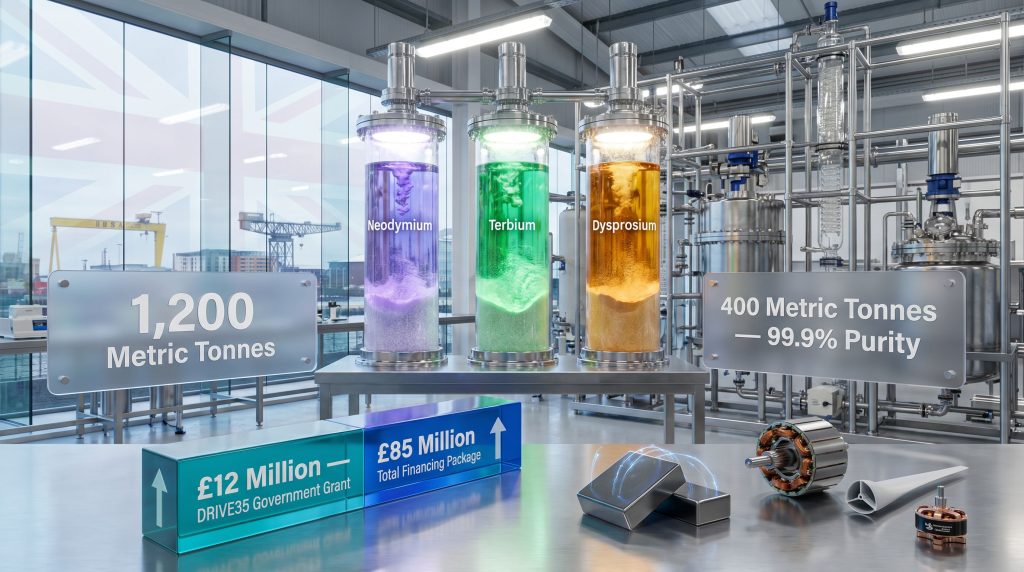
The planned commercial facility will process 1,200 metric tonnes of feedstock annually to produce 400 metric tonnes of individually separated rare earth oxides, a throughput ratio that reflects the genuine efficiency gains available through secondary recovery compared with processing primary ore from the ground.
Why Individual Separation Is the Critical Differentiator
Many recycling operations recover rare earth content as a mixed or bulk concentrate. While this has value, it cannot be directly fed into magnet manufacturing without further separation. The Belfast facility's long-loop hydrometallurgical process goes further, chemically isolating each rare earth element into a distinct oxide stream at 99.9% purity. This means the recovered neodymium, dysprosium, and terbium exiting the Belfast plant are specification-equivalent to primary mined and refined material from any supplier in the world.
This is a critical commercial advantage that is not always immediately obvious to observers unfamiliar with the downstream requirements of magnet manufacturers. Purity, consistency, and individual separation are the qualities that determine whether a material can enter the magnet supply chain directly. The Belfast process delivers all three from secondary feedstock.
The demonstration plant's production of 10 tonnes of separated rare earth oxides is not simply a technical milestone. It is commercially meaningful proof that the process works at real-world scale, generating output that meets the same specifications demanded by magnet manufacturers currently sourcing from primary producers.
How the Long-Loop Hydrometallurgical Process Works
The recycling technology underpinning the Belfast facility was developed in collaboration with Queen's University Belfast and is protected by intellectual property that forms a core part of Ionic Technologies' competitive positioning. Understanding why this process is genuinely differentiated requires a closer look at the challenge it solves.
End-of-life NdFeB magnets are not clean, uniform feedstock. They arrive oxidised, coated with various surface treatments, contaminated with other materials, and in widely varying physical states. Conventional recycling approaches struggle with this complexity, which is one reason why large-scale rare earth recycling has not previously achieved commercial viability in the West.
The Belfast long-loop process addresses this through a structured sequence:
- Feedstock Collection and Sorting – End-of-life NdFeB magnets are sourced from EV motors, wind turbines, hard disk drives, and industrial equipment. Manufacturing scrap from magnet producers represents an additional, often purer, feedstock stream.
- Pre-treatment and Conditioning – Oxidised, coated, and contaminated magnet material is prepared for chemical processing. The ability to handle degraded and contaminated inputs is a key differentiator of the Queen's University Belfast-developed approach.
- Hydrometallurgical Dissolution – Rare earth elements are leached from the magnet matrix into aqueous solution through carefully controlled acid chemistry.
- Proprietary Separation – Individual rare earth elements are isolated using solvent extraction or ion exchange techniques, separating the neodymium, dysprosium, and terbium into distinct streams.
- Precipitation and Calcination – Separated rare earth solutions are converted into high-purity oxide powders through controlled precipitation and thermal processing.
- Quality Verification – Final product is verified against the 99.9% purity benchmarks required for direct use in magnet alloy and sintered magnet manufacturing.
Long-Loop vs. Short-Loop: A Distinction Worth Understanding
The terminology of rare earth recycling includes an important distinction that affects both value and flexibility. Short-loop recycling re-processes magnets directly back into magnet alloy or sintered material without full chemical separation. This is faster and less capital-intensive but produces output that is locked into specific alloy compositions, limiting its applicability to particular magnet grades only.
Long-loop recycling, by contrast, takes the additional steps to achieve full chemical separation into individual oxide streams. The output is chemically indistinguishable from primary refined material and can be used by any magnet manufacturer globally for any NdFeB formulation. This flexibility is commercially superior, particularly when feedstock compositions vary and when serving a diverse customer base across multiple industries.
The Capital Structure and Funding Pathway
Developing industrial-scale critical mineral processing infrastructure requires substantial capital, and the Belfast commercial facility is no exception. The total planned financing package stands at £85 million, of which a £12 million capital grant has been secured through the UK government's DRIVE35 initiative. As Reuters reported, this mechanism is designed to reduce investment risk in critical mineral processing infrastructure.
| Funding Component | Amount | Source Type |
|---|---|---|
| DRIVE35 Government Capital Grant | £12 million (~$16.4 million USD) | Public |
| Remaining Financing Target | ~£73 million | Private and Strategic Partners |
| Total Planned Package | £85 million | Mixed Public-Private |
The remaining approximately £73 million is to be sourced from private investors and strategic partners, a funding structure consistent with how comparable critical mineral processing projects have been financed in the lithium and battery materials sectors. The public capital component serves primarily as a de-risking mechanism that can improve the risk-adjusted return profile for private capital entering the project.
It is worth noting that the existence of government grant funding and any strategic project designations, while reflecting broader UK policy interest in domestic critical mineral supply chains, should not be interpreted as guarantees of project success, committed offtake, or future government financial support beyond what has been explicitly confirmed. Investors should assess the facility on its commercial fundamentals, technology maturity, and the credibility of the full financing pathway.
Regional Leadership: The EMEA COO Appointment and What It Signals
The appointment of Sean Sargent as Chief Operating Officer for Europe, Middle East and Africa marks a structural shift in how Ionic Rare Earths is organising itself for international scale. Creating a dedicated regional COO role at this stage, when the commercial facility is still in the financing and construction phase, is a deliberate signal that the company views Belfast not as a standalone project but as the anchor point of a broader global network.
Sargent's professional background spans the precise industrial sectors that represent the primary end-markets for the Belfast facility's output:
- Low-carbon battery materials refinery leadership: Previously served as CEO of Green Lithium for four years, steering the UK-based start-up from concept through funding rounds and supply chain development, including securing contracts with miners and commodity traders.
- Nuclear and defence engineering: Over 25 years of leadership experience across the nuclear new build, operational, and decommissioning sectors, as well as defence engineering.
- Maritime civil engineering: Five years of project experience in maritime infrastructure.
- Chemical refining and executive leadership: Eighteen years at company executive level across chemical refining and nuclear operations, with established relationships spanning UK government bodies, financial institutions, regulators, trade unions, and defence sector organisations.
The alignment between this executive profile and the commercial target markets for the Belfast facility's output is not coincidental. Defence, nuclear, clean energy, and chemical refining organisations are exactly the customer segments that will be evaluating rare earth oxide supply agreements with the commercial facility.
Ionic's CEO Tim Harrison has confirmed that the EMEA COO appointment is the first in a series of planned senior hires, indicating the company is actively building the organisational depth needed to execute not just the Belfast project but an international replication strategy spanning the UK, broader Europe, North America, South America, and additional regions.
The next major ASX story will hit our subscribers first
The End Markets: Why Demand Visibility Is Unusually Strong
One of the distinctive investment characteristics of the rare earth oxide recycling sector, relative to many other critical mineral plays, is the unusual clarity of the demand side. The end markets consuming neodymium, dysprosium, and terbium are not speculative or early-stage. They are established, growing, and in several cases subject to mandated domestic supply requirements. Furthermore, rare earth geopolitics continue to sharpen the case for Western-controlled processing infrastructure of exactly the type Belfast represents.
Electric Vehicles
NdFeB permanent magnets in EV traction motors represent the dominant volume driver for rare earth oxide demand growth through the end of this decade. The performance characteristics of these magnets, particularly power density and thermal stability at elevated operating temperatures, make them essentially non-substitutable in high-performance motor designs. Dysprosium and terbium are specifically required to maintain coercivity in high-temperature operating environments, which explains why all three elements are produced at the Belfast facility rather than neodymium alone.
Defence and Sovereign Supply
Rare earth magnets feature in guided munitions, radar systems, submarine propulsion, drone motors, and a range of electronic warfare systems. The UK and allied defence procurement agencies have increasingly characterised rare earth supply as a national security matter, creating demand for domestically sourced, sovereignty-assured oxide supply that the Belfast facility is positioned to serve. In this context, the US rare earth supply chain race offers a useful parallel, as allied nations simultaneously push to reduce shared dependencies.
Offshore Wind Energy
Direct-drive offshore wind turbines, the preferred configuration for large-scale offshore deployments across the North Sea and beyond, are among the most rare-earth-intensive energy applications per unit of installed capacity. As the UK and European nations continue expanding offshore wind capacity, demand for domestically processed rare earth oxides grows in parallel. The circular economy opportunity is particularly compelling here: as the first generation of offshore wind turbines reaches end-of-life over the coming decade, they represent a substantial source of magnet feedstock that can re-enter the supply chain through facilities like the Ionic Rare Earths Belfast magnet recycling facility.
Advanced Manufacturing and Robotics
Industrial motors, servo systems, and precision actuators in factory automation incorporate NdFeB magnets at increasing intensity as manufacturing becomes more automated. This demand vector operates independently of energy transition dynamics, providing additional diversification across the revenue base.
The Global Replication Thesis: Beyond the Single Facility
Perhaps the most strategically significant aspect of the Belfast project is its intended role as a proof-of-concept for a replicable, modular recycling facility model. The proprietary technology, developed at Queen's University Belfast and protected through Ionic Technologies' intellectual property portfolio, is designed to be deployed across multiple geographies using the same underlying process.
This modular replication approach offers structural advantages over bespoke greenfield mining projects:
| Factor | Recycling Facility | Greenfield Mine |
|---|---|---|
| Development Timeline | Typically 3–5 years to commercial production | Often 10+ years |
| Environmental Permitting | Lower complexity; urban or industrial sites | High complexity; often remote locations |
| Feedstock Location | Adjacent to demand centres (urban mining) | Fixed by geology |
| Community Acceptance | Generally higher for circular economy model | Variable; often contentious |
| Capital Intensity | Moderate; modular and scalable | Very high; site-specific |
The identified expansion regions include North America and South America, both of which have growing end-of-life magnet feedstock volumes from existing EV and wind fleets, as well as regulatory environments that increasingly incentivise domestic critical mineral processing. As these fleets age and EV adoption continues, the volume of recoverable magnet material will grow substantially, improving the economics of recycling facilities over time.
Disclaimer: This article contains forward-looking statements regarding project timelines, production targets, financing outcomes, and expansion plans. These involve inherent uncertainty and should not be construed as investment advice. Readers should conduct independent due diligence and consult qualified financial advisers before making investment decisions related to any company or project discussed in this article.
For ongoing coverage of global rare earth project developments and policy developments shaping the critical minerals sector, readers can explore Mining Weekly's Rare Earth Minerals coverage at miningweekly.com.
Want to Track the Next Major Critical Minerals Discovery Before the Market Moves?
Discovery Alert's proprietary Discovery IQ model scans ASX announcements in real time, instantly identifying significant mineral discoveries across rare earths, battery metals, and over 30 other commodities — turning complex data into actionable opportunities for investors at every level. Explore historic examples of major discovery returns and begin your 14-day free trial at Discovery Alert to position yourself ahead of the broader market.