July 14, 2026
The Invisible Infrastructure Behind the World's Most Critical Supply Chain
Most investors think of rare earth elements as obscure metals buried in the footnotes of clean energy policy papers. The reality in 2026 looks dramatically different. Rare earths are now commanding boardroom attention, sovereign government capital, and institutional deal flow at a scale that would have seemed implausible just three years ago. The forces reshaping this sector are not cyclical, they are architectural, and understanding them requires looking beyond commodity price charts to the deeper structural logic of supply chain sovereignty.
The rare earths rising in global mining deal count story is ultimately about what happens when geopolitical fracture lines intersect with irreplaceable industrial inputs. Permanent magnets made from neodymium and praseodymium are not optional components in electric vehicle motors or wind turbine generators. They are the reason those machines work. Furthermore, for decades, the supply chain for those magnets has run almost entirely through a single country.
When big ASX news breaks, our subscribers know first
H1 2026: A Mining Capital Market Defined by Strategic Necessity
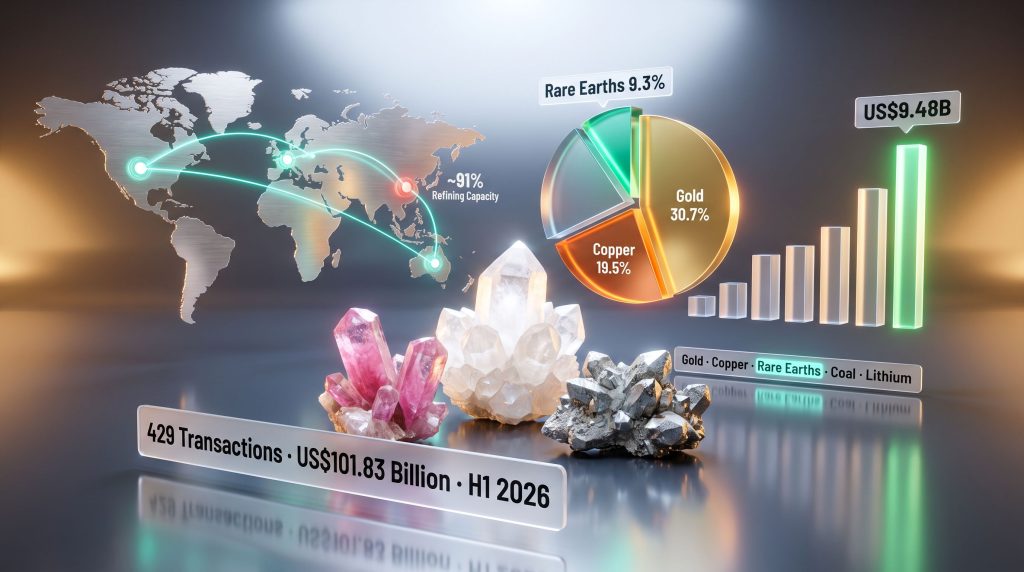
Mining Beacon's comprehensive review of global merger and acquisition activity for the first half of 2026 reveals a market operating at significant scale and with clear directional intent. Across the full universe of mining and metals transactions, 429 financing and M&A deals were recorded in the period, comprising 329 financing transactions and 100 corporate and asset-level acquisitions.
The combined value of all activity reached US$101.83 billion, with the M&A component alone accounting for US$58.43 billion across those 100 deals. Financing transactions contributed the remaining US$43.4 billion.
How the Capital Split Across Commodities
Gold retained its position as the dominant commodity, accounting for 30.7% of total deal value and 35% of all M&A transaction count. Copper followed at 19.5%, reflecting sustained demand from electrification infrastructure buildout. Then came rare earths at 9.3%, a figure that carries considerably more weight when viewed against the sector's historically marginal position in global mining capital markets.
| Commodity | Share of Total Deal Value (~US$101.83B) | Primary Deal Driver |
|---|---|---|
| Gold | 30.7% | Investor demand / inflation hedge |
| Copper | 19.5% | Electrification infrastructure |
| Rare Earths | 9.3% | Supply chain sovereignty |
| Coal | 7.7% | Energy security demand |
| Lithium | 6.2% | Battery supply chain recovery |
On the financing side specifically, the picture sharpens further. Gold led with US$11.15 billion, followed by copper at US$9.04 billion across 63 transactions, and rare earths at US$4.3 billion across 18 transactions. Lithium recorded US$3.86 billion across 15 deals, while nickel attracted US$1.91 billion from 7 transactions.
| Commodity | Financing Value | Transaction Count |
|---|---|---|
| Gold | US$11.15 billion | Multiple |
| Copper | US$9.04 billion | 63 |
| Rare Earths | US$4.3 billion | 18 |
| Lithium | US$3.86 billion | 15 |
| Nickel | US$1.91 billion | 7 |
| Silver | US$1.14 billion | 22 |
| Tungsten | US$1.06 billion | 11 |
| Uranium | US$910 million | 10 |
| Graphite | US$847 million | 9 |
| Tin | US$551.5 million | 8 |
The scale of rare earth financing in H1 2026 places the sector firmly within the top three commodities by capital deployed, a position it did not occupy just two years ago.
Why Rare Earths Are Rising So Rapidly in Global Mining Deal Count
The acceleration in rare earth transaction volume is not the product of a single catalyst. It reflects the convergence of at least four distinct structural forces, each reinforcing the others.
China's Processing Dominance Creates Systemic Urgency
The numbers defining China's position in rare earth supply chains are frequently cited but rarely fully appreciated. China accounts for approximately 61% of globally mined rare earth supply and an estimated 91% of global refining and processing capacity. This means that even ore extracted in Australia, the United States, or Brazil has historically needed to travel through Chinese facilities before becoming a usable industrial input.
China's rare earth export licensing tightening in April 2025 compressed deal timelines across Western defence, automotive, and clean energy sectors almost overnight. Transactions that might have taken years to negotiate were accelerated by the sudden realisation that theoretical supply chain vulnerability had become an operational risk.
A less commonly understood dimension of this concentration is the distinction between light and heavy rare earth elements. Light rare earths such as neodymium and praseodymium (NdPr) are more widely distributed geographically. Heavy rare earths including dysprosium and terbium, which are essential for high-performance magnets operating at elevated temperatures in EV motors and defence systems, are far more geographically concentrated, and China's dominance in their processing is even more pronounced than for light rare earths.
The Mine-to-Magnet Thesis Becomes Transactional
The concept of vertically integrated rare earth supply chains has moved decisively from strategic theory to executed transactions. Morgan Stanley described the Energy Fuels acquisition of Vacuumschmelze GmbH (VAC) as further underlining mine-to-magnet integration as a Western strategic priority, noting that ex-China NdFeB magnet capacity is actively scaling.
Understanding what mine-to-magnet actually means in practice matters for assessing where value accumulates:
- Mining – Extraction of rare earth bearing ore from the ground
- Beneficiation – Physical separation to produce rare earth concentrate
- Oxide production – Chemical processing to produce separated rare earth oxides
- Metal conversion – Reduction of oxides to rare earth metals and alloys
- Magnet manufacturing – Pressing, sintering, and finishing NdFeB permanent magnets
The critical insight here is that steps four and five, oxide-to-metal conversion and magnet manufacturing, represent where the vast majority of value-add occurs and where China's control is most deeply entrenched. Western investment has historically concentrated in step one (mining), creating a structural mismatch where upstream ore supply grows faster than midstream processing capacity can absorb it. In addition, the rare earth processing challenges associated with these intermediate stages remain a persistent bottleneck for Western supply chain developers.
Western Policy Architecture Mobilising Capital at Scale
Government-backed financing frameworks have become primary deal-enabling instruments rather than supplementary backstops. The United States signed 11 new bilateral critical minerals frameworks in 2026 alone, mobilising more than US$30 billion in combined government and institutional support. The U.S.-Australia bilateral agreement committed US$1 billion each from both nations, with a total pipeline valued at approximately US$8.5 billion.
The U.S. Export-Import Bank's conditional US$2.9 billion loan backing for the Stibnite antimony project in Idaho illustrates how government financing instruments are functioning as commercial deal catalysts across the broader critical minerals demand landscape.
End Market Demand Signals Are Hardening
NdPr production outside China is projected to increase 4.4 times between 2024 and 2030. Global rare earth production reached approximately 390,000 tonnes in 2024, up 3.7% year-on-year, with China accounting for roughly 69% of mined volume. According to the IEA's Global Critical Minerals Outlook, automotive OEMs, defence procurement agencies, and industrial robotics manufacturers are all signalling willingness to pay regional supply premiums rather than accept continued dependence on Chinese supply chains.
The Landmark Transactions Defining Western Rare Earth Strategy
Energy Fuels: Building a Transatlantic Magnet Chain
Two transactions by Energy Fuels collectively define the mine-to-magnet ambition more concretely than any policy document. The company's US$300 million acquisition of Australian Strategic Materials secured a processing capability and feedstock position in Australia. Its subsequent US$1.9 billion agreement to acquire Vacuumschmelze GmbH & Co (VAC) from Ara Partners created a direct pathway from Australian ore through to European permanent magnet manufacturing.
VAC is not a peripheral asset. It represents a cornerstone of Europe's existing NdFeB magnet manufacturing base, which currently stands at approximately 3,600 tonnes per annum. That figure sits against annual European magnet imports from China of approximately 22,000 tpa, revealing the magnitude of the supply gap that Western investment is attempting to close.
Morgan Stanley's assessment of the Energy Fuels-VAC transaction reinforced that ex-China NdFeB magnet capacity is scaling with meaningful momentum:
- U.S. capacity could reach approximately 28,000 tpa by 2028 from confirmed producers
- Including probable new entrants, that figure rises to approximately 35,000 tpa
- Long-term potential extends to 50,000-55,000 tpa if all funded and prospective projects reach production
- Current U.S. bulk magnet imports from China stand at approximately 8,500 tpa, showing the scale of the gap being closed
Serra Verde: Addressing the Heavy Rare Earth Bottleneck
USA Rare Earth's US$2.8 billion cash-and-stock acquisition of Brazil's Serra Verde in April 2026 addresses a more specific and arguably more acute supply chain vulnerability. Serra Verde's deposit is significant for its heavy rare earth content, including dysprosium and terbium, which command substantial performance premiums in high-specification magnet applications.
Following the announcement, USA Rare Earth's market capitalisation rose approximately 12% to around US$5 billion, with year-to-date gains of approximately 90% at the time of the transaction. The Serra Verde deal is structurally distinct from light rare earth plays precisely because heavy rare earth supply is more geographically constrained and more commercially critical for defence and next-generation EV applications.
Iluka Resources: The Offtake Model as Market Validation
Australia's Iluka Resources secured what represents a qualitative shift in how downstream buyers are engaging with non-Chinese rare earth supply. The company agreed to supply approximately 1,000 tonnes of rare earth oxides annually from 2028 to a global automaker, with the deal valued at US$155-172 million. This binding commitment from an OEM signals that commercial willingness to pay regional supply premiums is moving from negotiating position to executed contract.
Regional Capacity: Where the Ex-China Supply Chain Actually Stands
| Region | Current NdFeB Capacity | Key Constraint | Growth Trajectory |
|---|---|---|---|
| Japan | ~6,800 tpa | Feedstock dependency | Established and stable |
| Europe | ~3,600 tpa | 22,000 tpa import deficit | VAC-led expansion underway |
| North America | Sub-scale | Oxide-to-metal conversion gap | Rapid scale-up in progress |
| South Korea/Vietnam | Small but growing | Feedstock and processing | Emerging |
The most acute bottleneck constraining Western capacity expansion is not mining, it is the oxide-to-metal conversion stage. Investment in mines and magnet manufacturing has outpaced investment in the intermediate processing infrastructure that connects them. Without sufficient metal alloy production capacity, expanded upstream mining output cannot be translated into finished magnets regardless of how much capital flows into exploration and magnet manufacturing facilities.
Risk Factors That Could Slow the Momentum
The structural case for continued rare earth deal activity is compelling, however investors should be clear-eyed about the constraints that could complicate the timeline:
- Oxide-to-metal conversion remains underdeveloped relative to the investment being directed at upstream mining and downstream magnet manufacturing
- Heavy rare earth supply from assets outside China and Serra Verde remains limited, and dysprosium and terbium supply constraints could act as a ceiling on magnet performance improvements
- OEM premium acceptance is critical but not guaranteed at the scale required. Automakers absorbing higher input costs for regional supply must pass those costs somewhere in the value chain
- Permitting timelines in Western jurisdictions continue to represent a structural drag on project development, often running five to ten years from discovery to production
- Political continuity risk associated with bilateral government frameworks means that the sovereign capital underpinning many deals could shift with electoral cycles
Analytical distinction worth noting: gold deal volume primarily reflects investor risk appetite and inflation hedging behaviour. Rare earth deal volume reflects sovereign strategic necessity. These are fundamentally different demand drivers with different durability profiles.
The next major ASX story will hit our subscribers first
Frequently Asked Questions: Rare Earths Rising in Global Mining Deal Count
What is driving the increase in rare earth mining deals globally?
The primary drivers are China's dominant position in rare earth processing (approximately 91% of global refining capacity), Beijing's 2025 tightening of export licensing, and Western government policy frameworks actively mobilising capital for non-Chinese supply chain development. Consequently, these forces have converged to make rare earth transactions both strategically urgent and financially viable. The strategic importance of rare earths in modern industrial supply chains has made this urgency unmistakable to governments and investors alike.
What does mine-to-magnet integration actually mean in practice?
Mine-to-magnet integration describes vertically integrated supply chains spanning from ore extraction through oxide processing, metal conversion, alloy production, and finished permanent magnet manufacturing. The strategic importance lies in the fact that the midstream stages, particularly oxide-to-metal conversion, represent where China's control is most deeply entrenched and where Western investment is most urgently needed.
What are the biggest risks to continued rare earth deal growth?
The key risks include underdeveloped oxide-to-metal conversion infrastructure, heavy rare earth supply constraints, OEM reluctance to pay sustained regional supply premiums, permitting delays in Western jurisdictions, and political continuity risk associated with government-backed bilateral frameworks.
Which region has the most developed ex-China rare earth magnet capacity?
Japan maintains the most established ex-China magnet manufacturing position at approximately 6,800 tpa. Europe follows at roughly 3,600 tpa but faces a structural import deficit of approximately 22,000 tpa annually from China. North America, however, is scaling most rapidly from a comparatively low base.
What the Deal Surge Signals for the Next 24 Months
The H1 2026 rare earth transaction data represents something more durable than a speculative cycle. Five rare earth M&A transactions totalling US$5.18 billion, combined with 18 financing transactions worth US$4.3 billion, placed the sector at 5.4% of total global mining and metals deals by count in the first six months of the year. That positioning, within the top four commodities by both deal count and capital deployed, reflects a structural reallocation of mining capital that has multi-year momentum behind it.
The critical test over the next 24 months will be whether processing infrastructure investment, particularly oxide-to-metal conversion capacity in North America and Europe, keeps pace with the upstream mining and downstream magnet manufacturing commitments already being made. The role of rare earths rising in global mining deal count as a barometer of broader supply chain transformation will only intensify as these commitments mature. Furthermore, the energy transition's dependence on secure critical mineral supply makes this trajectory structurally self-reinforcing. The Reserve Bank of Australia has also noted in its analysis of critical minerals that the energy transition is reshaping global commodity demand in ways that go well beyond cyclical patterns.
Key milestones worth monitoring through 2028 include:
- U.S. NdFeB magnet capacity trajectory toward the confirmed 28,000-35,000 tpa range
- Progress on oxide-to-metal conversion facility announcements in North America and Europe
- Additional binding OEM offtake agreements that validate commercial pricing for non-Chinese supply
- Development of heavy rare earth production volumes from assets including Serra Verde
- Continuation and expansion of bilateral government critical minerals frameworks beyond 2026
This article contains forward-looking projections and capacity estimates sourced from industry analysis and company disclosures. Actual outcomes may differ materially from those projected. Nothing in this article constitutes financial or investment advice. Readers should conduct their own due diligence before making investment decisions.
Readers seeking additional context on global mining investment trends and critical minerals deal activity can explore related industry coverage at Mining Beacon, which tracks financing and M&A transactions across the full mining and metals value chain.
Want to Track the Next Major ASX Critical Minerals Discovery in Real Time?
Discovery Alert's proprietary Discovery IQ model instantly identifies significant ASX mineral discoveries — including rare earths and other critical minerals — turning complex announcement data into actionable insights before the broader market responds. Explore historic discoveries and their remarkable returns, then begin your 14-day free trial at Discovery Alert to position yourself ahead of the next major find.