July 15, 2026
The Geological Case for Brazil's Next Rare Earth District
Carbonatite-hosted rare earth systems have a habit of confounding expectations. While the broader mining world fixates on grades measured in tenths of a percent, certain carbonatite complexes in South America quietly harbour mineralisation that operates in an entirely different numerical register. Understanding why this happens, and why it matters commercially, requires stepping back from project-level metrics and examining the geological machinery that creates these anomalies in the first place.
The Poços de Caldas Alkaline Complex in Minas Gerais, Brazil, is one such setting. Spanning an approximate diameter of tens of kilometres across parts of Minas Gerais and São Paulo, it ranks among the largest alkaline intrusive complexes in South America. Its geological history involves multiple phases of alkaline magmatism, hydrothermal reworking, and prolonged surface weathering — a combination that, in the right circumstances, concentrates rare earth elements to grades that defy global norms. The Power Minerals Morro do Ferro rare earth project sits within this complex and has attracted serious analytical attention precisely because historical data from the site suggests grade characteristics that most comparable global projects cannot approach.
When big ASX news breaks, our subscribers know first
How Carbonatite Mineralisation Creates Grade Outliers
Most rare earth deposits globally are hosted in laterite profiles developed over weathered granites or ionic adsorption clays, particularly across southern China. These systems typically yield total rare earth oxide (TREO) grades in the range of 0.05% to 0.2%, and their economics depend heavily on favourable leaching conditions rather than raw grade. Carbonatite-hosted systems operate differently. Carbonatites are igneous rocks dominated by carbonate minerals, formed from carbon dioxide-rich magmas originating in the Earth's mantle.
When rare earth-bearing fluids migrate through and crystallise within these structures, they can produce mineral phases — particularly bastnäsite — with intrinsic rare earth concentrations that dwarf what ionic clay systems achieve. Furthermore, the rare earth supply chain implications of this distinction are significant, as carbonatite-hosted deposits represent a more concentrated and strategically valuable source of critical materials.
Bastnäsite, a fluorocarbonate mineral, is the dominant REE-bearing phase at Morro do Ferro. This matters for processing efficiency because bastnäsite responds well to established flotation and hydrometallurgical techniques, in contrast to some phosphate-hosted or clay-hosted systems that impose significantly higher rare earth processing challenges. The lateritic weathering overprint at Morro do Ferro adds another layer of commercial relevance: near-surface laterite profiles tend to be friable, meaning lower energy requirements for comminution, and often allow for simpler initial beneficiation.
When deep weathering profiles overlay primary carbonatite mineralisation, the geometry of mineable material frequently extends from the surface downward without a barren cap, which is advantageous for open-pit extraction planning.
"The geological combination of high-grade primary carbonatite mineralisation beneath a well-developed lateritic weathering profile is relatively uncommon globally. When this configuration is confirmed to extend continuously from surface to depth, it materially improves the economics of open-pit mining by eliminating the need to strip low-grade or barren material before reaching payable ore."
What the Historical Drilling Record Actually Shows
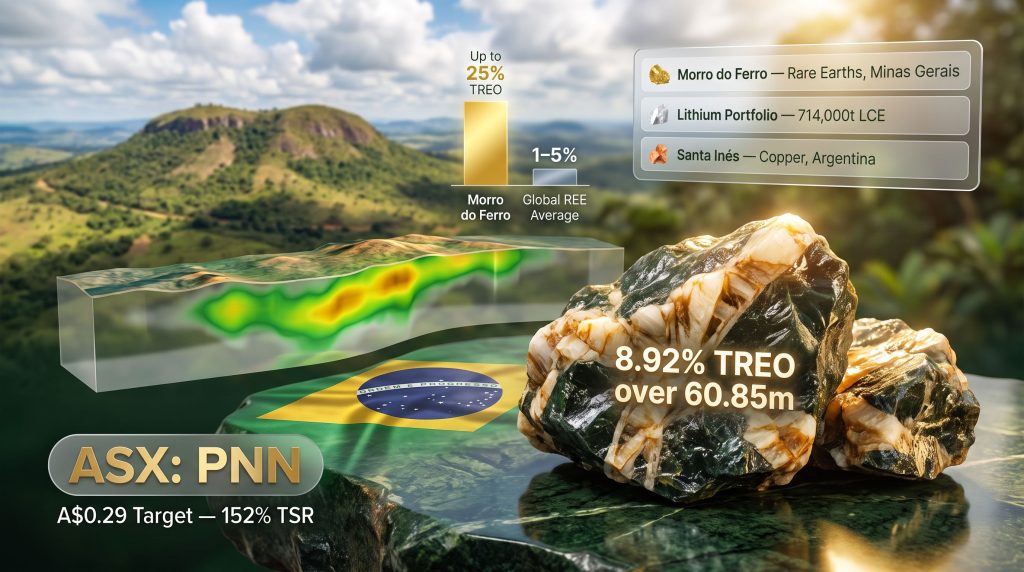
Historical drill results at Morro do Ferro are exceptional by any credible global benchmark. The intercepts documented include 60.85 metres at 8.92% TREO, 70.90 metres at 8.00% TREO, and 60.60 metres at 7.02% TREO, all commencing from surface. Peak zone concentrations within the deposit have been reported reaching up to 25% TREO, with magnetic rare earth oxide (MREO) grades hitting 35,332 ppm (3.53%) over discrete intervals.
To appreciate how unusual these figures are, consider the global context. The average TREO grade across comparable carbonatite projects globally sits between 1% and 5%, with most development-stage projects reporting drill intercepts of 1% to 3% TREO over comparable widths. Morro do Ferro's historical intercepts are roughly three to eight times that average.
| Metric | Morro do Ferro | Global REE Project Average |
|---|---|---|
| Peak TREO Grade | Up to 25% | 1 to 5% |
| Historical Drill Intercept (TREO) | Over 8% across 60 to 70 metres | 1 to 3% over comparable widths |
| MREO Peak Grade | 3.53% (35,332 ppm) | Approximately 0.5 to 1.2% |
| Mineralisation Continuity | Open at depth and along strike | Variable |
| Deposit Style | Carbonatite with lateritic overprint | Diverse |
It is important to note that historical drilling results have not yet been independently verified to JORC 2012 standards. Until a maiden JORC-compliant Mineral Resource Estimate (MRE) is completed, these intercepts represent indicative geological data rather than a defined resource. The technical programme currently underway at the project is specifically designed to convert this historical evidence into a compliant resource statement.
Why MREO Concentration Defines Commercial Value More Than Headline TREO
A critical but frequently misunderstood distinction in rare earth project evaluation is the difference between total rare earth oxide (TREO) and magnetic rare earth oxide (MREO) grades. TREO includes all rare earth elements measured together, but not all rare earths carry equal economic weight. The elements that drive the overwhelming majority of commercial value in today's market are those used in permanent magnet manufacturing: neodymium (Nd), praseodymium (Pr), dysprosium (Dy), and terbium (Tb).
These four elements collectively account for more than 80% of rare earth market value by revenue, yet they typically represent only a fraction of total rare earth content by mass. A deposit with a high MREO-to-TREO ratio is therefore significantly more commercially attractive than a headline TREO figure alone would suggest. Morro do Ferro's documented MREO grades, reaching 3.53% over discrete intervals, place it among a very select group of projects globally where the magnet-critical fraction is itself at exceptional concentrations.
Why Does the Permanent Magnet Supply Chain Matter?
The permanent magnet supply chain context reinforces why this matters. Neodymium-iron-boron (NdFeB) magnets are the enabling technology behind both electric vehicle (EV) traction motors and direct-drive offshore wind turbines. As EV penetration accelerates globally and offshore wind capacity expands, the critical minerals demand for NdPr oxide and the heavy rare earth elements dysprosium and terbium is expected to steepen considerably over the coming decade. Projects with demonstrable high-MREO grades are positioned at the most commercially sensitive point of that demand curve.
The Manifesto de Mina: A Structural Advantage Rarely Found in Modern Mining
Brazil's mining regulatory framework distinguishes between modern concession-based exploration licences and a category of legacy title known as the Manifesto de Mina. This historical title, applicable to mining operations formally registered under earlier Brazilian mining codes, confers perpetual extraction rights, direct land ownership by the title holder, and a markedly simplified permitting pathway for ground-disturbing activities.
The Morro do Ferro tenement is held under a Manifesto de Mina title first issued in 1946. In practical terms, this means Power Minerals is not required to seek third-party approvals before commencing drilling or other ground-disturbing exploration work — a requirement that burdens the majority of early-stage mineral projects globally and frequently introduces multi-year delays. For investors evaluating pre-resource rare earth projects, the permitting layer is often the least visible but most consequential source of schedule risk. The Manifesto de Mina structure eliminates a meaningful portion of that risk from the Morro do Ferro development pathway.
"The perpetual nature of the Manifesto de Mina title is particularly significant from a capital allocation perspective. Unlike time-limited exploration licences that require periodic renewal and expose project holders to administrative risk, this title structure provides the kind of tenure certainty that long-lead infrastructure planning and pre-feasibility work requires."
The Technical Roadmap: From Drilling to Resource Definition
Power Minerals has structured its inaugural drilling programme at Morro do Ferro with a total scope of approximately 3,800 metres, divided between approximately 3,000 metres of diamond core drilling and 800 metres of large diameter drilling. The large diameter component serves a specific and important function: it generates bulk samples of sufficient size to enable reliable metallurgical testwork and bulk density determinations, both of which are essential inputs to any credible economic study.
The programme timeline and key milestones are outlined below:
| Milestone | Target Date |
|---|---|
| Binding Letter of Intent signed | March 2026 |
| Acquisition completed | 27 April 2026 |
| Maiden drilling commenced | Mid-2026 |
| First assay results expected | July 2026 |
| JORC MRE target | End of 2026 |
| Engineering and environmental studies | Late 2027 |
| Pre-Feasibility Study | Post-2027 |
The maiden JORC MRE represents the pivotal de-risking event in this development sequence. A compliant resource estimate transforms historical drilling data into an internationally recognised, auditable statement of mineralisation, enabling comparative valuation analysis against peer projects and unlocking a broader institutional investor audience. In the junior resource sector, the transition from historical data to JORC compliance is frequently the single event most associated with meaningful upward re-rating.
The next major ASX story will hit our subscribers first
Acquisition Pricing and the Comparable Transaction Framework
Power Minerals completed the Morro do Ferro acquisition on 27 April 2026 for approximately AUD $14.51 million. Contextualising this entry price requires reference to how comparable rare earth projects have been valued at equivalent stages of development, and understanding the relevant mineral deposit tiers helps clarify where this project sits in the global hierarchy.
The most instructive parallel cited in the analytical framework surrounding this transaction is the SGQ (St. George Mining) Araxá rare earth project, also situated in Brazil's Minas Gerais state. The Araxá project underwent a market capitalisation re-rating from approximately AUD $53 million to approximately AUD $352 million following confirmation of resource growth, representing a roughly sixfold increase in implied project value. However, while no two projects are identical and past re-ratings do not guarantee future outcomes, the Araxá comparison illustrates the order of magnitude value step-change that JORC resource confirmation can catalyse in the Brazilian rare earth development sector specifically.
A risk-adjusted sum-of-parts (SOTP) valuation methodology assigns an implied 12-month price target of A$0.29 per share, representing a 152% total shareholder return (TSR) from the analysis date. This projection is explicitly scenario-dependent, contingent on the successful delivery of the maiden JORC MRE and subsequent resource growth. It does not constitute financial advice, and investors should treat SOTP projections as analytical frameworks rather than guaranteed outcomes.
Portfolio Architecture: Multiple Value Vectors Beyond Morro do Ferro
While Morro do Ferro occupies the primary position in Power Minerals' asset portfolio by strategic focus and implied valuation weighting, the company holds additional assets that provide commodity and jurisdictional diversification:
| Asset | Commodity | Location | Stage |
|---|---|---|---|
| Morro do Ferro | Rare Earths (MREO focus) | Minas Gerais, Brazil | Drilling and Pre-MRE |
| Santa Anna | Niobium and REE | Brazil | Early Exploration |
| Lithium Portfolio | Lithium (714,000 tonnes LCE) | Brazil | JV with Summit Nanotech |
| Santa Inés | Copper | Argentina | Early Exploration |
The lithium portfolio, held in joint venture with Summit Nanotech, represents a 714,000 tonne lithium carbonate equivalent (LCE) inventory, while the Santa Inés copper project in Argentina offers district-scale exploration optionality. The Santa Anna project in Brazil adds niobium to the commodity mix — an element with growing industrial relevance in high-strength steel and emerging battery applications. This multi-commodity structure reduces the binary risk of a single-project exploration company while preserving the leverage that Morro do Ferro provides to a successful rare earth resource outcome.
Leadership Depth as a Risk Mitigation Factor
Executive capability is disproportionately important in early-stage resource companies because the gap between a technically credible project and a commercially viable one is bridged largely through human capital: the ability to raise funds, navigate regulatory complexity, attract technical partners, and maintain market credibility through iterative exploration milestones.
Power Minerals appointed Alistair Stephens as CEO, bringing a track record that is directly relevant to the company's core focus. Stephens previously served as CEO of Arafura Rare Earths, where he advanced the Nolans rare earth project in Australia, and as CEO of Lindian Resources, where he was involved in advancing the Kangankunde rare earth project in Malawi. Both projects represent genuine technical advancement achievements in the rare earth supply chain under his leadership. Rare earth-specific executive experience of this depth remains scarce in the junior mining sector, and its presence at the CEO level materially reduces execution risk relative to comparably capitalised exploration companies.
Macro Demand Dynamics and the Western Supply Chain Imperative
The structural demand case for magnetic rare earths has been extensively documented but warrants specific framing in the context of Morro do Ferro's commercial proposition. Global EV production is projected to grow substantially through 2030 and beyond, with the permanent magnet motor architecture remaining the dominant drivetrain configuration in passenger vehicles due to its superior power density and efficiency characteristics. Each NdFeB magnet motor requires between 1 and 2 kilograms of rare earth magnet material, creating a direct and scaling demand channel for NdPr oxide, dysprosium, and terbium.
Offshore wind represents an additional demand vector that is often underweighted in market analysis. Direct-drive offshore wind turbines, which eliminate the gearbox for improved reliability in marine environments, use significantly larger permanent magnets than their onshore counterparts, with some configurations requiring several hundred kilograms of rare earth magnet material per turbine. As offshore wind deployment accelerates across Europe, Asia, and the United States, this demand channel compounds the EV-driven growth trajectory.
Against this demand backdrop, Western governments and their allied supply chains have intensified efforts to reduce dependence on Chinese rare earth processing, which currently controls an estimated 85% to 90% of global rare earth separation capacity. Brazilian projects with high-grade, magnet-focused rare earth profiles occupy a commercially interesting position in this supply chain reconfiguration, as Brazil is perceived as a geopolitically stable jurisdiction relative to many alternative REE-producing regions.
Key Risks Requiring Investor Consideration
A balanced assessment of the Power Minerals Morro do Ferro rare earth project requires transparent acknowledgement of the risks that apply at this stage of development:
- Resource uncertainty: Historical drill results have not been independently verified to JORC 2012 standards. Grade continuity and total tonnage remain unconfirmed until the maiden MRE is completed.
- Metallurgical risk: High-grade intercepts do not automatically translate into economically recoverable concentrates. Recoveries, concentrate grades, and deleterious element management must be demonstrated through systematic testwork.
- Funding risk: Pre-revenue exploration companies require continued capital market access. Adverse equity market conditions can delay or constrain exploration programmes regardless of asset quality.
- Jurisdictional complexity: While the Manifesto de Mina title reduces certain permitting risks, Brazilian environmental and community consultation requirements remain applicable and can introduce schedule uncertainty.
- Commodity price sensitivity: NdPr oxide prices are cyclical. A sustained downturn in magnet rare earth prices would reduce the implied project economics and affect market re-rating potential at resource milestones.
The Three Catalysts Defining Power Minerals' Trajectory Through 2027
For investors and industry observers seeking to track the Morro do Ferro thesis as it develops, three specific events will define the near-term risk-reward profile. Furthermore, understanding the relevant feasibility study stages ahead provides useful context for interpreting each milestone as it arrives.
-
First assay results from the inaugural drilling programme, expected from July 2026, will either validate or challenge the historical grade data. Consistency between historical intercepts and new assay results would significantly strengthen confidence in the resource model.
-
Delivery of the maiden JORC-compliant MRE by end of 2026 is the primary de-risking catalyst. A maiden resource that confirms meaningful tonnage at grades consistent with historical data would establish Morro do Ferro as a credible development-stage rare earth project and unlock comparative valuation frameworks.
-
Completion of engineering and environmental studies by late 2027 would move the project decisively toward pre-feasibility — the stage at which infrastructure, processing, and logistics requirements are formally scoped and costed, and at which institutional capital typically begins to engage more actively.
Each of these catalysts is measurable, time-bound, and directly linked to the valuation assumptions embedded in the SOTP analytical framework. Monitoring progress against these milestones provides the most rigorous basis for ongoing assessment of whether the development thesis is tracking as anticipated.
This article is intended for informational purposes only and does not constitute financial advice. Readers should conduct their own due diligence and seek independent professional advice before making any investment decisions. Forward-looking projections, including price targets and TSR estimates, are scenario-dependent and are not guarantees of future performance.
Want to Track the Next Major Rare Earth Discovery Before the Broader Market Does?
Discovery Alert's proprietary Discovery IQ model delivers real-time alerts on significant ASX mineral discoveries — including high-grade rare earth projects — instantly translating complex geological data into actionable investment insights for both short-term traders and long-term investors. Explore Discovery Alert's dedicated discoveries page to understand how historic mineral discoveries have generated substantial returns, and begin your 14-day free trial today to position yourself ahead of the market.