May 19, 2026
Advanced Material Engineering Transforms Energy Storage Efficiency
Energy storage markets face unprecedented demand for technological breakthroughs that simultaneously address performance limitations, manufacturing scalability, and environmental sustainability. Traditional lithium-ion battery architectures encounter fundamental constraints in energy density, charging speed, and operational temperature ranges. These challenges have catalysed comprehensive research initiatives across polymer chemistry, nanotechnology, and sustainable materials science, creating opportunities for revolutionary advances in innovative battery materials for electric mobility and energy storage.
When big ASX news breaks, our subscribers know first
Performance Metrics Driving Contemporary Battery Innovation
Modern battery development prioritises multifaceted performance improvements across several critical dimensions. Energy density requirements continue escalating toward theoretical limits, with research institutions targeting substantial increases in power-to-weight ratios for transportation applications. Cycle life specifications demand materials capable of withstanding thousands of charge-discharge cycles without significant capacity degradation.
Manufacturing scalability considerations equally influence material selection processes. Laboratory innovations must demonstrate compatibility with existing production infrastructure whilst maintaining cost-effectiveness at industrial scales. Safety standards encompass thermal runaway prevention, mechanical integrity under stress, and chemical stability across diverse operating conditions.
The Fraunhofer Institute for Applied Polymer Research has developed integrated material platforms spanning synthesis, scale-up, prototype production, and comprehensive characterisation. This approach enables companies to transition from initial concepts through industrial-scale implementation, addressing critical gaps between laboratory research and commercial deployment.
Polymer-Based Electrolyte Systems Enhance Battery Safety
Solid polymer electrolytes represent significant advancement over conventional liquid systems, addressing fundamental safety and performance limitations. Liquid electrolytes pose volatilisation risks at elevated temperatures, potential leakage upon cell damage, and restricted operational temperature windows. Furthermore, polymer alternatives demonstrate mechanical stability, non-volatile characteristics, and enhanced thermal robustness.
Ionic Conductivity Achievements
Recent developments in solid polymer electrolyte technology have achieved ionic conductivity levels exceeding 10⁻⁴ S/cm at room temperature. This performance threshold represents meaningful progress in solid-state electrolyte functionality, as conventional polymer systems historically demonstrated lower conductivity at ambient conditions.
Molecular engineering techniques enable precise adjustment of mechanical, thermal, and electrochemical properties through targeted polymer modifications. These materials demonstrate compatibility across multiple battery chemistries, including sodium-ion, zinc-air, and lithium-ion systems, providing standardised material platforms for diverse commercial applications.
Composite Architecture Development
Beyond pure polymer systems, composite electrolytes combine organic and inorganic components to achieve enhanced electrochemical stability and mechanical robustness. These hybrid architectures balance seemingly contradictory requirements of high ionic conductivity and structural integrity.
Advanced polymer composite cathodes integrate active materials like sodium-vanadium-phosphate into polymer matrices. Utilising identical polymer bases for both cathode and electrolyte components reduces interfacial resistance, addressing critical performance bottlenecks in innovative battery materials for electric mobility and energy storage systems. This design approach optimises ion transport kinetics whilst maintaining mechanical stability during extended cycling.
PFAS-Free Membrane Technologies Address Environmental Concerns
Per-fluoroalkyl substances face increasing regulatory scrutiny due to environmental persistence and bioaccumulation properties. Alternative membrane materials eliminate persistent fluorochemicals from production processes whilst maintaining essential separation functions in electrochemical cells.
Tunable Pore Structure Design
Engineered membrane architectures feature chemically and mechanically stable structures with adjustable pore configurations. Pore size and porosity parameters can be customised for specific battery system requirements, directly influencing ion transport kinetics, electrolyte retention, and cycle stability.
The technical challenge involves simultaneously achieving high ionic conductivity (facilitated by permeable pore structures) and mechanical integrity (typically requiring dense matrices). In addition, advanced pore engineering optimises this trade-off through precise architectural control.
Manufacturing compatibility enables integration into existing battery production infrastructure without requiring complete process redesign. This economic consideration proves critical for industrial adoption timelines and cost-effectiveness.
Carbon Material Innovation Increases Anode Performance
Carbon-based anode materials benefit from customisable processing approaches that optimise electrochemical properties. Advanced synthesis techniques enable specific adjustment of pore structure, surface characteristics, electrical conductivity, and chemical purity according to application requirements.
Biobased Carbon Material Development
Renewable feedstock utilisation addresses sustainability concerns whilst potentially achieving climate-negative material footprints through carbon sequestration during production processes. Cellulose and lignin serve as starting materials for carbon electrode development, offering alternatives to petroleum-derived graphite.
Processing methodologies during cellulose and lignin conversion enable engineering of pore architectures, surface chemistry profiles, and electrical conductivity characteristics. This processing flexibility facilitates electrochemical optimisation without dependence on conventional graphite sources.
Supply chain advantages include renewable feedstock availability and reduced geographic concentration risks compared to mineral graphite production. Consequently, life cycle assessment considerations favour biobased materials through reduced mining intensity and processing energy requirements.
Cathode Innovations Drive Energy Density Improvements
High-energy density cathode formulations continue evolving beyond conventional lithium-based systems. Prussian blue analogs demonstrate enhanced electrochemical stability for sodium-ion applications, offering improved structural integrity during extended cycling compared to layered oxide alternatives.
Sodium-Vanadium-Phosphate Integration
Polymer composite cathodes incorporating sodium-vanadium-phosphate active materials provide electronic percolation, mechanical stability, and controlled interfacial resistance. The polymer host matrix supports active material integration whilst facilitating ion transport and structural integrity.
Interface optimisation through identical polymer bases for cathode and electrolyte components minimises resistance barriers that typically limit battery performance. This design philosophy addresses fundamental electrochemical limitations through materials engineering rather than system-level modifications.
Polyanionic materials like lithium iron phosphate balance safety considerations, longevity requirements, and thermal performance characteristics. These systems prioritise operational stability and safety margins over maximum energy density for applications where reliability supersedes power-to-weight optimisation.
The next major ASX story will hit our subscribers first
Emerging Battery Chemistries Show Commercial Promise
Sodium-ion technology leverages resource abundance advantages compared to lithium-dependent systems. Sodium's crustal abundance and widespread availability reduce supply chain concentration risks whilst potentially achieving cost competitiveness for large-scale stationary storage deployments.
Application-Specific Positioning
Stationary energy storage applications relax energy density requirements compared to transportation uses, enabling sodium-ion systems to compete effectively based on cost and cycle life considerations. Manufacturing infrastructure compatibility with existing lithium-ion production lines facilitates technology transition and reduces capital investment barriers.
Grid storage applications prioritise long-duration discharge capabilities and maintenance-free operation over energy density maximisation. For instance, sodium-ion chemistry characteristics align well with these requirements whilst offering potential cost advantages.
What Role Do Advanced Ceramics Play in Battery Performance?
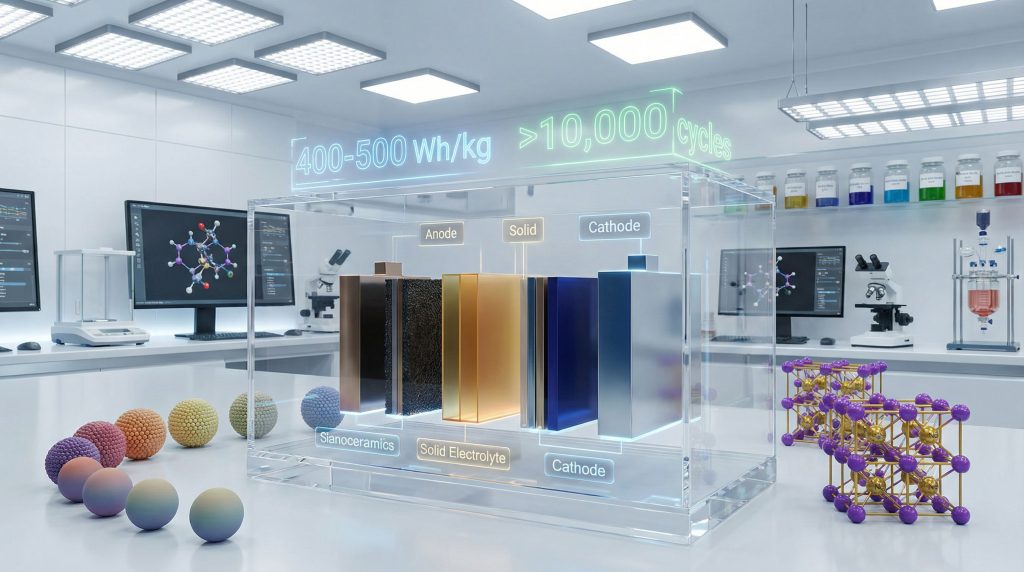
Hybrid material systems combining nanoceramic and polymer components balance mechanical flexibility with thermal stability requirements. Ion transport optimisation occurs through engineered crystal structures that facilitate ionic conductivity whilst maintaining structural integrity.
Metal-organic framework applications provide tunable pore architectures for optimised electrolyte retention and high surface area electrodes that increase active material utilisation. However, transition metal oxide integration enhances electrochemical performance through catalytic activity and electronic conductivity.
Long-term durability metrics for advanced ceramic materials exceed conventional separator performance, particularly regarding thermal stability and chemical resistance. Manufacturing process integration with roll-to-roll production methods enables scalable implementation.
Sustainable Material Strategies Reduce Critical Element Dependencies
Catalyst development initiatives focus on minimising cobalt and rare earth dependencies through alternative material formulations. Recycling-friendly material design enables closed-loop manufacturing processes that reduce waste streams and material costs.
The development of a battery-grade lithium refinery demonstrates industry commitment to securing sustainable supply chains. Furthermore, a recent battery recycling breakthrough shows promise for circular economy approaches.
Supply Chain Diversification
Local supply chain development reduces geographic concentration risks associated with critical mineral availability. Life cycle assessment optimisation across material production pathways considers environmental impact, energy consumption, and resource utilisation efficiency.
Quality control standardisation ensures consistent performance metrics across production batches whilst maintaining scalability for industrial deployment. Moreover, cost modelling frameworks evaluate competitive market positioning relative to conventional innovative battery materials for electric mobility and energy storage solutions.
Manufacturing Scalability Enables Commercial Deployment
Continuous synthesis methods replace batch processing approaches to achieve cost reduction and production efficiency improvements. Quality assurance protocols maintain consistent material properties whilst enabling high-volume manufacturing scalability.
Advanced direct lithium extraction technologies support sustainable lithium production for battery manufacturing. Additionally, battery metals investment trends indicate strong market confidence in next-generation materials.
Technology Transfer Frameworks
Research-to-commercialisation pathways connect laboratory development with industrial implementation through structured collaboration programmes. Risk-sharing arrangements across value chain partners facilitate technology development whilst reducing individual company exposure.
Intellectual property strategies protect innovations whilst enabling licensing arrangements that accelerate market deployment. Investment prioritisation frameworks evaluate competing technology pathways based on commercial viability and technical readiness levels.
How Is Market Integration Driving Technology Adoption?
Application-specific material optimisation enables customisation for diverse use cases ranging from electric vehicles to grid storage systems. Regulatory compliance frameworks accommodate new material technologies whilst maintaining safety standards and performance requirements.
Electric vehicle applications demand fast-charging capabilities, thermal management, and weight reduction through high energy density materials. The EV mining transformation demonstrates how innovative battery materials for electric mobility and energy storage are revolutionising industrial applications. Temperature performance ranges must accommodate diverse climate conditions whilst maintaining safety certification requirements.
Grid storage implementations prioritise cost-per-kWh optimisation over energy density maximisation, utilising material abundance characteristics rather than performance extremes. Long-duration discharge capabilities require materials optimised for sustained operation rather than peak power delivery.
According to next-generation batteries research, "emerging battery technologies could fundamentally transform how we store and utilise energy across multiple sectors, from residential applications to industrial-scale deployment".
Performance trajectory projections indicate continued advancement toward theoretical energy density limits whilst achieving cost reduction curves that approach grid parity for storage applications. Manufacturing scale requirements for global energy transition support necessitate materials that can be produced at unprecedented volumes whilst maintaining quality and performance standards.
This analysis represents current understanding of battery material development based on available research. Future performance claims and commercialisation timelines remain subject to technical and market uncertainties. Readers should conduct independent research before making investment decisions related to battery material technologies.
Looking to Capitalise on Battery Materials Innovation?
Discovery Alert's proprietary Discovery IQ model delivers real-time alerts on significant ASX mineral discoveries, instantly empowering subscribers to identify actionable opportunities in the rapidly expanding battery materials sector ahead of the broader market. Explore Discovery Alert's dedicated discoveries page to understand why historic mineral discoveries have generated substantial returns for investors, then begin your 14-day free trial to position yourself at the forefront of emerging opportunities.