May 19, 2026
The Hidden Liquid Asset Sitting Inside Mexico's Aging Oil Infrastructure
The global race to secure battery-grade lithium has driven exploration capital into some of the world's most remote deserts, salt flats, and hard-rock formations. Yet one of the more unconventional frontiers now drawing serious technical attention sits not in a greenfield mine site, but inside the produced water streams of existing petroleum operations. Across several countries, engineers are asking a provocative question: what if the byproduct fluid from oil extraction could be redirected into the critical minerals supply chain?
Mexico is among the nations beginning to grapple with this question in earnest. PEMEX, the state oil company, has confirmed the presence of lithium traces in oilfield brines recovered from wells in the country's northeastern basins. The discovery has generated considerable national attention, and the concept of PEMEX lithium in oil wells has entered the country's critical minerals conversation with notable momentum. However, the distance between a laboratory-confirmed trace and a commercially viable production stream is vast, and the technical, financial, and competitive challenges involved deserve careful examination.
When big ASX news breaks, our subscribers know first
What "Petrolithium" Actually Means and Why It Is Technically Distinct
A New Category of Unconventional Lithium Recovery
The term "petrolithium" has been coined to describe lithium recovered as a co-product or byproduct of petroleum operations, specifically from the salty water, known as produced water or brine, that returns to the surface during hydrocarbon extraction. This distinguishes it from three conventional lithium recovery categories: hard-rock spodumene lithium extraction, clay-hosted lithium extraction, and evaporative salar brine processing.
The theoretical advantage of the petrolithium approach is that it leverages drilling infrastructure, wellheads, fluid handling systems, and produced water management networks that already exist. In principle, this could reduce the capital intensity of lithium recovery compared to a greenfield mine development. However, petroleum brines present a fundamentally different chemistry profile than geothermal brines or salar brines, and that difference carries significant engineering consequences.
The Chemistry Problem Specific to Oil-Associated Brines
Standard lithium-bearing brines, such as those found in the Atacama or Lithium Triangle, are essentially concentrated saline solutions with relatively predictable ionic compositions. Petroleum brines, however, are mixed organic-aqueous fluids. They contain dissolved hydrocarbons, surfactants, scale inhibitors, corrosion products, and other compounds introduced both geologically and through the drilling process itself.
This complexity creates problems at every stage of direct lithium extraction technology application:
- Organic compounds can foul ion-exchange sorbents and degrade membrane selectivity
- Pre-treatment stages required to remove hydrocarbon contaminants add capital and operating cost
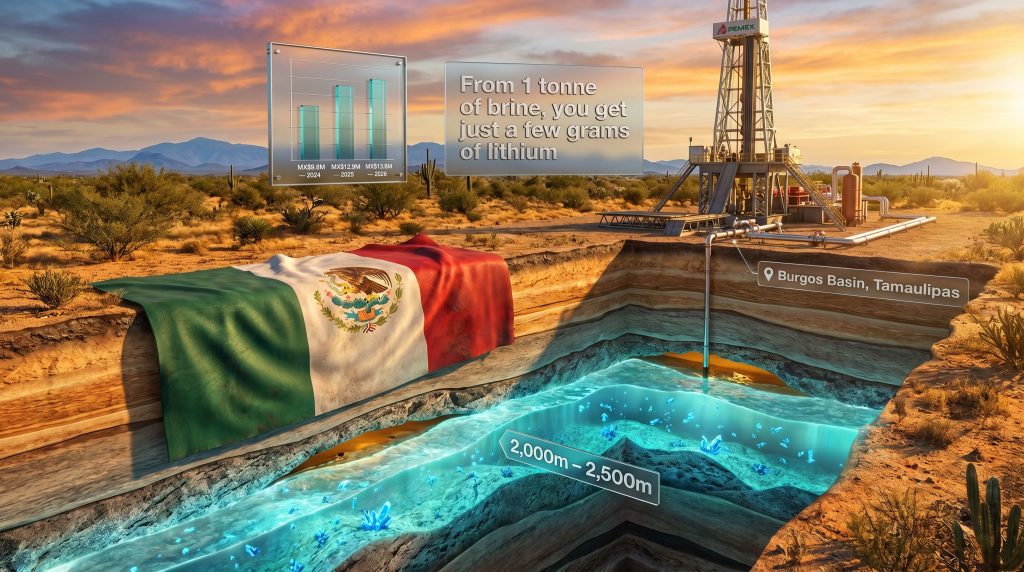
- Lithium concentrations in petroleum brines are extremely dilute, with specialists noting yields of only a few grams of lithium per tonne of brine processed
- Contamination events can reduce the economic life of DLE consumables, affecting project economics materially
These are not theoretical risks. They are the primary engineering reasons why petroleum brine lithium recovery is considered more technically demanding than most comparable DLE programmes globally.
Basin-by-Basin Analysis: Where PEMEX Has Detected Lithium
Burgos Basin: High Depth, Hydraulic Fracturing Dependency
The Burgos Basin in northeastern Mexico represents the most advanced site of PEMEX's lithium-from-brine investigations. Laboratory analysis has confirmed lithium traces embedded within volcanic rock formations at depths ranging from approximately 2,000 metres to 2,500 metres. The geographic footprint spans Tamaulipas, Veracruz, and Tabasco.
A critical structural constraint applies here: lithium recovery in the Burgos Basin is not an independent activity. It is operationally tethered to hydraulic fracturing for hydrocarbons. Energy sector specialist Ramsés Pech clarified this dependency publicly, noting that fracking must first be carried out for oil, after which the return water carrying lithium traces must be managed and processed. Without active fracking operations generating sufficient produced water volumes, there is simply no feedstock for any lithium recovery system.
Mexico currently has no commercial hydraulic fracturing programme operating at the scale required in this basin. This single fact makes the Burgos Basin lithium opportunity a medium-to-long-term proposition, entirely contingent on a separate policy and operational decision about fracking.
Tampico-Misantla Basin and the Five-State Disclosure
The Tampico-Misantla Basin represents a secondary frontier, with site selection studies active as of 2026. Onshore lithium accumulations have been confirmed through laboratory testing, but no quantified resource volumes exist for this basin either.
More broadly, former PEMEX CEO Victor Rodríguez disclosed that lithium concentrations comparable to those found in Bolivian deposits had been identified at drilling sites across five states. This statement attracted significant media attention, but it is important to contextualise it correctly. Bolivia's Salar de Uyuni is among the highest-grade lithium brine deposits on the planet. Describing PEMEX's findings as comparable in concentration terms is a geological observation about brine chemistry at specific sample points, not a reserve-level statement about extractable volumes.
| Basin or Region | States Covered | Depth Range | Current Status |
|---|---|---|---|
| Burgos Basin | Tamaulipas, Veracruz, Tabasco | 2,000m to 2,500m | Lab-confirmed traces, no reserves defined |
| Tampico-Misantla | Northeastern Mexico | Under assessment | Site selection phase |
| Five-State Brine Sites | Undisclosed (five states) | Variable | Concentration data only, no resource estimate |
How Direct Lithium Extraction Works in a Petroleum Context
The Seven-Stage Process From Wellbore to Battery-Grade Product
For those unfamiliar with the technical pathway, converting PEMEX oilfield brines into commercial lithium products would require the following sequence:
- Hydrocarbon extraction via hydraulic fracturing activates the production cycle and generates the produced water stream
- Produced water capture collects the return fluid carrying dissolved lithium ions alongside hydrocarbons and other compounds
- Oil-water separation and pre-treatment removes hydrocarbon contamination to prepare the brine for DLE application
- DLE application uses selective sorbent or membrane systems to isolate lithium ions from the complex brine matrix
- Concentration and purification upgrades the lithium-rich eluate to processing-grade feedstock
- Conversion processing transforms the concentrated solution into battery-grade lithium carbonate or lithium hydroxide
- Offtake and commercialisation moves the finished product into battery supply chains or chemical processing markets
Each step represents a distinct engineering challenge. In Mexico's context, steps 3 through 7 involve infrastructure and technology that does not currently exist domestically at any meaningful scale. For further context, oilfield brine lithium extraction programs in the United States demonstrate how technically demanding this process can be even under more favourable conditions.
Where Mexico Stands in the Global DLE Landscape
DLE technology is advancing rapidly across multiple geographies. The Smackover Formation in Arkansas, United States, represents one of the most closely watched oilfield brine lithium programmes globally, benefiting from relatively cleaner brine chemistry and a mature regulatory environment for produced water management. Argentine programmes in the Puna region, and Canadian oilfield brine investigations, are also progressing with higher levels of private capital involvement.
Paul Sánchez, Energy Sector Analyst and Visiting Professor at the University of California San Diego, drew a pointed distinction between Mexico's situation and these comparable programmes. In his assessment, Mexico is not discussing quantified reserves or approximate resources, but rather a potential that requires substantial research investment and technological development before any commercial pathway becomes viable.
"Mexico's oilfield brine lithium route carries a technical complexity premium that most investor-facing communications about the country's lithium potential do not adequately communicate."
LitioMx: Legal Authority Without Financial Firepower
The 2022 Mining Law Reform and Its Supreme Court Validation
Mexico's legal architecture for state lithium control was cemented when the Supreme Court validated the 2022 Mining Law reform in 2026, dismissing five constitutional challenges brought by a legislative minority. The court upheld Articles 1, 5bis, and 10 of the Mining Law, which collectively reserve to the state the full value chain of lithium exploration, exploitation, processing, and commercialisation. Private concessions are prohibited. Lithium deposit zones are designated as state mining reserve areas.
The court also ruled that prior indigenous consultation was not required on the basis that the reform did not generate a direct and differentiated impact on the rights of indigenous and Afro-Mexican communities. This ruling removed a significant legal overhang that had created uncertainty for the reform's implementation.
Three Years of Operational-Only Budgets
Legal clarity has not, however, translated into financial capacity. LitioMx's budget trajectory over three consecutive years tells a consistent story:
| Year | LitioMx Budget (MXN) | USD Equivalent | Year-on-Year Change |
|---|---|---|---|
| 2024 | MX$9.8 million | ~US$568,000 | Baseline year |
| 2025 | MX$12.9 million | ~US$748,000 | +27.3% |
| 2026 | MX$13.9 million | ~US$805,000 | +7.7% |
Every one of these budget allocations has been consumed by operational costs. No exploration capital has been deployed in any of these three years. For context, a single comprehensive lithium exploration programme — covering geophysical surveys, drilling, resource modelling, and preliminary feasibility work — typically requires expenditures in the range of tens to hundreds of millions of dollars before reaching resource definition. LitioMx's entire three-year budget combined would not fund a meaningful exploration campaign at a single deposit.
Rubén del Pozo, President of the AIMMGM, captured the structural problem clearly. Before any lithium can be extracted and sold at a profit, operators need to know precisely where the resource is located, how much exists, and in what physical and chemical condition it occurs. That knowledge requires time, substantial investment, and specialised technology. The current budget framework provides none of these at adequate scale.
Furthermore, the prohibition on private concessions — while legally settled — creates a structural constraint on capital formation. The mechanisms through which most critical mineral projects globally attract exploration investment, including private junior miners, royalty financiers, and strategic offtake partners providing prepayment capital, are unavailable under Mexico's current framework. No sovereign wealth mechanism or dedicated exploration fund has been established to fill this gap.
Mexico's Broader Lithium Inventory: Scale Versus Development Readiness
National Resource Footprint
Mexico's overall lithium resource base is substantial in geographic terms:
| Metric | Figure |
|---|---|
| Estimated total lithium reserves | Approximately 1.7 million tonnes |
| Number of identified deposits | 82 |
| States with known deposits | 18 |
| Leading state by deposit count | Sonora (13 deposits) |
| Second-ranked state | Puebla (12 deposits) |
| Third-ranked state | Oaxaca (9 deposits) |
Clay, Brine, and Hard Rock: Three Very Different Extraction Challenges
Mexico's lithium occurs across three fundamentally different geological forms, each requiring distinct extraction technology:
-
Clay-hosted lithium in Sonora requires acid leaching or high-temperature roasting, with significant water and energy demands. President Claudia Sheinbaum acknowledged this directly, describing the challenge of processing lithium from what is essentially a mud-like clay matrix, noting it is substantially more difficult than recovering lithium from sandy or granular deposits.
-
Hard-rock lithium at spodumene-bearing pegmatite deposits requires conventional hard-rock mining and high-temperature processing to convert spodumene to a lithium salt.
-
Oilfield brine lithium, the petrolithium pathway, requires DLE technology adapted for petroleum-contaminated fluids, supported by active fracking operations as the primary extraction trigger.
None of these pathways has production-ready infrastructure in Mexico today. The oilfield brine route is arguably the most novel and technically unproven of the three at industrial scale globally. In comparison, lithium brine extraction from traditional salar environments remains considerably more advanced in terms of commercial readiness.
The next major ASX story will hit our subscribers first
The Competitive Clock Is Running
Global Supply Concentration and Mexico's Current Position
The global battery-grade lithium market is dominated by a small number of producing nations:
| Supply Region | Approximate Share of Global Battery-Grade Lithium |
|---|---|
| China, Australia, and Chile (combined) | Approximately 94% |
| Argentina and Bolivia | Significant secondary share |
| Mexico (current contribution) | Negligible |
Sodium Battery Technology as a Structural Demand Risk
One factor that receives insufficient attention in discussions of Mexico's lithium potential is the accelerating commercialisation of sodium-ion battery technology, driven primarily by Chinese manufacturers. Sodium-ion batteries use no lithium whatsoever. For stationary energy storage and lower-range electric vehicles, sodium-ion cells are approaching commercial cost parity with lithium iron phosphate chemistry.
Paul Sánchez framed this risk starkly, warning that if Mexico takes too long to commercialise its lithium resources, it risks losing the race entirely as the global market pivots toward alternative chemistries. This is not a distant theoretical risk. Chinese battery manufacturers have sodium-ion cells in commercial production, and integration into vehicle platforms is advancing on a 2026-to-2030 timeline.
2026 Global Lithium Market Dynamics
| Market Metric | 2025 | 2026 Projection |
|---|---|---|
| Lithium carbonate surplus | 141,000 tonnes | 109,000 tonnes |
| Global consumption growth | Baseline | +13.5% |
| Global consumption volume | Baseline | 1.48Mt LCE |
| Global production growth | Baseline | +9.9% |
| Global production volume | Baseline | 1.58Mt LCE |
Projections sourced from S&P Global Energy CERA.
While the surplus is narrowing, the lithium market oversupply means new entrants face price pressure rather than a shortage premium. The window during which a new lithium producer can enter the market and capture premium pricing may be narrower than Mexico's development timeline allows.
Armando Alatorre, Vice President of CIMMGM, described the competitive stakes directly. While Mexico remains engaged in governance debates, the global automotive industry has been actively locking in supply contracts with established producers, leaving Mexico progressively further outside the investment race for battery and electric vehicle supply chains. In addition, China's battery recycling outlook is further reshaping how secondary lithium supply is distributed across global markets, adding another layer of competitive pressure for emerging producers.
Moreover, PEMEX itself has publicly confirmed its ambitions to participate in this space, as outlined in reporting on PEMEX's oilfield brine strategy, though analysts caution that institutional ambition has yet to be matched by technical or financial resources.
Risk Matrix: The Full Picture for PEMEX's Brine Lithium Strategy
| Risk Category | Specific Risk | Severity Assessment |
|---|---|---|
| Technical | DLE not commercially mature for petroleum brines at scale | High |
| Technical | Extremely low lithium yield per tonne of brine | High |
| Financial | LitioMx budget covers only operational costs | Critical |
| Financial | No private capital mechanism available under current law | Critical |
| Operational | No brine processing infrastructure exists in Mexico | High |
| Regulatory | Active commercial fracking absent from relevant basins | High |
| Competitive | Global EV supply chains contracting elsewhere now | High |
| Market | Sodium battery adoption compresses lithium demand window | Medium-High |
Three Development Scenarios for Mexico's Oilfield Lithium
Scenario 1: Accelerated State Commitment (Optimistic Pathway)
LitioMx receives a substantial budget increase to the hundreds of millions of dollars range. PEMEX formally establishes a dedicated lithium subsidiary. DLE pilot programmes targeting petroleum brines launch by 2028. Fracking policy is resolved and commercial-scale operations begin generating sufficient produced water volumes. Commercial lithium production commences in the mid-2030s, positioning Mexico to supply USMCA-aligned battery manufacturing demand.
Scenario 2: Incremental Progress (Base Case)
Budget constraints persist through the late 2020s. Fracking operations remain limited in scope. DLE pilots are delayed until the early 2030s. Commercial production does not materialise until the late 2030s, by which point the peak demand window for current lithium battery chemistries may have already passed its inflection point.
Scenario 3: Structural Stagnation (Downside)
The prohibition on private capital combined with chronic underfunding of LitioMx, accelerating sodium battery adoption, and the absence of active fracking operations in the Burgos Basin renders the oilfield lithium pathway commercially unviable within the relevant technology transition window. Mexico's petrolithium findings remain a geological footnote rather than a strategic asset.
Disclaimer: The scenarios above represent analytical projections based on publicly available information and specialist commentary. They do not constitute investment advice or forecasts of specific outcomes. Readers should conduct independent due diligence before making any investment decisions related to critical minerals or related sectors.
Frequently Asked Questions: PEMEX Lithium in Oil Wells
What exactly did PEMEX find in its oil wells?
PEMEX confirmed the presence of lithium traces in produced water from oilfield operations across the Burgos and Tampico-Misantla basins in northeastern Mexico. The mineral was identified through laboratory analysis of brine samples from wells spanning Tamaulipas, Veracruz, and Tabasco. These findings represent geological indicators at pre-resource stage, not quantified reserves or economically defined deposits.
How is lithium physically extracted from petroleum brines?
The process requires capturing produced water during hydrocarbon operations, removing hydrocarbon contamination through pre-treatment, then applying direct lithium extraction technology to selectively isolate lithium ions from the complex brine matrix. The resulting lithium-rich solution is concentrated and converted into battery-grade lithium carbonate or lithium hydroxide. The petroleum contamination in PEMEX brines adds pre-treatment complexity not present in geothermal or salar DLE programmes.
When could commercial production realistically begin?
Based on specialist assessments, commercial production from PEMEX lithium in oil wells is at minimum 10 to 12 years away from 2026. This estimate assumes that hydraulic fracturing operations begin at relevant scale, brine processing infrastructure is engineered and built, DLE technology is successfully piloted and scaled, and investment capital is secured. None of these prerequisites currently exist in Mexico.
What is LitioMx and what authority does it hold?
LitioMx is Mexico's state lithium agency, established under the 2022 Mining Law reform and validated by Supreme Court ruling in 2026. It holds exclusive state authority over lithium exploration, extraction, processing, and commercialisation across Mexico. Private concessions are prohibited. However, its 2026 federal budget of approximately US$805,000 covers only operational expenses, leaving no capital available for the exploration and development activities required to advance Mexico's lithium resource base.
Is the PEMEX oilfield brine route better or worse than Sonora's clay lithium?
Neither pathway is straightforward. Sonora's clay-hosted lithium requires energy-intensive acid leaching or roasting with high water consumption. The oilfield brine route requires DLE technology adapted for petroleum-contaminated fluids and is structurally dependent on fracking operations. Both face significant technical and infrastructure challenges that no Mexican entity has yet demonstrated the capacity or funding to resolve.
Want To Stay Ahead Of The Next Major Mineral Discovery?
Discovery Alert's proprietary Discovery IQ model delivers real-time alerts on significant ASX mineral discoveries, transforming complex mineral data into clear, actionable insights for investors at every level — explore the historic returns major discoveries have generated and begin your 14-day free trial at Discovery Alert to position yourself ahead of the broader market.