May 18, 2026
Why Mine Restarts Tell You More About a Commodity Than Any Price Chart
There is a specific moment in every commodity cycle that price charts alone cannot capture: the moment an operator decides the economics of production are once again worth the operational risk of switching the lights back on. Mine restarts are not simply logistical events. They are forward-looking declarations of confidence, made by management teams who have spent months, sometimes years, watching cost structures, demand signals, and pricing benchmarks against the threshold needed to justify reactivation.
For hard-rock lithium producers in Western Australia, that threshold has historically been a moving target. The same assets celebrated as critical infrastructure during the 2022 price boom were quietly placed into care and maintenance throughout 2023 and 2024 as spodumene markets collapsed. The lithium market downturn combined oversupply with weakening Chinese conversion demand. Now, with lithium carbonate pricing recovering sharply into 2026, those same assets are being dusted off. The Mineral Resources Bald Hill lithium mine restart is one of the most operationally significant examples of this recovery dynamic playing out in real time.
When big ASX news breaks, our subscribers know first
Understanding the Bald Hill Asset: Location, Scale, and Ownership
Bald Hill sits approximately 50 kilometres south-east of Kambalda in Western Australia's Goldfields region, a landscape that has hosted hard-rock mineral extraction for decades. The mine is wholly owned by Mineral Resources Ltd (ASX: MIN), placing it firmly within one of Australia's most diversified mining services and resource production companies.
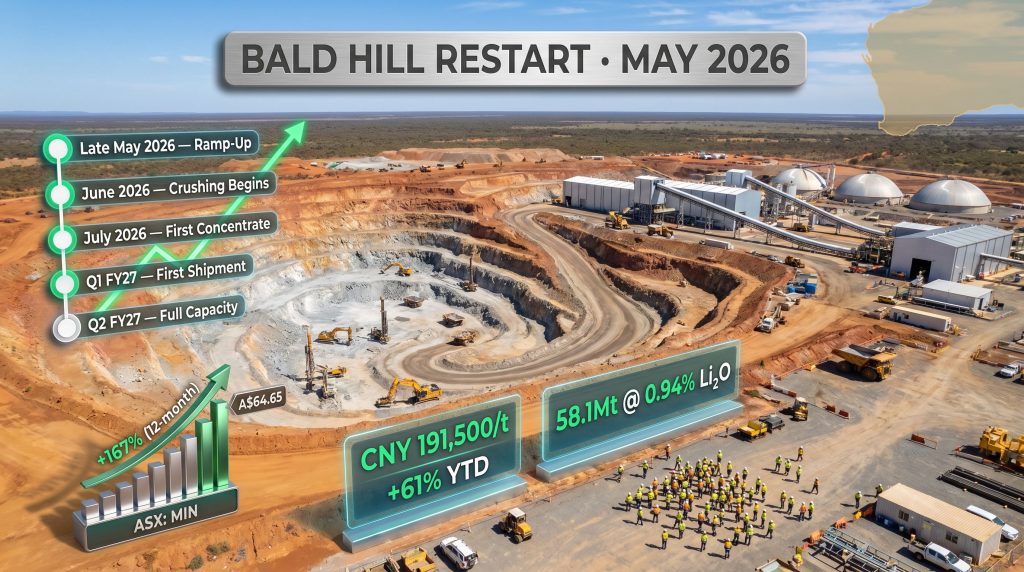
When the operation was placed into care and maintenance in November 2024, it held a resource base of 58.1 million tonnes at 0.94% lithium oxide (Li₂O). That is a substantial orebody by global hard-rock lithium standards, and retaining it in a dormant but preserved state while prices recovered was a deliberate capital management decision rather than a permanent closure.
Care and maintenance in mining refers to a state where a project is kept in a condition suitable for rapid restart, with essential equipment maintained, environmental compliance upheld, and a skeleton workforce managing site security and upkeep. It is fundamentally different from project abandonment, and the distinction matters enormously for investors assessing the value embedded in a mothballed asset.
What the Resource Grade Actually Means
A grade of 0.94% Li₂O is a meaningful figure within the context of Australian spodumene deposits. While it sits below some of the richer deposits in the Pilbara and Greenbushes regions, what matters operationally is the concentrate grade achievable after processing, not the raw ore grade alone. Furthermore, spodumene extraction techniques at Bald Hill's dual-stream processing configuration produce:
- Stream 1: Approximately 165,000 dry metric tonnes per annum (DMT/a) of 5.1% Li₂O spodumene concentrate
- Stream 2: An equivalent of approximately 140,000 DMT/a at 5.6% Li₂O spodumene concentrate
These grades are commercially significant. The global benchmark specification for spodumene concentrate typically sits at 6% Li₂O, but Chinese lithium hydroxide and carbonate converters routinely process material in the 5.1% to 5.6% range with price adjustments relative to benchmark. The ability to deliver two distinct concentrate specifications gives Bald Hill flexibility in targeting different downstream customer requirements.
The Lithium Price Recovery That Changed the Calculus
From Historic Trough to 61% Year-to-Date Gain
The lithium price story of 2023 to 2024 was one of the most severe commodity corrections in recent memory. Prices for both lithium carbonate and spodumene concentrate fell dramatically from their 2022 peaks, driven by a surplus of supply from new Australian and South American projects, slowing electric vehicle adoption growth in key markets, and a destocking cycle among Chinese battery manufacturers.
For Australian hard-rock producers, this created an acute problem: the high fixed costs of maintaining processing plant operations, combined with falling realised revenue per tonne of concentrate, pushed many operations into loss-making territory. Bald Hill was not alone in entering care and maintenance during this period.
By May 2026, however, the picture had shifted materially. Lithium carbonate pricing, as tracked by Trading Economics, had reached CNY 191,500 per tonne, representing a 61% increase year-to-date. That is a recovery rate that goes beyond seasonal fluctuation or short-term sentiment shifts. It reflects a structural realignment in supply-demand dynamics, driven by:
- Accelerating EV sales in China and Europe recovering from their 2024 slowdown
- Supply curtailments from multiple care-and-maintenance decisions across the Australian sector
- Restocking demand from battery cell manufacturers who had drawn down inventories during the downturn
- Longer lead times to restart mothballed capacity, tightening near-term supply availability
A 61% year-to-date price move in a commodity as volatile as lithium is not confirmation of a new supercycle. But it is a credible signal that the floor has been established and that the supply response to lower prices is now working through the system. For operators with low restart costs and existing infrastructure, that signal is sufficient to act.
The Upstream-Downstream Pricing Sequence
One lesser-understood dynamic in lithium markets is the timing relationship between upstream spodumene concentrate prices and downstream lithium carbonate or hydroxide prices. Spodumene, as the raw feedstock for hard-rock lithium processing, often signals directional changes in the broader market before they appear in refined chemical prices.
When Chinese converters begin competing more aggressively for spodumene cargoes, it typically indicates that downstream battery-grade chemical demand is improving. Mineral Resources specifically cited strengthening demand for spodumene concentrate as a driver of the restart decision, which is consistent with this upstream signal preceding a confirmed downstream recovery.
| Metric | Care and Maintenance Period (Nov 2024) | Restart Decision (May 2026) |
|---|---|---|
| Lithium Carbonate Price (CNY/t) | Depressed lows | ~CNY 191,500 |
| YTD Price Change | N/A | +61% |
| Bald Hill Status | Suspended | Restart confirmed |
| Spodumene Demand Signal | Weak | Strong recovery |
| Workforce | Skeleton crew | ~370 positions mobilised |
The Restart Timeline: Phase by Phase
One of the most commercially attractive aspects of the Mineral Resources Bald Hill lithium mine restart is the speed with which the operation can return to full production. Because infrastructure, processing equipment, and export logistics were preserved during the care-and-maintenance period, ramp-up timelines are compressed significantly compared to building a new operation from scratch.
The phased restart schedule confirmed by Mineral Resources runs as follows:
- Late May 2026 – Ramp-up activities commence, with site mobilisation, workforce deployment, and equipment recommissioning underway
- June 2026 – Crushing circuits and open-pit mining operations formally restart
- July 2026 – First spodumene concentrate production is expected from the processing plant
- Q1 FY27 – First spodumene concentrate shipment departs via the Port of Esperance
- Q2 FY27 – Full production capacity achieved across both processing streams
This timeline from first production to full capacity spans roughly two quarters, which is remarkably fast relative to greenfield project timelines that typically run three to five years from feasibility to first ore. The Port of Esperance export pathway is an established logistics corridor that has handled Bald Hill concentrate shipments previously, removing another potential bottleneck from the restart sequence.
Cost of Reactivation: A$20 Million
Mineral Resources has estimated restart costs at approximately A$20 million, with this expenditure expected to be recognised in the fourth quarter of FY26. This is classified as a one-time capital mobilisation cost rather than ongoing operational expenditure, and investors should assess it against the revenue potential of the operation at current spodumene pricing once full capacity is achieved.
Detailed FY27 guidance covering expected sales volumes, free-on-board (FOB) costs, and capital expenditure for Bald Hill is scheduled for release on 27 August 2026, which will serve as the primary financial benchmark for assessing the mine's contribution to Mineral Resources' overall earnings profile.
Workforce Strategy and Regional Economic Impact
The restart is projected to generate approximately 370 jobs, a figure that carries both operational and regional economic significance. Of these, roughly 110 positions will be filled through internal redeployment of workers from other Mineral Resources operations, while the remaining 260 new workers will involve external hires, backfill roles, and contractor engagements.
The decision to deploy a full workforce rather than a partial or phased crew deployment is itself a signal worth analysing. Companies that are uncertain about price sustainability in a restart scenario typically begin with reduced staffing and scale up contingent on market conditions. Committing to approximately 370 positions from the outset indicates management conviction that the price recovery has sufficient depth and durability to support full operational expenditure from the moment production resumes.
The internal redeployment component also carries a less obvious advantage: workers transferred from other Mineral Resources operations arrive with institutional knowledge of the company's systems, safety culture, and equipment, reducing both onboarding costs and the ramp-up risk associated with building a new workforce from scratch in a competitive labour market.
Three Hard-Rock Lithium Mines: A Globally Unique Position
Why This Distinction Matters Strategically
Upon the Bald Hill restart reaching full operation, Mineral Resources will hold a position that no other company globally can claim: the simultaneous operation of three separate hard-rock lithium mines, each with its own dedicated spodumene concentrate processing facility. This is not a marketing distinction. It has real operational and commercial implications.
Hard-rock lithium production, based on the extraction and processing of spodumene-bearing pegmatite ore, differs fundamentally from brine-based operations. Indeed, the contrast between hard-rock versus brine production is central to understanding why Australian producers hold a strategic advantage in responsiveness. Key differences include:
- Ramp-up speed: Hard-rock operations can scale production faster than brine evaporation systems, which require extended solar evaporation pond cycles
- Grade consistency: Spodumene ore tends to deliver more predictable concentrate grades than brine operations, which are subject to seasonal and geological variability
- Supply reliability: Hard-rock mines can respond to demand signals more quickly, making them preferred feedstock sources for converters managing just-in-time processing schedules
For a company operating three such facilities simultaneously, the commercial leverage is substantial:
| Operational Model | Single Asset Producer | Multi-Mine Operator (MIN) |
|---|---|---|
| Revenue Diversification | Low | High |
| Restart Flexibility | Limited | High (internal redeployment) |
| Offtake Negotiating Power | Moderate | Strong |
| Supply Continuity Risk | High | Reduced |
| Global Competitive Position | Standard | Unique (3 hard-rock mines) |
Multi-mine operators can blend concentrate grades across production streams to meet specific customer specifications, negotiate larger and longer-term offtake agreements with Chinese converters, and absorb temporary disruptions at one operation without losing supply continuity entirely. Furthermore, Australia's lithium sector continues to demonstrate its global importance through precisely these kinds of operationally sophisticated, multi-asset strategies.
The next major ASX story will hit our subscribers first
ASX: MIN Share Price Performance and Market Psychology
Reading the Market's Reaction
Mineral Resources shares traded at A$64.65 on the day the Bald Hill restart was confirmed, representing a gain of 0.86% on the session. Taken in isolation, that is a modest single-day move. However, the context is what makes it analytically interesting.
MIN shares had already delivered approximately 18% year-to-date gains in 2026 and a 167% return over the trailing 12-month period by the time the restart announcement landed. This pattern is characteristic of how equity markets process commodity recovery cycles: the share price tends to move well in advance of confirmed operational catalysts, reflecting probabilistic pricing of an expected recovery. When the operational confirmation arrives, the incremental gain is smaller because much of the re-rating has already occurred.
When a stock has already gained 167% over twelve months before a major operational announcement, the market is telling you it had already priced in the recovery thesis. The restart confirmation does not create the re-rating. It validates it, and shifts the focus to execution risk and earnings delivery.
For investors monitoring this situation, the 27 August FY27 guidance release will function as the next genuine valuation inflection point. Until then, the share price will largely trade on lithium price movements, broader commodity sentiment, and any operational updates from the ramp-up phase.
Key Risks Investors Should Not Overlook
Operational Execution Risk
Extended care-and-maintenance periods create genuine recommissioning risk. Equipment that has been idle for eighteen months or more requires thorough mechanical inspection, and processing plants can produce below-specification concentrate during initial production phases as operators calibrate reagent dosing, flotation circuits, and gravity separation systems. Investors should therefore treat the July 2026 first production target and Q2 FY27 full capacity projection as management estimates subject to revision.
Market and Pricing Risk
The same price dynamic that triggered the 2024 shutdown could re-emerge. Lithium markets remain structurally sensitive to Chinese policy shifts, EV adoption rates, and new supply entering the market from projects that may have been advanced during the recovery phase. A reversal in spodumene demand from Chinese converters, or an AUD/CNY currency movement that compresses realised revenue, could alter the economics of continued operation more quickly than management guidance suggests.
Financial Transparency Risk
Until the 27 August guidance release, investors lack visibility into Bald Hill's FOB cost structure, projected sales volumes, and capital requirements for FY27. The A$20 million restart cost estimate is a pre-operational figure that may require revision following full recommissioning assessment. Investors should also contextualise this expenditure within Mineral Resources' broader balance sheet position rather than assessing it as a standalone item.
This article contains general information only and does not constitute financial advice. Past share price performance is not indicative of future returns. Investors should conduct their own due diligence or consult a licensed financial adviser before making investment decisions related to ASX-listed securities.
Frequently Asked Questions: Mineral Resources Bald Hill Lithium Mine Restart
When will Bald Hill produce its first spodumene concentrate after the restart?
First spodumene concentrate production from the processing plant is targeted for July 2026, following the recommencement of crushing and open-pit mining in June 2026.
What is Bald Hill's annual production capacity?
The operation runs two processing streams with a combined output of approximately 165,000 DMT/a of 5.1% Li₂O spodumene concentrate and an equivalent of 140,000 DMT/a at 5.6% Li₂O.
How much will the restart cost?
Mineral Resources has guided to restart costs of approximately A$20 million, expected to be recognised in Q4 FY26.
Why was Bald Hill suspended in the first place?
The operation was placed into care and maintenance in November 2024 following a sustained deterioration in lithium prices that rendered continued production economically unviable. The decision was framed as a capital preservation strategy to retain the asset's long-term value.
When will detailed FY27 guidance be released?
Full guidance covering Bald Hill's expected sales volumes, FOB costs, and capital expenditure is scheduled for release on 27 August 2026.
What makes Mineral Resources unique in the global lithium sector after this restart?
Upon resuming full operations at Bald Hill, the Mineral Resources Bald Hill lithium mine restart positions the company as the only operator globally running three separate hard-rock lithium mines, each with its own dedicated spodumene concentrate processing facility.
Want to Know Which ASX Lithium Discovery Could Be the Next Major Opportunity?
Discovery Alert's proprietary Discovery IQ model scans ASX announcements in real time, delivering instant alerts on significant mineral discoveries — including lithium — so investors can identify actionable opportunities before the broader market catches on. Explore historic examples of exceptional mineral discovery returns and begin your 14-day free trial at Discovery Alert to position yourself ahead of the next major commodity cycle.