May 18, 2026
The Lithium Market Reset: What Mine Restarts Reveal About Where Prices Are Heading
Commodity cycles rarely move in straight lines, and nowhere has that been more visible over the past three years than in the global lithium market. Spodumene prices, which reached extraordinary highs during the electric vehicle demand surge of 2022 and early 2023, collapsed with equal ferocity as supply caught up and downstream inventory corrections spread through the battery supply chain. For Australia's hard-rock lithium producers, the response was predictable: suspend operations, protect the orebody, and wait for conditions to improve.
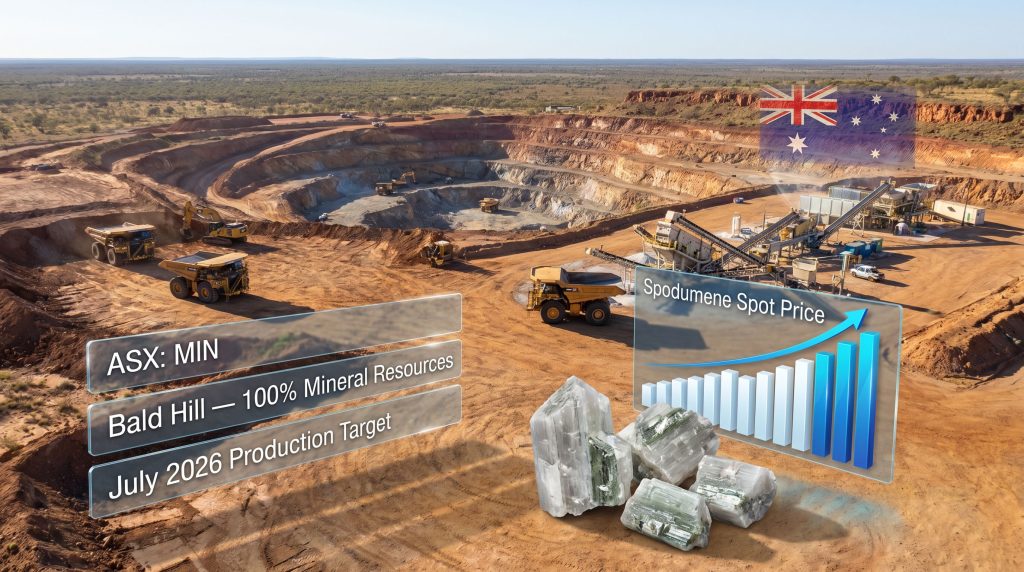
That waiting period now appears to be ending. The MinRes Bald Hill lithium mine restart is one of the clearest signals yet that producers believe the market floor is behind them, and that the economics of returning to production are beginning to stack up once more.
When big ASX news breaks, our subscribers know first
Understanding the Spodumene Price Cycle That Shaped This Decision
Spodumene concentrate, the primary feedstock for lithium chemical refining, became one of the world's most talked-about commodities during the EV boom. Prices for 6% Li₂O spodumene concentrate peaked at over USD $8,000 per tonne in late 2022 before entering a sustained correction that dragged values down by more than 90% at the lows. By mid-2024, spot prices had collapsed to levels that rendered a significant portion of Australia's hard-rock lithium production either marginal or deeply loss-making.
The response across Western Australia's lithium belt was swift and widespread. A series of high-profile operations entered care and maintenance status during 2024 and into 2025, including assets operated by some of the sector's largest players. The suspensions were not disorderly shutdowns but carefully managed transitions designed to preserve optionality, keeping ore bodies accessible and processing infrastructure intact for an eventual return.
What distinguishes a genuine price recovery from a temporary bounce is the alignment of several demand-side and supply-side forces simultaneously. On the demand side, EV penetration rates across key markets including China, Europe, and Southeast Asia continue to climb. On the supply side, the mothballing of Australian and other hard-rock producers has trimmed available concentrate supply in a way that gradually tightens the market balance. When those forces converge, restart decisions move from speculative to rational.
Spodumene is not a uniform product. Concentrate grade, typically expressed as percentage Li₂O content, directly affects the value realised at sale. The industry benchmark of 6% Li₂O concentrate commands a premium over lower-grade material, and assets capable of consistently producing at or above that threshold carry a structural advantage in a recovering market.
What Bald Hill Is, and Why It Occupies a Unique Position in the MinRes Portfolio
The Bald Hill lithium mine is located approximately 100 kilometres east of Kambalda in the Eastern Goldfields region of Western Australia, within the broader Widgiemooltha greenstone belt. The site hosts a spodumene-bearing pegmatite deposit, and its processing plant is configured to produce spodumene concentrate as a direct-shipping product.
Critically, Mineral Resources (ASX: MIN) holds 100% ownership of Bald Hill. This is a structurally different position from the company's other major lithium operations. Wodgina is operated as a joint venture with global lithium giant Albemarle, while Mt Marion is held in partnership with Chinese lithium chemicals producer Ganfeng Lithium. Both of those joint ventures require partner alignment before any significant operational changes can be implemented.
Bald Hill requires no such consensus. MinRes can make restart, curtailment, or expansion decisions unilaterally, giving it a degree of operational agility that is genuinely uncommon for assets of this scale in Western Australia.
How Bald Hill Compares to Its Stablemates
| Asset | MinRes Ownership | JV Partner | Current Status (Mid-2026) |
|---|---|---|---|
| Bald Hill | 100% | None | Care & Maintenance, restart pending |
| Wodgina | ~50% | Albemarle | Active, FY26 guidance upgraded |
| Mt Marion | ~50% | Ganfeng Lithium | Active, FY26 guidance upgraded |
Both Wodgina and Mt Marion have benefited from MinRes' FY26 production guidance upgrade following a solid third quarter, providing a cash flow foundation that supports the capital allocation decisions now being made around Bald Hill.
Why Bald Hill Was Suspended, and How the Asset Was Preserved
The suspension of Bald Hill was a direct consequence of the lithium market downturn. When the cost of producing each tonne of concentrate exceeds the revenue that tonne generates, continued operation becomes a value-destructive exercise. MinRes made the decision to place Bald Hill into care and maintenance rather than absorb ongoing operational losses.
The workforce impact was significant. Approximately 300 employees were affected by the suspension, with MinRes reportedly prioritising internal redeployment across its broader portfolio rather than mass redundancies. That approach serves two purposes: it retains skilled workers familiar with the operation, and it reduces the rehiring and retraining burden when a restart becomes viable.
What is less widely understood is the technical discipline required to maintain a mine in a genuinely restart-ready condition. Care and maintenance is not simply locking the gates. It involves:
- Ongoing corrosion prevention and mechanical preservation of processing plant equipment
- Regular inspection and testing of electrical and control systems
- Maintenance of site drainage and groundwater management to prevent orebody deterioration
- Preservation of reagent storage and handling infrastructure
- Periodic operation of key equipment to prevent seizure and mechanical degradation
This level of ongoing investment during a period of zero revenue reflects a deliberate strategic choice. MinRes effectively paid an insurance premium throughout the downturn to retain the ability to restart quickly when market conditions warranted it.
The Restart Mechanics: From Decision to First Tonne
One of the most commercially significant aspects of the MinRes Bald Hill lithium mine restart is the compressed timeframe between the restart decision and first production. Management has indicated a ramp-up window of approximately four to six weeks from the decision point to active production, with a July 2026 production target in view.
That timeline is achievable because of the care and maintenance discipline described above, but it is not without sequencing complexity. A realistic restart involves the following stages:
- Plant recommissioning: Systematic testing and reactivation of crushing, screening, dense media separation, and flotation circuits within the processing facility.
- Infrastructure restoration: Reactivation of the accommodation village, water supply, power generation, and fuel storage systems to support an operational workforce.
- Workforce mobilisation: Recalling internally redeployed workers and initiating targeted external recruitment to fill gaps, particularly in trades and plant operations roles.
- Mining equipment recommissioning: Returning mobile fleet including excavators, haul trucks, and ancillary equipment to operational status after extended standby.
- Production ramp: Gradual throughput escalation from initial commissioning tonnes to nameplate capacity, with quality monitoring to ensure concentrate grades meet customer specification.
The four-to-six-week estimate applies to the transition from decision to first ore through the plant. Reaching nameplate throughput and stable production rates takes additional time and is influenced by workforce availability and ore feed consistency.
Restart Economics: The Variables MinRes Is Weighing
No publicly listed company restarts a mothballed mine without a rigorous internal economics review. The key variables at play in the Bald Hill restart decision span both the revenue and cost sides of the ledger.
| Variable | Commercial Significance |
|---|---|
| Spodumene spot price | Determines revenue per dry metric tonne of concentrate shipped |
| Operating cost per tonne | Sets the cash breakeven and margin threshold |
| Concentrate grade (% Li₂O) | Higher grade material commands a price premium at sale |
| Workforce cost and availability | Influences both ramp speed and ongoing operating cost |
| Logistics and port access | Affects net realised price after transport and handling |
| MinRes debt position | Shapes the urgency and scale of cash generation required |
MinRes has been managing a significant debt reduction programme following a period of aggressive capital investment across its iron ore and lithium operations. A recovering spodumene price environment, combined with operational improvements at Wodgina and Mt Marion, has started to rebuild the financial headroom that makes a Bald Hill restart more executable from a balance sheet perspective.
The strategic logic of restarting a 100%-owned asset in a rising market is particularly compelling because every dollar of operating margin flows directly to MinRes without dilution through a joint venture structure. This full economic capture dynamic makes the timing of the Bald Hill restart disproportionately impactful relative to the mine's scale.
The next major ASX story will hit our subscribers first
What Market Analysts Are Modelling for Bald Hill
Broker analysis has engaged directly with the Bald Hill restart question. Jefferies, in its coverage of Mineral Resources, has modelled a second quarter of FY2027 as a plausible restart window based on its assumptions around spodumene price recovery trajectories and MinRes' financial position. That framing is slightly more conservative than the company's own July 2026 production target, reflecting the caution analysts typically apply to restart timelines in the mining sector.
For the July 2026 target to hold, a specific set of conditions needs to remain aligned:
- Spodumene prices must stay at or above levels that justify variable operating costs
- The workforce mobilisation and plant recommissioning must proceed without material delays
- MinRes' broader balance sheet must remain stable enough to absorb the working capital requirement of a production restart before first revenue is received
The downside risks are real but manageable. A renewed price softness driven by Chinese battery inventory builds, a delay in workforce mobilisation in a tight WA labour market, or unexpected equipment issues during recommissioning could each push the timeline toward the more conservative analyst estimate.
Australia's Lithium Supply Recovery: Where Bald Hill Fits
The MinRes Bald Hill lithium mine restart does not exist in isolation. It is one component of a broader potential recovery in Australian lithium supply that could reshape the global spodumene market balance through FY2027 and beyond. Furthermore, advances in lithium extraction technology continue to improve the economics of hard-rock operations across the region.
Australia remains the world's largest producer of spodumene concentrate by volume, with Western Australia's Pilbara and Goldfields regions hosting the majority of global hard-rock lithium production capacity. When Australian producers collectively suspend and then restart, the effect on global supply is material.
Several other Western Australian lithium assets remain in care and maintenance as of mid-2026, and their restart sequencing will follow a broadly similar logic to Bald Hill's: prices need to recover sufficiently, asset readiness needs to be confirmed, and financing conditions need to support the working capital requirement.
The order in which these assets return matters for the market. Assets with lower operating costs, higher concentrate grades, single-owner decision-making structures, and preserved infrastructure will restart first, absorbing available market demand before higher-cost operations become viable. Bald Hill's single-ownership structure and maintained readiness position it favourably in that sequencing.
The Broader Strategic Picture for Mineral Resources
For MinRes as a business, the Bald Hill restart is not simply an operational decision. It intersects with the company's ongoing effort to reduce its debt load, optimise its asset portfolio, and demonstrate to the market that its lithium business retains genuine upside leverage to a recovering commodity cycle. In addition, underground lithium mining developments elsewhere in Western Australia are reinforcing broader confidence in the sector's long-term trajectory.
A successful Bald Hill restart would add a third active lithium production stream to the MinRes portfolio alongside Wodgina and Mt Marion, all contributing cash flow toward the company's debt reduction objectives. The fact that Bald Hill contributes 100% of its margin to MinRes rather than sharing it with a joint venture partner amplifies this contribution per tonne produced.
It also signals something important about MinRes' operational capability. Executing a rapid restart of a previously suspended mine requires logistical coordination, workforce management, and technical execution across multiple departments simultaneously. A clean restart would reinforce the company's credibility with investors who have been watching its broader financial stabilisation programme closely. Consequently, industry observers are tracking how MinRes and its peers sequence their return to full production.
Frequently Asked Questions: MinRes Bald Hill Lithium Mine Restart
When is Bald Hill expected to restart production?
MinRes has targeted July 2026 for first production following the restart decision, with a four-to-six-week ramp timeline from decision to initial output.
How many workers will be needed when Bald Hill resumes operations?
The site previously supported approximately 300 employees. Workforce requirements for the restart are likely to reflect a similar operational scale, with MinRes prioritising the recall of previously redeployed workers.
What spodumene price makes Bald Hill economically viable?
MinRes has not publicly disclosed a specific breakeven price for Bald Hill. The viability threshold depends on the combination of operating cost per tonne and the concentrate grade achieved, alongside logistics costs.
Is Bald Hill a joint venture or wholly owned by MinRes?
Bald Hill is 100% owned by Mineral Resources, giving the company full operational and strategic control without requiring partner approval for restart or curtailment decisions.
How does the Bald Hill restart affect MinRes' FY26 and FY27 production guidance?
The restart contributes incremental spodumene production volume to MinRes' portfolio. Jefferies has modelled a 2Q FY2027 restart scenario, while MinRes itself targets July 2026 production, making the restart's contribution most significant in FY27.
What happened to the 300 employees when Bald Hill was suspended?
MinRes prioritised internal redeployment across its broader operations rather than widespread redundancies, a workforce management approach that also serves the practical purpose of retaining skilled personnel for an eventual restart.
Key Takeaways at a Glance
- Ownership: 100% Mineral Resources (ASX: MIN), enabling unilateral restart decisions without joint venture partner alignment
- Suspension trigger: Prolonged spodumene price weakness through 2024, rendering operations cash-negative
- Workforce impact: Approximately 300 employees affected, with redeployment across MinRes' broader portfolio prioritised
- Restart ramp time: Estimated four to six weeks from decision to first production, enabled by rigorous care and maintenance discipline during the suspension
- Production target: July 2026, with Jefferies modelling a more conservative 2Q FY2027 scenario
- Strategic advantage: Full economic capture of margin without JV dilution, combined with a preserved, restart-ready asset
- Market signal: One of the first indicators of a broader Australian lithium supply recovery as spodumene prices stabilise and improve
This article is for informational purposes only and does not constitute financial advice. Statements regarding production timelines, price forecasts, and analyst modelling involve forward-looking assumptions that may not be realised. Investors should conduct their own due diligence before making investment decisions.
Want to Stay Ahead of the Next Major ASX Lithium Discovery?
Discovery Alert's proprietary Discovery IQ model scans ASX announcements in real time, instantly identifying significant mineral discoveries across lithium and more than 30 other commodities — so subscribers can act before the broader market catches on. Explore what major mineral discoveries have historically returned by visiting Discovery Alert's dedicated discoveries page, and begin your 14-day free trial today to position yourself at the forefront of the next big find.