May 18, 2026
Europe's Battery Supply Chain Has a Structural Problem — and Finland May Hold Part of the Answer
The global race to secure battery-grade lithium has exposed a fundamental weakness in Europe's industrial architecture. While China controls the dominant share of lithium processing capacity and the United States has moved aggressively through the Inflation Reduction Act to subsidise domestic critical mineral production, Europe has largely relied on policy declarations rather than operational assets. That gap between ambition and execution is precisely what makes the Sibanye Keliber lithium project in Finland so strategically consequential — and so commercially complex.
Understanding Keliber requires more than reading a project summary. It demands an examination of lithium market mechanics, the realities of vertical integration in battery metals, the contested territory of EU industrial policy, and the genuine execution risks that separate a well-constructed mine from a well-functioning business.
When big ASX news breaks, our subscribers know first
The Geology and Geography Advantage: Why Finland Is Not an Accident
Finland's Central Ostrobothnia region sits atop a Precambrian geological formation known as the Kaustinen lithium pegmatite district, one of Europe's most significant hard-rock lithium endowments. Spodumene extraction, the primary process at Keliber, involves lithium-bearing minerals found within pegmatite intrusions, producing battery-grade lithium hydroxide monohydrate (LiOH·H₂O) — the preferred cathode precursor for high-energy-density NMC battery chemistries used in electric vehicles.
Unlike lithium brine production, which dominates South American output and requires large evaporation ponds and extended processing times, hard-rock spodumene operations offer faster response to demand signals and more predictable product quality. This geological distinction matters to battery manufacturers, who require consistent feedstock chemistry for cathode active material production.
Finland also offers advantages that extend beyond what is underground. The country ranks among the most stable regulatory jurisdictions in the world, operates within the EU's legal and environmental framework, and has an existing industrial chemicals infrastructure through the port city of Kokkola — where Keliber's lithium hydroxide refinery has been constructed. The co-location of refining capacity within an established industrial cluster is not incidental; it reduces logistics costs, provides access to skilled labour, and creates proximity to potential European battery manufacturing customers.
What Vertical Integration Actually Delivers — and What It Demands
The term "integrated producer" is used frequently in mining, but its economic implications are often underappreciated. In the context of the Sibanye Keliber lithium project in Finland, integration means the operation spans two fundamentally different industrial processes:
- Stage 1 — Spodumene concentration: Run-of-mine ore is crushed, processed through dense media separation and flotation circuits, and upgraded into spodumene concentrate, typically grading around 6% lithium oxide (Li₂O). This is a conventional hard-rock mining and beneficiation process.
- Stage 2 — Lithium hydroxide conversion: Spodumene concentrate is roasted at high temperatures to convert it from alpha-spodumene to gamma-spodumene (a process called decrepitation), then leached with sulphuric acid, purified through multiple stages, and crystallised into battery-grade LiOH·H₂O. This is a chemical manufacturing process requiring entirely different engineering competencies, reagent supply chains, and quality control systems.
The distinction is critical because Stage 2 is where most of the margin in the lithium value chain is captured — but it is also where most of the execution complexity resides. Battery manufacturers purchasing lithium hydroxide apply rigorous qualification processes to new supply sources, testing product consistency across multiple parameters including particle size distribution, impurity profiles, and moisture content.
Sibanye-Stillwater has indicated that its internal estimate for product qualification of spodumene concentrate runs at approximately six to nine months. However, RBC Capital Markets analyst Ben Davis noted after a site visit that at least one comparable European operation experienced a qualification timeline of approximately two years. That gap between internal estimates and market precedent represents a genuine — and frequently underpriced — execution risk.
Capital Deployed, Financing Architecture, and the Construction Timeline
The total capital invested in building Keliber from a greenfield position reaches approximately R18.9 billion, making it one of the largest single mining investments in European recent history. The project was developed over roughly five years — a compressed timeline by global mining standards, particularly within a high-regulatory European jurisdiction where environmental permitting and community engagement processes are thorough.
The financing structure is multi-layered:
| Financing Source | Contribution | Nature |
|---|---|---|
| European Investment Bank (EIB) | €150 million (part of €500 million facility) | Debt |
| Finnish Minerals Group | 20% equity stake + pro-rata participation | Equity |
| Sibanye-Stillwater | Majority ownership and project operation | Equity / balance sheet |
The Finnish Minerals Group's 20% stake reflects Finland's strategic interest in retaining domestic participation in critical mineral assets. The EIB facility provides concessional financing that partially offsets the risk premium associated with a new commodity in a new jurisdiction for Sibanye-Stillwater. However, the project has received limited early-stage EU financial support beyond this — a point noted by analysts examining the gap between Keliber's designation as an EU Strategic Project under the Critical Raw Materials Act and the tangible financial backing it has attracted.
Lithium Price Dynamics: The Variable That Governs Everything
No analysis of Keliber is complete without a frank assessment of where lithium prices have been, where they are now, and what they need to do. According to Bloomberg's global commodity lithium index, prices were elevated during Keliber's early planning and construction phases, before declining by more than 50% between mid-2023 and the end of 2024. That collapse was driven by a combination of aggressive capacity additions from Chinese lepidolite and brine producers, demand softness in European EV markets, and inventory destocking across the battery supply chain.
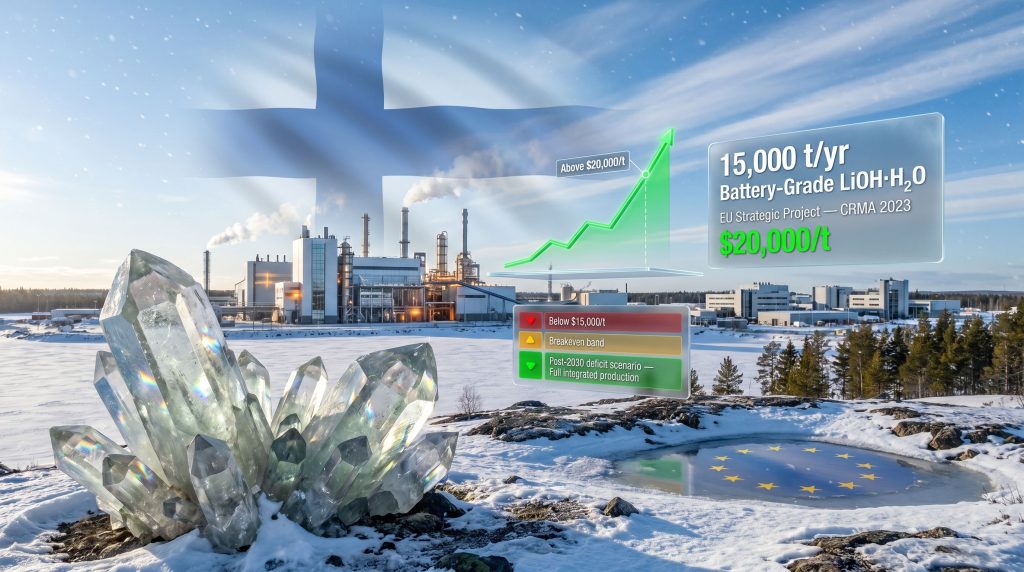
The recovery in 2025 has been meaningful, with prices moving above $20,000 per tonne — a level that analysts broadly associate with profitable production from Stage 1 operations at Keliber. However, Stage 2 refinery economics require sustained pricing at higher levels or greater certainty of future price trajectory before the capital and operational costs of lithium hydroxide conversion can be justified.
| Price Scenario | Stage 1 Viability | Stage 2 Viability | Strategic Posture |
|---|---|---|---|
| Below $15,000/t | Marginal to loss-making | Unviable | Capital preservation |
| $15,000 to $20,000/t | Breakeven to modest profit | Uncertain | Staged approach retained |
| Above $20,000/t | Profitable | Approaching viability | Potential acceleration |
| Post-2030 structural deficit | Strong | Fully viable | Full integrated production rationale |
Sibanye-Stillwater's internal modelling, as communicated by CEO Richard Stewart, assumes a broadly balanced lithium market through the near term, with a structural deficit emerging from approximately 2030 onward as demand from the EV, stationary storage, and grid sectors outpaces supply additions. If that deficit thesis proves accurate, first-mover integrated producers in stable jurisdictions — precisely what Keliber is designed to be — will hold significant pricing and offtake leverage.
This is a speculative projection, and investors should treat long-range commodity forecasts with appropriate scepticism. Furthermore, demand curves for lithium are sensitive to battery chemistry evolution; the ongoing shift toward lithium iron phosphate (LFP) chemistries in some vehicle segments uses lithium carbonate rather than lithium hydroxide, which could affect the specific product mix dynamics at Keliber's refinery.
The EU Floor Price Question: Sound Policy Logic, Uncertain Political Reality
One of the more distinctive aspects of Sibanye-Stillwater's commercial strategy around Keliber involves its active advocacy for an EU-level price floor mechanism for lithium, modelled on the support framework that the US government has extended to its domestic rare earths industry.
The US precedent is instructive. Washington established a price guarantee for prominent domestic rare earths producer MP Materials at $110 per tonne, ensuring the operation remains economically viable even when Chinese state-subsidised production undercuts market prices. China's influence over both rare earth and lithium pricing through subsidised production capacity represents a structural threat to any Western producer operating at commercial cost structures.
Sibanye-Stillwater's proposal frames a similar mechanism as a tool for de-risking investment across Europe's critical minerals supply chain at scale. The logic is coherent: without price certainty, the cost of capital for European lithium projects remains elevated, discouraging the upstream investment the EU's own CRMA targets require.
However, analyst conviction on this outcome is low. RMB Morgan Stanley analysts Brian Morgan and Christopher Nicholson have stated in a published report that they hold limited confidence in Sibanye-Stillwater's ability to secure floor pricing or comparable EU incentives, citing the lack of meaningful progress to date.
The structural barriers are real:
- The EU lacks a unified critical minerals procurement mandate comparable to US Defence Production Act mechanisms
- Member state industrial policy fragmentation creates competing priorities around any centralised support framework
- The European critical raw materials targets for domestic extraction (10%) and processing (40%) have not been matched by dedicated financing or procurement instruments
- The bloc has been notably slow to adapt policy to mineral demand spikes, including for defence-related materials
RBC Capital Markets analyst Ben Davis has noted that while markets remain naturally sceptical that the EU will match the proactive approaches taken by the US and China in critical minerals supply chain security, the current geopolitical environment may represent the most conducive moment for decisive policy action that Europe has yet encountered.
The next major ASX story will hit our subscribers first
Keliber Within Sibanye-Stillwater's Portfolio Resilience Architecture
Evaluating the Sibanye Keliber lithium project in Finland in isolation misses an important dimension of how management frames its strategic value. Sibanye-Stillwater has been executing a deliberate diversification away from its historical identity as a South Africa-centric precious metals miner, building a portfolio that spans geographies and commodity exposure.
The offshore and battery metals portfolio now includes:
- Keliber (Finland): Long-duration lithium exposure through an integrated mine-to-refinery model
- Stillwater (USA): Palladium-dominant PGM production targeting all-in sustaining costs of $1,000 per ounce, structured to be financially independent of US government subsidies
- US recycling operations: Processing end-of-life catalytic converters and battery materials, increasingly recognised by analysts as a more resilient revenue stream than previously modelled
BMO Capital Markets analyst Raj Ray has observed that the US recycling business is demonstrating higher quality and resilience characteristics than earlier assessments had assumed, while the US PGM operation appears positioned for cyclical recovery following a period of operational reset.
The near-term financial picture remains nuanced. Sibanye-Stillwater's earnings recovery for the twelve months to end-December — which enabled dividend reinstatement — was driven primarily by South African platinum and gold operations rather than the offshore portfolio. Management's argument is that the international and battery metals assets remain undervalued by the market, a thesis that requires execution milestones at Keliber and Stillwater to become investable catalysts.
As Raj Ray noted, while the long-term strategic rationale for the international portfolio is clear, ramp-up and execution risks continue to represent a near-term cash drag, with improved pricing across PGM, gold, and lithium providing the buffer needed as the broader asset base matures.
Key Risks Investors Should Independently Assess
Execution Risk
- Product qualification timelines for spodumene concentrate could extend well beyond the six-to-nine-month internal estimate, delaying revenue generation
- The gap between nameplate production capacity and actual output during ramp-up is a universal challenge in greenfield hard-rock mining
- Stage 2 refinery activation remains contingent on price signal confirmation, creating revenue model uncertainty
Market and Commodity Risk
- Lithium price volatility has proven severe; a return to sub-$15,000/t levels would pressure Stage 1 economics materially
- Battery chemistry evolution toward LFP formulations could structurally reduce demand for lithium hydroxide specifically; in addition, direct lithium extraction technologies are maturing rapidly and may further reshape competitive dynamics
- Chinese state-subsidised production capacity can re-enter markets rapidly if prices rise, capping upside
Policy Risk
- The EU floor price mechanism remains speculative with no confirmed implementation timeline
- CRMA target ambitions have consistently outpaced policy execution instruments
- Shifts in EU-China trade relations introduce unpredictable variables into the regulatory environment
Financial Risk
- The R18.9 billion capital base is denominated in South African rand, creating translation exposure against euro-denominated revenues
- EIB facility terms and Finnish Minerals Group participation conditions add structural complexity to ongoing capital management decisions
This analysis is provided for informational purposes only and does not constitute financial advice. Commodity price forecasts and project timelines involve significant uncertainty. Investors should conduct independent due diligence before making any investment decisions.
Frequently Asked Questions: Sibanye Keliber Lithium Project in Finland
What is the Keliber lithium project?
Keliber is a vertically integrated lithium mining and refining operation in Central Ostrobothnia, western Finland. Developed by Sibanye-Stillwater, it is designed to produce battery-grade lithium hydroxide monohydrate from Finnish spodumene pegmatite ore, positioning it as Europe's first mine-to-refinery lithium operation.
What is Keliber's designed production capacity?
The project is designed to produce approximately 15,000 tonnes per year of battery-grade lithium hydroxide monohydrate, with an operational lifespan projected at a minimum of 18 years.
When will Keliber produce first lithium concentrate?
Stage 1 spodumene concentrate production is targeted for commencement in the third quarter of 2026. Stage 2 refinery activation is expected around 2028, subject to lithium price recovery to levels that support conversion economics. According to a recent Keliber update, construction progress has remained broadly on schedule ahead of these milestones.
Who co-owns Keliber alongside Sibanye-Stillwater?
Finnish Minerals Group holds a 20% equity stake and has committed to participating in additional financing rounds on a pro-rata basis. The European Investment Bank has approved €150 million in debt financing as part of a broader €500 million facility.
The Bellwether Dimension: What Keliber's Trajectory Signals for European Critical Minerals Policy
Beyond its commercial significance, the Sibanye Keliber lithium project in Finland functions as a live test of whether European critical minerals policy can translate from legislative text into operational reality. The CRMA's targets are clear on paper. The investment, the infrastructure, and the geological endowment exist in Finland. What remains unresolved is whether EU policy instruments will evolve quickly enough to support the economics of projects like Keliber during the critical ramp-up phase — before the projected post-2030 lithium market deficit arrives to provide its own commercial justification.
For investors, the monitoring framework is relatively clear. Key inflection points include:
- Cold commissioning milestones through Q1 2026 and concentrate production commencement in Q3 2026
- Product qualification outcomes for spodumene with European battery manufacturers
- Lithium price trajectory relative to the $20,000/t threshold for Stage 1 profitability and higher levels for Stage 2 viability
- Any concrete EU policy development related to floor pricing or procurement mechanisms for critical minerals
- Stage 2 refinery activation decision, currently projected around 2028
Keliber is simultaneously a mining project, a supply-chain instrument, and a policy experiment. Its outcome over the next three to five years will carry implications well beyond the balance sheet of one South African diversified miner — consequently shaping how European governments, battery manufacturers, and investors think about the feasibility of building sovereign critical mineral capacity in a jurisdiction where the regulatory environment is stable but the commercial support architecture remains a work in progress.
Want to Know Which ASX Mineral Discoveries Could Deliver Returns Like Europe's Critical Minerals Race?
Discovery Alert's proprietary Discovery IQ model scans ASX announcements in real time, delivering instant alerts on significant mineral discoveries — including battery metals critical to the energy transition — so subscribers can identify actionable opportunities ahead of the broader market. Explore how major discoveries have historically generated exceptional returns on Discovery Alert's dedicated discoveries page, and begin your 14-day free trial today to position yourself at the forefront of the next significant find.