May 17, 2026
The Technology Rewriting Lithium's Future: Why Selective Ion Extraction Changes Everything
The global battery supply chain has spent the better part of two decades wrestling with a fundamental tension: lithium is abundant, yet reliably accessible lithium at the speed and scale modern electrification demands remains elusive. Conventional production methods, whether blasting open-pit spodumene mines in Western Australia or waiting eighteen months for Chilean evaporation ponds to concentrate sun-dried brine, were designed for a world where lithium demand grew incrementally. That world no longer exists.
What is emerging in its place is a processing philosophy built around selectivity rather than brute-force extraction, and nowhere is that philosophy advancing more concretely than in the sedimentary basin country of Saskatchewan, Canada. Prairie Lithium direct lithium extraction Saskatchewan represents one of the most technically advanced brine lithium initiatives currently approaching commercial production anywhere in North America, and understanding why requires looking closely at both the technology and the geology beneath the Canadian prairies.
When big ASX news breaks, our subscribers know first
How Direct Lithium Extraction Actually Works at a Molecular Level
Understanding why Prairie Lithium direct lithium extraction Saskatchewan matters begins with grasping how DLE differs from anything that came before it. At its core, direct lithium extraction technology exploits the electrochemical uniqueness of lithium ions. Lithium carries a distinctive ionic radius and charge density that allows specifically engineered sorbent materials, most commonly lithium manganese oxide or lithium iron phosphate frameworks, to selectively bind lithium from complex brine solutions while rejecting competing ions like sodium, magnesium, calcium, and potassium.
This selectivity is not incidental. Brines, particularly those found in sedimentary basins, contain dozens of dissolved minerals, and the ratio of competing ions to lithium can be enormous. A brine might contain fifty or sixty times more sodium than lithium by mass. A non-selective membrane or evaporation process would either fail to concentrate lithium meaningfully or would require extraordinary energy input to separate it from the ionic noise. DLE's selective adsorption mechanism sidesteps this problem almost entirely.
Three Core DLE Mechanisms Compared
| DLE Technology Type | Mechanism | Recovery Rate | Processing Time | Key Advantage |
|---|---|---|---|---|
| Ion Exchange (IX) | Selective resin binding | 80-95%+ | Hours to days | High selectivity |
| Adsorption (LIS) | Lithium manganese oxide sorbents | 85-95%+ | Hours | Proven at scale |
| Solvent Extraction | Organic solvent selectivity | 70-90% | Variable | Flexible feed grades |
| Membrane Filtration | Nanofiltration/electrodialysis | 60-85% | Continuous | Low chemical input |
The practical consequence of these recovery rates is significant. At 95% lithium recovery with 99% rejection of key contaminants, a DLE column is not merely concentrating lithium — it is producing a remarkably clean lithium eluate that requires substantially less downstream purification than the impurity-laden slurries generated by conventional extraction. Standard Lithium's Arkansas facility has independently demonstrated exactly these metrics, reporting the successful processing of approximately one million barrels of brine at 95% or greater lithium recovery rates, providing a real-world validation benchmark that Saskatchewan developers can point to directly.
Technical Insight: The 99% contaminant rejection figure is particularly consequential for downstream battery-grade processing. Magnesium removal is historically one of the most energy-intensive and costly steps in lithium refinery operations. DLE's ability to reject magnesium at the point of extraction fundamentally reduces refinery complexity and cost.
What Saskatchewan's Geology Offers That Most Lithium Basins Cannot
Saskatchewan's strategic position in the global lithium conversation derives not merely from the presence of lithium-bearing brines but from the extraordinary informational infrastructure that sits above those brines. The province's Williston Basin and adjacent sedimentary sequences have been the subject of intensive petroleum exploration and production activity for over seventy years.
That history means subsurface characterisation in Saskatchewan is orders of magnitude more advanced than in most greenfield lithium jurisdictions. Thousands of legacy oil and gas wells have penetrated the same formations that host lithium brine extraction operations, generating core samples, pressure records, brine chemistry assays, and reservoir flow data across a geographic spread that would require decades and billions of dollars to replicate from scratch. For DLE developers, this pre-existing knowledge base is transformative.
Saskatchewan's Lithium Brine Resource Characteristics
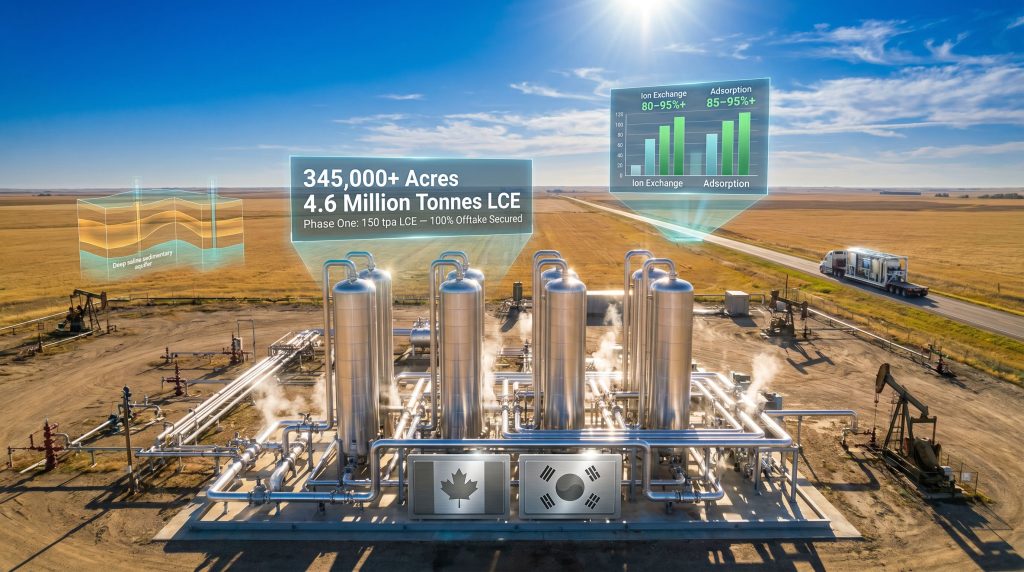
- Total project area under development: 345,000+ acres across the Saskatchewan sedimentary basin
- Estimated resource base: approximately 4.6 million tonnes lithium carbonate equivalent (LCE)
- Brine type: Deep saline formation water hosted within sedimentary lithium deposits of the Williston Basin
- Infrastructure advantage: Existing oilfield pipelines, brine handling equipment, pressure management systems, and drilling rigs available for repurposing at materially lower capital cost than greenfield construction
- Regulatory maturity: Phase one production has received full permitting approval, distinguishing it from many competing North American DLE projects still navigating multi-year environmental assessment processes
There is an additional geological subtlety worth understanding. Unlike hard-rock deposits where grade is fixed at the time of mining, brine reservoirs are dynamic systems. Depleted brine can be re-injected to maintain reservoir pressure, and in some formations, natural recharge mechanisms mean the productive life of a brine well can extend far beyond what static resource calculations suggest. Furthermore, this reservoir management dimension, familiar to any petroleum engineer, is genuinely novel in lithium extraction and gives Saskatchewan projects a production sustainability profile that hard-rock mines simply cannot replicate.
Lesser-Known Geological Insight: Saskatchewan formation brines are what petroleum geologists classify as connate water, meaning they are ancient seawater that has been trapped within sedimentary pore spaces for geological timescales, often hundreds of millions of years. During this confinement, geochemical processes have concentrated lithium through mineral dissolution and ion exchange reactions within the rock matrix, producing naturally elevated lithium concentrations without any anthropogenic intervention. This geological enrichment mechanism is fundamentally different from the surface evaporite processes that formed South American Lithium Triangle deposits.
The Scale Argument: Why Four DLE Columns Change the Commercial Calculus
Prairie Lithium's phase one DLE unit consists of four commercial-scale columns operating as an integrated system. This configuration is approximately four times the column capacity of the single commercial-scale DLE installation operating at Standard Lithium's Arkansas project, which itself represents one of the most technically validated DLE operations currently in existence.
The significance of this scale differential extends well beyond simple throughput arithmetic.
DLE Scale Comparison: North American Commercial Installations
| Project | Location | DLE Columns (Commercial Scale) | Brine Processed (Reported) | Li Recovery Rate |
|---|---|---|---|---|
| Standard Lithium Arkansas | Arkansas, USA | 1 column | ~1,000,000 barrels | 95%+ |
| Prairie Lithium Phase One | Saskatchewan, Canada | 4 columns | Commissioning Q4 2026 | Target: 95%+ |
Running four columns in parallel rather than sequentially achieves several distinct operational objectives:
- Throughput multiplication: Four columns process proportionally greater brine volumes, directly accelerating the path to nameplate production capacity
- Operational redundancy: If one column requires maintenance or sorbent regeneration, the remaining three continue producing, eliminating the complete production shutdowns that would affect a single-column configuration
- Performance data richness: Four columns operating simultaneously under varying feed conditions generate comparative performance datasets that are genuinely novel in the DLE field, accelerating process optimisation
- Revenue path acceleration: Higher throughput from day one means faster attainment of the production volumes required to fulfil binding offtake commitments
- Scale-up de-risking: Demonstrating integrated multi-column performance at phase one directly informs the engineering design for subsequent production expansion phases
A less commonly appreciated point is that DLE sorbent materials degrade over operational cycles. Understanding degradation rates, regeneration requirements, and replacement intervals across four parallel columns operating under real Saskatchewan brine conditions will generate proprietary process knowledge that cannot be obtained from desktop studies or laboratory pilots. This operational intelligence compounds in value as the project scales.
Factory Acceptance Testing: The Engineering Gateway Between Fabrication and Field
Factory acceptance testing, or FAT, is a formal engineering verification process conducted at the equipment manufacturer's facility before the physical asset moves to its operational site. For a capital-intensive DLE installation, FAT represents the contractual and technical inflection point between the fabrication phase and the field deployment phase. According to Prairie Lithium's investor announcements, the FAT process has been a pivotal milestone in advancing the project towards first production.
The FAT Process: Step-by-Step
- Mechanical completion verification confirming all components have been fabricated to engineering specifications and dimensional tolerances
- Pressure and leak testing validating structural integrity of vessels, pipework, and column housings under simulated operating conditions
- Instrumentation and control loop checks ensuring all sensors, flow meters, automated valves, and programmable logic controllers function correctly and communicate with the central control system
- Process simulation runs cycling the unit through operational sequences using water or synthetic brine to verify adsorption, washing, and elution phase transitions
- Documentation sign-off involving formal acceptance certification by both the equipment manufacturer's engineering team and the client's independent technical representatives
- Logistics preparation including packaging specifications, transport weight and dimension calculations, and route planning for delivery to the Saskatchewan site
What FAT Completion Signals to Investors: Successful FAT means the equipment has been independently verified against design specifications before leaving the factory floor. This substantially reduces the probability of costly on-site modifications, rework, or commissioning delays that have derailed numerous other junior mining equipment installations. FAT completion is a technically meaningful milestone, not a procedural formality.
Projected Milestone Timeline
| Milestone | Status | Target Period |
|---|---|---|
| DLE Unit Fabrication | Complete | Q1-Q2 2026 |
| Factory Acceptance Testing | Underway | Q2 2026 |
| Transportation to Saskatchewan Site | Pending FAT completion | Q2-Q3 2026 |
| On-site Installation | Planned | Q3 2026 |
| Commissioning | On target | Q4 2026 |
| First Production and Revenue Generation | Projected | Late 2026 |
The Hydro Lithium Partnership: More Than an Offtake Agreement
The commercial architecture underpinning Prairie Lithium's phase one operation deserves careful analysis, because the Hydro Lithium arrangement is structurally more sophisticated than a conventional offtake contract.
At its surface, the agreement secures 100% of phase one production, equivalent to 150 tonnes per annum of lithium carbonate equivalent, under binding terms with South Korea's Hydro Lithium. For a junior developer at early production stage, eliminating spot market exposure at a time when lithium prices have undergone significant volatility since their 2022 peak is a meaningful risk reduction.
However, the deeper strategic element is the equipment provision dimension. Hydro Lithium is deploying approximately US$10 million of proprietary refining equipment directly to the Saskatchewan site. This is not a passive financial contribution. It means the downstream processing partner is co-investing in the upstream extraction infrastructure, aligning their capital with the project's operational success in a way that a standard purchase agreement would never achieve.
The South Korea-Canada Lithium Supply Chain Logic
South Korea's battery manufacturing sector has been aggressively pursuing upstream lithium security since supply chain disruptions of 2021 and 2022 exposed the fragility of reliance on Chinese-controlled refinery capacity. Canadian production represents a strategically attractive source jurisdiction for Korean battery manufacturers for several specific reasons:
- Geopolitical alignment: Canada is a Five Eyes partner and G7 member, reducing sovereign risk concerns that attach to production from jurisdictions outside allied trade networks
- Free trade access: The Canada-Korea Free Trade Agreement provides preferential tariff terms for lithium products traded between the two countries
- ESG credentials: Canadian-produced lithium, particularly from low-disturbance DLE operations, carries demonstrably lower environmental and social governance risk than lithium from jurisdictions with less rigorous regulatory oversight
- Proximity to North American demand: Canadian production can serve both Korean battery cell manufacturers and the growing North American battery gigafactory network under construction in response to domestic content incentives
Strategic Framing: The Hydro Lithium partnership functions as a vertically integrated supply chain arrangement in which a downstream battery materials processor has co-invested in upstream extraction infrastructure to secure supply certainty. This alignment of financial interests between producer and buyer is qualitatively different from a standard offtake and represents a more durable commercial foundation for early-stage production.
The next major ASX story will hit our subscribers first
How Saskatchewan DLE Compares to the Broader Global Lithium Supply Landscape
The Four Primary Lithium Supply Pathways: A Comparative Framework
| Supply Pathway | Primary Regions | Time to Production | Environmental Footprint | Capital Intensity | Concentration Risk |
|---|---|---|---|---|---|
| Hard-Rock Spodumene Mining | Australia, Canada, Africa | 5-10 years | High (land disturbance) | Very High | Moderate |
| Evaporation Pond Brine | Chile, Argentina, Bolivia | 3-7 years | High (water consumption) | High | High (Lithium Triangle) |
| Direct Lithium Extraction (Brine) | Canada, USA, Argentina | 2-5 years | Lower | Moderate-High | Diversifying |
| Clay-Hosted Lithium | USA (Nevada) | 7-12 years | Moderate | Very High | Low (early stage) |
DLE projects in Saskatchewan sit at a genuinely unusual intersection of advantages relative to most other lithium development pathways. The combination of pre-existing oilfield infrastructure, advanced subsurface characterisation, established regulatory frameworks, and proximity to North American battery manufacturing capacity creates a development profile that would be difficult to replicate in jurisdictions without Saskatchewan's specific industrial history. Consequently, shifts in the global lithium market are increasingly favouring projects with exactly these characteristics.
Global DLE Project Status Comparison (2026)
| Project / Region | Technology Approach | Stage | Notable Feature |
|---|---|---|---|
| Arkansas, USA (Standard Lithium) | Adsorption (LIS) | Commercial pilot operating | ~1M barrels brine processed; 95%+ recovery |
| Saskatchewan, Canada (Prairie Lithium) | Commercial-scale columns | FAT complete; commissioning Q4 2026 | Largest DLE unit in North America |
| Salta, Argentina | Multiple DLE pilots | Pilot to demonstration | Lithium Triangle brine application |
| Salton Sea, USA | Geothermal brine DLE | Demonstration scale | Geothermal co-production model |
| Atacama, Chile | Pilot programs | Early pilot | Incumbent operators trialling DLE |
Key Technical Risks Remaining Before First Production
A complete analysis of Prairie Lithium's phase one trajectory requires honest assessment of the variables that remain unresolved between FAT completion and sustained commercial output.
Technical Risk Matrix: Prairie Lithium Phase One
| Risk Category | Description | Mitigation Factor | Residual Risk Level |
|---|---|---|---|
| Brine Feed Variability | Subsurface brine chemistry may vary from pilot conditions | Extensive Saskatchewan pilot program data | Low-Moderate |
| Multi-Column Integration | Four columns have not operated as an integrated field system | FAT validates individual column performance | Moderate |
| Site Integration | Connecting DLE unit to brine handling and refining infrastructure | Hydro Lithium equipment co-location reduces complexity | Moderate |
| Logistics and Transport | Moving large-scale equipment to Saskatchewan | Standard oilfield logistics infrastructure available | Low |
| Commissioning Timeline | Q4 2026 target requires sequential milestone completion | FAT completion confirms timeline feasibility | Low-Moderate |
| Lithium Price Exposure | Phase one revenue depends on offtake pricing | 100% binding offtake eliminates spot market exposure | Low |
One risk dimension that deserves specific attention is sorbent chemistry interaction with Saskatchewan formation brines. Laboratory and pilot-scale performance data are generated under controlled conditions that cannot fully replicate the ionic complexity, temperature gradients, and pressure characteristics of deep saline formation water in the field.
The first full operational cycles of the four-column system will generate genuinely novel field performance data, and there remains a non-trivial probability that process parameter adjustments will be required during the commissioning phase before nameplate performance is consistently achieved.
This is not unusual for first-of-kind commercial deployments, and it is precisely why phase one is framed as a de-risking operation rather than a full-scale production ramp. The 150 tonne per annum LCE target is intentionally sized to generate commercial proof points rather than to maximise near-term revenue.
The Midstream Integration Model: From Brine to Battery-Grade Product on Site
A structural shift is emerging in how the lithium industry thinks about where value is created. The conventional model, in which raw lithium is extracted in one country, refined in a second, and incorporated into battery materials in a third, is increasingly being challenged by integrated site models that compress the value chain geographically.
Prairie Lithium's arrangement with Hydro Lithium, which involves deploying approximately US$10 million of proprietary refining equipment directly to Saskatchewan, represents exactly this midstream integration approach. For instance, the innovative lithium extraction methodology employed at the Saskatchewan site positions it as a leader in the transition towards on-site, battery-grade processing. In this context, innovative lithium extraction models from comparable Canadian projects offer useful benchmarks for what integrated site production can achieve commercially.
The strategic implication is that the Saskatchewan facility is not merely an extraction operation producing a raw commodity for downstream processing. It is producing lithium carbonate equivalent, a battery-grade intermediate product, at or near the point of extraction.
This distinction matters commercially and strategically. Battery-grade lithium carbonate commands a premium over technical-grade material. Producing it domestically rather than shipping brine or low-grade lithium concentrate to Korean or Chinese refineries captures a greater proportion of the value chain within the project economics. It also reduces the number of custody and quality control handoffs in the supply chain, which has historically been a source of specification compliance risk for battery manufacturers.
Investor Consideration: The midstream integration model reduces revenue leakage to third-party refiners while simultaneously improving the project's strategic attractiveness to offtake partners who require guaranteed specification compliance at the point of sale. This is a qualitatively different commercial position than selling a raw or semi-processed feedstock.
Frequently Asked Questions: Prairie Lithium DLE in Saskatchewan
What makes DLE fundamentally different from conventional lithium mining?
Direct lithium extraction operates more like an industrial water treatment process than a mining operation. Rather than physically excavating and crushing rock, or waiting for solar evaporation to concentrate brine over twelve to twenty-four months, DLE cycles subsurface brine through selective sorbent materials that bind lithium ions from solution within hours. The depleted brine is then re-injected into the subsurface, maintaining reservoir pressure and minimising surface disturbance. The result is a dramatically compressed production timeline and a significantly lower land disturbance footprint compared to either hard-rock or evaporation pond methods.
Why is Saskatchewan specifically well-suited for brine lithium development?
Saskatchewan's sedimentary basin contains deep saline aquifers with naturally elevated lithium concentrations, the product of millions of years of geochemical enrichment within porous rock formations. More practically, decades of oil and gas activity have generated an extraordinary base of subsurface knowledge, including thousands of well records, brine chemistry data, and pressure measurements, that allows DLE developers to characterise their reservoir before drilling a single new hole. The province's regulatory framework, built around a century of resource extraction experience, has also enabled comparatively efficient permitting for brine-based lithium operations.
What does the 150 tonne per annum LCE phase one production target actually represent?
Phase one production at 150 tonnes per annum LCE is not sized to generate maximum revenue. It is sized to generate maximum learning. Operating the largest DLE unit in North America under real Saskatchewan brine conditions, with 100% of output secured under binding offtake, allows Prairie Lithium direct lithium extraction Saskatchewan to validate process performance, characterise sorbent behaviour across the full operational cycle, and generate the engineering data required to design subsequent, larger production phases. Phase one is fundamentally a commercially funded proof-of-concept at a scale that has not previously been demonstrated in the Canadian prairies.
How does the Hydro Lithium arrangement reduce financial risk specifically?
The partnership addresses financial risk through two simultaneous mechanisms. The binding offtake eliminates the spot price exposure that has caused significant revenue uncertainty for lithium producers since prices peaked and subsequently declined from 2022 highs. Additionally, Prairie Lithium's collaboration with Hydro Lithium demonstrates how co-investment in proprietary refining equipment reduces Prairie Lithium's own capital expenditure requirement at the site while ensuring the downstream processing infrastructure is aligned precisely with the offtake partner's product specification requirements. The result is a capital-lighter development model with a committed buyer already embedded in the project's operational infrastructure.
Disclaimer: This article is intended for informational purposes only and does not constitute financial advice. Readers should conduct their own due diligence and consult with a qualified financial adviser before making investment decisions. Forward-looking statements, projections, and timeline estimates discussed in this article involve inherent uncertainty and may differ materially from actual outcomes.
Want to Track the Next Major ASX Mineral Discovery Before the Market Moves?
Discovery Alert's proprietary Discovery IQ model scans ASX announcements in real time, delivering instant alerts on significant mineral discoveries across more than 30 commodities — turning complex data into actionable investment insights for both new and experienced investors. Explore historic discoveries and their market returns, then begin your 14-day free trial at Discovery Alert to position yourself ahead of the broader market.