July 15, 2026
When Industrial Waste Becomes Strategic Resource: Chile's Lithium Liability Revolution
Across the global mining sector, a quiet but consequential shift is underway. As pressure mounts on governments and operators alike to reduce environmental footprints and accelerate domestic critical mineral supply chains, attention is turning toward an unconventional source of lithium that has largely been ignored: the accumulated residues of decades-long industrial mineral processing. Chile, which holds roughly 53% of the world's identified lithium reserves, is now at the forefront of translating this concept into commercial and contractual reality through the Quiborax lithium recovery project in Chile.
This is not a story about a new greenfield discovery or a race to the next untapped salt flat. It is something more nuanced and arguably more consequential for long-term mining governance: the monetisation of industrial liabilities through a sophisticated contractual architecture that embeds sustainability, state revenue participation, and technological mandates into a single instrument.
When big ASX news breaks, our subscribers know first
Understanding the Resource: Lithium Locked in Industrial Waste
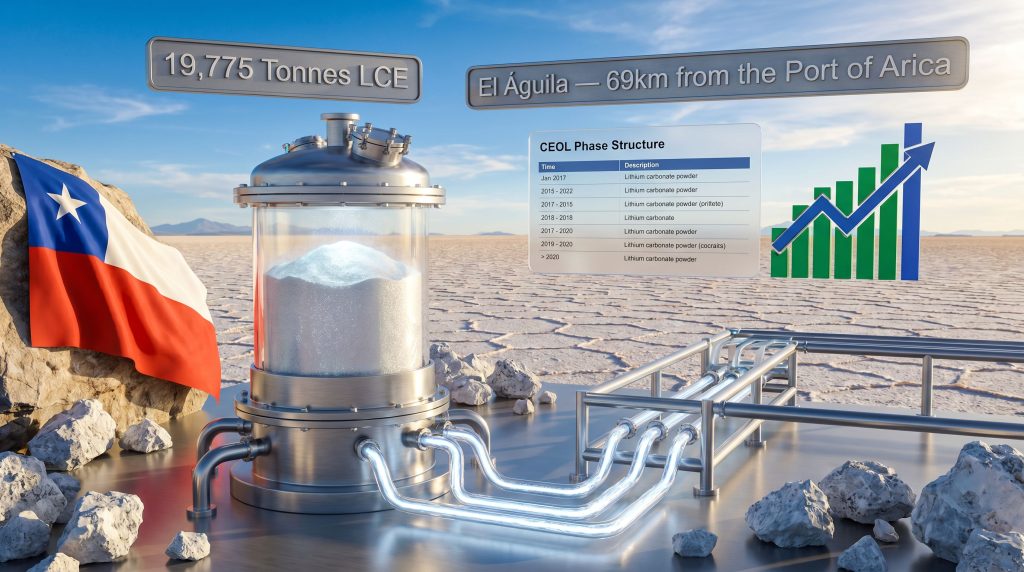
The El Águila chemical plant, operated by Quiborax and situated 69 kilometres from the Port of Arica in Chile's northernmost Arica Region, has functioned for many years as a boric acid production facility. With an annual throughput capacity of 110,000 tonnes, the plant's primary commercial output has always been boron-related. Yet layered within the same site is a waste dump containing lithium-bearing residues that have accumulated over the course of the facility's operational history.
What makes this resource distinctive from a geological and commercial standpoint is its origin. Rather than existing within a natural brine system requiring large-scale hydrological intervention, the lithium here is embedded in processed industrial material. Furthermore, this distinction carries enormous implications for:
- Environmental permitting complexity, which is significantly lower than for new salar developments
- Water consumption profiles, since the source material is solid rather than liquid brine
- Land disturbance risk, given that no new terrain requires opening
- Community and regulatory opposition potential, which is reduced by the existing industrial footprint
The estimated production potential of the project stands at approximately 19,775 tonnes of lithium carbonate equivalent (LCE). While this figure is modest relative to the multi-hundred-thousand-tonne production ambitions of major salar operations, it carries disproportionate strategic significance as a proof-of-concept for a previously untested resource pathway in Chilean mining law. The broader context of critical minerals demand makes this kind of novel resource pathway increasingly important.
The CEOL Framework: Chile's Contractual Architecture for Lithium Governance
Central to understanding the Quiborax lithium recovery project in Chile is the legal instrument through which it is being structured: the Special Lithium Operation Contract, known by its Spanish acronym CEOL (Contrato Especial de Operación del Litio).
A CEOL is a contractual mechanism issued by Chile's Ministry of Mining that grants private operators the right to develop lithium under conditions defined and enforced by the state. It is not a mining concession in the traditional sense. CEOLs embed sustainability obligations, progressive royalty structures calibrated to international lithium prices, and specific technological requirements such as mandatory Direct Lithium Extraction. The contract terms are published through the Official Gazette, providing public transparency over the conditions attached to each award.
The CEOL for the Quiborax project was recently published by the Ministry of Mining in Chile's Official Gazette, signalling that contract preparation has advanced to a formal stage. The structure of obligations across the project's lifecycle is tiered and sequential:
| Project Phase | Duration | Key Obligations |
|---|---|---|
| Evaluation Phase | 2 years (extendable by 1 year) | Reserve quantification, feasibility determination, environmental and sectoral permitting |
| Construction Phase | 3 years (extendable) | Infrastructure build-out, DLE technology integration |
| Processing and Operations Phase | To be determined | Active lithium carbonate production |
| Closure Phase | To be determined | Environmental rehabilitation and site remediation |
One often-overlooked aspect of the CEOL structure is the progressive royalty mechanism. Unlike fixed-rate royalty regimes that can misalign state revenue with commodity cycle realities, Chile's lithium strategy sees CEOL royalties scale with international lithium prices. This means the state captures greater value during price surges while reducing the fiscal burden on operators during troughs, creating a more economically resilient contract structure for both parties.
Why Direct Lithium Extraction Is Non-Negotiable Under This Contract
The CEOL mandates the use of Direct Lithium Extraction (DLE) technology rather than treating it as an optional pathway. Understanding why requires appreciating both the hydrological context of northern Chile and the technical characteristics of the resource itself.
Direct lithium extraction operates by selectively isolating lithium ions from liquid streams or processed materials without relying on the large evaporation ponds that have historically dominated salar-based production. Traditional evaporation-based processing can take 12 to 24 months per production cycle, consumes vast amounts of land, and draws heavily on fragile aquifer systems in the Atacama and surrounding high-altitude wetland zones.
For the Quiborax recovery project, DLE and other selective extraction methods serve several simultaneous purposes:
- Higher recovery efficiency from waste material streams that may have lower lithium concentrations than virgin brine
- Reduced water consumption, which is critical in a region where continental water scarcity is a material operational and regulatory constraint
- Compliance with sustainability obligations embedded directly in the CEOL terms
- Faster processing cycles compared to evaporation-dependent methods
The CEOL also requires energy sourced from renewable sources, integrating decarbonisation commitments into the operational fabric of the project from day one rather than treating them as voluntary additions.
Operator Selection and Financial Qualification: What Chile Looks for in a CEOL Partner
A detail that merits closer examination is how Quiborax came to be identified as the counterparty for this contract. Chile's Ministry of Mining evaluated the operator against financial qualification criteria, with demonstrated low indebtedness and sufficient financial backing identified as the determining factors in considering the company capable of executing the project.
This selection logic reflects a broader principle embedded in Chile lithium reserves governance: the state is not simply awarding contracts to the highest bidder or the largest operator. It is seeking financially stable counterparties capable of sustaining multi-year, multi-phase development commitments without becoming a liability to the state if lithium prices deteriorate.
For investors and analysts tracking Chile's lithium sector, this qualification methodology signals that future CEOL awards may systematically favour established industrial operators with existing infrastructure and balance sheet strength over speculative exploration-stage entrants.
The Salar de Ascotán Dimension: Quiborax's Parallel Lithium Strategy
The El Águila recovery project represents only one dimension of Quiborax's lithium ambitions. Running in parallel is a structurally distinct initiative targeting virgin brine resources at the Salar de Ascotán, described as Chile's third-largest salt flat. To pursue this opportunity, Quiborax has established a joint venture with Codelco through the entity Minera Ascotán SpA:
- Joint Venture Entity: Minera Ascotán SpA
- Ownership Structure: Quiborax holds 66%, Codelco holds 34% at initial formation, with a majority partner planned for introduction post-CEOL award
- Target Asset: Salar de Ascotán, with significant but largely unquantified lithium potential
- CEOL Application Filed: January 2025
- Regulatory Pathway: Ministry of Mining review followed by Comptroller General assessment
These two initiatives, the El Águila waste recovery project and the Ascotán brine development, are complementary but structurally independent strategies. One targets an entirely novel resource category within Chilean mining law; the other pursues a more conventional brine pathway through state partnership. Together, they position Quiborax as one of the more strategically diversified lithium operators in Chile's emerging post-reform sector.
The next major ASX story will hit our subscribers first
How the Recovery Model Compares to Conventional Lithium Development
To appreciate the structural novelty of the Quiborax recovery model, a direct comparison with traditional salar development is instructive. Indeed, the contrast highlights the strategic importance of lithium brine mining as a baseline against which newer approaches must be evaluated:
| Dimension | Quiborax Recovery Model (El Águila) | Conventional Salar Development |
|---|---|---|
| Resource Origin | Industrial waste and mining residues | Virgin brine in natural salt flats |
| Environmental Footprint | Lower, no new land disturbance required | Higher, large evaporation ponds required |
| Water Consumption | Minimal, DLE mandated | Historically high, evaporation-dependent |
| Permitting Complexity | Moderate, existing site with legacy status | High, full environmental impact assessment required |
| Production Scale | ~19,775 tonnes LCE (estimated) | Typically hundreds of thousands of tonnes LCE |
| Circular Economy Alignment | High | Low to moderate |
| Precedent Value | Significant, first of its kind in Chile | Established but increasingly contested pathway |
The contrast is stark. The recovery model's primary competitive advantage is not scale but speed-to-compliance and lower environmental contestation risk. In a regulatory environment where Indigenous community consultation requirements and water aquifer protections can delay conventional lithium projects by years, the ability to operate within an existing industrial footprint is a material advantage.
Environmental and Community Risk: The Factors That Could Reshape the Timeline
Despite its lower-impact profile, the Quiborax lithium recovery project in Chile is not without environmental complexity. The El Águila plant's proximity to the Salar de Surire, a protected wetland ecosystem and Ramsar site, means that even waste-focused operations will attract scrutiny from environmental regulators and Indigenous community groups during the two-year evaluation phase.
Key risk dimensions include:
- Aquifer sensitivity: Northern Chile's high-altitude water systems are interconnected in ways that are not fully mapped, and any processing activity that risks subsurface contamination will require detailed hydrological modelling
- Indigenous consultation obligations: Chilean environmental law requires meaningful consultation with affected Indigenous communities, a process that can extend timelines significantly if managed poorly
- Waste characterisation complexity: Not all lithium-bearing residues in industrial dumps are equivalent in grade or extractability. The evaluation phase must rigorously characterise what is actually recoverable versus what has been degraded through decades of exposure
Investors and analysts should note that the two-year evaluation phase, extendable by one year, functions as both a technical due diligence window and a regulatory proving ground. Projects that fail to secure environmental permits within this window face material delays before construction can commence.
The Precedent Question: Can This Model Be Replicated Across Chile's Industrial Mineral Belt?
Perhaps the most significant long-term implication of the Quiborax CEOL is the precedent it establishes for other operators sitting on decades of accumulated mineral processing residues. Chile's northern industrial mineral belt, which includes legacy boron, nitrate, sulphate, and iodine processing facilities, represents a largely unmapped reservoir of secondary lithium content.
If the evaluation phase confirms viable reserve volumes at El Águila and the project advances to construction, it would signal to Chile's Ministry of Mining that a dedicated sub-framework for mining liability recovery projects could be commercially and environmentally justified. Consequently, this could catalyse a new category of CEOL applications from operators who had previously written off their waste streams as cost centres rather than revenue opportunities.
The speculative but credible thesis here is that Chile's total recoverable lithium from industrial residues across the northern processing corridor may be meaningfully larger than current estimates suggest. Most historical waste characterisation studies were conducted before DLE technology reached commercial viability, meaning the assessable lithium content of legacy dumps may have been systematically underestimated.
Frequently Asked Questions: Quiborax Lithium Recovery Project in Chile
What is the Quiborax lithium recovery project?
It is an initiative to extract lithium carbonate equivalent from industrial waste accumulated at the El Águila chemical plant in Chile's Arica Region, governed by a Special Lithium Operation Contract issued by the Ministry of Mining.
Where is the El Águila plant located?
The facility sits 69 kilometres from the Port of Arica in northern Chile, near the Salar de Surire protected wetland zone.
How much lithium could the project produce?
The CEOL identifies a production potential of approximately 19,775 tonnes of LCE from waste material at the site.
What is a CEOL?
A Special Lithium Operation Contract is a state-defined contractual instrument governing private lithium development in Chile, incorporating royalties, sustainability obligations, and technology mandates.
What is the difference between El Águila and the Salar de Ascotán project?
El Águila targets existing industrial residues; Salar de Ascotán is a conventional brine development pursued through the Minera Ascotán SpA joint venture with Codelco.
What environmental conditions apply?
The CEOL requires DLE technology adoption, renewable energy use, low continental water consumption, and compliance with Chilean environmental permitting requirements throughout the evaluation phase.
When could production begin?
Subject to successful completion of the two-year evaluation phase and a three-year construction period, production is unlikely before the early 2030s at the earliest, assuming no significant permitting delays.
This article is informational in nature and does not constitute financial or investment advice. Timelines, production estimates, and regulatory outcomes are subject to change based on feasibility results, permitting processes, and market conditions. Readers should conduct independent due diligence before making any investment decisions related to the companies or projects discussed.
Want to Stay Ahead of the Next Major ASX Mineral Discovery?
Discovery Alert's proprietary Discovery IQ model delivers real-time alerts the moment significant ASX mineral discoveries are announced, turning complex commodity data into actionable investment insights for both short-term traders and long-term investors — explore the historic returns major discoveries have generated and begin your 14-day free trial at Discovery Alert to secure your market-leading edge.