
August 6, 2026
The Hidden Economics of Grid-Scale Battery Deployment in Emerging Markets
The global energy storage industry has entered a phase where the most consequential decisions are no longer about whether to deploy batteries at scale, but how to do it fastest and most cost-effectively. Reliance CATL battery energy storage systems have become central to this conversation, particularly as large industrial groups operating in emerging markets determine whether to build their own cells, assemble from procured components, or licence proven technology from an established manufacturer. Each path carries different risk profiles, capital requirements, and timelines.
India is now at the centre of this calculation. With a national renewable energy target of 500 GW by 2030 and a grid that still struggles to absorb intermittent solar and wind generation, the country faces an urgent and structural need for dispatchable storage capacity. The conglomerates positioned to deliver that storage will shape India's energy future for decades. Furthermore, India's lithium market dynamics are adding additional complexity to these procurement decisions.
When big ASX news breaks, our subscribers know first
From Cell Factories to System Integrators: The Shift in Reliance's Battery Thinking
Reliance Industries initially pursued a deeply vertical approach to energy storage, seeking to manufacture lithium-ion cells domestically using proprietary technology transferred from established global producers. That strategy ran into a hard wall. As Beijing progressively tightened controls over the export of core battery manufacturing technology, access to the cell chemistry know-how that Reliance required became increasingly difficult to secure.
The earlier discussions between Reliance and CATL centred on exactly this kind of technology transfer arrangement, where CATL would have enabled Reliance to produce cells domestically under licence. Those talks did not result in an agreement. Rather than persisting with a strategy that faced mounting geopolitical friction, Reliance pivoted toward a fundamentally different model: sourcing pre-manufactured battery cells and components from global producers, then assembling and integrating them into large-scale battery energy storage systems (BESS) at its own facilities.
This is a commercially rational recalibration. The distinction matters enormously in practice:
- Technology transfer involves receiving proprietary manufacturing IP, cell chemistry processes, and production know-how. It carries high regulatory risk under China's export controls and requires gigafactory-scale capital investment to operationalise.
- Component procurement involves purchasing finished or near-finished cell modules from a manufacturer and assembling them into containerised BESS units. It requires significantly less capital, carries lower geopolitical friction, and compresses deployment timelines substantially.
The shift mirrors a broader pattern emerging across developing economies, where energy companies bypass the capital-intensive cell R&D phase entirely and instead leverage China's existing production scale to access cost-competitive storage hardware. It is a pragmatic trade-off: less manufacturing independence in exchange for faster grid-ready outcomes.
What Grid-Scale BESS Actually Involves and Why Deployment Speed Matters
Battery energy storage systems at utility scale are engineered solutions designed to store electricity generated from renewable or grid sources and discharge it on demand. In their most common commercial form, they consist of containerised arrays of battery modules, power conversion electronics, thermal management systems, and grid interconnection hardware.
Key applications at the grid level include:
- Smoothing output variability from large solar and wind installations
- Providing frequency regulation services to maintain grid stability
- Shifting peak generation to periods of high demand (peak-load shifting)
- Deferring costly transmission and distribution infrastructure upgrades
- Supplying backup power capacity to industrial and commercial anchor loads
The critical difference between a BESS assembly operation and a cell gigafactory is time-to-deployment. A large-scale BESS facility using procured components can be operational within 18 to 36 months of project commitment. A cell manufacturing gigafactory, by contrast, typically requires five to eight years from groundbreaking to full-rate production, along with several billion dollars in capital and access to proprietary manufacturing process technology.
For grid-scale renewable developers facing immediate storage demand, BESS assembly from proven components offers a fundamentally different risk-reward equation than vertically integrated cell manufacturing, particularly when technology transfer pathways are blocked.
India's Storage Market: The Numbers Behind the Urgency
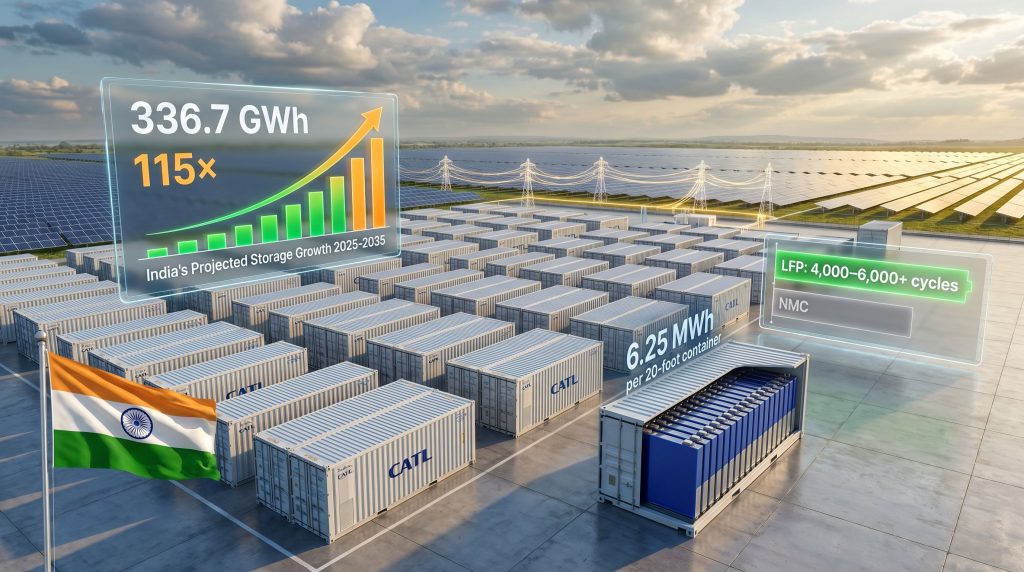
The macro opportunity driving Reliance CATL battery energy storage discussions is substantial by any measure. According to BloombergNEF analysis published in May 2025, India's cumulative energy storage installations are projected to reach 336.7 GWh by the end of 2035, representing approximately 115 times the total capacity installed as of 2025.
| Metric | Value | Timeframe |
|---|---|---|
| Projected Indian energy storage market | 336.7 GWh cumulative | By end of 2035 |
| Growth multiple from 2025 baseline | 115x cumulative installations | 2025–2035 |
| India's national renewable energy target | 500 GW | By 2030 |
| CATL Tener BESS energy density | 6.25 MWh per 20-foot container | Launched April 2024 |
A 115-fold expansion in storage capacity over a decade is not a marginal growth story. It reflects the structural reality that India cannot credibly achieve its 500 GW renewable energy target without a corresponding buildout of dispatchable storage. Solar generation in India peaks for roughly six to eight hours per day, while grid demand is highest in the early evening.
Without storage buffers of sufficient scale, curtailment rates rise, grid operators struggle to maintain frequency, and the economic case for further renewable investment deteriorates. In addition, critical minerals and energy security considerations are increasingly influencing how India structures these storage procurement relationships.
India's grid infrastructure gaps compound this challenge. Transmission constraints in high-solar states like Rajasthan and Gujarat mean that locally sited BESS installations can deliver value not just through energy arbitrage, but by reducing congestion and deferring costly grid upgrades. This creates a strong economic rationale for large-format storage at industrial anchor sites.
Jamnagar: India's Clean Energy Nerve Centre
Reliance's flagship site for this storage buildout is the Jamnagar energy complex in Gujarat, which is projected to become India's largest energy storage facility upon completion. Jamnagar's strategic positioning is not incidental. Gujarat is one of India's highest solar irradiance states, making it an ideal location for co-located renewable generation and storage.
The facility's scale will allow Reliance to support both its own substantial industrial energy demand and potentially provide grid stabilisation services to third-party renewable operators. The Jamnagar complex sits at the centre of Mukesh Ambani's clean energy strategy for Reliance, a multi-decade transformation of what has historically been a petrochemical and refining business into a diversified clean energy platform.
CATL's Technology Credentials and Why They Matter for This Deal
Reliance CATL battery energy storage discussions are commercially significant partly because CATL is not simply a large battery manufacturer. It is the largest battery manufacturer in the world by both production volume and installed capacity, operating at a scale that no Western or Indian competitor can currently match.
CATL's flagship grid-scale product is the Tener BESS system, launched in April 2024. Its key specifications set a competitive benchmark:
- Energy density: 6.25 MWh per standard 20-foot container
- Degradation warranty: Zero capacity degradation guaranteed for the first five years of operation
- Chemistry: LFP (lithium iron phosphate) based
The zero-degradation guarantee is particularly significant for project finance. When storage assets are being financed by banks or institutional investors, performance guarantees that reduce uncertainty around long-term capacity retention directly improve debt serviceability assumptions and reduce financing costs.
Why LFP Chemistry Dominates Grid-Scale Storage
| Attribute | LFP (Lithium Iron Phosphate) | NMC (Nickel Manganese Cobalt) |
|---|---|---|
| Safety profile | High, thermally stable | Moderate, higher thermal runaway risk |
| Energy density | Lower | Higher |
| Cycle life | 4,000–6,000+ cycles | 1,500–3,000 cycles |
| Cost per kWh | Lower | Higher |
| Primary use case | Grid storage, solar integration | EV applications, portable electronics |
| CATL grid storage preference | Primary chemistry | Secondary |
LFP's dominance in stationary storage applications comes down to a combination of thermal safety, longevity, and cost. For a grid-scale facility in Gujarat experiencing ambient temperatures regularly exceeding 40°C, the thermal stability of LFP compared to NMC chemistry reduces fire risk and simplifies thermal management engineering.
The cycle life advantage, typically 4,000 to 6,000 cycles for LFP versus 1,500 to 3,000 cycles for NMC, is decisive for daily charge/discharge applications where a BESS unit may cycle once or twice every 24 hours. Over a 15-year asset life, the cumulative cost differential between LFP and NMC per usable kilowatt-hour of throughput is substantial, making LFP the economically rational choice for grid-scale deployment in virtually all current market contexts.
CATL's Three Core BESS Application Segments
- Power generation integration: Smoothing output variability from large solar and wind farms to meet grid dispatch requirements
- Transmission and distribution support: Using localised storage to defer grid infrastructure upgrades and relieve transmission congestion
- End-user and commercial applications: Peak-valley energy arbitrage, demand charge reduction for industrial facilities, and backup power provision
For Jamnagar specifically, applications one and three are most immediately relevant given the site's co-location with renewable generation and large-scale industrial demand.
The Supplier Landscape: Hithium, CATL, and the Logic of Diversification
Reliance's current engagement with CATL exists alongside, rather than replacing, its relationship with Xiamen Hithium Energy Storage Technology Co., which had been established as Reliance's primary BESS component partner following the collapse of the CATL technology transfer talks. The Hithium partnership has encountered its own complications in recent months.
The precise nature of those obstacles has not been publicly disclosed, but the pattern is consistent with a broader supply chain risk environment in which single-source dependency on any Chinese technology supplier carries elevated uncertainty. Moreover, the broader battery raw materials market is itself adding further pressure to procurement timelines and pricing.
The strategic rationale for pursuing multiple supplier relationships simultaneously is straightforward:
- Procurement leverage: Competing suppliers create downward pressure on component pricing and upward pressure on contract terms
- Supply continuity: Dual-sourcing reduces vulnerability to production disruptions, export control changes, or commercial disputes with any single supplier
- Technology benchmarking: Evaluating components from multiple manufacturers allows Reliance to set higher performance specifications and select the best-fit technology for each application
- Geopolitical hedging: Diversifying across suppliers reduces exposure to any single regulatory or diplomatic risk event
It is important to note that no agreement between Reliance and CATL has been finalised. The discussions are ongoing, and there is no certainty that they will result in a commercial partnership.
The next major ASX story will hit our subscribers first
How India's Two Largest Conglomerates Are Converging on the Same Strategy
| Company | Battery Storage Approach | Key Activity |
|---|---|---|
| Reliance Industries | BESS assembly via component sourcing | Active discussions with CATL and Hithium for Jamnagar facility |
| Adani Group | Direct engagement with Chinese manufacturers | Adani Group chairman visited CATL headquarters; toured automated energy storage production lines |
| Indian public sector utilities | Grid-scale procurement tenders | BESS capacity tenders under national storage mission frameworks |
The independent convergence of Reliance and Adani Group on Chinese battery technology as the most viable near-term pathway to large-scale storage is a defining feature of India's current energy storage landscape. Both of the country's most powerful industrial groups have concluded, through separate processes, that China's manufacturing scale and cost efficiency cannot be practically replicated domestically within the timeframes required.
This creates a structural tension for India's domestic battery manufacturing ambitions. Production Linked Incentive (PLI) schemes for advanced chemistry cells are designed to build an indigenous supply chain over time, but they cannot deliver cost-competitive capacity quickly enough to satisfy the demand being generated by India's renewable energy acceleration. The near-term gap will almost certainly be filled by imported Chinese components.
Geopolitical Risks and the Technology Export Control Environment
China's tightening controls on battery technology exports represent the most significant regulatory variable in Reliance's procurement strategy. The distinction between exporting finished BESS components and transferring core manufacturing IP is critical here. Finished product exports face lower restriction risk than proprietary technology licensing arrangements, which is precisely why the current discussions represent a fundamentally lower-friction commercial model than the earlier technology transfer talks.
CATL's own approach to the US market offers instructive precedent. Facing trade barriers that prevented direct market entry, CATL structured technology licensing agreements with Ford Motor Co. and Tesla Inc., allowing it to maintain commercial presence without direct technology transfer in a traditional sense. Similar structural creativity may be required in the Indian context, particularly if import duties or local content requirements become more stringent.
Furthermore, South Korea battery expansion strategies are adding a competitive dimension to Chinese manufacturers' willingness to negotiate flexible partnership models in Asian markets. India's broader India-China economic relationship adds another layer of complexity, as large-scale procurement of Chinese battery components involves commercial decisions that intersect with national security considerations, import duty frameworks, and strategic sector designations.
Three Scenarios for How This Strategy Plays Out
-
Successful CATL Partnership: Reliance secures a reliable supply of LFP-based BESS components from CATL at competitive pricing, accelerating the Jamnagar commissioning timeline. This establishes a cost-competitive storage business that can support third-party renewable developers across India and positions Reliance as the country's dominant grid-scale storage operator.
-
Multi-Supplier Diversification Without CATL: The CATL talks do not result in an agreement. Reliance builds a diversified procurement model using Hithium, alternative Chinese manufacturers, and potentially South Korean or European suppliers. Component costs may be higher and lead times longer, but geopolitical risk exposure is reduced.
-
Domestic Manufacturing Pivot Over 5–10 Years: India's PLI incentive framework gradually makes domestic cell production economically viable. Reliance, having built operational BESS expertise through the Jamnagar facility, pivots toward a hybrid model incorporating domestically produced cells alongside imported components. Chinese battery recycling breakthroughs may also influence how domestic manufacturing economics evolve over this period.
Disclaimer: The scenarios above are forward-looking projections based on current commercial and policy conditions. They involve significant uncertainty and should not be interpreted as financial forecasts or investment advice. Actual outcomes will depend on regulatory developments, commercial negotiations, technology trends, and geopolitical factors that cannot be reliably predicted.
Frequently Asked Questions: Reliance CATL Battery Energy Storage Systems
What is the current status of Reliance's talks with CATL?
Reliance Industries is engaged in active discussions with CATL regarding the procurement of components for Reliance CATL battery energy storage systems. No agreement has been finalised, and there is no certainty that current negotiations will result in a commercial partnership.
Why did Reliance's earlier CATL technology transfer discussions not succeed?
Earlier negotiations focused on CATL providing proprietary cell manufacturing technology to enable domestic production by Reliance. Those talks concluded without an agreement, after which Reliance shifted its strategic focus toward component procurement from established manufacturers rather than attempting to replicate cell manufacturing capabilities domestically.
What makes LFP chemistry particularly suitable for Indian grid-scale storage?
LFP's superior thermal stability is critical in India's high-temperature operating environment, where ambient conditions can exceed 40°C. Its cycle life of 4,000 to 6,000 cycles and lower cost per kWh compared to NMC alternatives make it the economically and operationally preferred chemistry for daily grid storage applications.
What is the projected scale of India's energy storage market?
BloombergNEF projected in May 2025 that India's cumulative energy storage installations will reach 336.7 GWh by end of 2035, representing approximately 115 times the installed capacity as of 2025.
What is the significance of CATL's Tener BESS system?
The Tener, launched in April 2024, delivers 6.25 MWh per 20-foot container with a five-year zero-degradation performance guarantee. Its energy density benchmark and warranty structure make it commercially significant for project financing and long-term operational economics.
How does Reliance's approach differ from what Adani Group is pursuing?
Both conglomerates are independently engaging with Chinese battery technology as their primary pathway to large-scale storage capability. Adani Group's chairman visited CATL's headquarters and toured its production facilities. Reliance is pursuing component procurement discussions with CATL and Hithium for its Jamnagar facility. The strategies are structurally similar but involve separate commercial negotiations and different facility contexts.
For ongoing coverage of India's energy storage sector and Reliance's clean energy developments, ET EnergyWorld at energy.economictimes.indiatimes.com provides detailed reporting on India's power sector transition and major industrial energy investments.
Want to Track the Next Major Mineral Discovery Before the Market Does?
India's 115-fold projected growth in energy storage capacity signals a structural shift in demand for critical minerals — and the companies making significant discoveries on the ASX could be central to that story. Discovery Alert's proprietary Discovery IQ model delivers real-time alerts the moment significant ASX mineral discoveries are announced, turning complex data across 30-plus commodities into actionable insights — explore why historic discoveries have generated extraordinary returns and start your 14-day free trial to position yourself ahead of the market.