May 21, 2026
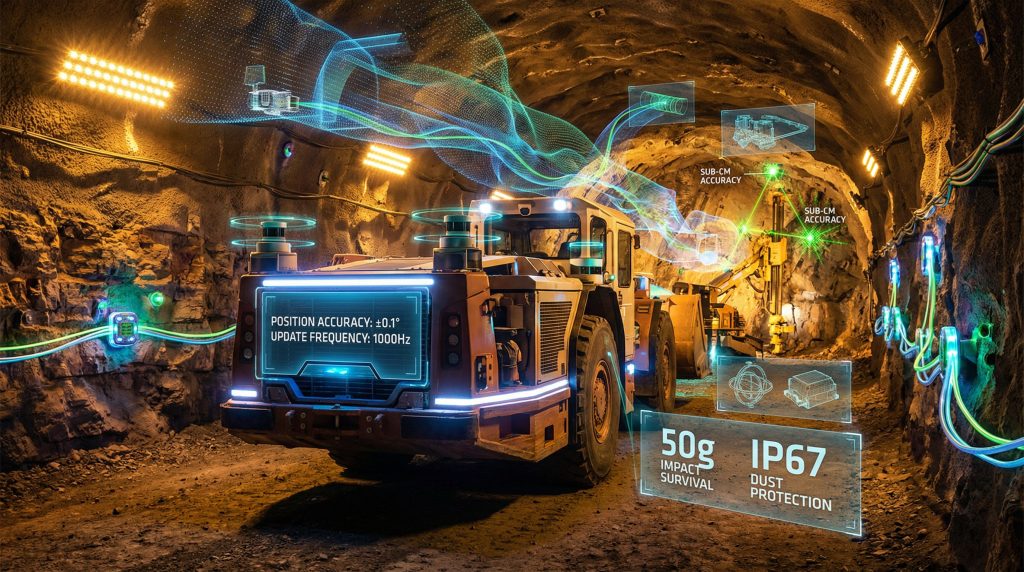
Underground mining operations face unprecedented technical challenges as the industry transitions toward deeper, more complex extraction methods. The absence of reliable Global Navigation Satellite System (GNSS) signals creates a fundamental positioning problem that traditional surface-based solutions cannot address. Advanced navigation in underground mining technologies have emerged as critical infrastructure components, enabling precise machine coordination and autonomous operations in environments where conventional GPS systems fail completely.
The technical complexity of subterranean navigation extends beyond simple positioning challenges. Modern mining operations require real-time coordination between multiple autonomous vehicles, precise drilling equipment control, and comprehensive safety monitoring systems. These requirements demand navigation solutions that can maintain accuracy over extended periods while operating in harsh environmental conditions with minimal external reference points.
Environmental Barriers That Challenge Traditional Navigation Methods
Underground mining environments present unique obstacles that render conventional positioning systems ineffective. Rock formations create complete radio frequency blockages, preventing any satellite signal penetration beyond shallow depths. Electromagnetic interference from heavy machinery, power distribution systems, and industrial equipment further compromises sensor accuracy and reliability.
Atmospheric conditions within mining operations introduce additional complexity factors. High concentrations of dust particles can interfere with optical sensors and laser-based measurement systems. Humidity variations and extreme temperature fluctuations affect electronic component performance and sensor calibration stability. These environmental factors require robust engineering solutions that can maintain operational integrity across diverse underground conditions.
Infrastructure limitations compound these challenges significantly. Power distribution constraints in underground environments limit the deployment of energy-intensive positioning systems. Communication network gaps between different operational areas create coordination difficulties for fleet management systems. Emergency backup power requirements add complexity to system design and deployment strategies.
When big ASX news breaks, our subscribers know first
Foundational Technologies Enabling Underground Navigation
Inertial Navigation Systems form the core technology foundation for GNSS-independent positioning solutions. These systems utilise sophisticated sensor arrays that measure acceleration and angular velocity to calculate position through dead-reckoning algorithms. Furthermore, Fibre Optic Gyroscope integration provides high-precision angular measurements that resist vibration interference common in mining environments.
| Navigation Component | Key Specification | Mining Application Benefit |
|---|---|---|
| Fibre Optic Gyroscopes | Sub-degree per hour drift rates | Long-duration autonomous operations |
| MEMS Accelerometer Arrays | Multi-axis motion detection | Shock-resistant heavy machinery mounting |
| Processing Control Units | High-frequency update cycles | Real-time vehicle coordination systems |
Laser Velocity Sensor technology complements inertial systems by providing ground-relative speed measurements independent of wheel slip conditions. These sensors utilise multiple laser beam configurations to enhance measurement accuracy through redundant data paths. Infrared wavelength optimisation allows effective operation in dusty environments where visible light systems would fail.
In addition, sensor fusion algorithms combine multiple input streams to optimise positioning accuracy beyond individual component capabilities. Kalman filtering implementations provide statistical error correction for multiple sensor inputs simultaneously. Adaptive response mechanisms enable dynamic adjustment to changing environmental conditions without manual intervention, supporting evolving mining innovations.
Performance Standards for Underground Navigation Excellence
Mining industry navigation systems must meet stringent accuracy benchmarks to ensure operational safety and efficiency. Position drift rates typically cannot exceed specific percentages of distance travelled to maintain reliable autonomous vehicle guidance. Heading accuracy requirements demand sub-degree precision for automated equipment coordination across multiple operational zones.
Update frequency specifications are critical for dynamic equipment control applications. Systems must provide continuous positioning data at rates sufficient for real-time vehicle guidance and collision avoidance calculations. These requirements necessitate high-performance processing capabilities and optimised sensor integration architectures.
Reliability standards in harsh underground environments require exceptional durability specifications. Navigation systems must survive significant shock impacts from heavy machinery mounting applications. Temperature operating ranges must accommodate extreme variations from near-freezing conditions to elevated temperatures near geothermal activity areas.
Dust ingress protection ratings ensure sensor housing integrity in particulate-heavy environments. Waterproofing specifications protect electronic components from moisture infiltration and condensation effects. These environmental protection standards are essential for maintaining long-term operational reliability without frequent maintenance interventions.
Transforming Mining Operations Through Advanced Navigation
Automated haulage truck systems represent a primary application area for advanced navigation technology. Route optimisation algorithms utilise real-time positioning data to calculate efficient transportation paths between loading and dumping locations. Dynamic path planning capabilities adjust routes based on traffic conditions, equipment maintenance schedules, and operational priority changes, contributing to transforming mining transportation.
Collision avoidance systems rely on precise positioning data to implement predictive modelling for multi-vehicle coordination. These systems calculate trajectory intersections and implement automatic speed adjustments or route modifications to prevent accidents. Load monitoring integration accounts for vehicle weight distribution effects on navigation accuracy and braking performance.
Drilling equipment precision control applications require exceptional positioning accuracy for blast pattern execution. Automated hole positioning systems utilise navigation data to ensure proper spacing and alignment across large operational areas. Angle control mechanisms adjust drilling parameters based on geological formation changes detected through integrated sensor systems, enhancing AI in mining processes.
Core sample location tracking provides critical data correlation between underground extraction points and surface mapping coordinates. This capability enables accurate resource estimation and geological analysis across three-dimensional mining areas. GPS coordinate correlation allows surface-based analysis teams to precisely locate underground sampling locations.
Infrastructure Requirements Supporting Navigation Deployment
Communication network architecture forms the backbone of coordinated navigation systems across mining operations. Mesh networking protocols create redundant data transmission paths that maintain connectivity even when individual network nodes fail. Edge computing capabilities provide local processing power to reduce latency in time-critical navigation calculations.
Data synchronisation systems ensure real-time updates across all fleet management platforms and individual vehicle navigation units. Bandwidth optimisation techniques minimise network congestion while maintaining data integrity for safety-critical applications. Network security protocols protect navigation data from unauthorised access and potential interference, supporting data-driven mining operations.
Power management solutions address the unique challenges of underground electrical infrastructure. Battery backup systems provide uninterrupted operation during power grid failures or scheduled maintenance periods. Energy harvesting technologies convert mechanical vibration and thermal gradients into electrical power for sensor systems.
Charging infrastructure must accommodate automated battery replacement systems for continuous equipment operations. Power distribution optimisation ensures adequate electrical capacity for navigation systems without compromising other operational requirements. Redundant power supply architectures prevent single-point failures that could compromise safety systems.
Economic Analysis of Advanced Navigation Investment
Operational efficiency improvements provide measurable returns on navigation technology investments. Fuel consumption reduction results from optimised routing algorithms that minimise unnecessary vehicle movements and idle time. Equipment utilisation rates increase significantly when automated systems can operate continuously without human operator limitations.
Maintenance cost savings emerge from predictive algorithms that identify potential equipment problems before they cause operational failures. Scheduled maintenance optimisation reduces unplanned downtime and extends equipment service life through improved operational parameters. Parts inventory optimisation reduces storage costs and ensures availability of critical components.
Safety risk mitigation provides substantial value through accident prevention and emergency response improvements. Automated location tracking capabilities reduce rescue response times during emergency situations. Regulatory compliance benefits include automated documentation systems that ensure accurate record-keeping for safety audits.
Insurance cost reductions often follow implementation of advanced safety systems and documented operational improvements. Training cost savings result from reduced operator certification requirements for automated systems. Long-term operational scalability provides additional value as mining operations expand into deeper or more complex areas.
The next major ASX story will hit our subscribers first
Environmental Factors Affecting Navigation System Selection
Depth-related performance considerations become increasingly important as mining operations extend to greater underground distances. Pressure effects on sensitive electronic components require specialised housing and calibration procedures. Temperature gradient impacts necessitate thermal compensation algorithms to maintain sensor accuracy across varying conditions.
Structural vibration patterns from heavy machinery and blasting operations require frequency filtering systems to isolate navigation signals from interference. Mounting system design must accommodate these vibration levels while maintaining precise sensor alignment. Shock isolation techniques protect sensitive components from impact damage during normal operations.
Geological formation influences create unique challenges for different mining environments. Magnetic interference zones require navigation systems that can operate independently of magnetic compass references. Water infiltration areas demand exceptional waterproofing standards and corrosion-resistant materials for long-term reliability.
Gas emission regions impose additional safety requirements including explosion-proof certification for all electronic components. Ventilation system integration ensures navigation equipment does not interfere with air quality monitoring systems. Chemical resistance specifications protect equipment from corrosive atmospheric conditions common in certain mining environments.
Future Technology Developments in Underground Navigation
How will AI enhance navigation capabilities?
Artificial intelligence integration represents the next evolution in advanced navigation in underground mining capabilities. Machine learning algorithms can recognise operational patterns and implement predictive adjustments to navigation parameters. Neural network processing enables real-time decision making for complex routing scenarios involving multiple variables and constraints, supporting AI-boosted mining efficiency.
Behavioural modelling systems analyse equipment operator patterns to optimise automated system responses. These capabilities reduce the learning curve for human-machine interaction and improve overall operational efficiency. Predictive maintenance algorithms can identify equipment degradation patterns before they affect navigation accuracy.
What quantum technologies show promise?
Quantum sensor technologies offer potential breakthrough capabilities for underground navigation applications. Atomic gyroscope development promises ultra-high precision angular measurements that surpass current fibre optic technology limitations. Quantum accelerometers could provide gravity-based positioning systems that operate independently of all external references.
Entangled particle communication systems could enable secure, instantaneous data transmission between underground navigation nodes. These quantum communication networks would be immune to electromagnetic interference and provide unprecedented data security. However, development timelines for practical quantum navigation applications remain uncertain but show promising research progress.
Implementation Strategies for Mining Companies
Phased deployment approaches minimise operational disruption while enabling gradual system integration. Pilot programme design allows testing of navigation systems on limited vehicle fleets before full-scale implementation. Scalability planning ensures system architecture can accommodate future expansion across multiple operational areas.
Integration timeline coordination with existing equipment upgrade schedules optimises capital expenditure efficiency. Compatibility assessment ensures new navigation breakthrough technology can interface with legacy mining equipment. Performance benchmarking establishes baseline measurements for evaluating system effectiveness.
Training and support requirements must address both technical staff education and operator certification needs. Specialised maintenance courses ensure internal teams can support navigation system operations. Hands-on training programmes familiarise equipment operators with automated system interfaces and emergency override procedures.
Vendor support agreements should include comprehensive technical assistance and rapid response capabilities for critical operations. Service level agreements define response times and availability requirements for navigation system support. Spare parts inventory management ensures critical components remain available for immediate replacement needs.
Investment decisions regarding advanced navigation in underground mining technology should consider the long-term operational benefits alongside initial capital costs. Market conditions, regulatory requirements, and operational complexity can significantly impact the financial returns from navigation system investments. Companies should conduct thorough cost-benefit analyses specific to their operational requirements and risk tolerance levels before implementing these technologies.
Want to Stay Ahead of Mining Industry Breakthroughs?
With mining technology advancing rapidly, staying informed about innovations in advanced navigation and underground operations is crucial for investment success. Discovery Alert's proprietary Discovery IQ model delivers real-time alerts on significant mineral discoveries across the ASX, helping you identify companies implementing cutting-edge technologies before broader market recognition. Start your 14-day free trial today to gain immediate access to actionable mining investment opportunities.