June 21, 2026
The Geology Beneath the Grid: Why Ultramafic Rock Is Becoming an Energy Resource
For most of industrial history, the rocks that host nickel, cobalt, and chromium deposits were valued exclusively for their metallic content. The possibility that those same formations could simultaneously function as hydrogen generators would have been dismissed as geochemical curiosity rather than engineering opportunity. That perception is shifting. As the global energy transition creates demand for zero-carbon fuels across hard-to-abate industrial sectors, the geochemical properties of ultramafic rock are attracting serious attention from engineers, investors, and mining companies alike.
The convergence of critical minerals demand development and geologic hydrogen production at a single site represents one of the more structurally compelling innovations emerging from the mining sector in recent years. Understanding why requires examining both the underlying science and the specific project context where this approach is being tested for the first time.
When big ASX news breaks, our subscribers know first
What Is Geologic Hydrogen and Why Does It Matter for Critical Minerals Projects?
Defining Natural Hydrogen as a Distinct Resource Class
Geologic hydrogen, sometimes referred to as natural hydrogen or gold hydrogen, occupies a fundamentally different position in the energy taxonomy compared to green or blue hydrogen. Green hydrogen is manufactured through electrolysis powered by renewable electricity, while blue hydrogen derives from steam methane reforming with carbon capture and storage attached. Both require substantial energy inputs and engineered infrastructure to produce a molecule that does not exist in a usable form at the point of production.
Geologic hydrogen, by contrast, is generated continuously through naturally occurring chemical reactions within specific rock formations. No manufacturing process initiates it. The hydrogen already exists as a product of ongoing geochemistry happening kilometres beneath the surface. The engineering challenge is not creating it but accessing and concentrating it at commercially viable rates.
This distinction matters enormously for carbon accounting. Because the generation process involves no fossil fuel combustion and no electrolytic energy demand, the lifecycle carbon intensity of geologic hydrogen is structurally near-zero at the point of production. For industries where decarbonisation is technically difficult and economically costly, that characteristic is highly attractive. Furthermore, a recent white hydrogen discovery in France has demonstrated just how significant naturally occurring hydrogen formations can be on a global scale.
The Global Distribution of Ultramafic Hydrogen Systems
Natural hydrogen seeps have been documented across six continents, with confirmed occurrences in West Africa, the Arabian Peninsula, Eastern Europe, the United States, and Canada. The Precambrian basement rocks underlying much of the Canadian Shield are among the largest ultramafic formations on Earth, making Canada a geologically significant territory for natural hydrogen exploration. The Timmins Nickel District sits within this geological context, hosted by rock sequences that have been generating hydrogen through serpentinization reactions for millions of years.
Mining as the Logical Host Environment
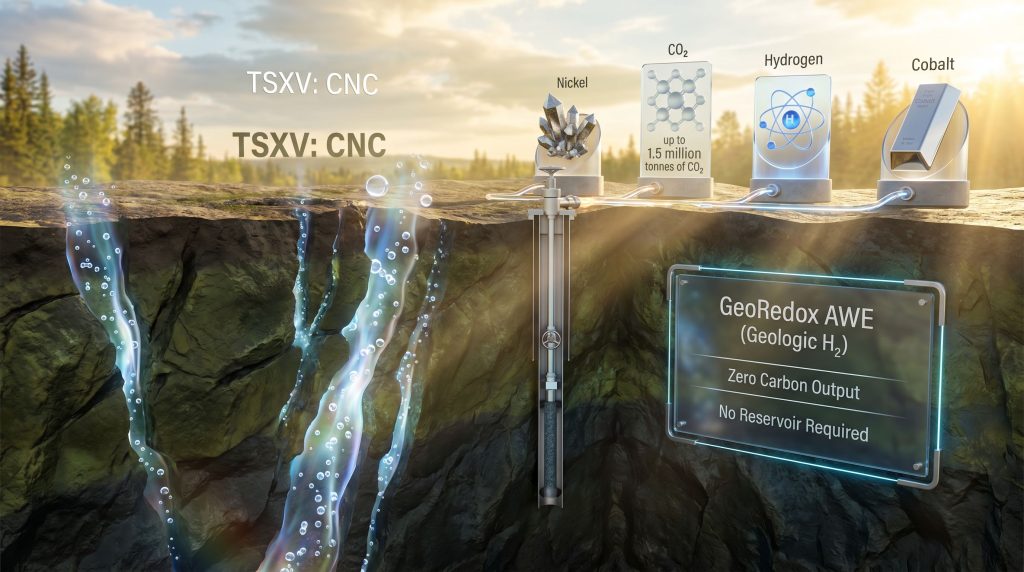
The mining sector possesses several structural advantages that make it a natural early adopter of geologic hydrogen technology. Mining operations at scale require substantial on-site energy supply, creating immediate industrial demand for any hydrogen produced. Existing geological datasets, drill core archives, and operational infrastructure reduce the cost and time required to evaluate hydrogen potential. The Canada Nickel GeoRedox geologic hydrogen well at Crawford exemplifies this logic precisely: the exploration work already completed to define the nickel deposit simultaneously characterises the ultramafic formations relevant to hydrogen generation.
How GeoRedox's Advanced Weathering Enhancement Technology Works
The Core Geochemical Reaction
The hydrogen generation process exploited by GeoRedox's AWE technology centres on serpentinization, a well-documented geochemical reaction in which water interacts with iron- and magnesium-rich silicate minerals in ultramafic rock. During this process, ferrous iron in minerals such as olivine undergoes oxidation, and water molecules are reduced to produce molecular hydrogen. The reaction occurs naturally across a range of temperatures and pressures, with optimal conditions typically found at depths accessible through conventional drilling.
Technical Context: The serpentinization reaction can be simplified as the oxidation of ferrous silicates in the presence of water, producing serpentine minerals, magnetite, and hydrogen gas. The process is exothermic under certain conditions and self-sustaining once initiated, meaning that stimulation can potentially trigger extended production cycles without continuous energy input.
What distinguishes AWE from passive observation of natural hydrogen seeps is the application of controlled stimulation techniques designed to enhance reaction rates and improve recovery at the surface. The system requires no capping rock layer and no underground reservoir, which removes two of the most significant geological constraints associated with conventional gas extraction.
Comparing Hydrogen Production Pathways
| Feature | Green Hydrogen | Blue Hydrogen | GeoRedox AWE |
|---|---|---|---|
| Primary Energy Input | High (electrolysis) | Moderate (SMR + CCS) | Minimal (stimulation) |
| Carbon Output | Zero (if renewable-powered) | Low (with CCS) | Zero |
| Reservoir Required | No | Yes | No |
| Cap Rock Required | No | Yes | No |
| Rock Type Dependency | None | None | Ultramafic formations |
| Cost Trajectory | Declining | Moderate | Potentially ultralow |
| Water Dependency | High | Moderate | Low |
Why the Absence of a Reservoir Changes the Risk Equation
Conventional subsurface gas production requires both a source rock and a structural trap where gas accumulates before extraction. The absence of these requirements in the AWE framework fundamentally alters the geological risk profile. Projects are no longer constrained to locations where structural geology happens to have created a sealed reservoir. Anywhere the target ultramafic lithology is present and accessible, the technology can theoretically be applied.
This has significant implications for the Crawford project specifically. The ultramafic rock hosting the nickel mineralisation is the same rock from which hydrogen would be generated. There is no separate exploration campaign required to find a reservoir because the generation zone and the target formation are one and the same.
Why Crawford Is the Right Geological Setting
The Timmins Nickel District's Ultramafic Belt
The Crawford deposit sits within a belt of Archean ultramafic rocks in Northeastern Ontario, part of the Abitibi Greenstone Belt, one of the largest Archean granite-greenstone terrains on Earth. These formations are characterised by high concentrations of olivine, pyroxene, and associated iron-rich minerals that are directly relevant to hydrogen-generating serpentinization reactions. The same geological sequence that makes Crawford among the largest nickel sulphide resources identified in the Western world also makes it a structurally compelling candidate for geologic hydrogen demonstration work.
Critically, the ultramafic rock formations at Crawford are not isolated. The same geological trend underlies more than 20 additional project sites across the Timmins Nickel District, meaning that a successful demonstration at Crawford could provide a geological template applicable across a substantially larger footprint. This regional scalability is a key differentiator from single-site hydrogen experiments conducted in geologically unique settings.
Infrastructure and Operational Advantages
Beyond the geology, Crawford's location within an established industrial corridor provides practical advantages that accelerate the path from demonstration to commercialisation:
- Northeastern Ontario hosts decades of mining infrastructure, including roads, power transmission, and processing facilities
- Canada Nickel's existing geological dataset and drill core archive provide detailed subsurface characterisation at no additional exploration cost
- The regional workforce is experienced in both mining and energy sector operations
- Proximity to existing transport networks reduces logistics complexity for equipment deployment
A 41-Year Mine Life as a Demand Anchor
The Crawford Nickel Project's projected operational life of 41 years creates an unusually durable demand anchor for on-site hydrogen supply. Most energy infrastructure investments require long payback periods to be economically justified. A mining operation with a multi-decade operational horizon provides exactly the kind of long-duration offtake certainty that makes capital-intensive infrastructure development viable. If the AWE demonstration confirms commercial-scale hydrogen generation, Crawford's timeline provides a compelling economic foundation for full-scale deployment.
Canada Nickel's Zero-Carbon Industrial Cluster Vision
Four Value Pillars at a Single Site
Canada Nickel is pursuing a development model that goes considerably beyond conventional single-commodity mine construction. The Crawford platform is being architected around four distinct but interconnected value streams:
- Nickel and cobalt sulphide production targeting Western world top-tier project status by output volume and cost position
- Large-scale carbon mineralisation through proprietary In-Process Tailings Carbonation, targeting permanent storage of up to 1.5 million tonnes of CO₂ annually
- Geologic hydrogen generation to supply zero-carbon energy for on-site industrial processes
- Downstream critical minerals processing through the NetZero Metals strategy, supporting North American supply chain integration with finished products including nickel, chromium, and cobalt
In addition, the nickel uses and importance to the broader energy transition cannot be overstated, as the metal underpins battery technology, stainless steel, and a growing range of industrial applications.
How IPT Carbonation and Hydrogen Production Interact
Canada Nickel's proprietary In-Process Tailings Carbonation approach integrates carbon dioxide sequestration directly into the tailings management process. Ultramafic rocks are naturally reactive with CO₂, and the grinding and processing of these materials during nickel extraction creates large surface areas that can permanently mineralise atmospheric or industrial CO₂. This process, when operating at Crawford's projected scale, could store carbon at volumes that classify the operation as carbon negative in net terms.
System Interaction: When zero-carbon hydrogen from the GeoRedox AWE programme supplies the energy needs of on-site processing, and carbon mineralisation removes CO₂ from the atmosphere at industrial scale, the combined emissions profile of the Crawford cluster could shift decisively negative. The two technologies are not simply additive; they are geochemically and operationally complementary.
The Regional Carbon Storage Opportunity
The Timmins region's ultramafic rock sequences extend well beyond the Crawford deposit boundary, creating a carbon storage capacity that industry observers have described as among the largest in Canada. This geological abundance amplifies the industrial cluster case by providing a physical resource base capable of supporting permanent carbon sequestration at volumes relevant to regional industrial decarbonisation, not just on-site emissions management.
How the Demonstration Programme Is Structured
Roles and Financial Commitments
The MOU between GeoRedox Corporation and Canada Nickel Company (TSXV: CNC) establishes a clearly delineated division of responsibility for the demonstration phase:
| Party | Financial Commitment | Operational Contribution |
|---|---|---|
| GeoRedox Corporation | Full funding of demonstration programme | AWE technology deployment and management |
| Canada Nickel (TSXV: CNC) | No capital outlay at demonstration phase | Site access, geological data, rock samples, technical expertise |
This structure is notably advantageous for Canada Nickel shareholders. The company gains exposure to a potentially transformative hydrogen technology at zero capital cost during the validation phase, with the option to participate in subsequent programme phases if the demonstration confirms commercial viability.
What the Demonstration Well Is Designed to Prove
The first-phase objectives are deliberately focused on validation rather than production optimisation. Specifically, the demonstration programme aims to:
- Confirm that AWE stimulation generates measurable hydrogen from Crawford's ultramafic formations at the subsurface scale
- Establish baseline production rate data relevant to industrial-scale supply modelling
- Characterise the geological and geochemical response to stimulation across the specific rock types present at Crawford
- Generate the engineering and scientific dataset required to design subsequent, larger-scale programme phases
The Pathway from Well to Cluster
A single demonstration well is the starting point rather than the endpoint. If production rates at the demonstration scale support the commercial projections underpinning the industrial cluster vision, subsequent phases would involve multiple wells designed to aggregate supply toward the volumes required for continuous industrial use. The geological footprint of more than 20 ultramafic project sites across the Timmins Nickel District suggests that a multi-well, multi-site programme could eventually generate hydrogen at a scale relevant not just to Crawford's internal energy needs but potentially to the broader regional industrial corridor.
The next major ASX story will hit our subscribers first
Geologic Hydrogen Versus Other Low-Carbon Energy Options for Mining
Why Hydrogen Is a Logical Industrial Fuel for Nickel Processing
Nickel sulphide processing is energy-intensive. Smelting, refining, and downstream processing operations consume substantial quantities of thermal and electrical energy. Conventional energy supply for remote or semi-remote mining operations typically relies on diesel generation or grid power, both carrying significant carbon footprints and cost volatility. Hydrogen's properties as a high-energy-density, zero-combustion-emission fuel make it technically suitable for industrial process heat and potentially for on-site power generation through fuel cell systems.
Carbon Intensity Comparison
Key Distinction: Geologic hydrogen produced through AWE-stimulated serpentinization carries a near-zero carbon footprint at the point of generation. Unlike green hydrogen, it does not depend on the availability and cost of renewable electricity. Unlike grid power in most Canadian provinces, it is not subject to transmission constraints or grid carbon intensity variations. For an industrial cluster operating continuously over four decades, this structural independence from external energy markets represents a significant long-term cost and risk advantage.
Risk Factors That Cannot Be Ignored
Intellectual honesty requires acknowledging the uncertainties that remain at this stage of the programme's development:
- Geological variability: The consistency of hydrogen-generating potential across the ultramafic formation has not yet been confirmed at production scale
- Production rate uncertainty: Pre-demonstration projections cannot substitute for empirical well-test data
- Regulatory maturity: Frameworks specifically governing geologic hydrogen development in Canada remain at an early stage, introducing potential permitting uncertainty for commercial phases
- Integration complexity: Connecting a geologic hydrogen supply to existing nickel processing infrastructure requires engineering work that may reveal unforeseen technical constraints
Investors and industry observers should treat the demonstration phase as exactly that: a test, not a confirmed outcome. The MOU and programme design reflect appropriate scientific caution about results that remain to be established empirically.
The Broader Market Context for Geologic Hydrogen
Natural Hydrogen's Emergence as a Recognised Resource Category
Until relatively recently, natural hydrogen was treated by the energy industry as a geological curiosity rather than a resource class warranting systematic exploration. That assessment began changing as confirmed seeps in Mali, Oman, Australia, and the United States demonstrated that natural hydrogen could occur in concentrations and flow rates relevant to commercial production. Several dedicated natural hydrogen exploration companies have since been formed, and established energy majors have begun evaluating the resource category more seriously.
The Canada Nickel GeoRedox geologic hydrogen well at Crawford enters this context at an inflection point: natural hydrogen is transitioning from academic observation to industrial demonstration, and the Crawford project positions itself at the leading edge of that transition. Furthermore, the broader energy transition minerals agenda is accelerating the urgency with which governments and investors are seeking low-carbon industrial solutions of exactly this kind.
What Investors and Industry Observers Should Monitor
Several specific milestones will determine whether the Crawford demonstration programme fulfils its technical and commercial promise:
- Publication of well-test results confirming hydrogen generation rates from AWE stimulation
- Comparison of measured production rates against the thresholds required to supply industrial-scale cluster operations
- GeoRedox's assessment of whether Crawford's geological characteristics support multi-well programme expansion
- Progress on Canada Nickel's broader permitting timeline, with construction potentially commencing by end of 2026 if approvals proceed on schedule
- Development of regulatory frameworks in Canada specifically addressing geologic hydrogen as a resource category
The intersection of critical minerals, carbon sequestration, and geologic hydrogen at a single world-scale project site is a structural configuration that does not yet have a direct comparable in the global mining industry. Whether Crawford ultimately realises the full industrial cluster vision will depend on technical results that are genuinely uncertain at this stage. What is already clear is that the geological and engineering logic underpinning the attempt is coherent, the capital structure of the demonstration is low-risk for Canada Nickel shareholders, and the potential upside, if validated, extends well beyond a conventional nickel project's value proposition. Consequently, critical minerals trade dynamics stand to be meaningfully influenced should projects of this kind demonstrate that mining sites can simultaneously supply zero-carbon energy and store atmospheric carbon at scale.
Frequently Asked Questions: Canada Nickel GeoRedox Geologic Hydrogen Well at Crawford
What is a geologic hydrogen well and how does it differ from a conventional hydrogen plant?
A geologic hydrogen well extracts hydrogen that is generated naturally through chemical reactions within rock formations, rather than manufacturing hydrogen through an industrial process. A conventional hydrogen plant consumes energy and feedstock to produce hydrogen from scratch. The geologic approach requires stimulation and collection infrastructure but does not require the continuous energy input that defines electrolytic or reforming-based production methods.
Why does ultramafic rock produce hydrogen naturally?
Ultramafic rock contains high concentrations of iron- and magnesium-rich minerals, particularly olivine and pyroxene. When these minerals react with water in a process called serpentinization, the ferrous iron in the mineral structure is oxidised and water molecules are reduced, releasing hydrogen gas as a natural reaction product. This process has been occurring in Earth's crust for billions of years and continues wherever the right mineral compositions and fluid conditions coexist.
What is AWE technology and does it require drilling?
Advanced Weathering Enhancement is GeoRedox's proprietary approach to accelerating and capturing the natural hydrogen generation process in ultramafic rock. While the technical specifics of the stimulation method remain proprietary, the system does involve subsurface access and likely requires a wellbore, though it does not require the conventional reservoir and cap rock structures associated with oil and gas extraction.
How large is the Crawford Nickel Project?
Crawford is among the largest nickel sulphide resources identified in the Western world. The project has a projected mine life of 41 years and is expected, once constructed, to rank among the world's lowest-carbon nickel operations. It is located in Ontario's Critical Minerals Corridor near Timmins and is being developed by Canada Nickel Company, trading on the TSX Venture Exchange under the ticker CNC. For further detail, the Crawford project's federal permitting progress provides useful context on the regulatory milestones already achieved.
What does the MOU commit each party to?
GeoRedox Corporation commits to funding the demonstration programme in full and deploying its AWE technology at the Crawford site. Canada Nickel commits to providing site access, rock samples, geological data, and technical expertise to support programme planning and implementation. Canada Nickel has no capital obligation at the demonstration phase.
Could the Crawford hydrogen programme supply energy beyond the mine itself?
The current demonstration is focused on validating the technology at a single well. However, the geological footprint of ultramafic rock across more than 20 project sites in the Timmins Nickel District creates a theoretical basis for a multi-well programme that could generate hydrogen well in excess of Crawford's own operational requirements. Whether regional supply becomes feasible depends entirely on the production rates confirmed through the demonstration and subsequent phases.
How does geologic hydrogen support Canada Nickel's carbon storage objectives?
The two programmes are geochemically linked. Ultramafic rock is both the source material for hydrogen generation through serpentinization and the primary medium for CO₂ mineralisation in Canada Nickel's IPT Carbonation process. A mining operation that generates its own zero-carbon hydrogen fuel while permanently sequestering industrial CO₂ in processed tailings represents a fundamentally different emissions profile compared to a conventional nickel operation. The Canada Nickel GeoRedox geologic hydrogen well at Crawford, if fully realised, would position Crawford as a net-negative carbon operation at industrial scale.
Disclaimer: This article is intended for informational purposes only and does not constitute financial or investment advice. The Crawford geologic hydrogen demonstration programme is at an early stage, and all projections regarding production rates, commercial viability, and industrial cluster development are subject to material uncertainty. Readers should conduct their own due diligence and consult qualified financial advisors before making investment decisions.
Want to Stay Ahead of the Next Major Mineral Discovery on the ASX?
Discovery Alert's proprietary Discovery IQ model scans ASX announcements in real time, instantly identifying significant mineral discoveries across nickel, cobalt, and more than 30 other commodities — turning complex geological data into clear, actionable investment insights. Explore historic discoveries and the returns they generated, then begin your 14-day free trial to position yourself ahead of the broader market.