May 20, 2026
The Geological Foundations That Make Nordic Rock a Drilling Frontier
Few geological environments on Earth test drilling systems as relentlessly as the ancient Precambrian shield that underlies much of Scandinavia. Formed more than 600 million years ago, this vast crystalline basement comprises some of the hardest, most abrasive rock types encountered in commercial drilling operations anywhere in the world. For contractors, equipment manufacturers, and technology developers, this geological reality is not a barrier but an opportunity. Scandinavia's unforgiving subsurface has become the proving ground where drilling systems are stress-tested before being deployed globally, and where generations of operational experience have accumulated into what is arguably the world's most sophisticated geodrilling ecosystem.
Understanding why geodrilling in Scandinavia holds global significance requires looking beyond headline projects and examining the structural convergence of factors that continuously pushes the region's drilling capability forward. These include ancient geology that demands engineering precision, a centuries-long mining heritage that has institutionalised hard-rock expertise, and an accelerating clean energy transition that is generating entirely new categories of drilling demand across Sweden, Norway, and Denmark. A broader Nordic mining overview helps contextualise how deeply embedded this expertise has become.
When big ASX news breaks, our subscribers know first
What Geodrilling Actually Encompasses in a Nordic Context
More Than Mining: A Multi-Disciplinary Drilling Sector
The term geodrilling encompasses a considerably broader range of activities than conventional mining operations. Across Scandinavia, the discipline spans underground production drilling, surface exploration drilling, raiseboring for ventilation and infrastructure shafts, geothermal borehole construction, geotechnical site investigation, groundwater resource development, and offshore seabed investigation. Each of these application areas carries distinct technical requirements, and Scandinavia's unique geological and economic profile generates substantial demand across nearly all of them simultaneously.
This diversity matters for understanding regional market dynamics. While Swedish hard-rock mining operations drive demand for high-torque underground drilling systems, Swedish and Danish municipalities are simultaneously expanding geothermal borehole fields for district heating. Norwegian infrastructure and offshore energy development creates sustained demand for geotechnical investigation. The result is a drilling ecosystem that is structurally resilient because it is not dependent on any single sector for its activity base.
The Precambrian Shield: Why Scandinavian Rock Is Different
The Fennoscandian Shield, which forms the geological foundation beneath Sweden, Finland, and parts of Norway, presents drilling conditions that differ fundamentally from sedimentary basins and younger rock formations found elsewhere. The rock is old, dense, and in many areas, extremely hard. Compressive strength values in Swedish granites, gneisses, and metamorphic formations regularly exceed levels that would rapidly destroy drill bits designed for softer geological environments.
Ore bodies within this shield tend to occur at significant depths and are often structurally complex, with steeply dipping formations and variable mineralogy requiring precise directional drilling capability. The fracture patterns within crystalline Precambrian rock also behave differently from younger sedimentary sequences, creating borehole stability challenges that demand both engineered drilling fluids and carefully managed penetration rates. These conditions are not unique to Scandinavia, but they exist here in concentrated form alongside the financial and technical infrastructure to respond to them systematically.
Norway's geological profile adds further complexity. The country's dramatic fjord topography reflects a history of glacial scouring over deeply fractured basement rock, creating highly variable ground conditions in coastal zones and presenting particular challenges for geotechnical investigations associated with harbour construction, bridge foundations, and marine infrastructure.
Denmark operates on a different geological register entirely. Underlain by sedimentary basins rather than crystalline shield rock, Denmark's drilling environment is geologically younger and mechanically softer, making it better suited to deep geothermal development where borehole construction through layered sedimentary sequences requires precision over brute force.
Sweden's Historical Role as a Drilling Technology Exporter
OEM Heritage and Global Market Reach
Sweden's position as an originating country for globally significant drilling equipment manufacturers is not coincidental. It reflects the feedback loop between demanding local geology, commercially successful mining operations, and engineering culture that prizes precision over convention. Historically, Sweden has been home to some of the drilling industry's most influential equipment providers, with original equipment manufacturers establishing operations that extend well beyond Nordic borders into global markets.
Epiroc, the Stockholm-headquartered mining and infrastructure equipment manufacturer, represents one of the most visible expressions of this legacy. With manufacturing operations and distribution networks spanning multiple continents, Epiroc's product range covers underground drilling rigs, surface drill rigs, rock reinforcement systems, and related automation technologies, all of which trace their engineering lineage to the demands of hard-rock Scandinavian mining. Similarly, Sandvik's rock tools division has built global market presence on the foundation of drilling technology developed and refined for Nordic geological conditions.
This OEM heritage creates a distinct competitive dynamic within Scandinavian geodrilling. Contractors operating in the region benefit from proximity to equipment manufacturers whose products are continuously updated based on real-world performance feedback from the most demanding geological environments on the planet. Furthermore, Sandvik's record-breaking raise boring achievements in Scandinavia illustrate how this proximity between equipment developer and end-user shortens the innovation cycle.
The Three Forces Reshaping Geodrilling Demand Across Scandinavia
Force 1: Mining Depth and the Push for Single-Pass Performance
Swedish underground mining operations are progressively moving deeper as surface and near-surface ore bodies reach depletion and economically significant mineralisation is found at greater depths. This trend carries direct consequences for drilling contractors, who must adapt both their equipment specifications and operational methodologies to deliver consistent performance in conditions that compound in difficulty as depth increases. The broader drilling and exploration trends emerging globally reflect this same shift toward deeper, more technically demanding operations.
One of the most technically demanding expressions of this trend is raiseboring, a method used to construct vertical or near-vertical shafts for ventilation, material passes, and underground infrastructure without requiring personnel to work within the active excavation. Modern raiseboring machines are engineered to penetrate hard Precambrian rock while maintaining directional accuracy over extended distances, a combination of requirements that tests the limits of cutting head design, rod string engineering, and fluid management systems.
The operational significance of extended single-pass raiseboring performance is considerable. Completing a ventilation shaft in a single continuous pass rather than in multiple staged lifts reduces mobilisation costs, shortens project timelines, and eliminates the logistical complexity of intermediate access arrangements. For mines operating under tight production schedules, the difference between a single-pass and a multi-pass shaft completion can translate directly into operational throughput and capital efficiency.
Force 2: The Geothermal Transition and Borehole Thermal Energy Storage
The transition away from fossil-fuel-based district heating across Scandinavian municipalities is generating a category of drilling demand that did not exist at significant scale two decades ago. Borehole thermal energy storage (BTES) systems, which use arrays of vertical boreholes drilled into bedrock to store and extract thermal energy for heating and cooling applications, require large volumes of precisely constructed boreholes across urban and peri-urban sites. In addition, renewable mining solutions are increasingly intersecting with geothermal development as the clean energy transition accelerates.
Sweden has emerged as a global leader in the deployment of BTES technology, with municipalities across the country investing in large-scale underground thermal batteries that reduce dependence on combustion-based heating. The drilling requirements for these systems differ meaningfully from mining applications:
- Borehole diameters are smaller, typically ranging from 100 to 200 millimetres
- Depths generally range from 100 to 300 metres depending on rock thermal properties
- Site access is frequently constrained by urban infrastructure
- Thermally enhanced grout must be placed precisely to maximise heat transfer efficiency
- Multiple boreholes must be drilled in tightly coordinated patterns across limited footprints
These requirements have driven specific equipment adaptations, with compact, high-torque rigs designed for urban deployment becoming increasingly important in the Swedish geoenergy market. Denmark's geothermal ambitions extend toward deep district heating applications, with projects targeting depths beyond 250 metres in sedimentary basin geology, requiring different technical approaches from those used in Swedish crystalline rock environments.
Wassara, the Swedish developer of water-powered down-the-hole hammer technology, represents one of the most significant innovations connecting mining and geothermal drilling applications. Water-powered DTH systems replace compressed air as the driving medium for the percussive hammer, offering meaningful advantages in deep, water-saturated underground environments where conventional air systems lose efficiency. The same performance characteristics that make these systems effective in deep underground mining conditions also make them well-suited for geothermal borehole construction in Swedish crystalline rock.
Force 3: Norwegian Geotechnical Investigation and Offshore Work
Norway's geodrilling market operates under a fundamentally different set of demand drivers from Sweden's mining and geothermal focus. The country's complex coastal topography, extensive fjord system, and substantial offshore energy and infrastructure development create sustained demand for geotechnical investigation services that combine drilling expertise with engineering consultancy capability.
Onshore geotechnical work in Norway encompasses foundation investigations for buildings, bridges, and transport infrastructure across ground conditions that range from soft marine sediments to fractured metamorphic rock exposed at surface. Offshore, investigation programmes support platform foundations, pipeline routing, subsea infrastructure installation, and increasingly, offshore wind development, where understanding seabed conditions is fundamental to foundation design and installation planning.
Firms operating in this space typically integrate drilling capability with engineering analysis, offering clients a combined service that moves from ground investigation through to geotechnical interpretation and foundation design recommendation. This integration of disciplines represents a distinct model from the pure drilling contractor approach more common in Swedish mining contexts.
Technology Innovation: Where Scandinavian Drilling Leads
Water-Powered DTH Systems and Their Expanding Applications
The operating principle behind water-powered down-the-hole hammers involves using high-pressure water rather than compressed air to drive the percussive mechanism at the drill bit face. This substitution delivers several performance advantages that are particularly relevant to Scandinavian operating conditions:
- Energy efficiency at depth — water transmits percussive energy more effectively than compressed air as borehole depth increases, maintaining impact performance where air-powered systems experience declining efficiency
- Reduced dust and fines — water flushing produces cleaner borehole cuttings return, improving geological logging accuracy in exploration applications
- Environmental compatibility — water-based systems eliminate the hydrocarbon contamination risk associated with air compressor oils in sensitive geothermal and groundwater drilling contexts
- Thermal compatibility — water-powered systems integrate naturally with geothermal borehole applications where water circulation is fundamental to the heating or cooling mechanism
The deployment of water-powered drilling technology at Boliden Garpenberg, one of Sweden's most productive underground zinc operations, has demonstrated that these systems can deliver competitive penetration rates in demanding hard-rock conditions. The collaborative model employed at Garpenberg, bringing together drilling consumable expertise, specialist tooling capability, and shaft construction experience in an integrated project team approach, illustrates an important trend toward consortium-based delivery of technically complex underground drilling projects.
Raiseboring Technology and the Demand for Greater Shaft Depths
Raiseboring as a method for underground shaft construction offers significant safety advantages over conventional drill-and-blast shaft sinking. The process involves drilling a pilot hole from surface to the target underground level, followed by reaming upward from below using a large-diameter cutting head to produce the finished shaft profile. Personnel are not required to work within the active shaft during excavation, removing a significant occupational hazard from underground shaft development programmes.
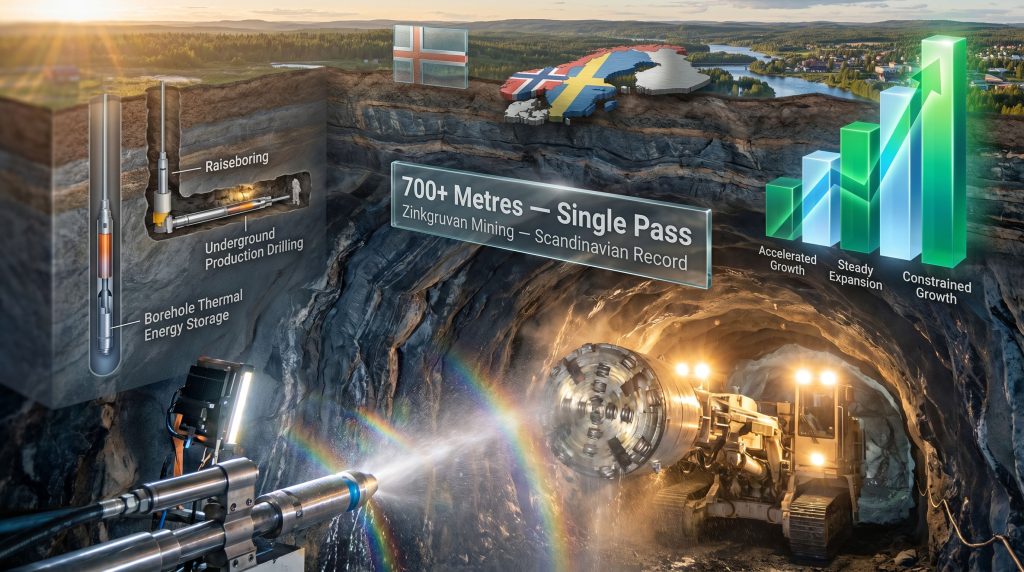
Modern raiseboring machines capable of completing shafts at depths exceeding 700 metres in a single continuous pass represent a meaningful advance over earlier generation equipment. The engineering challenges associated with extended single-pass raiseboring in hard Precambrian rock include:
- Managing rod string torque and tensile loading over extended depths
- Maintaining directional accuracy through variable rock formations
- Ensuring adequate cutting head rotation speed and weight-on-bit despite rod string flex
- Managing cuttings return and preventing borehole blockage during the reaming pass
Achieving a ventilation shaft at depths beyond 700 metres in a single pass, as demonstrated at Zinkgruvan Mining in southern Sweden, establishes a new performance reference point for Scandinavian underground contractors and signals the capabilities that mine operators will increasingly expect as operations push deeper.
The Ecosystem: Contractors, OEMs, and the Supporting Supply Chain
Key Participants in the Scandinavian Geodrilling Market
The Scandinavian geodrilling market supports a layered ecosystem of participants spanning equipment manufacturing, specialist contracting, consumables supply, and engineering consultancy. The table below summarises the primary categories of market participants and their respective roles:
| Participant Category | Primary Function | Geographic Focus |
|---|---|---|
| Underground drilling contractors | Production drilling, raiseboring, shaft construction | Sweden, with export capability |
| Geothermal drilling specialists | BTES borehole construction, deep geothermal | Sweden, Denmark |
| Geotechnical investigation firms | Ground investigation, offshore surveys | Norway, offshore |
| OEM equipment manufacturers | Rig design, DTH systems, drill tooling | Nordic + global |
| Consumables and support suppliers | Drill rods, bits, grouts, resins, fluids | Regional supply chain |
Drillcon Group, headquartered in Sweden, represents one of the most comprehensive underground drilling contractors in the Nordic region, with capability spanning diamond core drilling, production drilling, raiseboring, and shotcrete lining services. The breadth of this capability suite reflects the integrated nature of modern underground mining services, where clients increasingly seek single contractors able to manage multiple aspects of underground development rather than coordinating multiple specialist providers.
The consumables and support supply chain plays a less visible but operationally critical role in sustaining drilling productivity. Drill rods, cutting heads, grout materials, resin systems, and borehole stabilisation products must be available with short lead times to prevent costly equipment downtime in operations where drilling delay translates directly to mining production loss.
The next major ASX story will hit our subscribers first
Geopolitical Uncertainty and the Resilience of Nordic Drilling Economics
Why Scandinavian Geodrilling Is Structurally Insulated
The headline framing of geopolitical uncertainty as a risk to Scandinavian drilling economics obscures an important structural reality: the primary demand drivers for geodrilling in Scandinavia are long-cycle investment commitments that are relatively insensitive to short-term geopolitical fluctuations. Municipal investment in geothermal infrastructure, for instance, is driven by multi-decade decarbonisation commitments rather than quarterly market sentiment. Underground mine development at operations like Boliden Garpenberg and Zinkgruvan reflects ore body economics and long-term production planning rather than current commodity price movements alone.
Sweden and Finland's NATO membership, formalised in 2024 and 2023 respectively, has introduced a new category of infrastructure investment that carries geotechnical investigation implications. Defence-related construction programmes, including hardened installations, logistics infrastructure, and coastal fortification work, generate ground investigation requirements that add an incremental demand layer to existing geodrilling markets without displacing established activity.
Scandinavia's geodrilling market benefits from an unusually diverse demand base. When commodity price weakness reduces mining drilling budgets, geothermal and geotechnical drilling typically provides a countercyclical offset, creating a market structure that is more resilient than single-sector drilling markets in other regions.
Input Cost Pressures and the Automation Response
Global steel price volatility directly affects the cost of drill rods, casing, and cutting consumables, representing a meaningful input cost variable for Scandinavian contractors operating on fixed-price contracts. Labour market tightness in Nordic countries, where unemployment rates are structurally low and skilled technical workers command competitive compensation, adds further cost pressure to contractor economics. The combination of materials and labour inflation is consequently accelerating investment in automation, remote monitoring, and data-driven drill management systems.
The broader shift toward mining electrification trends is directly influencing how Scandinavian contractors are approaching fleet renewal. Battery-electric and hybrid drilling rigs, currently in trial deployment by leading Scandinavian contractors, offer the additional benefit of reducing Scope 1 emissions from drilling operations, which is becoming commercially relevant as public-sector geothermal clients begin incorporating environmental performance requirements into contractor selection criteria.
Geodrilling as Climate Infrastructure: The Green Energy Dimension
How Boreholes Are Decarbonising Nordic Cities
The technical process of constructing a geothermal borehole field for a municipal district heating system follows a defined sequence that integrates geological assessment, precision drilling, and system engineering:
- Subsurface characterisation — thermal response testing of representative boreholes establishes rock thermal conductivity and borehole thermal resistance values that govern field design
- Borehole field design — spacing, depth, and quantity of boreholes are optimised using thermal simulation modelling to prevent long-term thermal depletion of the ground volume
- Rig selection and mobilisation — purpose-built compact rigs suited to urban site constraints are selected based on borehole specification and surface access conditions
- Drilling and casing — penetration through overburden soils and into competent bedrock using rotary or DTH methods appropriate to local geology
- Heat exchanger and grout installation — U-tube polyethylene heat exchangers are installed and the borehole annulus grouted with thermally enhanced material to maximise energy transfer
- System integration and commissioning — borehole loops are connected to heat pumps and district heating networks, with monitoring instrumentation installed for long-term performance management
The carbon arithmetic of this infrastructure investment is compelling from a lifecycle perspective. Although diesel-powered drilling rigs consume substantial fuel during borehole construction, the resulting geothermal system displaces combustion-based heating for 25 to 40 years, generating a strongly positive lifetime carbon balance. The transition to electric and hybrid drilling equipment progressively improves even the construction-phase emissions profile.
Scenarios for Scandinavian Geodrilling Through 2030
Three Pathways for Regional Drilling Activity
The trajectory of geodrilling in Scandinavia through the end of the decade depends on the interaction of multiple variables, including mining investment cycles, geothermal policy settings, and broader macroeconomic conditions. Three plausible scenarios emerge from examining these variables:
| Scenario | Core Assumption | Volume Outlook |
|---|---|---|
| Accelerated expansion | Geothermal rollout intensifies, mine deepening continues, infrastructure investment grows | Strong multi-sector growth across all application areas |
| Steady progression | Current policy and mining investment maintained, geothermal adoption at existing pace | Moderate consistent growth, led by geoenergy and underground mining |
| Constrained environment | Commodity weakness reduces mining capex, energy policy uncertainty slows geothermal | Flat to modest growth, with geotechnical work providing demand floor |
What the Next Generation of Scandinavian Drilling Looks Like
Several converging trends are reshaping the operational model of geodrilling in Scandinavia beyond the current cycle. Furthermore, the role of AI in drilling is emerging as a transformative force, complementing these structural shifts:
- Electrification of underground drilling fleets is advancing from trial toward commercial deployment, driven by both emissions requirements and the operating cost advantages of electric power in grid-connected mines
- Digitalisation is transforming drill monitoring, with real-time performance data enabling automated adjustment of drilling parameters to optimise penetration rates and bit life
- Contractor consolidation is concentrating capability within larger Nordic drilling groups that can offer integrated underground services spanning drilling, ground support, and shaft construction
- Technology export from Scandinavia continues, with regional contractors and OEMs leveraging hard-won credibility from demanding Nordic projects to compete for contracts in similarly challenging geological environments globally
The combination of these forces positions geodrilling in Scandinavia not merely as a regional market story but as a window into where the global drilling industry is heading. The geological demands of Precambrian shield mining, the precision requirements of urban geothermal construction, and the engineering rigour of Norwegian offshore investigation collectively define the frontier of what modern drilling systems must be capable of delivering.
Frequently Asked Questions: Geodrilling in Scandinavia
What makes Scandinavia a global leader in geodrilling technology?
The region's combination of ancient hard-rock geology, a deep mining heritage, and significant public investment in geothermal energy infrastructure has created conditions where drilling technology is continuously pushed to performance limits that do not exist in softer geological environments. Swedish original equipment manufacturers including Epiroc and Sandvik, alongside specialist contractors and technology innovators, have built global reputations on the foundation of capability developed in Nordic operating conditions.
What is the difference between geothermal and mining drilling in the Nordic context?
| Characteristic | Geothermal Drilling | Mining Drilling |
|---|---|---|
| Typical depth | 100 to 300m (ground source); 250m+ (district heating) | 200 to 1,000m exploration; up to 700m+ raiseboring |
| Primary objective | Thermal energy extraction or storage | Ore body access, ventilation, infrastructure |
| Rock type | Variable; hard crystalline in Sweden, sedimentary in Denmark | Hard Precambrian metamorphic and igneous rock |
| Overlap | Water-powered DTH technology applicable to both | Water-powered DTH technology applicable to both |
Which Scandinavian country has the most active geodrilling market?
Sweden leads in overall drilling volume, driven by the combination of active underground mining operations and the most developed geothermal borehole market in the region. Norway leads in geotechnical and offshore ground investigation activity. Denmark, however, represents the fastest-growing segment for deep geothermal drilling as municipal district heating programmes expand.
How does geopolitical uncertainty affect drilling investment in the region?
Scandinavia's geodrilling market benefits from demand drivers that are largely insulated from short-term geopolitical volatility. Municipal geothermal commitments, mine life extensions, and infrastructure development programmes represent long-cycle investment decisions. Defence-related infrastructure requirements associated with NATO membership represent an additional incremental demand layer rather than a displacement of existing activity.
Disclaimer: This article contains forward-looking statements and scenario analysis regarding future market conditions, drilling activity levels, and technology adoption trajectories. These projections are based on publicly available information and industry trends and should not be interpreted as investment advice. Actual outcomes may differ materially from scenarios described. Readers should conduct independent research before making any commercial or investment decisions related to the geodrilling sector.
Further reading: Ongoing coverage of geodrilling developments across Scandinavia and globally is available through GeoDrilling International at geodrillinginternational.com, which provides daily reporting across mining, geothermal, geotechnical, and construction drilling disciplines.
Want to Identify the Next Major Mineral Discovery Before the Broader Market?
Discovery Alert's proprietary Discovery IQ model delivers real-time alerts the moment significant ASX mineral discoveries are announced, transforming complex geological data into clear, actionable investment insights for both short-term traders and long-term investors. Explore Discovery Alert's discoveries page to see how historic finds have generated extraordinary returns, and begin your 14-day free trial today to position yourself ahead of the market.