May 20, 2026
The Geology of Scarcity: Why Alkaline-Carbonatite Systems Are Reshaping Critical Mineral Strategy
Global demand for rare earth elements is not a future problem. It is a present-tense industrial constraint. The clean energy transition, electric vehicle rollout, and defence electronics modernisation have collectively placed rare earth supply chains under a level of scrutiny not seen since the 2010–2011 supply crisis, when China temporarily restricted REE exports and sent prices into a multi-hundred-percent spike. That episode exposed a structural vulnerability that most governments have spent the past decade attempting to remedy, with mixed results.
The core challenge is geological. Economically significant rare earth deposits are not evenly distributed across the planet. The world's highest-quality REE systems tend to cluster within specific rock types, particularly carbonatites and alkaline intrusive complexes, which form through deep-crustal magmatic processes that concentrate incompatible elements, including the full suite of lanthanides alongside critical co-products like niobium. Identifying, mapping, and developing these systems is a multi-decade endeavour, and the pipeline of advanced-stage projects outside China remains dangerously thin.
Within this context, India's Siwana Ring Complex rare earth elements story is not simply a state-level mining update. It represents a much broader question: whether India can mobilise its domestic geological endowment fast enough to reduce a critical dependency before the clean energy demand wave peaks in the 2030s.
When big ASX news breaks, our subscribers know first
Decoding the Geology: What Makes the Siwana Ring Complex a Credible REE Target
The Malani Igneous Province and Its Significance
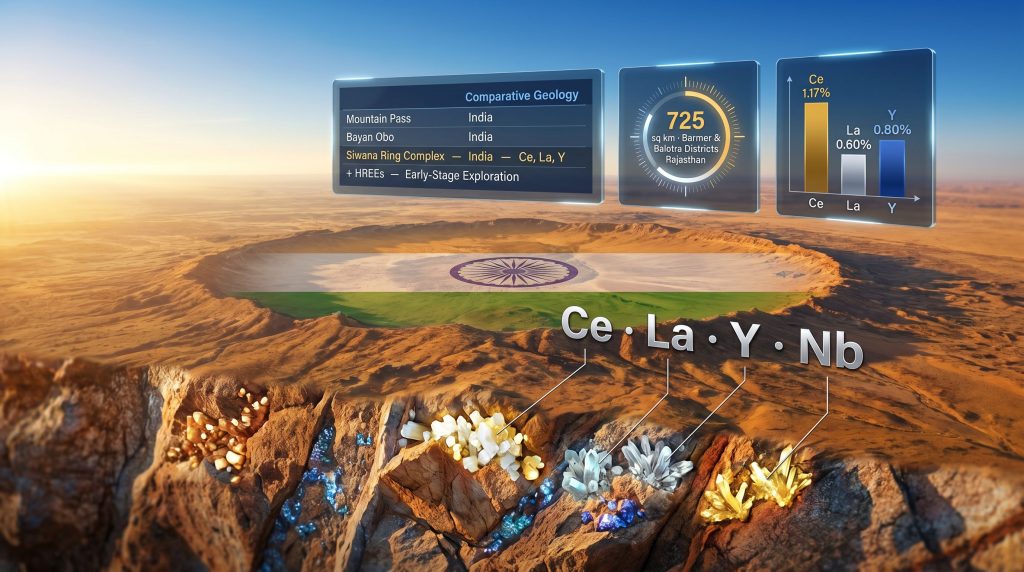
The Siwana Ring Complex sits within one of South Asia's most remarkable geological terranes. The Malani Igneous Province of western Rajasthan is among the largest felsic volcanic provinces in the region, formed approximately 750 million years ago during a period of extensive crustal magmatism. Within this province, the Siwana Ring Complex represents a well-preserved caldera structure spanning roughly 725 square kilometres across the Barmer and Balotra districts, making it one of the more spatially significant geological features in the region.
The preservation of the caldera morphology is itself a meaningful geological signal. Limited post-emplacement erosion implies that deeper mineralisation zones, which in alkaline systems often carry the highest REE concentrations, may remain largely intact beneath the surface. This is a characteristic that separates the SRC from many deeply eroded ancient terranes where the most prospective horizons have been stripped away over geological time.
Why Felsite Dykes and Alkaline Intrusions Matter for REE Prospectivity
The internal geology of the Siwana Ring Complex is dominated by felsite dykes and alkaline-carbonatite style lithologies, both of which are globally recognised as the primary host rock types for economically significant REE mineralisation. Carbonatites, in particular, are responsible for some of the world's largest and highest-grade REE deposits, including the Mountain Pass deposit in California and the Bayan Obo system in Inner Mongolia.
Trace element studies conducted within the complex's Phulan area have yielded results that clearly justify further investigation. According to published research on REE mineralisation, reported concentrations include:
- Up to 1.17% Cerium (Ce), a light rare earth element critical for catalytic converters and permanent magnets
- Up to 0.60% Lanthanum (La), used extensively in battery technology and optical glass
- Up to 0.80% Yttrium (Y), a heavy rare earth element with applications in LED phosphors, defence optics, and high-temperature alloys
These are trace element study figures, not resource estimates, and should be interpreted accordingly. They do, however, establish the scientific basis for prospectivity and justify the systematic exploration programme that has yet to be completed at scale.
The Critical Distinction: Light Versus Heavy Rare Earths at the SRC
Understanding Why HREE Co-Occurrence Changes the Strategic Calculation
Not all rare earth deposits carry equal strategic weight. The REE family encompasses 17 elements, broadly divided into light rare earth elements (LREEs) and heavy rare earth elements (HREEs). This distinction matters enormously in terms of both market value and geopolitical sensitivity.
| REE Category | Elements Identified at SRC | Primary Industrial Applications |
|---|---|---|
| Light REEs (LREEs) | Cerium (Ce), Lanthanum (La) | Catalysts, magnets, clean energy systems |
| Heavy REEs (HREEs) | Yttrium (Y) and associated HREEs | Defence optics, EV motors, wind turbines |
| Co-mineralisation | Niobium (Nb) | High-strength steel, superconductors |
HREEs are structurally scarcer in the Earth's crust and considerably more difficult to separate and process than their lighter counterparts. Global HREE production is heavily concentrated in China, with Myanmar providing a secondary supply source that has its own significant geopolitical risk profile. Any credible HREE occurrence outside this supply concentration carries disproportionate strategic value relative to its size.
The presence of Yttrium and associated HREEs at the Siwana Ring Complex means this is not a standard LREE-only Indian carbonatite occurrence. It places the complex within a more select category of REE systems, one where the full suite of critical elements, including those most difficult to source outside China, may be recoverable from a single geological setting. Furthermore, the rare earth geopolitical impact of such concentrated supply dependencies continues to shape national mineral strategies globally.
The Niobium Factor: A Second Critical Mineral Dimension
Less widely discussed but potentially equally significant is the Niobium co-mineralisation signature identified within the SRC's alkaline geology. Niobium is a critical mineral in its own right, essential for the production of high-strength low-alloy steel used in automotive and construction industries, and increasingly important for niobium-based superconducting applications in quantum computing and medical imaging technology.
Global niobium production is dominated by a single Brazilian operation, CBMM, which supplies approximately 80–85% of world demand. The strategic concentration risks associated with niobium are arguably more acute than those for most REEs. An Indian source of combined REE and niobium mineralisation would represent a meaningful addition to the critical mineral diversification portfolio, though this remains speculative until confirmed by systematic sampling at resource-definition scale.
How the SRC Compares to Global REE Alkaline-Carbonatite Systems
Contextualising the Siwana Ring Complex within the global landscape of known REE deposits provides a more grounded perspective on its developmental potential.
| Deposit | Country | Geology Type | Primary REEs | Stage |
|---|---|---|---|---|
| Mountain Pass | USA | Carbonatite | Ce, La, Nd, Pr | Active Production |
| Bayan Obo | China | Carbonatite-Iron | Ce, La, Nd | Active Production |
| Lofdal | Namibia | Carbonatite | HREE-dominant | Advanced Exploration |
| Kvanefjeld | Greenland | Alkaline Intrusive | HREE + Uranium | Advanced Exploration |
| Siwana Ring Complex | India | Alkaline-Felsic/Carbonatite | Ce, La, Y + HREEs | Early-Stage Exploration |
The SRC's alkaline-felsic geology is most closely comparable to systems like Lofdal and Kvanefjeld, both of which are recognised for their HREE bias and co-product potential. The key differentiator is development stage. While Lofdal and Kvanefjeld have advanced to resource estimate and feasibility study phases, the SRC remains at the early exploration stage with significant data gaps still to be addressed.
Important Note for Investors and Industry Observers: The Siwana Ring Complex has not yet had a confirmed large-scale mineral resource estimate established under any internationally recognised framework such as JORC or NI 43-101. All comparisons to advanced-stage deposits must be understood within this context. The geological indicators are encouraging, but they are not a substitute for systematic exploration data.
India's Critical Mineral Dependency and the Role of Rajasthan
The Import Vulnerability Problem
India's position in global REE supply chains is structurally exposed. The country currently imports a significant share of its processed rare earth requirements, with China controlling more than 60% of global REE processing capacity even as other nations have worked to develop alternative refining infrastructure. India's own processing capabilities remain nascent, and the gap between domestic REE-bearing geology and commercially separable, application-ready REE products is substantial.
The sectors that depend on reliable REE access span the full breadth of India's industrial ambition:
- Solar energy manufacturing, where REEs appear in photovoltaic components and inverter systems
- Electric vehicle production, particularly for permanent magnet motors in which neodymium-iron-boron alloys are irreplaceable with current technology
- Defence and aerospace manufacturing, where specific HREEs appear in guidance systems, radar equipment, and high-performance alloys
- Telecommunications infrastructure, including 5G antenna systems and fibre optic components
- Agricultural technology, where REE-based sensors and precision equipment are growing in importance
In addition, the broader surge in critical minerals demand driven by the energy transition is compressing the timeline for nations like India to secure domestic supply.
Rajasthan's Mineralogical Diversity as a National Asset
Rajasthan's geological endowment is exceptional by any measure. The state contains 82 distinct mineral types, with active commercial extraction currently covering 57 of these minerals. This breadth of mineralisation makes Rajasthan one of the most resource-diverse states in India, and positions it as a central pillar of any serious domestic critical mineral development strategy.
The state government's stated focus on transparency, policy reform, and infrastructure development within the mining sector reflects an understanding that geological endowment alone is insufficient. Attracting the capital, technical expertise, and processing investment needed to convert geological prospectivity into actual production requires a governance environment that reduces uncertainty and accelerates decision timelines.
Governance Actions and the Path to Exploration Progress
The Nodal Officer Appointment and What It Signals
At a high-level coordination meeting between Rajasthan's Chief Minister and the Union Minister for Coal and Mines, officials directed the appointment of a dedicated nodal officer specifically tasked with implementation activities related to the Siwana Ring Complex. The Mining Department and district collectors of both Barmer and Balotra have been assigned active coordination responsibilities with central government counterparts.
This type of administrative architecture, while bureaucratic in appearance, serves a genuine functional purpose in Indian mineral development. Without a designated coordination point, REE-bearing sites frequently become trapped in inter-departmental ambiguity, where land-use decisions by non-mining agencies inadvertently compromise the integrity of mineralised ground before any formal exploration programme can be established. The Chief Minister's separate request for the Geological Survey of India (GSI) to share its site identification and exploration data with state authorities directly addresses this risk.
The Administrative Bottleneck Problem in Indian Mining
The meeting also addressed several systemic challenges that have historically slowed the transition from mineralogical identification to active production in India. These include:
- Environmental clearance delays, which can add years to project timelines when not proactively managed from early in the exploration phase
- Forest clearance coordination, particularly relevant in states where mineralised ground overlaps with protected or reserved forest categories
- Operationalisation failures at auctioned blocks, where mineral rights have been allocated but production has not commenced due to downstream approvals gaps
- District Mineral Foundation fund utilisation, where community development funds associated with mining operations remain undeployed
The Union Minister's statement that mining sector reforms have accelerated the exploration-to-auction pipeline for critical minerals reflects a central government intent that aligns with Rajasthan's state-level priorities. Whether this intent translates into the reduced timeline outcomes that exploration-stage assets like the SRC require remains to be demonstrated through actual approvals performance.
The next major ASX story will hit our subscribers first
What Needs to Happen Before the SRC Can Become a Producing Asset
The Exploration-to-Production Pathway
The gap between current status and production-ready asset is substantial, and understanding this gap is essential for any realistic assessment of the SRC's timeline. Recommended next-stage activities, as outlined in peer-reviewed prospectivity assessments of western Rajasthan, include a structured sequence:
- Detailed geological mapping across the full 725 km² complex footprint to establish the spatial distribution of mineralised lithologies
- Systematic geochemical sampling of felsite dykes, carbonatite bodies, and associated rock types to characterise grade variability
- High-resolution airborne magnetic surveys to identify subsurface structural controls on mineralisation
- Radiometric surveys to delineate anomalous zones of REE and radioactive mineral concentration
- Integration of geophysical and geochemical datasets to design a targeted initial drill programme
- Resource definition drilling to establish tonnage and grade estimates under internationally recognised reporting standards
- Metallurgical testwork to establish processing routes for the specific REE mineralogy present
- Environmental baseline studies concurrent with exploration to compress the approvals timeline
Each of these steps requires time, capital, and technical expertise. Even in an optimistic scenario with strong governance support and minimal approvals delays, the pathway from current exploration stage to confirmed JORC-equivalent resource estimate typically spans five to eight years for complex alkaline systems.
The Processing Challenge: India's Missing Infrastructure Link
Perhaps the most underappreciated challenge in India's domestic REE ambition is not geological prospectivity but processing infrastructure. The rare earth processing challenges involved are technically demanding, chemically intensive, and capital-heavy. The journey from mined ore to separated rare earth oxide, and then to application-ready alloy or magnet material, involves multiple processing stages that India currently lacks at meaningful domestic scale.
Building this value chain is a multi-decade industrial development task that parallels the exploration and mining development timeline. Without concurrent investment in separation and processing capacity, even a well-defined and economically attractive deposit like the SRC could end up exporting ore or concentrate to Chinese processors, defeating the supply chain sovereignty objective that motivates the development effort in the first place.
Three Scenarios for the Siwana Ring Complex's Future
The trajectory of the Siwana Ring Complex rare earth elements development depends heavily on the quality and consistency of governance execution over the next decade. Three plausible pathways exist:
Scenario 1: Accelerated National Priority Track
Rapid GSI data sharing, concurrent environmental baseline work, nodal officer effectiveness, and sustained inter-agency coordination compress the exploration-to-production timeline. Under this pathway, SRC could potentially become a contributing domestic REE asset in the mid-2030s, aligned with the peak demand window for clean energy transition minerals.
Scenario 2: Measured Systematic Progression
A standard but well-managed exploration campaign over five to seven years establishes a confirmed resource estimate. A competitive mineral block auction follows, with production commencing by the late 2030s under private sector or joint venture operation. This remains a positive outcome, though it lands later in the demand cycle.
Scenario 3: Governance and Clearance Stall
Inter-agency coordination failures, data-sharing delays, environmental clearance gridlock, and land-use conflicts progressively erode the timeline. The SRC remains an exploration-stage asset through the 2030s, and India's REE import dependency persists through the most critical phase of its clean energy industrial buildout.
Consequently, an alternative rare earth supply strategy at the national level becomes even more pressing if domestic timelines stall.
The governance measures currently being implemented, including the nodal officer framework, inter-agency coordination mandates, and formal GSI data-sharing requests, are explicitly designed to prevent the third scenario from taking hold. Their effectiveness will depend on sustained institutional follow-through rather than one-off policy announcements.
Frequently Asked Questions: Siwana Ring Complex Rare Earth Elements
What minerals are found in the Siwana Ring Complex?
The Siwana Ring Complex contains rare earth elements including Cerium (Ce), Lanthanum (La), and Yttrium (Y), alongside additional heavy rare earth elements and Niobium (Nb). The alkaline-felsic host geology supports broader trace element enrichment that warrants systematic investigation.
How large is the Siwana Ring Complex?
The complex covers approximately 725 square kilometres, spanning the Barmer and Balotra districts of western Rajasthan, India.
Is the Siwana Ring Complex currently producing rare earth elements?
No. As of 2026, the Siwana Ring Complex remains at an early exploration stage. No confirmed large-scale mineral resource estimate has been publicly established under any internationally recognised reporting framework, and no production activities have commenced.
Why are heavy rare earth elements at the SRC considered strategically significant?
HREEs are critical inputs for electric vehicle motors, wind turbine generators, defence electronics, and advanced telecommunications systems. Their relative global scarcity and the concentration of HREE processing capacity in China make any credible domestic Indian HREE occurrence a matter of national supply chain importance.
What is the Geological Survey of India's role at the SRC?
The GSI has conducted site identification and preliminary exploration across the SRC region. The Rajasthan state government has formally requested that this data be shared with state authorities to guide land-use planning and protect mineralised ground from inadvertent allocation to non-mining purposes.
What needs to happen before mining can begin at the Siwana Ring Complex?
Key prerequisites include completion of detailed geological mapping and geochemical surveys, establishment of a confirmed mineral resource estimate, environmental and forest clearance approvals, a competitive mineral block auction process, and development of appropriate processing infrastructure capable of producing commercially usable REE products.
Disclaimer: This article is intended for informational and educational purposes only. It does not constitute financial or investment advice. All statements regarding exploration timelines, resource potential, and development scenarios involve material uncertainty. Readers are encouraged to conduct independent research and consult qualified professional advisers before making any investment decisions related to the mining or critical minerals sector.
Want to Track the Next Major Critical Mineral Discovery Before the Market Does?
Discovery Alert's proprietary Discovery IQ model delivers real-time alerts the moment significant ASX mineral discoveries are announced — including critical minerals like rare earths and niobium — transforming complex geological data into clear, actionable insights for investors at every level. Explore Discovery Alert's dedicated discoveries page to understand how historic mineral discoveries have generated substantial market returns, and begin your 14-day free trial today to position yourself ahead of the broader market.