May 20, 2026
The Hidden Architecture of India's Zinc Belt: Why Rajasthan Holds the Key to Industrial Self-Reliance
Long before policy frameworks began prioritising domestic mineral security, the Aravalli mountain range in northwestern India was quietly sitting atop one of the most geologically significant polymetallic corridors on the planet. Stretching across Rajasthan in a northeast-southwest arc, this ancient Precambrian orogenic belt hosts zinc-lead-silver mineralisation of a scale and grade that most nations can only observe from a distance. The recent Hindustan Zinc ministerial visit in Rajasthan, led by Union Minister G. Kishan Reddy, brought this geological reality into sharp policy focus, connecting India's deepest underground workings to its most ambitious national development targets.
Understanding why this visit matters requires stepping back from the event itself and examining the structural forces reshaping global metal supply chains, the technical sophistication being deployed beneath Rajasthan's surface, and what a fully integrated mining-to-metal operation genuinely means for a country trying to convert its mineral endowment into industrial strength.
When big ASX news breaks, our subscribers know first
Rajasthan's Geological Endowment: More Than Meets the Eye
The Aravalli-Delhi fold belt represents one of the world's oldest geological formations, with mineral-hosting sequences dating back over 1.6 billion years. What makes this corridor particularly valuable is not simply the presence of zinc and lead, but the polymetallic nature of the ore bodies, which co-produce silver at grades that rival dedicated silver mining operations globally.
Ore deposits in this belt are classified as sediment-hosted massive sulphide deposits (SHMS) and Mississippi Valley-type (MVT) systems, both of which are associated with high metal continuity at depth. This geological characteristic is critical for underground mining economics: it means ore zones extend predictably downward, allowing mechanised longhole open stoping and sublevel caving methods to be applied efficiently, and enabling paste-fill systems to function as genuine ground-management tools rather than compliance exercises.
Rajasthan accounts for the overwhelming majority of India's confirmed zinc and lead reserves, with the Zawar, Rajpura Dariba, and Rampura Agucha deposits representing the three primary ore corridors within Hindustan Zinc's portfolio. The Rampura Agucha deposit has historically been cited as one of the highest-grade zinc-lead mines in the world, while Sindesar Khurd has evolved into a globally significant silver producer as mining has progressed to deeper, silver-enriched ore zones.
Geological Note: Silver grades in SHMS-type deposits frequently increase with depth as hydrothermal fluid temperatures and mineralising conditions change. Sindesar Khurd's status as one of the world's largest underground silver producers is partly a function of this depth-grade relationship, making deeper mine development directly correlated with silver output growth.
What the Rajpura Dariba Complex Actually Represents
The Rajpura Dariba Complex encompasses two operationally distinct but economically interdependent facilities: the Sindesar Khurd underground mine and the Dariba Smelting Complex. Together, they represent something genuinely rare in emerging market mining: a fully integrated operation where the journey from blasted ore face to refined metal cathode occurs within a single geographic and corporate structure.
During the ministerial review, key operational systems examined included:
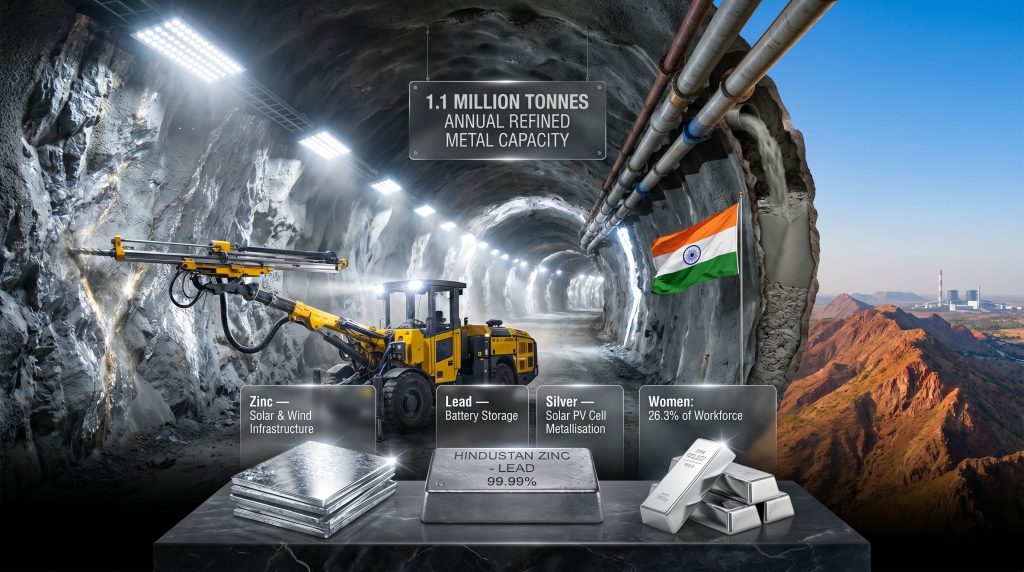
- Tele-remote equipment systems enabling surface-based control of underground drilling and haulage machinery, reducing personnel exposure in active extraction zones
- Real-time control room monitoring providing operational visibility across the underground network, integrating data on ground movement, air quality, equipment positioning, and production metrics
- Paste-fill ground management using processed tailings as structural backfill material within mined-out stopes
- Women mine rescue team capabilities, demonstrating emergency response preparedness at the operational coal face level
- Cell house and cathode yard operations at the smelting complex, where electrolytic refining converts dissolved zinc into high-purity metal cathodes
Each of these elements represents a layer of operational sophistication that places the Rajpura Dariba Complex alongside Tier-1 underground zinc operations in Australia, Canada, and Scandinavia rather than within the conventional framing of an emerging market mining site.
Paste-Fill Technology: The Underground System Reshaping Mine Economics
Paste-fill is frequently discussed in ESG contexts as an environmental measure, but its economic significance is equally profound and far less commonly understood outside technical mining circles.
Technical Insight: In conventional open-stope mining, ore pillars must be left in place between mined voids to maintain ground stability. Paste-fill systems eliminate this constraint by pumping a high-density slurry of mill tailings, water, and cement binder into exhausted stopes. Once cured, this material provides sufficient structural support to allow adjacent pillars to be mined, improving total ore recovery from the deposit by a material margin.
The practical implications are significant:
- Ore recovery improvement – Deposits that might yield 75–80% of in-situ ore under conventional methods can approach 90%+ recovery with paste-fill support, directly extending mine life and improving the economics of deep ore bodies
- Tailings surface footprint reduction – By returning processed tailings underground, operators reduce the volume of material requiring surface storage in tailings storage facilities (TSFs), lowering long-term closure liability and environmental risk
- Ground stability management – Subsidence risk above high-extraction underground mines is substantially reduced, a consideration of growing importance as mining progresses beneath populated or agricultural land
- Regulatory positioning – Operations demonstrating advanced tailings management are increasingly differentiated in regulatory assessments and ESG-linked financing discussions
At Sindesar Khurd, paste-fill adoption signals a long-term commitment to extracting maximum value from the deposit at depth while managing the surface footprint of a large-scale underground operation.
Tele-Remote Operations: The Benchmark Shift in Indian Underground Mining
The deployment of tele-remote equipment at Sindesar Khurd represents a meaningful benchmark for the Indian mining sector. Remote-controlled and semi-autonomous underground machinery has been standard practice at leading zinc operations in Finland, Sweden, and Australia for over a decade, but its adoption in India has been considerably slower due to capital intensity, skills requirements, and historically lower labour costs that reduced the economic urgency of automation.
The case for tele-remote systems in deep underground mines rests on three converging arguments:
- Safety mathematics: Reducing the number of personnel required in active stoping zones directly reduces exposure to rockfall, seismic activity, and equipment-related incidents. At depths exceeding several hundred metres, ground conditions become progressively more challenging and the value of remote operation increases correspondingly.
- Productivity consistency: Tele-remote loaders and drilling equipment can operate through shift changes, meal breaks, and minor operational interruptions without the downtime associated with manual crew rotations.
- Data integration: Modern remote-operated equipment generates continuous operational data streams that feed into mine management systems, enabling predictive maintenance scheduling and real-time production optimisation.
The ministerial review of these systems at Sindesar Khurd effectively placed them on the policy radar as a potential model for sector-wide adoption, a signal not lost on other domestic mining operators watching the central government's engagement closely.
Silver's Underappreciated Role in India's Energy Transition
Base metal narratives around zinc and lead dominate discussions of Hindustan Zinc's output, but silver's industrial role is increasingly difficult to overlook as India accelerates its solar energy buildout. Furthermore, considering silver as a critical mineral adds another dimension to its strategic importance within domestic supply chain planning.
| Metal | Key Energy Transition Application | Nature of India's Supply Risk |
|---|---|---|
| Zinc | Galvanising steel for solar mounting structures, wind towers, and transmission infrastructure | Moderate – domestic production covers a meaningful share of demand |
| Lead | Lead-acid battery backup systems for grid stability, telecom towers, and off-grid solar | Low-moderate – domestic refining capacity provides reasonable coverage |
| Silver | Conductive paste for solar photovoltaic cell metallisation | High – significant import exposure for refined, high-purity silver |
Each silicon-based solar photovoltaic cell requires silver paste applied to its surface to conduct electricity generated by photons. This is not a substitutable input at current technology levels; silver's electrical conductivity properties are essential to cell efficiency, and while research into copper-based alternatives continues, silver remains the dominant metallisation material in commercial PV manufacturing globally.
India's ambitious solar capacity targets, which extend into hundreds of gigawatts of installed capacity over the coming decade, translate directly into substantial and growing silver demand. A domestic integrated silver producer of Sindesar Khurd's scale therefore occupies a strategically important position that extends well beyond its conventional classification as a co-product of zinc-lead mining.
The next major ASX story will hit our subscribers first
Workforce Diversity as an Operational and ESG Signal
Women in mining accounting for 26.3% of Hindustan Zinc's total workforce is a figure that requires contextualisation to appreciate fully. The Indian mining sector as a whole has historically maintained female workforce participation rates in low single-digit percentages, driven by a combination of regulatory barriers (many of which have been progressively removed), cultural norms, and the physical demands of underground work.
The presence of a women mine rescue team at Sindesar Khurd is particularly notable because mine rescue is among the most technically demanding and physically rigorous roles in underground operations. These teams are trained in emergency gas detection, first aid in confined spaces, use of breathing apparatus, and the extraction of injured personnel from compromised underground environments. Their deployment at the operational level represents a more substantive form of workforce inclusion than administrative or surface-level roles.
For institutional investors and ESG-focused capital allocators, workforce diversity in mining carries increasing weight in portfolio assessment frameworks. A female workforce participation rate exceeding 26% at an underground mining operation places Hindustan Zinc in a distinct peer group that few global mining companies, let alone Indian ones, currently occupy.
Benchmarking Hindustan Zinc Against Global Zinc Producers
| Metric | Hindustan Zinc | Global Industry Context |
|---|---|---|
| Annual refined metal capacity | More than 1.1 million tonnes | Positions the company among the top five integrated zinc producers globally |
| Mine type | Mechanised underground with tele-remote capability | Consistent with Tier-1 global underground zinc operations |
| Silver co-production | Sindesar Khurd ranks among the world's largest underground silver mines | Differentiates substantially from pure-play zinc producers |
| Workforce gender diversity | 26.3% women | Significantly above the Indian mining sector average |
| Processing integration | Full mining-to-metal vertical integration | Uncommon among emerging market mining operations of comparable scale |
The vertical integration dimension deserves particular emphasis. Producers that sell zinc concentrate rather than refined metal receive prices that reflect the cost of smelting and refining, which is deducted from the payable metal calculation. Fully integrated producers capture this margin internally, making their revenue per tonne of ore mined substantially higher than concentrate-selling peers. This structural advantage also provides insulation from spot treatment charge volatility, which can compress margins for concentrate producers significantly during periods of global smelter overcapacity.
The Viksit Bharat Framework and What It Actually Demands from Domestic Mining
Viksit Bharat 2047 is India's centenary development vision, targeting the country's transition to developed-nation status by the time it marks 100 years of independence. Within this framework, critical minerals and energy security occupy a foundational position because virtually every infrastructure, manufacturing, and energy transition goal downstream depends on reliable access to base and critical metals.
The challenge India faces is not simply one of ore extraction. Numerous countries possess mineral resources but remain dependent on foreign processing capacity, shipping ore or concentrate to overseas smelters and importers of refined metal. India's path to genuine mineral self-reliance requires the full processing chain to be domestically anchored, which is precisely the model the Rajpura Dariba Complex demonstrates at industrial scale.
The ministerial visit, attended by both Union Minister G. Kishan Reddy and Joint Secretary Vivek Bajpai from the Ministry of Mines, carried the weight of a policy assessment rather than a ceremonial review. The Joint Secretary's presence specifically suggests that operational practices observed at Hindustan Zinc's facilities are being evaluated for their applicability as standards or benchmarks across the broader Indian mining sector. According to a recent press release, the Union Minister explicitly highlighted the mining sector's role in advancing the Viksit Bharat 2047 agenda during the visit.
Frequently Asked Questions: Hindustan Zinc Ministerial Visit in Rajasthan
What was reviewed during the Hindustan Zinc ministerial visit in Rajasthan?
Union Minister G. Kishan Reddy reviewed underground mining operations at the Sindesar Khurd Mine, including tele-remote equipment, control room systems, paste-fill practices, and a live mine rescue demonstration. At the Dariba Smelting Complex, the visit covered the control room, cell house, and cathode yard operations.
What makes Sindesar Khurd globally significant?
Sindesar Khurd is recognised as one of the world's largest underground silver-producing mines. Its silver output is a co-product of zinc-lead mining, and grades increase with depth due to the SHMS geological characteristics of the Aravalli belt deposit system.
What is paste-fill and why does it matter?
Paste-fill involves pumping a cured slurry of processed tailings back into mined-out underground voids. It improves ore recovery by allowing previously unmined support pillars to be extracted, reduces surface tailings storage requirements, and improves long-term ground stability.
How does Hindustan Zinc's production capacity compare globally?
With annual refined metal production capacity exceeding 1.1 million tonnes across zinc, lead, and silver, Hindustan Zinc ranks among the top five integrated zinc producers in the world.
What percentage of Hindustan Zinc's workforce is female?
Women account for 26.3% of the total workforce, a figure that substantially exceeds typical Indian mining sector participation rates and positions the company favourably against global ESG benchmarks.
Why is silver strategically important for India's energy goals?
Silver is an essential input in solar photovoltaic cell manufacturing, used as conductive paste applied to silicon cells. As India scales its solar energy capacity, domestic silver production becomes directly relevant to reducing import dependence in a critical clean energy supply chain input.
Reading the Policy Signal: What the Ministerial Visit Tells Investors and Sector Observers
Ministerial site visits to operational mining facilities in India are not routine events. They consume significant political bandwidth and carry reputational stakes for both the government official and the company involved. The fact that this visit included a senior Ministry of Mines official alongside the Union Minister elevates it beyond the level of a goodwill engagement.
For observers tracking India's industrial policy trajectory, the visit provides several data points worth noting:
- The central government is actively benchmarking domestic mining operations against global technology standards, using Hindustan Zinc's facilities as a reference point
- The explicit connection drawn between mining sector capability and the Viksit Bharat 2047 agenda signals that base metal production is being repositioned within national strategic planning rather than treated as a legacy extractive industry
- The emphasis on responsible mining, safety technology, and workforce diversity reflects the ESG dimensions that increasingly influence both regulatory frameworks and international capital flows into the sector
- Silver's relevance to solar PV supply chains is likely to attract growing policy attention as India's renewable energy buildout accelerates, potentially elevating the strategic classification of domestic silver producers
Hindustan Zinc's broader strategic ambitions are also reflected in its participation at the Rising Rajasthan Global Investment Summit, where the company's integrated mining-to-metal model drew considerable attention from investors and policymakers alike.
Investor Consideration: This article contains forward-looking observations about policy trends and sector positioning. These represent analytical perspectives based on publicly available information and should not be construed as financial advice. Commodity prices, regulatory environments, and operational outcomes involve inherent uncertainty. Readers should conduct independent due diligence before making investment decisions.
What the Hindustan Zinc ministerial visit in Rajasthan ultimately illustrates is that the gap between mineral endowment and industrial self-reliance is bridged not by geology alone, but by the technological sophistication, operational integration, and human capital depth that transform ore bodies into national economic assets. The Rajpura Dariba Complex, viewed through this lens, is less a mining site than a working proof-of-concept for what India's mineral sector can become.
Want to Identify the Next Major Mineral Discovery Before the Broader Market Does?
Discovery Alert's proprietary Discovery IQ model delivers real-time alerts on significant ASX mineral discoveries, turning complex geological and commodity data into actionable investment insights — explore the historic returns major discoveries have generated and begin your 14-day free trial today to position yourself ahead of the market.