May 17, 2026
The Hidden Architecture of Rare Earth Project Development: Why Deposit Geology Determines Everything
Most investors tracking the critical minerals sector focus on commodity prices, geopolitical headlines, and company announcements. Far fewer examine the geological and technical foundations that actually determine whether a rare earth project succeeds or fails. Yet it is precisely at this technical level, in the chemistry of the ore body, the mineralogy of the host rock, and the extractive pathway it enables, that project economics are made or broken long before a shovel touches the ground.
This distinction sits at the heart of why the Viridis Colossus rare earth project construction timeline and economics are generating serious attention from project financiers, export credit agencies, and downstream manufacturers across three continents.
When big ASX news breaks, our subscribers know first
Why Ionic Clay Deposits Are Fundamentally Different from Hard-Rock Rare Earth Ore Bodies
The rare earth sector encompasses several distinct deposit types, and the differences between them are not merely technical curiosities. They translate directly into capital requirements, processing complexity, environmental risk, and ultimately, the probability that a project reaches production.
Ionic adsorption clay (IAC) deposits, the category to which Colossus belongs, form through the deep weathering of granitic and volcanic source rocks over geological timescales. During this weathering process, rare earth elements are stripped from their original host minerals and adsorbed onto the surface of clay minerals, primarily kaolinite and halloysite. Because the rare earths are not locked inside a crystalline lattice structure, they can be liberated using relatively mild leaching chemistry, typically ammonium sulfate or magnesium sulfate solutions, without the energy-intensive crushing, grinding, and flotation circuits required for hard-rock alternatives.
Furthermore, understanding rare earth processing challenges helps contextualise why deposit type matters so profoundly to project outcomes.
Technical Insight: The leaching selectivity of IAC deposits is a significant advantage. Because rare earths sit on clay mineral surfaces rather than inside mineral grains, leach recoveries can be achieved at ambient temperatures and low reagent concentrations, fundamentally reducing both operating costs and the thermal energy budget of the processing plant.
A comparison of deposit types illustrates how consequential these geological distinctions are in practice:
| Deposit Type | Mining Method | Processing Complexity | Typical CAPEX Intensity | Radioactivity Risk |
|---|---|---|---|---|
| Hard-Rock (Carbonatite) | Drill and Blast | High | High | Elevated (Th/U) |
| Ionic Adsorption Clay | Free-Dig (Mechanical) | Low to Medium | Lower | Minimal |
| Monazite Placer | Dredging | Medium | Medium | Moderate |
The carbonatite category is particularly instructive as a cautionary comparison. Projects hosted in carbonatite intrusions, including several high-profile Western rare earth developments, carry elevated concentrations of thorium and uranium as geochemical co-passengers. This radioactivity profile creates a cascading set of complications: radioactive material handling regulations, complex tailings classification and storage requirements, and significant community opposition risk.
Ionic clay deposits like Colossus carry materially lower radioactivity, which reduces regulatory burden and simplifies the path to both environmental permitting and downstream customer acceptance.
One dimension rarely discussed in mainstream coverage is the TREO grade distribution within IAC deposits. Unlike hard-rock deposits where total rare earth oxide (TREO) grades can be high but dominated by cerium and lanthanum (elements with limited commercial value in magnet applications), well-characterised IAC deposits often carry a disproportionately favourable distribution of magnet-critical elements. The ratio of NdPr, dysprosium, and terbium to total TREO, known informally as the magnet rare earth fraction or MREF, is a more commercially meaningful metric than headline grade alone.
What the Colossus Project Is and Why Its Location Matters
The Colossus project is located in Poços de Caldas, Minas Gerais, Brazil, a municipality with a rare distinction in the rare earth world. The region has historically hosted rare earth processing activity, including operations associated with the Brazilian Nuclear Energy Commission (CNEN), giving it an established technical workforce and a degree of community familiarity with rare earth extraction that most greenfield jurisdictions lack entirely.
Minas Gerais more broadly is Brazil's pre-eminent mining state, accounting for significant shares of the country's iron ore, niobium, and gold production. Its regulatory agencies have accumulated institutional experience with large-scale mining project assessment, which, while not guaranteeing speed, does bring a degree of procedural predictability that matters to project financiers.
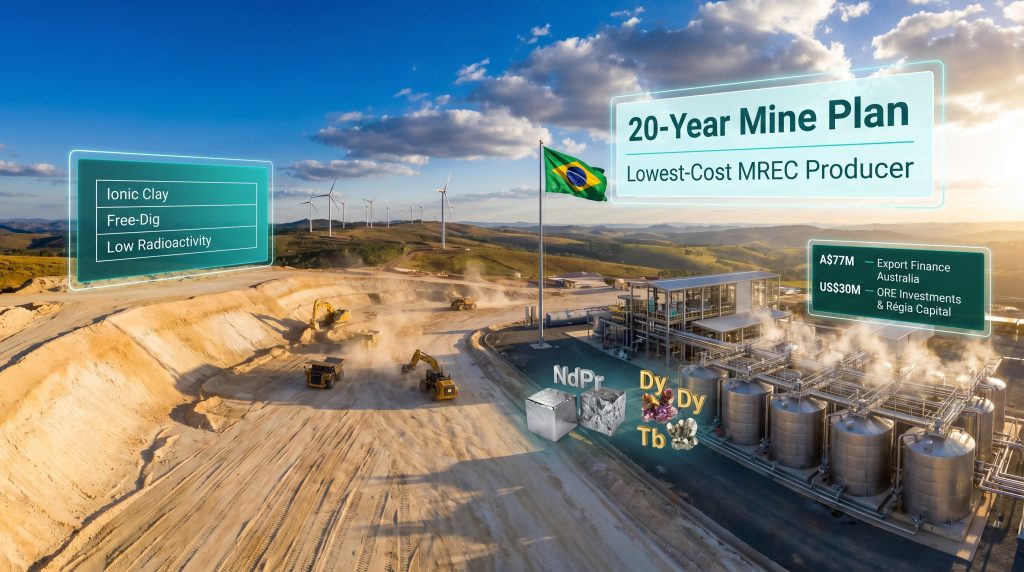
The Viridis Colossus rare earth project construction plan is underpinned by a completed pre-feasibility study (PFS) that outlines a 20-year mine life, positioning it firmly in the industrial-scale category. The PFS economics, as outlined in the official project presentation, suggest that Colossus could achieve a competitive cost position as a mixed rare earth carbonate (MREC) producer — a claim that carries weight because MREC is the upstream product form that feeds into separation facilities to produce individual rare earth oxides for magnet manufacturing.
What Colossus targets across its resource base:
- Neodymium and praseodymium (NdPr): The foundational inputs for sintered NdFeB permanent magnets used in EV traction motors and direct-drive wind turbine generators
- Dysprosium (Dy): A heavy rare earth added to NdFeB magnets to maintain coercivity, the resistance to demagnetisation, at elevated operating temperatures above approximately 150 degrees Celsius
- Terbium (Tb): A functionally similar heavy rare earth to dysprosium, commanding significant per-kilogram price premiums and with an even more concentrated supply profile
The combination of light and heavy rare earth targets is commercially significant. Dysprosium and terbium together can represent a disproportionate share of magnet alloy input value relative to their weight fraction, meaning a project that produces all four elements is positioned to capture substantially more revenue per tonne of ore than an NdPr-only deposit.
The Regulatory Pathway: Understanding Brazil's Three-Stage Licensing Architecture
One of the most consequential and least understood aspects of Brazilian mining project development is its sequential environmental licensing framework. Unlike single-permit systems in some jurisdictions, Brazil operates a three-stage process administered primarily at the state level through agencies such as SUPRAM in Minas Gerais, with federal oversight from IBAMA for projects with potential transboundary or significant national environmental implications.
The three stages operate as follows:
- Preliminary License (LP): Authorises the project concept and confirms its environmental viability in principle. Requires an Environmental Impact Assessment (EIA/RIMA) and public consultation processes. Receipt of the LP means the state authority has accepted that the project can proceed to detailed design.
- Installation License (LI): Authorises the physical construction of the project. Issued after the developer demonstrates compliance with the conditions attached to the LP and submits detailed construction plans. The LI submission by Viridis marks the current regulatory position of the Colossus project.
- Operating License (LO): Authorises commercial production. Issued after construction is completed and the developer demonstrates that all environmental management systems are operational and compliant.
Regulatory Risk Note: Each licence stage can be subject to public challenges, requests for additional studies (known as pareceres técnicos), or procedural delays at the state agency level. Projects that have been technically thorough at the LP stage tend to experience fewer complications at the LI stage, but timeline variability remains a genuine risk factor.
The submission of the LI application by Viridis is a meaningful de-risking milestone. It signals that the preliminary environmental conditions have been satisfied and that the project has sufficient engineering maturity to submit detailed construction documentation. For project debt providers assessing environmental and social risk, the LP-to-LI transition is often a prerequisite condition for moving from indicative to binding financing terms.
The Capital Stack: How Viridis Is Financing the Path to Construction
The financing architecture assembled around the Colossus project reflects the increasingly geopolitical character of rare earth project development. Traditional project finance models, which rely on commodity price forecasts, engineering studies, and offtake agreements, are now being supplemented by export credit agency involvement that introduces a strategic layer of risk mitigation.
| Financing Component | Provider | Amount | Type |
|---|---|---|---|
| Export Finance Support | Export Finance Australia (EFA) | Up to A$77 million | Non-binding Letter of Support |
| Strategic Investment | ORE Investments and Régia Capital | US$30 million | Strategic equity and investment agreement |
| Project Debt Package | Under development | TBC | Debt finance, FID-contingent |
The involvement of Export Finance Australia (EFA) deserves careful analysis. EFA is a Commonwealth-owned export credit agency whose mandate includes supporting Australian companies and supply chains in accessing critical mineral projects internationally. Its participation does not constitute a grant or government subsidy; rather, it represents a willingness to provide direct lending on commercial terms, backed by EFA's balance sheet, to help close the debt component of the project's capital structure.
The strategic logic here runs in multiple directions. Australia has significant interests in rare earth supply chains diversification, both as a producer nation and as a supplier of technology metals to allied countries under frameworks such as the Quad and AUKUS adjacent supply chain initiatives. An Australian export credit agency anchoring part of the debt stack in a Brazilian rare earth project reflects how thoroughly the geopolitics of critical minerals has permeated institutional financing decisions.
The US$30 million strategic investment from ORE Investments and Régia Capital, while representing a fraction of total project capital, serves an important signalling function. Strategic investors at this stage of development typically conduct their own technical and commercial due diligence, meaning their commitment validates the project's economic thesis to subsequent lenders and offtake partners.
Environmental Credentials and the ESG Premium in Rare Earth Financing
Access to institutional capital for mining projects has been fundamentally reshaped by ESG screening criteria over the past decade. For rare earth projects specifically, the environmental credentials of the deposit type and processing route have become as commercially important as the ore grade itself, because they determine which pools of capital and which downstream customers can engage.
The Colossus project's environmental positioning rests on several interconnected characteristics:
- 100% renewable energy supply planned for operations, a credible commitment given Minas Gerais' access to Brazil's predominantly hydropower-based grid, supplemented by the state's significant solar and wind generation capacity
- Approximately 75% water recycling targeted across processing circuits, meaningfully above the 30 to 50 percent range typical of comparable processing facilities, and directly relevant to social licence in a state where historical mining water impacts have created community sensitivity
- Low radioactivity profile eliminating the thorium and uranium waste stream complications that encumber carbonatite-hosted projects and restrict the range of acceptable end-use customers in jurisdictions with strict radioactive material import controls
- Free-dig mining removing the blasting noise, vibration, and dust generation profile associated with drill-and-blast hard-rock operations, simplifying community relations management
These characteristics collectively position Colossus to access ESG-aligned institutional capital that is increasingly screened out of conventional hard-rock rare earth projects. European offtake partners and Japanese magnet manufacturers operating under their own supply chain due diligence regulations are explicitly seeking upstream suppliers with demonstrable low-impact credentials. In addition, critical minerals demand from the energy transition continues to intensify pressure on developers to demonstrate robust environmental standards.
The next major ASX story will hit our subscribers first
NdPr Price Dynamics and What They Mean for Colossus Economics
NdPr oxide prices have been among the most volatile in the rare earth complex over the past five years. Prices climbed from below US$40 per kilogram in early 2020 to a peak approaching US$130 per kilogram in early 2022, driven by EV demand expectations and supply disruption concerns. By 2024 and into 2025, prices had retreated substantially, with NdPr trading in a range broadly between US$45 and US$65 per kilogram, pressured by a combination of demand softening in China's EV market and incremental new supply from projects including Lynas Rare Earths' Malaysian processing operations.
Price Context for Investors: The economic viability of any rare earth project is highly sensitive to NdPr price assumptions. Projects claiming world-competitive cost positions are specifically positioning themselves to remain economically robust at lower price levels. If Colossus' claimed cost position is validated through its definitive feasibility study, it should theoretically remain cash-flow positive across a wider price range than higher-cost alternatives.
Dysprosium and terbium price dynamics add a further dimension. These heavy rare earths are produced almost exclusively from Chinese ionic clay deposits in Jiangxi and neighbouring southern Chinese provinces, meaning their supply is even more concentrated than NdPr. Terbium in particular has historically traded at multiples of NdPr on a per-kilogram basis. A project that co-produces these elements benefits from natural revenue diversification and a degree of insulation against NdPr price weakness.
Scenario Analysis: Three Pathways for Colossus by 2028
The project's trajectory to construction and production is not a single deterministic path. It involves multiple regulatory, financing, and technical decision nodes, each with its own timeline probability distribution.
| Scenario | Key Conditions | Likely Outcome |
|---|---|---|
| Base Case | LI granted on schedule, DFS completed, project finance executed | Construction begins late 2026 or early 2027; first production 2028 |
| Delayed Case | LI or DFS delays of 6 to 12 months | Construction pushed to 2027; production 2029 |
| Accelerated Case | Binding offtake or additional co-investment unlocks FID early | Construction begins mid-2026; production possible late 2027 |
The critical path to construction now runs through three sequential gates that investors and industry observers should monitor closely:
- Formal approval of the Installation Licence (LI) from Minas Gerais state authorities
- Completion and publication of the Definitive Feasibility Study (DFS), which will update and refine the PFS cost and revenue assumptions
- Execution of binding project finance agreements, including the conversion of EFA's non-binding letter of support into executed lending documentation
Beyond these three gates, the execution of binding offtake agreements with downstream processors or magnet manufacturers remains a parallel critical path item. Commercial lenders providing project debt typically require take-or-pay offtake contracts covering a meaningful percentage of projected production before they will finalise lending terms. Consequently, the absence of disclosed binding offtake remains the most significant outstanding commercial risk for the project at this stage of development.
Brazil's Strategic Position in the Global Critical Minerals Rebalancing
Brazil is frequently overlooked in Western-centric narratives about rare earth supply chain diversification, which tend to focus on Australia, Canada, and select African jurisdictions. However, this oversight is geologically unjustified. Brazil's territory hosts substantial rare earth endowment, and the country's geological survey (CPRM) has progressively expanded its rare earth mapping programmes across Para, Goias, and Minas Gerais states.
Minas Gerais carries particular historical significance. The Poços de Caldas plateau, where Colossus is located, represents one of South America's most geologically distinctive alkaline complexes, hosting a range of mineralisations that include rare earths, niobium, and uranium across different zones of the intrusion and its surrounding weathering profile.
A producing Viridis Colossus rare earth project construction outcome would represent Brazil's most significant entry into the separated rare earth product export market. Furthermore, Australia's broader critical minerals strategy to engage with projects like Colossus reflects the country's ambition to anchor allied supply chains well beyond its own borders. Independent analysis from SmallCaps confirms that Colossus has cleared major technical hurdles, underlining the project's momentum as it approaches its next critical milestones.
It would also create a template for downstream rare earth processing investment in Minas Gerais, building on existing technical infrastructure and institutional knowledge, complementing the country's established positions in niobium and iron ore.
This article is intended for informational purposes only and does not constitute financial advice or a solicitation to buy or sell any securities. The Viridis Colossus rare earth project involves forward-looking elements including production timelines, financing commitments, and price assumptions that are subject to material risks and uncertainties. Readers should conduct their own due diligence and consult qualified financial advisers before making any investment decisions.
Want To Stay Ahead of the Next Major Mineral Discovery?
Discovery Alert's proprietary Discovery IQ model delivers real-time alerts on significant ASX mineral discoveries, instantly turning complex mineral data into actionable insights for both short-term traders and long-term investors. Explore how historic discoveries have generated substantial returns on Discovery Alert's dedicated discoveries page, and begin your 14-day free trial today to position yourself ahead of the broader market.